 Add to Chrome
 Add to Firefox
 Add to Edge
One Knob to Rule Them All: A Unified Optimal Transport View of Cold-Start Active Learning
Aug 04, 2026
Cold-Start Active Learning (CSAL) aims to select a valuable subset from an unlabeled pool without any prior knowledge or human assistance. Existing methods take diverse routes based on typicality, coverage, or diversity. Each rests on its own inductive bias and therefore performs well on some tasks yet poorly on others. We argue that the real challenge is not to design yet another selection heuristic, but to make CSAL adapt automatically to the data and task at hand. To this end, we revisit CSAL through the lens of optimal transport. First, we propose a generalized transport selection framework that reveals the shared allocation structure of existing methods and exactly subsumes representative formulations. Second, we introduce a theoretical analysis that characterizes the trade-off controlled by entropic regularization and establishes a task-agnostic minimax bound for cold-start selection. These results provide a principled foundation for adapting the regularization strength to the unlabeled data. Third, we derive a data-adaptive regularization rule and present a novel Sinkhorn-based CSAL algorithm, termed $ε$-Adaptive Selection ($ε$-AS). Extensive experiments on six public datasets and multiple annotation budgets show that $ε$-AS consistently achieves state-of-the-art performance. On ImageNet-1k, it improves the average accuracy over ActiveFT by 1.29% while reducing selection time by 56.2%. Code will be released at https://github.com/Z-yiwei/OT-CSAL

Rectify Then Diffuse: Disentangling Concepts Before Denoising Trajectory Unfolds
Aug 04, 2026Text-to-image diffusion models can generate individual concepts well, but they often omit or merge concepts incorrectly with multiple concepts. We trace these failures to an early coordination bottleneck: before denoising begins, prompt-conditioned attention may allocate different concepts to strongly overlapping spatial support, which can keep their attention coupled as denoising proceeds. This observation motivates treating compositional generation as a boundary-condition problem rather than repeatedly controlling the evolving trajectory. To this end, we propose Rectify-then-Diffuse (RTD), a training-free framework that rectifies the initial allocation once before standard denoising. Firstly, we propose Soft-Overlap Disentanglement (SOD), which converts normalized overlap between pilot concept maps into a differentiable and layout-agnostic separation objective. Secondly, we introduce Isotropic Gradient Rectification (IGR), which normalizes the SOD gradient and applies a bounded latent displacement with a consistent scale across prompts and initializations. Extensive experiments show that RTD achieves state-of-the-art compositional fidelity and robust gains. On the AE-Bench object pair subset, RTD improves BLIP-VQA by 45.8% and ImageReward by 19.6% over CO3 while running 2.3$\times$ faster. Code will be released at https://github.com/Z-yiwei/rectify-then-diffuse
AXIS: A Growable Community-Driven Data Engine for Scalable Robot Manipulation
Jul 23, 2026Learning effective robot manipulation policies requires diverse, high-quality demonstrations, yet existing data pipelines are often difficult to scale because they rely on specialized hardware, centralized operators, or fixed task suites. We present AXIS, a growable community-driven data engine and benchmark for scalable robot learning, which enables browser-based teleoperation for large-scale demonstration collection, automatically generates and validates new manipulation tasks, and transforms community-collected demonstrations into training-ready data through automated success checking, quality filtering, trajectory smoothing, and visual and physics-based augmentation. The AXIS dataset currently contains 207 diverse tasks and 50K+ trajectories. Meanwhile, AXIS organizes data into task snapshots and evaluates policies with a systematic held-out protocol. We compare vision-language-action (VLA) policies under a unified AXIS evaluation suite and analyze scaling behavior across different data volumes. Continual pretraining on AXIS substantially improves the overall success rate of $π_{0.5}$ by 5.8%, outperforms the model pretrained on RoboCasa365 by 37.3%, and exhibits consistent scaling with increasing data volume, with the largest gains observed under layout, sensor-noise, and camera perturbations.
APEX: Adaptive Policy Execution for Precise Manipulation
Jun 15, 2026Modern imitation learning methods, including visuomotor and Vision-Language-Action (VLA) policies, typically output high-level action references that are executed by low-level controllers. However, the absence of higher-order reference signals, together with the policy's lack of awareness of the underlying low-level control dynamics during training, inevitably induces an execution gap. As a result, realized actions deviate systematically from policy-commanded ones, with a critical impact on precision-sensitive manipulation. Prior work either modifies the policy architecture or the low-level controller, both requiring intrusive changes to the pretrained policy or packaged controller. This raises a natural question: when the policy and controller are both treated as inaccessible black boxes, can we bridge the execution gap? We propose Adaptive Policy Execution (APEX), a plug-and-play framework inserted between the policy and the controller that reconstructs a dynamically feasible reference from policy outputs and adapts at test-time according to low-level state feedback, with a provable convergence guarantee. Extensive empirical studies show that APEX reduces controller-induced tracking error by 41.2% on demonstration replay and improves manipulation success by 4.8--25.8 percentage points across four visuomotor and VLA policy classes.
TensorNEAT: A GPU-accelerated Library for NeuroEvolution of Augmenting Topologies
Apr 11, 2025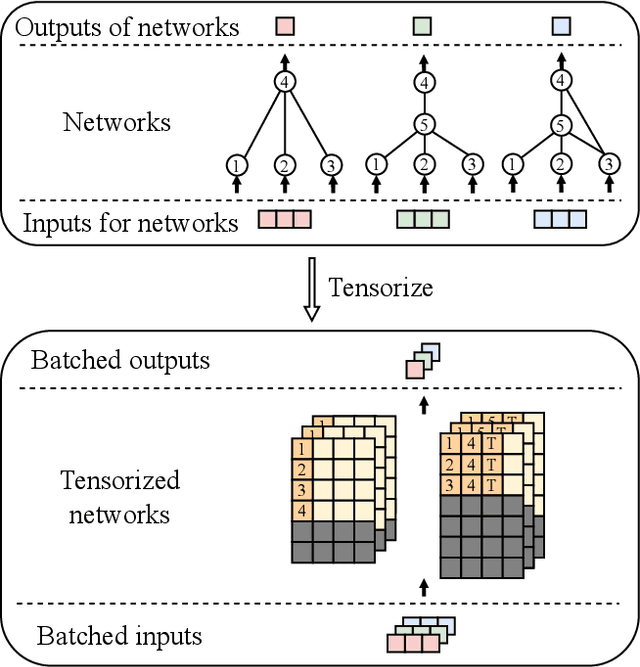
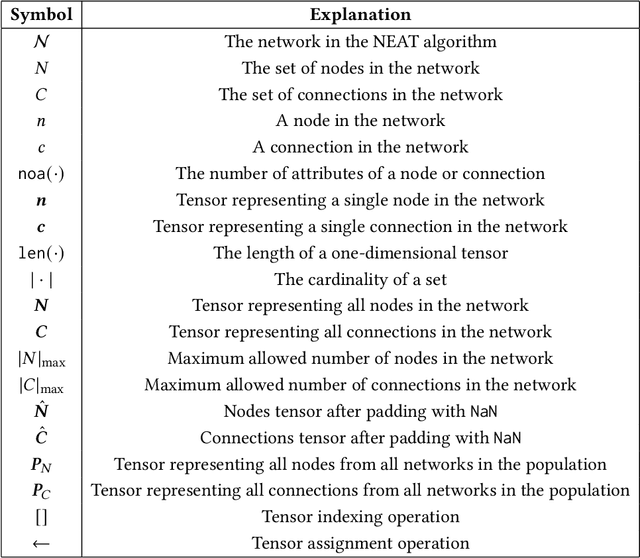
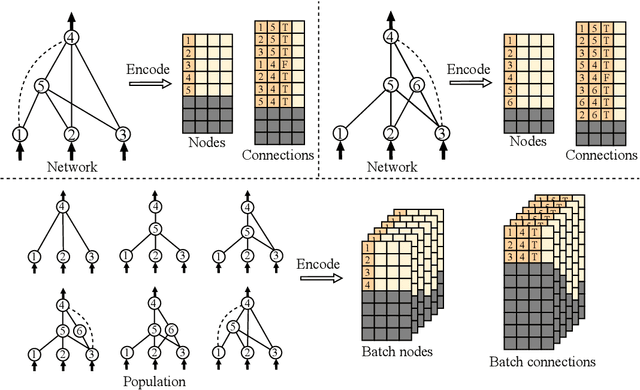

The NeuroEvolution of Augmenting Topologies (NEAT) algorithm has received considerable recognition in the field of neuroevolution. Its effectiveness is derived from initiating with simple networks and incrementally evolving both their topologies and weights. Although its capability across various challenges is evident, the algorithm's computational efficiency remains an impediment, limiting its scalability potential. To address these limitations, this paper introduces TensorNEAT, a GPU-accelerated library that applies tensorization to the NEAT algorithm. Tensorization reformulates NEAT's diverse network topologies and operations into uniformly shaped tensors, enabling efficient parallel execution across entire populations. TensorNEAT is built upon JAX, leveraging automatic function vectorization and hardware acceleration to significantly enhance computational efficiency. In addition to NEAT, the library supports variants such as CPPN and HyperNEAT, and integrates with benchmark environments like Gym, Brax, and gymnax. Experimental evaluations across various robotic control environments in Brax demonstrate that TensorNEAT delivers up to 500x speedups compared to existing implementations, such as NEAT-Python. The source code for TensorNEAT is publicly available at: https://github.com/EMI-Group/tensorneat.
Tensorized NeuroEvolution of Augmenting Topologies for GPU Acceleration
Apr 11, 2024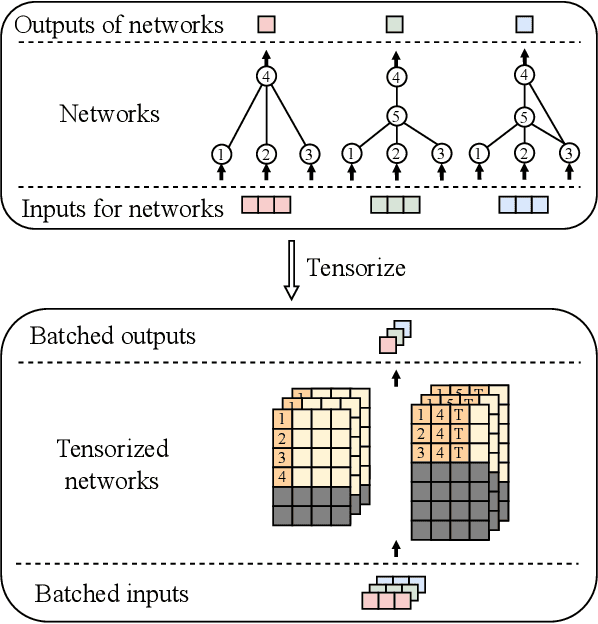
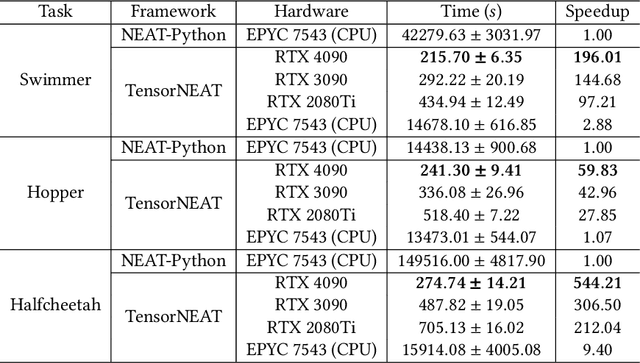
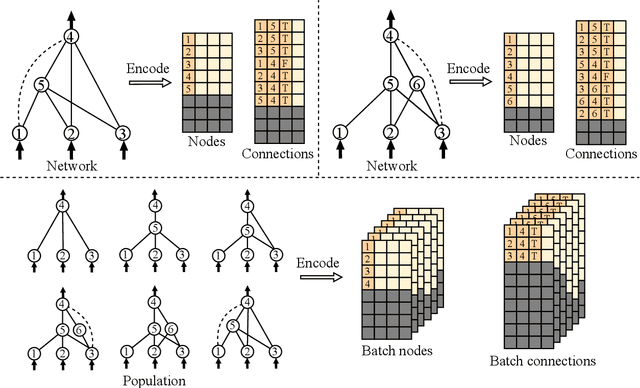
The NeuroEvolution of Augmenting Topologies (NEAT) algorithm has received considerable recognition in the field of neuroevolution. Its effectiveness is derived from initiating with simple networks and incrementally evolving both their topologies and weights. Although its capability across various challenges is evident, the algorithm's computational efficiency remains an impediment, limiting its scalability potential. In response, this paper introduces a tensorization method for the NEAT algorithm, enabling the transformation of its diverse network topologies and associated operations into uniformly shaped tensors for computation. This advancement facilitates the execution of the NEAT algorithm in a parallelized manner across the entire population. Furthermore, we develop TensorNEAT, a library that implements the tensorized NEAT algorithm and its variants, such as CPPN and HyperNEAT. Building upon JAX, TensorNEAT promotes efficient parallel computations via automated function vectorization and hardware acceleration. Moreover, the TensorNEAT library supports various benchmark environments including Gym, Brax, and gymnax. Through evaluations across a spectrum of robotics control environments in Brax, TensorNEAT achieves up to 500x speedups compared to the existing implementations such as NEAT-Python. Source codes are available at: https://github.com/EMI-Group/tensorneat.