 Add to Chrome
 Add to Firefox
 Add to Edge
AXIS: A Growable Community-Driven Data Engine for Scalable Robot Manipulation
Jul 23, 2026
Learning effective robot manipulation policies requires diverse, high-quality demonstrations, yet existing data pipelines are often difficult to scale because they rely on specialized hardware, centralized operators, or fixed task suites. We present AXIS, a growable community-driven data engine and benchmark for scalable robot learning, which enables browser-based teleoperation for large-scale demonstration collection, automatically generates and validates new manipulation tasks, and transforms community-collected demonstrations into training-ready data through automated success checking, quality filtering, trajectory smoothing, and visual and physics-based augmentation. The AXIS dataset currently contains 207 diverse tasks and 50K+ trajectories. Meanwhile, AXIS organizes data into task snapshots and evaluates policies with a systematic held-out protocol. We compare vision-language-action (VLA) policies under a unified AXIS evaluation suite and analyze scaling behavior across different data volumes. Continual pretraining on AXIS substantially improves the overall success rate of $π_{0.5}$ by 5.8%, outperforms the model pretrained on RoboCasa365 by 37.3%, and exhibits consistent scaling with increasing data volume, with the largest gains observed under layout, sensor-noise, and camera perturbations.

GUI-Perturbed: Domain Randomization Reveals Systematic Brittleness in GUI Grounding Models
Apr 15, 2026GUI grounding models report over 85% accuracy on standard benchmarks, yet drop 27-56 percentage points when instructions require spatial reasoning rather than direct element naming. Current benchmarks miss this because they evaluate each screenshot once with a single fixed instruction. We introduce GUI-Perturbed, a controlled perturbation framework that independently varies visual scenes and instructions to measure grounding robustness. Evaluating three 7B models from the same architecture lineage, we find that relational instructions cause systematic accuracy collapse across all models, a 70% browser zoom produces statistically significant degradation, and rank-8 LoRA fine-tuning with augmented data degrades performance rather than improving it. By perturbing along independent axes, GUI-Perturbed isolates which specific capability axes are affected-spatial reasoning, visual robustness, reasoning calibration-providing diagnostic signal that aggregate benchmarks cannot. We release the dataset, augmentation pipeline, and a fine-tuned model.
PaperTok: Exploring the Use of Generative AI for Creating Short-form Videos for Research Communication
Jan 26, 2026The dissemination of scholarly research is critical, yet researchers often lack the time and skills to create engaging content for popular media such as short-form videos. To address this gap, we explore the use of generative AI to help researchers transform their academic papers into accessible video content. Informed by a formative study with science communicators and content creators (N=8), we designed PaperTok, an end-to-end system that automates the initial creative labor by generating script options and corresponding audiovisual content from a source paper. Researchers can then refine based on their preferences with further prompting. A mixed-methods user study (N=18) and crowdsourced evaluation (N=100) demonstrate that PaperTok's workflow can help researchers create engaging and informative short-form videos. We also identified the need for more fine-grained controls in the creation process. To this end, we offer implications for future generative tools that support science outreach.
Creativity in the Age of AI: Evaluating the Impact of Generative AI on Design Outputs and Designers' Creative Thinking
Oct 31, 2024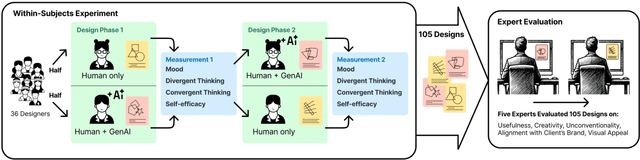

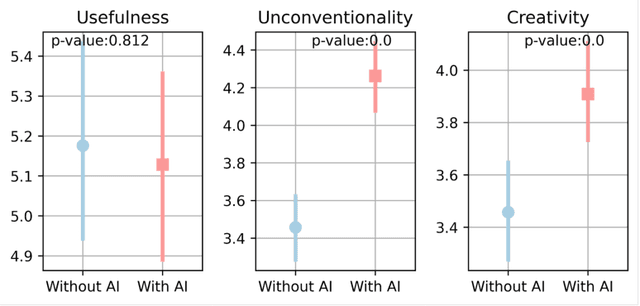
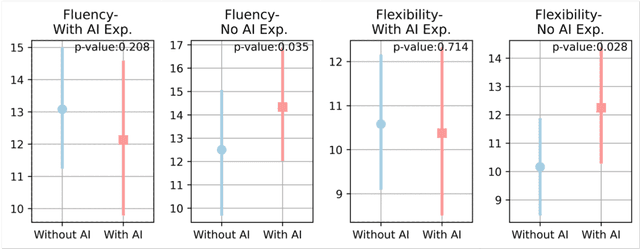
As generative AI (GenAI) increasingly permeates design workflows, its impact on design outcomes and designers' creative capabilities warrants investigation. We conducted a within-subjects experiment where we asked participants to design advertisements both with and without GenAI support. Our results show that expert evaluators rated GenAI-supported designs as more creative and unconventional ("weird") despite no significant differences in visual appeal, brand alignment, or usefulness, which highlights the decoupling of novelty from usefulness-traditional dual components of creativity-in the context of GenAI usage. Moreover, while GenAI does not significantly enhance designers' overall creative thinking abilities, users were affected differently based on native language and prior AI exposure. Native English speakers experienced reduced relaxation when using AI, whereas designers new to GenAI exhibited gains in divergent thinking, such as idea fluency and flexibility. These findings underscore the variable impact of GenAI on different user groups, suggesting the potential for customized AI tools.