 Add to Chrome
 Add to Firefox
 Add to Edge
Fishbone: From One 3D Asset to a Million Controllable Edits
May 24, 2026
Large-scale controllable 3D assets are critical for computer graphics, embodied AI, robotics, and interactive content creation, yet creating diverse 3D assets remains challenging due to the high cost of manual modeling and rigging. Shape deformation offers a natural way to generate variations from existing meshes, but existing data-driven methods often rely on sparse user inputs, while parametric editing frameworks require manually designed control structures and category-specific configurations. Inspired by natural creatures, where a central spine governs global shape and cross-sectional ribs control local variation, we introduce Fishbone, a unified rib-spine representation for general shapes that supports controllable parametric mesh deformation, reduced-space dynamics, and animation. Given an input mesh, Fishbone computes a geodesic scalar field with an adaptive heat method, extracts iso-contours as cross-sectional ribs, constructs a smooth geometry-aware spine through rib centers, and associates surface vertices with nearby rib and spine structures using Gaussian-weighted skinning. The resulting representation enables real-time and predictable deformation: ribs control local profiles such as thickness, orientation, and cross-sectional variation, while the spine controls global bending, twisting, and stretching. The same structure also supports reduced-space simulation and keyframe animation. We further construct Fishbone-136K by augmenting Hunyuan3D with rib-spine structures, and demonstrate applications in controllable 3D generation, deformation-based data augmentation for robot learning, interactive mesh editing, and agentic generation. Experiments demonstrate the effectiveness, efficiency, and versatility of the proposed framework.

Embedded IPC: Fast and Intersection-free Simulation in Reduced Subspace for Robot Manipulation
Sep 24, 2024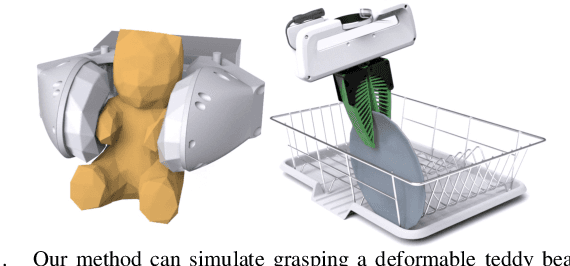
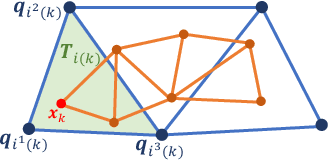

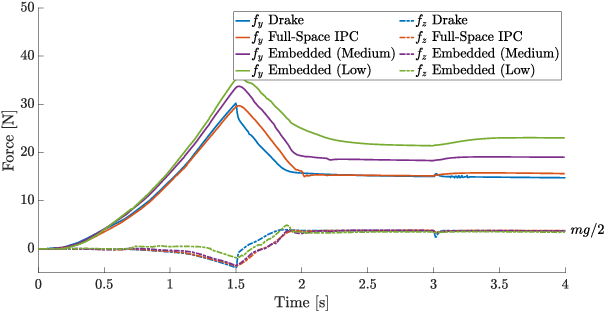
Physics-based simulation is essential for developing and evaluating robot manipulation policies, particularly in scenarios involving deformable objects and complex contact interactions. However, existing simulators often struggle to balance computational efficiency with numerical accuracy, especially when modeling deformable materials with frictional contact constraints. We introduce an efficient subspace representation for the Incremental Potential Contact (IPC) method, leveraging model reduction to decrease the number of degrees of freedom. Our approach decouples simulation complexity from the resolution of the input model by representing elasticity in a low-resolution subspace while maintaining collision constraints on an embedded high-resolution surface. Our barrier formulation ensures intersection-free trajectories and configurations regardless of material stiffness, time step size, or contact severity. We validate our simulator through quantitative experiments with a soft bubble gripper grasping and qualitative demonstrations of placing a plate on a dish rack. The results demonstrate our simulator's efficiency, physical accuracy, computational stability, and robust handling of frictional contact, making it well-suited for generating demonstration data and evaluating downstream robot training applications.