 Add to Chrome
 Add to Firefox
 Add to Edge
OmniCap-IF: Benchmarking and Improving Instruction Following Abilities for Omni-Video Captioning
Jun 07, 2026
While Omni-modal Large Language Models (OLLMs) have demonstrated impressive capabilities in jointly processing audio and visual streams, their ability to strictly adhere to complex, multi-faceted user instructions remains largely unexplored. Existing benchmarks primarily focus on holistic video understanding or text-only instruction following, failing to capture the intricate interplay between modalities and user constraints. To bridge this gap, we introduce OmniCap-IF, the first comprehensive benchmark specifically designed to evaluate instruction-following capabilities in omni-modal captioning. OmniCap-IF incorporates a systematic framework that assesses captions on two dimensions: format correctness and content correctness. Our benchmark encompasses 50 distinct constraint types across pure visual, pure audio, and audio-visual modalities, while integrating Temporal Grounding to assess spatio-temporal precision. Extensive evaluations of prominent models on 1,920 high-quality samples reveal significant performance disparities. Furthermore, our analysis uncovers a critical "format-content tradeoff", demonstrating that increasing formatting complexity directly degrades models' omni-modal reasoning abilities. Finally, to advance the field, we curate a 54K instruction-tuning dataset, OmniCap-IF-54K and present OmniCaptioner-IF, which achieves notable improvements in both complex instruction adherence and general omni-modal captioning performance.

NCL-CIR: Noise-aware Contrastive Learning for Composed Image Retrieval
Apr 06, 2025Composed Image Retrieval (CIR) seeks to find a target image using a multi-modal query, which combines an image with modification text to pinpoint the target. While recent CIR methods have shown promise, they mainly focus on exploring relationships between the query pairs (image and text) through data augmentation or model design. These methods often assume perfect alignment between queries and target images, an idealized scenario rarely encountered in practice. In reality, pairs are often partially or completely mismatched due to issues like inaccurate modification texts, low-quality target images, and annotation errors. Ignoring these mismatches leads to numerous False Positive Pair (FFPs) denoted as noise pairs in the dataset, causing the model to overfit and ultimately reducing its performance. To address this problem, we propose the Noise-aware Contrastive Learning for CIR (NCL-CIR), comprising two key components: the Weight Compensation Block (WCB) and the Noise-pair Filter Block (NFB). The WCB coupled with diverse weight maps can ensure more stable token representations of multi-modal queries and target images. Meanwhile, the NFB, in conjunction with the Gaussian Mixture Model (GMM) predicts noise pairs by evaluating loss distributions, and generates soft labels correspondingly, allowing for the design of the soft-label based Noise Contrastive Estimation (NCE) loss function. Consequently, the overall architecture helps to mitigate the influence of mismatched and partially matched samples, with experimental results demonstrating that NCL-CIR achieves exceptional performance on the benchmark datasets.
Dynamic Identity-Guided Attention Network for Visible-Infrared Person Re-identification
May 21, 2024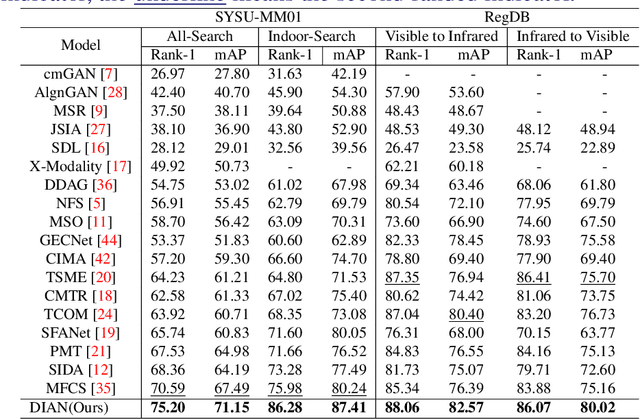
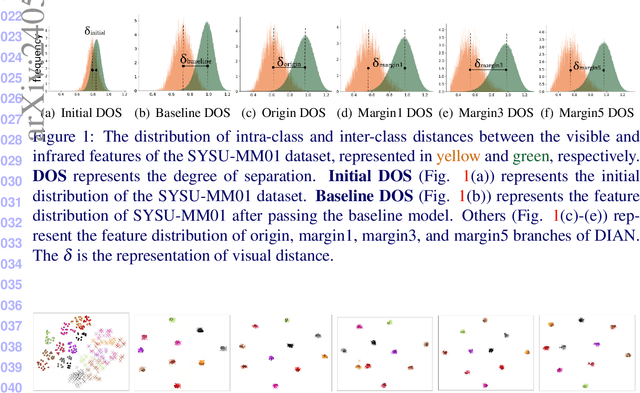
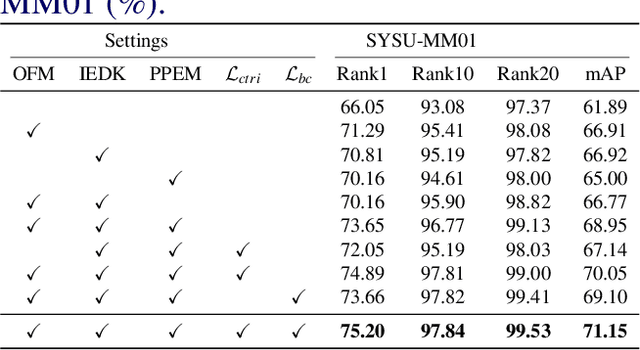
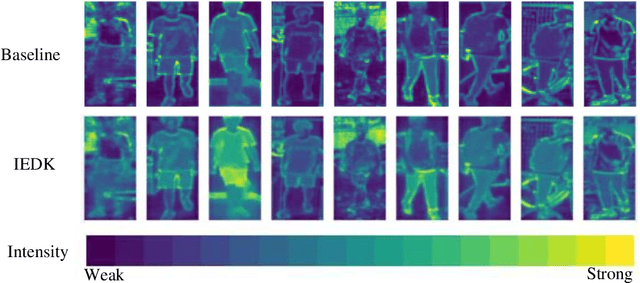
Visible-infrared person re-identification (VI-ReID) aims to match people with the same identity between visible and infrared modalities. VI-ReID is a challenging task due to the large differences in individual appearance under different modalities. Existing methods generally try to bridge the cross-modal differences at image or feature level, which lacks exploring the discriminative embeddings. Effectively minimizing these cross-modal discrepancies relies on obtaining representations that are guided by identity and consistent across modalities, while also filtering out representations that are irrelevant to identity. To address these challenges, we introduce a dynamic identity-guided attention network (DIAN) to mine identity-guided and modality-consistent embeddings, facilitating effective bridging the gap between different modalities. Specifically, in DIAN, to pursue a semantically richer representation, we first use orthogonal projection to fuse the features from two connected coarse and fine layers. Furthermore, we first use dynamic convolution kernels to mine identity-guided and modality-consistent representations. More notably, a cross embedding balancing loss is introduced to effectively bridge cross-modal discrepancies by above embeddings. Experimental results on SYSU-MM01 and RegDB datasets show that DIAN achieves state-of-the-art performance. Specifically, for indoor search on SYSU-MM01, our method achieves 86.28% rank-1 accuracy and 87.41% mAP, respectively. Our code will be available soon.