 Add to Chrome
 Add to Firefox
 Add to Edge
What Matters for Latent Actions in Robot Learning
Aug 20, 2026
Latent Action Models (LAMs) have emerged as a promising paradigm for enabling robot learning to leverage large-scale unlabeled videos through latent actions that serve as compact surrogates for physical actions. Despite rapid progress, research on LAM remains highly fragmented, with existing methods evaluating different design choices in isolation under inconsistent experimental settings, making it difficult to identify the factors that truly determine downstream robotic manipulation performance. In this work, we present the first comprehensive empirical study of latent action learning for robotic manipulation. We unify representative LAM methods within a common autoencoding framework and systematically investigate 41 LAM design choices across three dimensions, including latent action modeling paradigms, learning objectives and regularization methods, and latent action integration strategies. We further examine four proxy metrics for evaluating latent action quality and assess their ability to reliably predict downstream robotic manipulation performance. Extensive experiments on three widely used benchmarks provide strong empirical evidence that fine-tuning vision-language model (VLM) backbones with latent actions provides a stronger initialization for downstream policy learning, with further validation on real-world robot manipulation tasks.

LAFP: Preserving Latent Action Structure in Latent Policy Learning via Flow Matching
Jun 09, 2026Learning high-quality latent actions from large-scale unlabeled videos, coupled with limited real-world interaction data for training an action decoder, has emerged as a promising paradigm for scalable latent policy learning. However, existing approaches typically rely on behavior cloning, which tends to collapse inherently multimodal action distributions into unimodal ones, thereby degrading the pretrained latent action structure. While flow matching provides a potential alternative, directly applying it leads to a misalignment between latent actions and physical actions during action decoder training, due to the stochastic nature of the learned policy. To address these, we propose Latent Action Flow Policy (LAFP), which leverages flow matching for latent policy learning and introduces an inference-time interpolation mechanism to mitigate stochasticity-induced misalignment. Experimental results demonstrate that LAFP consistently outperforms prior methods on downstream imitation learning tasks, achieving up to 10-15% improvement in success rate while incurring less than 1x additional inference overhead.
Data-Asymmetric Latent Imagination and Reranking for 3D Robotic Imitation Learning
May 11, 2026Robotic imitation learning typically assumes access to optimal demonstrations, yet real-world data collection often yields suboptimal, exploratory, or even failed trajectories. Discarding such data wastes valuable information about environment dynamics and failure modes, which can instead be leveraged to improve decision-making. While 3D policies reduce reliance on high-quality demonstrations through strong spatial generalization, they still require large-scale data to achieve high task success. To address this, we propose DALI-R, a Data-Asymmetric Latent Imagination and Reranking framework for 3D robotic imitation learning from mixed-quality trajectories. It learns a Latent World Model over 3D point clouds for imagined rollouts and a Task Completion Scorer that reranks candidate action chunks, improving decision-making without additional high-quality demonstrations. We instantiate DALI-R with both diffusion and efficient flow-matching policies and evaluate it on Adroit and MetaWorld benchmarks. Across the two evaluated 3D base policies, DALI-R achieves an average $6.8$\% improvement in success rate while incurring less than $0.7\times$ additional inference overhead.
OneVL: One-Step Latent Reasoning and Planning with Vision-Language Explanation
Apr 20, 2026Chain-of-Thought (CoT) reasoning has become a powerful driver of trajectory prediction in VLA-based autonomous driving, yet its autoregressive nature imposes a latency cost that is prohibitive for real-time deployment. Latent CoT methods attempt to close this gap by compressing reasoning into continuous hidden states, but consistently fall short of their explicit counterparts. We suggest that this is due to purely linguistic latent representations compressing a symbolic abstraction of the world, rather than the causal dynamics that actually govern driving. Thus, we present OneVL (One-step latent reasoning and planning with Vision-Language explanations), a unified VLA and World Model framework that routes reasoning through compact latent tokens supervised by dual auxiliary decoders. Alongside a language decoder that reconstructs text CoT, we introduce a visual world model decoder that predicts future-frame tokens, forcing the latent space to internalize the causal dynamics of road geometry, agent motion, and environmental change. A three-stage training pipeline progressively aligns these latents with trajectory, language, and visual objectives, ensuring stable joint optimization. At inference, the auxiliary decoders are discarded and all latent tokens are prefilled in a single parallel pass, matching the speed of answer-only prediction. Across four benchmarks, OneVL becomes the first latent CoT method to surpass explicit CoT, delivering state-of-the-art accuracy at answer-only latency, and providing direct evidence that tighter compression, when guided in both language and world-model supervision, produces more generalizable representations than verbose token-by-token reasoning. Project Page: https://xiaomi-embodied-intelligence.github.io/OneVL
Resolving State Ambiguity in Robot Manipulation via Adaptive Working Memory Recoding
Dec 31, 2025State ambiguity is common in robotic manipulation. Identical observations may correspond to multiple valid behavior trajectories. The visuomotor policy must correctly extract the appropriate types and levels of information from the history to identify the current task phase. However, naively extending the history window is computationally expensive and may cause severe overfitting. Inspired by the continuous nature of human reasoning and the recoding of working memory, we introduce PAM, a novel visuomotor Policy equipped with Adaptive working Memory. With minimal additional training cost in a two-stage manner, PAM supports a 300-frame history window while maintaining high inference speed. Specifically, a hierarchical frame feature extractor yields two distinct representations for motion primitives and temporal disambiguation. For compact representation, a context router with range-specific queries is employed to produce compact context features across multiple history lengths. And an auxiliary objective of reconstructing historical information is introduced to ensure that the context router acts as an effective bottleneck. We meticulously design 7 tasks and verify that PAM can handle multiple scenarios of state ambiguity simultaneously. With a history window of approximately 10 seconds, PAM still supports stable training and maintains inference speeds above 20Hz. Project website: https://tinda24.github.io/pam/
Learning from Imperfect Demonstrations through Dynamics Evaluation
Dec 18, 2023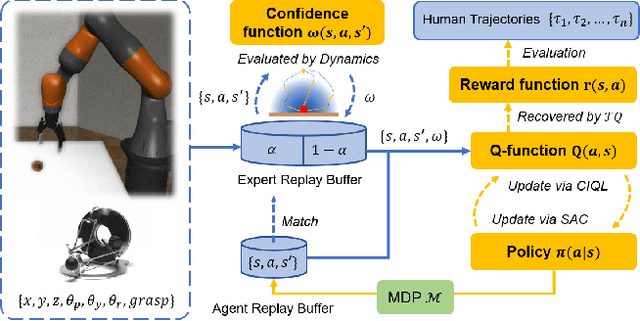
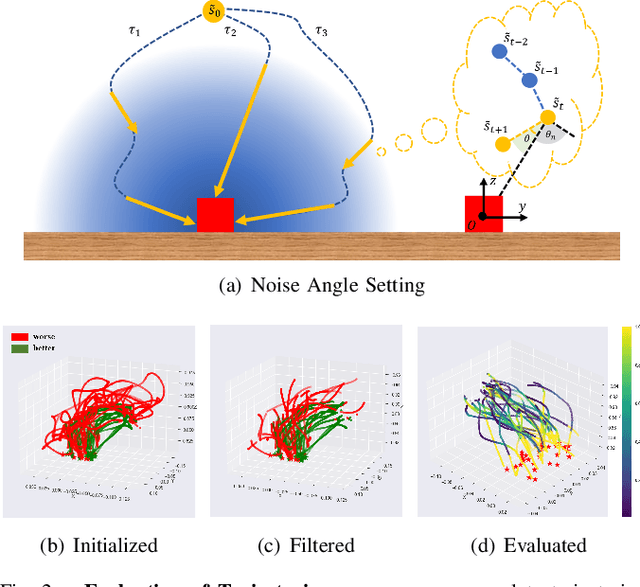
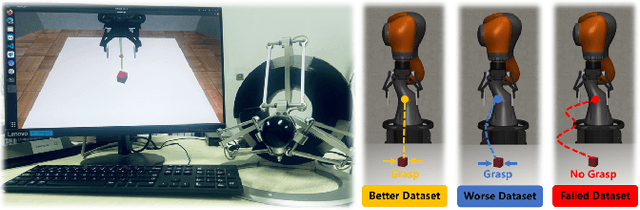

Standard imitation learning usually assumes that demonstrations are drawn from an optimal policy distribution. However, in real-world scenarios, every human demonstration may exhibit nearly random behavior and collecting high-quality human datasets can be quite costly. This requires imitation learning can learn from imperfect demonstrations to obtain robotic policies that align human intent. Prior work uses confidence scores to extract useful information from imperfect demonstrations, which relies on access to ground truth rewards or active human supervision. In this paper, we propose a dynamics-based method to evaluate the data confidence scores without above efforts. We develop a generalized confidence-based imitation learning framework called Confidence-based Inverse soft-Q Learning (CIQL), which can employ different optimal policy matching methods by simply changing object functions. Experimental results show that our confidence evaluation method can increase the success rate by $40.3\%$ over the original algorithm and $13.5\%$ over the simple noise filtering.