 Add to Chrome
 Add to Firefox
 Add to Edge
MANIGUARD: A Benchmark and Data Suite for Specification-Grounded Safety Evaluation and Improvement of Robotic Manipulation
Aug 18, 2026
Foundation-model policies for robotic manipulation are advancing rapidly on task success, but rigorous evaluation of whether they succeed safely is still lacking. We introduce ManiGuard, a specification-grounded framework for evaluating and improving the safety of foundation-model manipulation, comprising the ManiGuard-Bench task suite and a paired safety-annotated trajectory-generation pipeline. ManiGuard-Bench organizes six contact-rich household task families into 200 locked base tasks along a skill $\times$ constraint taxonomy, with safety specified independently of task success. Each task is evaluated under one in-distribution and four single-axis out-of-distribution perturbations that hold the safety specification fixed, giving 1,000 locked scenarios. Every rollout is runtime-checked by LTL$_f$-grounded automaton monitors over physics-grounded predicates rather than learned classifiers or LLM judges, in simulation and on a physical Franka platform. The pipeline pairs an automated motion-planning generator with human teleoperation, annotated by the same per-step monitor, and directly supports safety-aware fine-tuning; we release 8,000 safety-annotated demonstrations, 40 per base task. Benchmarking zero-shot and fine-tuned VLAs across more than 23,000 rollouts, we find: (i) safety must be evaluated independently of task success, as 6-21% of successful rollouts violate the specification; (ii) fine-tuning on our suite raises safe task completion from near zero to 7.5-29.8% and engaged-and-safe behavior from 16-40% to 51-72%; but (iii) a gap remains that scaling demonstrations does not close, with 21-42% of engaged rollouts still violating, two of six families below 2% safe success for every policy, and these failures persisting under distribution shift and on hardware.

Benchmarking and Enhancing LLMs for Rule-Intensive Review of National Standard Documents
Aug 06, 2026Large language models (LLMs) increasingly support complex professional tasks, yet their capabilities in rule-intensive document review remain insufficiently evaluated. National standard documents, such as China GB/T standards, offer a representative testbed: they are lengthy, highly structured, and governed by explicit rules for scope, terminology, normative wording, and cross-section consistency. Existing benchmarks focus on domain knowledge and question answering, largely overlooking intrinsic quality review for professional documents. Such reviews rely heavily on human experts, making them costly and difficult to scale. To bridge this gap, we introduce GB/T-Bench, the first benchmark for the structured review of national standard documents. Its GB/T Review Taxonomy is a hierarchical schema covering document structure, scope alignment, normative modality, terminology consistency, and normative references, with 25 diagnosable error types. A controllable counterexample generation mechanism combines deterministic rules and constrained LLM rewriting to process 488 documents into 7,306 traceable review error instances for evaluation. We also develop a diagnosis-oriented evaluation protocol requiring exact matches on error location, review dimension, and error type, plus document-level coverage metrics. We further propose GB/T-Reviewer, a multi-agent framework that converts review knowledge into specialized skills and coordinates global inspection, targeted diagnosis, rule scanning, and result verification. Experiments with 14 mainstream LLMs reveal a substantial human-LLM gap: the strongest model achieves only 0.3280 CMCS versus 0.6640 for experts. GB/T-Reviewer raises the best CMCS to 0.5094, showing the value of structured skill coordination for rule-intensive document review. This work paves the way for trustworthy AI in standardization and other high-stakes document domains.
An Adversarial-Driven Experimental Study on Deep Learning for RF Fingerprinting
Jul 18, 2025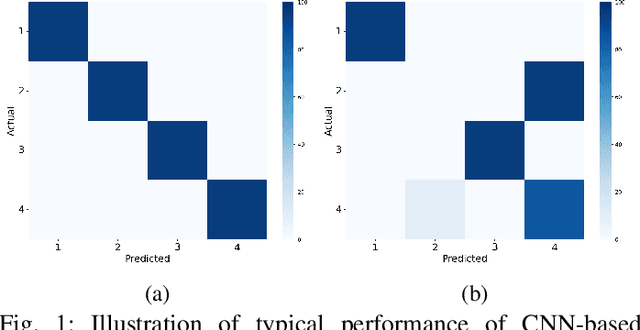
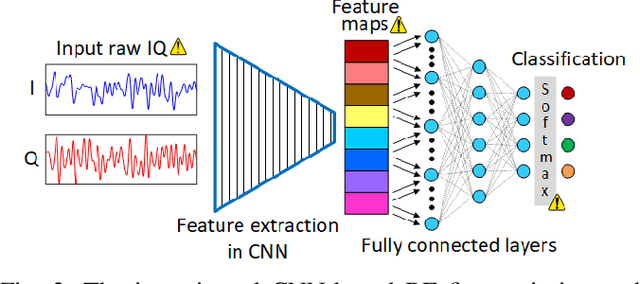
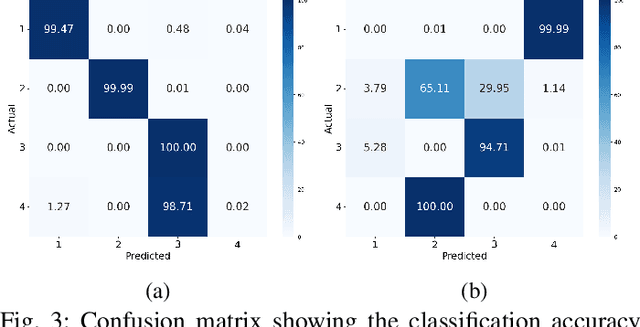
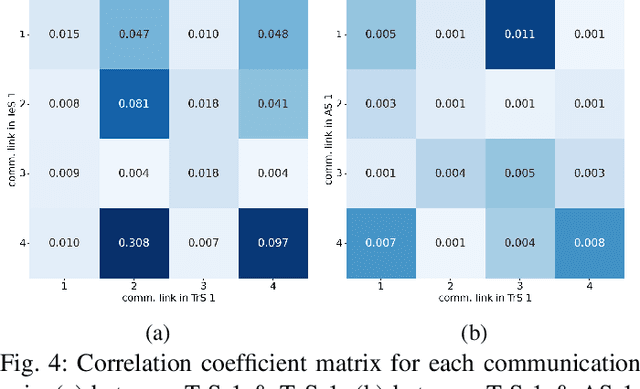
Radio frequency (RF) fingerprinting, which extracts unique hardware imperfections of radio devices, has emerged as a promising physical-layer device identification mechanism in zero trust architectures and beyond 5G networks. In particular, deep learning (DL) methods have demonstrated state-of-the-art performance in this domain. However, existing approaches have primarily focused on enhancing system robustness against temporal and spatial variations in wireless environments, while the security vulnerabilities of these DL-based approaches have often been overlooked. In this work, we systematically investigate the security risks of DL-based RF fingerprinting systems through an adversarial-driven experimental analysis. We observe a consistent misclassification behavior for DL models under domain shifts, where a device is frequently misclassified as another specific one. Our analysis based on extensive real-world experiments demonstrates that this behavior can be exploited as an effective backdoor to enable external attackers to intrude into the system. Furthermore, we show that training DL models on raw received signals causes the models to entangle RF fingerprints with environmental and signal-pattern features, creating additional attack vectors that cannot be mitigated solely through post-processing security methods such as confidence thresholds.
NTIRE 2025 Challenge on Cross-Domain Few-Shot Object Detection: Methods and Results
Apr 14, 2025Cross-Domain Few-Shot Object Detection (CD-FSOD) poses significant challenges to existing object detection and few-shot detection models when applied across domains. In conjunction with NTIRE 2025, we organized the 1st CD-FSOD Challenge, aiming to advance the performance of current object detectors on entirely novel target domains with only limited labeled data. The challenge attracted 152 registered participants, received submissions from 42 teams, and concluded with 13 teams making valid final submissions. Participants approached the task from diverse perspectives, proposing novel models that achieved new state-of-the-art (SOTA) results under both open-source and closed-source settings. In this report, we present an overview of the 1st NTIRE 2025 CD-FSOD Challenge, highlighting the proposed solutions and summarizing the results submitted by the participants.
Learning Fine-Grained Segmentation of 3D Shapes without Part Labels
Mar 24, 2021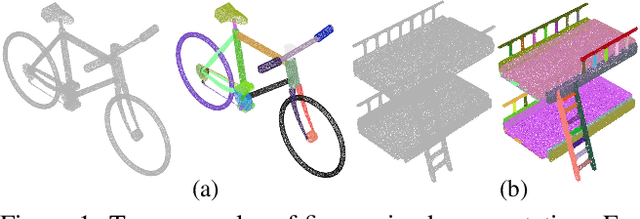
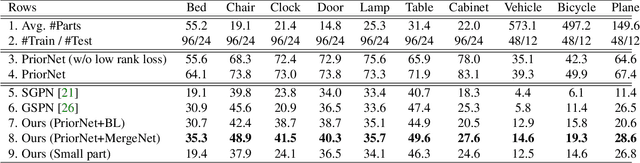
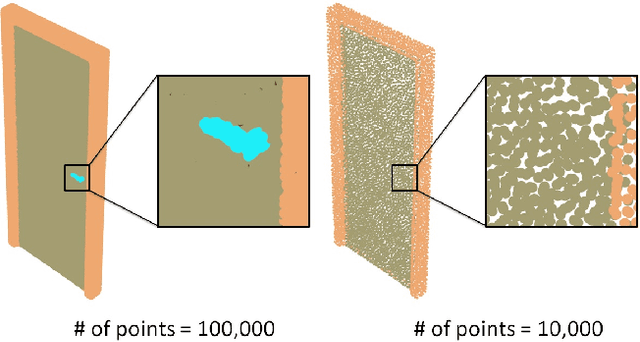
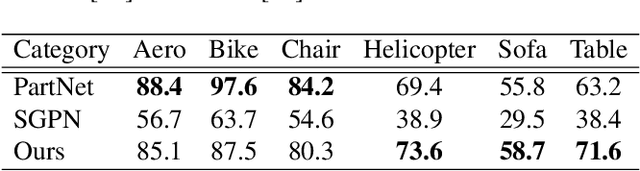
Learning-based 3D shape segmentation is usually formulated as a semantic labeling problem, assuming that all parts of training shapes are annotated with a given set of tags. This assumption, however, is impractical for learning fine-grained segmentation. Although most off-the-shelf CAD models are, by construction, composed of fine-grained parts, they usually miss semantic tags and labeling those fine-grained parts is extremely tedious. We approach the problem with deep clustering, where the key idea is to learn part priors from a shape dataset with fine-grained segmentation but no part labels. Given point sampled 3D shapes, we model the clustering priors of points with a similarity matrix and achieve part segmentation through minimizing a novel low rank loss. To handle highly densely sampled point sets, we adopt a divide-and-conquer strategy. We partition the large point set into a number of blocks. Each block is segmented using a deep-clustering-based part prior network trained in a category-agnostic manner. We then train a graph convolution network to merge the segments of all blocks to form the final segmentation result. Our method is evaluated with a challenging benchmark of fine-grained segmentation, showing state-of-the-art performance.
Self-Supervised Learning of Part Mobility from Point Cloud Sequence
Oct 20, 2020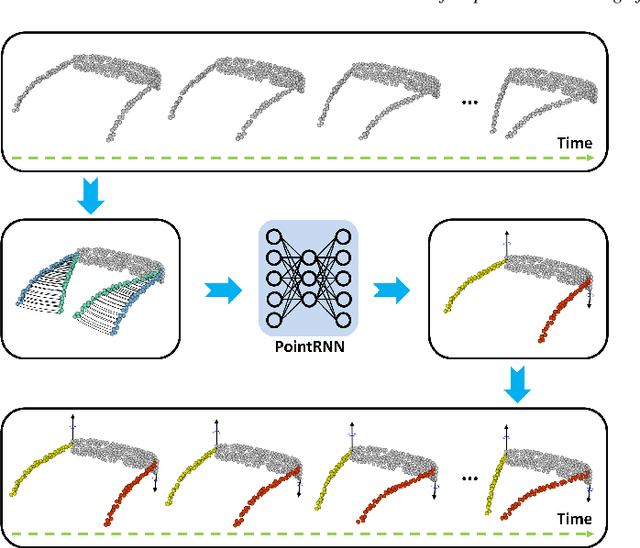
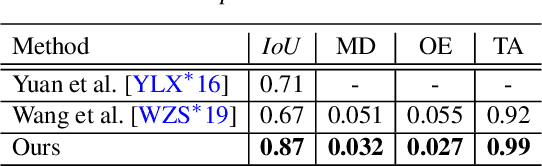
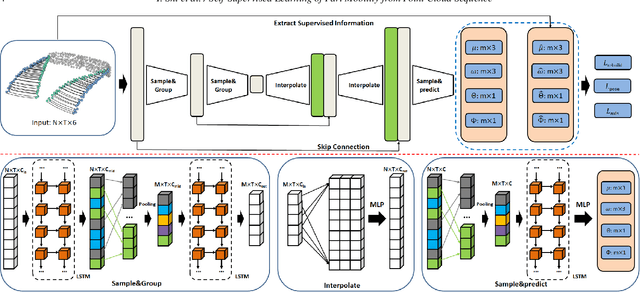
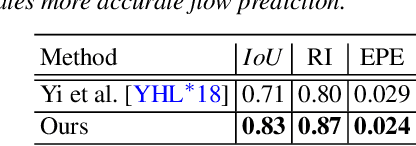
Part mobility analysis is a significant aspect required to achieve a functional understanding of 3D objects. It would be natural to obtain part mobility from the continuous part motion of 3D objects. In this study, we introduce a self-supervised method for segmenting motion parts and predicting their motion attributes from a point cloud sequence representing a dynamic object. To sufficiently utilize spatiotemporal information from the point cloud sequence, we generate trajectories by using correlations among successive frames of the sequence instead of directly processing the point clouds. We propose a novel neural network architecture called PointRNN to learn feature representations of trajectories along with their part rigid motions. We evaluate our method on various tasks including motion part segmentation, motion axis prediction and motion range estimation. The results demonstrate that our method outperforms previous techniques on both synthetic and real datasets. Moreover, our method has the ability to generalize to new and unseen objects. It is important to emphasize that it is not required to know any prior shape structure, prior shape category information, or shape orientation. To the best of our knowledge, this is the first study on deep learning to extract part mobility from point cloud sequence of a dynamic object.