 Add to Chrome
 Add to Firefox
 Add to Edge
Benchmarking and Enhancing LLMs for Rule-Intensive Review of National Standard Documents
Aug 06, 2026
Large language models (LLMs) increasingly support complex professional tasks, yet their capabilities in rule-intensive document review remain insufficiently evaluated. National standard documents, such as China GB/T standards, offer a representative testbed: they are lengthy, highly structured, and governed by explicit rules for scope, terminology, normative wording, and cross-section consistency. Existing benchmarks focus on domain knowledge and question answering, largely overlooking intrinsic quality review for professional documents. Such reviews rely heavily on human experts, making them costly and difficult to scale. To bridge this gap, we introduce GB/T-Bench, the first benchmark for the structured review of national standard documents. Its GB/T Review Taxonomy is a hierarchical schema covering document structure, scope alignment, normative modality, terminology consistency, and normative references, with 25 diagnosable error types. A controllable counterexample generation mechanism combines deterministic rules and constrained LLM rewriting to process 488 documents into 7,306 traceable review error instances for evaluation. We also develop a diagnosis-oriented evaluation protocol requiring exact matches on error location, review dimension, and error type, plus document-level coverage metrics. We further propose GB/T-Reviewer, a multi-agent framework that converts review knowledge into specialized skills and coordinates global inspection, targeted diagnosis, rule scanning, and result verification. Experiments with 14 mainstream LLMs reveal a substantial human-LLM gap: the strongest model achieves only 0.3280 CMCS versus 0.6640 for experts. GB/T-Reviewer raises the best CMCS to 0.5094, showing the value of structured skill coordination for rule-intensive document review. This work paves the way for trustworthy AI in standardization and other high-stakes document domains.

Dynamic Graph Structure Learning via Resistance Curvature Flow
Jan 13, 2026Geometric Representation Learning (GRL) aims to approximate the non-Euclidean topology of high-dimensional data through discrete graph structures, grounded in the manifold hypothesis. However, traditional static graph construction methods based on Euclidean distance often fail to capture the intrinsic curvature characteristics of the data manifold. Although Ollivier-Ricci Curvature Flow (OCF) has proven to be a powerful tool for dynamic topological optimization, its core reliance on Optimal Transport (Wasserstein distance) leads to prohibitive computational complexity, severely limiting its application in large-scale datasets and deep learning frameworks. To break this bottleneck, this paper proposes a novel geometric evolution framework: Resistance Curvature Flow (RCF). Leveraging the concept of effective resistance from circuit physics, RCF transforms expensive curvature optimization into efficient matrix operations. This approach achieves over 100x computational acceleration while maintaining geometric optimization capabilities comparable to OCF. We provide an in-depth exploration of the theoretical foundations and dynamical principles of RCF, elucidating how it guides the redistribution of edge weights via curvature gradients to eliminate topological noise and strengthen local cluster structures. Furthermore, we provide a mechanistic explanation of RCF's role in manifold enhancement and noise suppression, as well as its compatibility with deep learning models. We design a graph optimization algorithm, DGSL-RCF, based on this framework. Experimental results across deep metric learning, manifold learning, and graph structure learning demonstrate that DGSL-RCF significantly improves representation quality and downstream task performance.
HSKBenchmark: Modeling and Benchmarking Chinese Second Language Acquisition in Large Language Models through Curriculum Tuning
Nov 19, 2025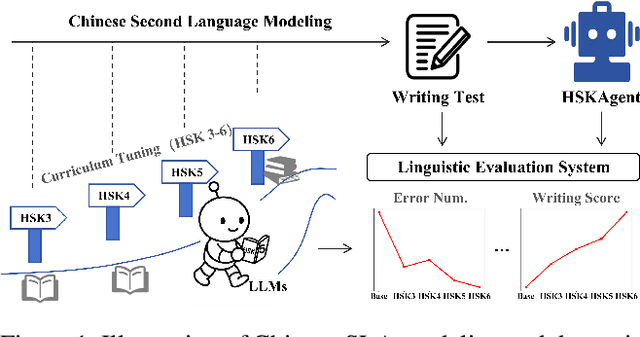
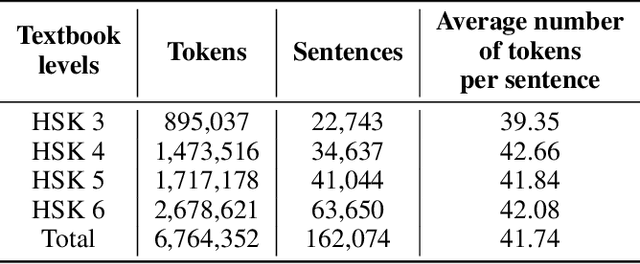
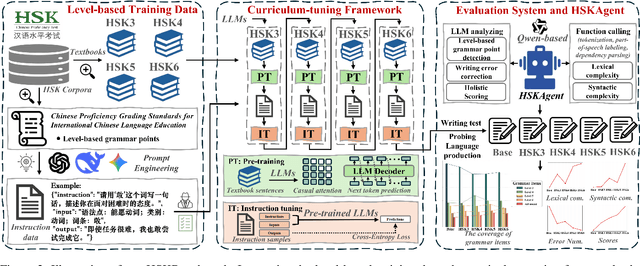
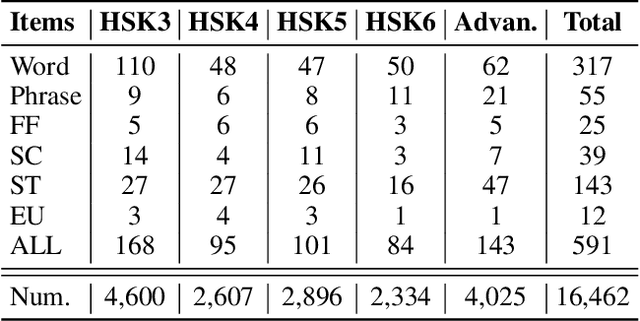
Language acquisition is vital to revealing the nature of human language intelligence and has recently emerged as a promising perspective for improving the interpretability of large language models (LLMs). However, it is ethically and practically infeasible to conduct experiments that require controlling human learners' language inputs. This poses challenges for the verifiability and scalability of language acquisition modeling, particularly in Chinese second language acquisition (SLA). While LLMs provide a controllable and reproducible alternative, a systematic benchmark to support phase-wise modeling and assessment is still lacking. In this paper, we present HSKBenchmark, the first benchmark for staged modeling and writing assessment of LLMs in Chinese SLA. It covers HSK levels 3 to 6 and includes authentic textbooks with 6.76 million tokens, 16K synthetic instruction samples, 30 test topics, and a linguistically grounded evaluation system. To simulate human learning trajectories, we introduce a curriculum-tuning framework that trains models from beginner to advanced levels. An evaluation system is created to examine level-based grammar coverage, writing errors, lexical and syntactic complexity, and holistic scoring. We also build HSKAgent, fine-tuned on 10K learner compositions. Extensive experimental results demonstrate that HSKBenchmark not only models Chinese SLA effectively, but also serves as a reliable benchmark for dynamic writing assessment in LLMs. Our fine-tuned LLMs have writing performance on par with advanced human learners and exhibit human-like acquisition characteristics. The HSKBenchmark, HSKAgent, and checkpoints serve as foundational tools and resources, with the potential to pave the way for future research on language acquisition modeling and LLMs interpretability. Code and data are publicly available at: https://github.com/CharlesYang030/HSKB.