 Add to Chrome
 Add to Firefox
 Add to Edge
Benchmarking and Enhancing LLMs for Rule-Intensive Review of National Standard Documents
Aug 06, 2026
Large language models (LLMs) increasingly support complex professional tasks, yet their capabilities in rule-intensive document review remain insufficiently evaluated. National standard documents, such as China GB/T standards, offer a representative testbed: they are lengthy, highly structured, and governed by explicit rules for scope, terminology, normative wording, and cross-section consistency. Existing benchmarks focus on domain knowledge and question answering, largely overlooking intrinsic quality review for professional documents. Such reviews rely heavily on human experts, making them costly and difficult to scale. To bridge this gap, we introduce GB/T-Bench, the first benchmark for the structured review of national standard documents. Its GB/T Review Taxonomy is a hierarchical schema covering document structure, scope alignment, normative modality, terminology consistency, and normative references, with 25 diagnosable error types. A controllable counterexample generation mechanism combines deterministic rules and constrained LLM rewriting to process 488 documents into 7,306 traceable review error instances for evaluation. We also develop a diagnosis-oriented evaluation protocol requiring exact matches on error location, review dimension, and error type, plus document-level coverage metrics. We further propose GB/T-Reviewer, a multi-agent framework that converts review knowledge into specialized skills and coordinates global inspection, targeted diagnosis, rule scanning, and result verification. Experiments with 14 mainstream LLMs reveal a substantial human-LLM gap: the strongest model achieves only 0.3280 CMCS versus 0.6640 for experts. GB/T-Reviewer raises the best CMCS to 0.5094, showing the value of structured skill coordination for rule-intensive document review. This work paves the way for trustworthy AI in standardization and other high-stakes document domains.

Ideas Have Genomes: Benchmarking Scientific Lineage Reasoning and Lineage-Grounded Idea Generation
Jul 09, 2026Scientific ideas rarely start from a blank page. They inherit mechanisms, repair known limitations, and recombine pieces of earlier work, much like biological genomes. Current benchmarks still say little about whether AI systems can follow this inheritance structure. We present IdeaGene-Bench (IG-Bench), a benchmark for scientific lineage reasoning and lineage-grounded idea generation. IG-Bench is organized around the IdeaGene framework: each paper or proposal is represented as a set of minimal, typed, evidence-grounded Idea Genome objects, and a GenomeDiff aligns these objects to record inheritance, mutation, loss, external import, and novel insertion under six operational evolutionary dynamics. The benchmark contains 1,961 golden lineage traces, 1,085 curated Idea Genome objects, and 920 pairwise GenomeDiff records across 10 scientific domains. It supports two evaluations. IG-Exam (42 task types, 1,029 instances) tests closed-form lineage reasoning across Idea Genome abstraction, inheritance tracing, evolutionary reasoning, and lineage verification. IG-Arena evaluates generation with a lineage-conditioned Population-Evolution Score(PES), asking whether a proposal can be inserted as a coherent descendant of a given lineage population: it should inherit the right Idea Genome objects, vary meaningfully from nearby work, and offer selection value for future research. Experiments on 14 LLM-based scientists expose a compositional bottleneck. The strongest system reaches only 27.3% exact accuracy on lineage reasoning, and structured lineage context reshuffles system rankings rather than helping every participant uniformly.
SkillOpt: Executive Strategy for Self-Evolving Agent Skills
May 25, 2026Agent skills today are hand-crafted, generated one-shot, or evolved through loosely controlled self-revision, none of which behaves like a deep-learning optimizer for the skill, and none of which reliably improves over its starting point under feedback. We argue the skill should instead be trained as the external state of a frozen agent, with the same discipline that makes weight-space optimization reproducible. SkillOpt is, to our knowledge, the first systematic controllable text-space optimizer for agent skills: a separate optimizer model turns scored rollouts into bounded add/delete/replace edits on a single skill document, and an edit is accepted only when it strictly improves a held-out validation score. A textual learning-rate budget, rejected-edit buffer, and epoch-wise slow/meta update make skill training stable while adding zero inference-time model calls at deployment. Across six benchmarks, seven target models, and three execution harnesses (direct chat, Codex, Claude Code), SkillOpt is best or tied on all 52 evaluated (model, benchmark, harness) cells and beats every per-cell competitor among human, one-shot LLM, Trace2Skill, TextGrad, GEPA, and EvoSkill skills. On GPT-5.5 it lifts the average no-skill accuracy by +23.5 points in direct chat, by +24.8 inside the Codex agentic loop, and by +19.1 inside Claude Code. Transfer experiments further show that optimized skill artifacts retain value when moved across model scales, between Codex and Claude Code execution environments, and to a nearby math benchmark without further optimization. Code: https://aka.ms/skillopt
From Raw Experience to Skill Consumption: A Systematic Study of Model-Generated Agent Skills
May 22, 2026Language agents increasingly improve by reusing \emph{skills} -- structured procedural artifacts distilled from past experience. In particular, \emph{domain-level} and \emph{model-generated} skills are especially promising. They offer fast adaptation within a domain by encoding domain-specific recurring procedures, and they scale beyond labor-intensive hand-crafting. However, while extraction methods continue to proliferate, understanding remains limited, with no comprehensive study spanning the full skill lifecycle -- \textbf{experience generation}, \textbf{skill extraction}, and \textbf{skill consumption} -- to ask whether such skills actually work, when they work, and what makes them succeed or fail. To close this gap, we build a utility-grounded evaluation framework that provides systematic experimental results across extractors and target agents, covering five diverse agentic task domains. We find that model-generated skills are beneficial on average but exhibit non-trivial negative transfer, and that neither extractors nor targets behave uniformly. A model can be a strong extractor yet a weak consumer, or vice versa, with skill utility independent of model scale or baseline task strength. To explain these patterns, we then dissect each lifecycle stage in depth, analyzing how experience composition shapes skill quality, what properties characterize useful skills, and how the same skill transfers across different consumers. Finally, we translate these findings into a concrete \emph{meta-skill} that guides skill extraction toward the features tied to actual utility, which consistently improves skill quality across domains and substantially reduces negative transfer.
HSKBenchmark: Modeling and Benchmarking Chinese Second Language Acquisition in Large Language Models through Curriculum Tuning
Nov 19, 2025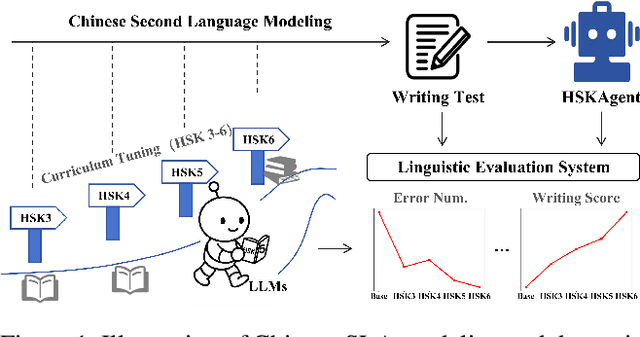
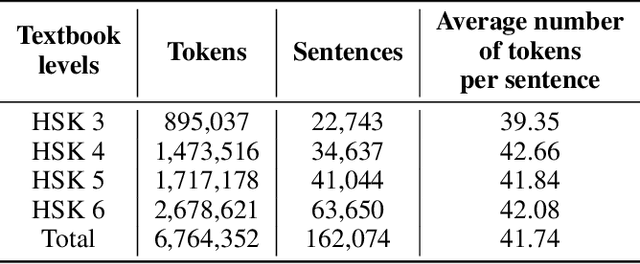
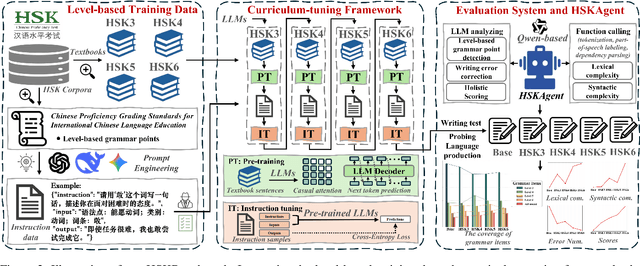
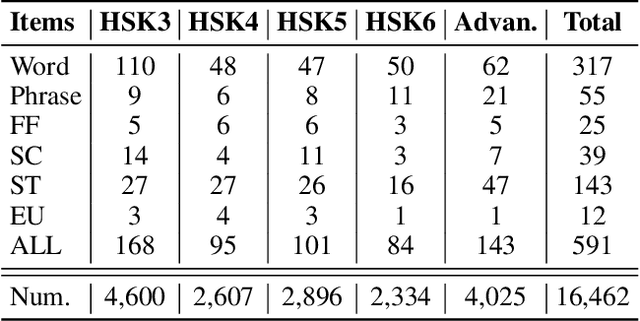
Language acquisition is vital to revealing the nature of human language intelligence and has recently emerged as a promising perspective for improving the interpretability of large language models (LLMs). However, it is ethically and practically infeasible to conduct experiments that require controlling human learners' language inputs. This poses challenges for the verifiability and scalability of language acquisition modeling, particularly in Chinese second language acquisition (SLA). While LLMs provide a controllable and reproducible alternative, a systematic benchmark to support phase-wise modeling and assessment is still lacking. In this paper, we present HSKBenchmark, the first benchmark for staged modeling and writing assessment of LLMs in Chinese SLA. It covers HSK levels 3 to 6 and includes authentic textbooks with 6.76 million tokens, 16K synthetic instruction samples, 30 test topics, and a linguistically grounded evaluation system. To simulate human learning trajectories, we introduce a curriculum-tuning framework that trains models from beginner to advanced levels. An evaluation system is created to examine level-based grammar coverage, writing errors, lexical and syntactic complexity, and holistic scoring. We also build HSKAgent, fine-tuned on 10K learner compositions. Extensive experimental results demonstrate that HSKBenchmark not only models Chinese SLA effectively, but also serves as a reliable benchmark for dynamic writing assessment in LLMs. Our fine-tuned LLMs have writing performance on par with advanced human learners and exhibit human-like acquisition characteristics. The HSKBenchmark, HSKAgent, and checkpoints serve as foundational tools and resources, with the potential to pave the way for future research on language acquisition modeling and LLMs interpretability. Code and data are publicly available at: https://github.com/CharlesYang030/HSKB.