 Add to Chrome
 Add to Firefox
 Add to Edge
DrivingDepth: Sparse-Prompted Pixel-wise Scale Correction for Driving Depth Estimation
Jun 30, 2026
Dense depth estimation for autonomous driving faces a geometry-scale conflict: depth foundation models deliver pixel-aligned dense visual geometry without reliable metric scale, while projected LiDAR provides metric anchors that are sparse, noisy, and misaligned with image structures. Existing sparse-prompted methods incorporate LiDAR by regenerating depth from scratch, overriding the foundation model's coherent geometry and producing structural artifacts on visually continuous surfaces. Our key insight is that foundation models already capture geometrically coherent relative depth; no additional surface structure learning is required-only a per-pixel scale factor mapping relative geometry to metric coordinates. Based on this, we propose DrivingDepth, which treats sparse LiDAR as geometric prompts that locally calibrate a frozen foundation prior through residual pixel-wise scale correction, preserving dense visual geometry by construction. On nuScenes with 4-frame surround-view input, DrivingDepth achieves an AbsRel of 11.19 and an EdgeCR of 5.741, outperforming MapAnything (11.99/1.914) by simultaneously delivering SOTA metric accuracy and geometric consistency.

Monte Carlo Energy Aggregation for Mobile 3D Gaussian Splatting
Jun 29, 2026Recent advances in 3D Gaussian Splatting have demonstrated unprecedented success in novel view synthesis. However, the substantial inference and storage overhead driven by high-order Spherical Harmonics (SH) are primary bottlenecks for mobile platforms. In this paper, we present Flux-GS, a real-time Gaussian Splatting method designed to achieve high-fidelity rendering with significantly reduced overhead for resource-constrained mobile platforms. We first propose a Monte Carlo Specular Energy Aggregator, sampling third-order radiance residuals and aggregating specular energy into a compact latent space. In this way, our method effectively preserves visually salient lighting features in lower-order bands without expensive distillation or pre-training. To mitigate the high-frequency details lost during compression, we introduce an Attribute-Conditioned SH Enhancement module. This module predicts Gaussian-aware offsets based on intrinsic Gaussian attributes, which enhance the first-order SH representation prior to inference, without extra inference costs. Furthermore, the original single-view gradient-based densification is prone to producing excessive Gaussians and overfitting to a certain view. We address these limitations by proposing a Multi-view Alpha-based Densification and Pruning strategy. By leveraging multi-view guidance, we ensure multi-view structure consistency and the precise removal of redundant primitives. Extensive experiments demonstrate that Flux-GS achieves substantial parameter reduction while maintaining competitive visual quality, offering a robust and scalable solution for real-time mobile rendering. Code: \textcolor{magenta}{\href{https://xiaobiaodu.github.io/flux-gs-project/}{https://xiaobiaodu.github.io/flux-gs-project/}}.
On the Evolution of Knowledge Graphs: A Survey and Perspective
Oct 10, 2023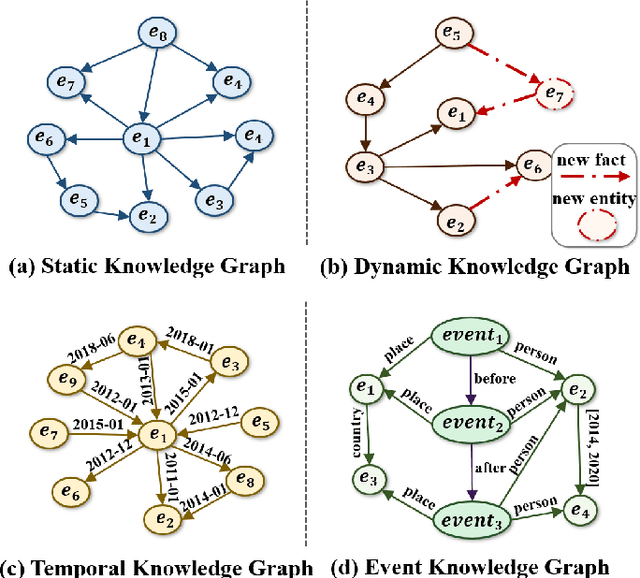
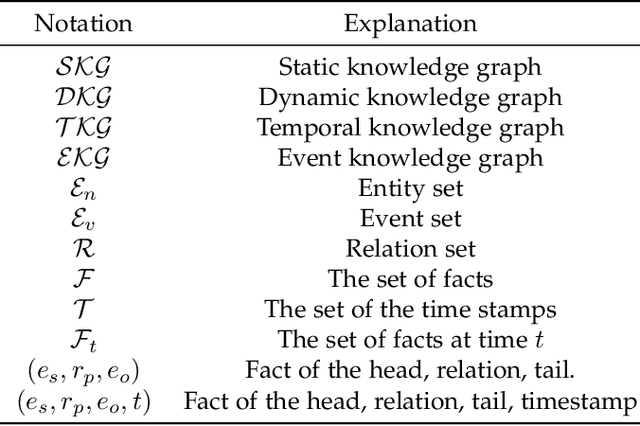
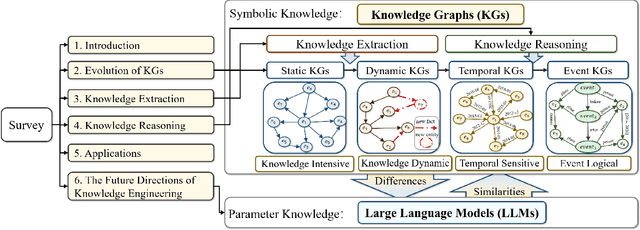
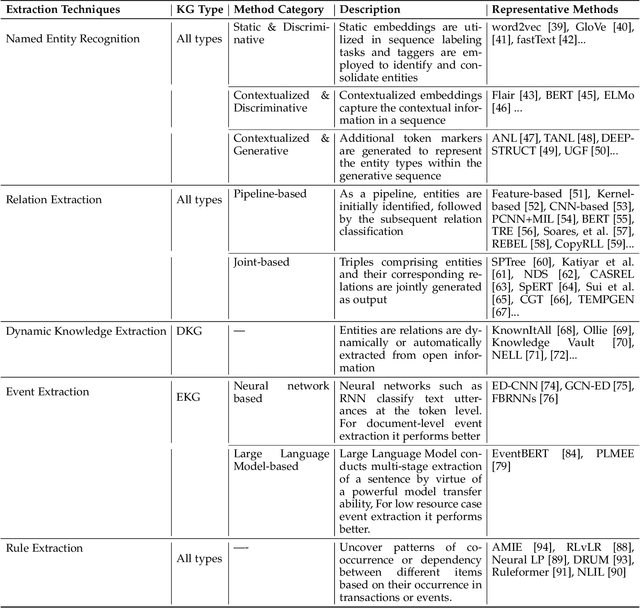
Knowledge graphs (KGs) are structured representations of diversified knowledge. They are widely used in various intelligent applications. In this article, we provide a comprehensive survey on the evolution of various types of knowledge graphs (i.e., static KGs, dynamic KGs, temporal KGs, and event KGs) and techniques for knowledge extraction and reasoning. Furthermore, we introduce the practical applications of different types of KGs, including a case study in financial analysis. Finally, we propose our perspective on the future directions of knowledge engineering, including the potential of combining the power of knowledge graphs and large language models (LLMs), and the evolution of knowledge extraction, reasoning, and representation.
Learning Semantic Abstraction of Shape via 3D Region of Interest
Jan 13, 2022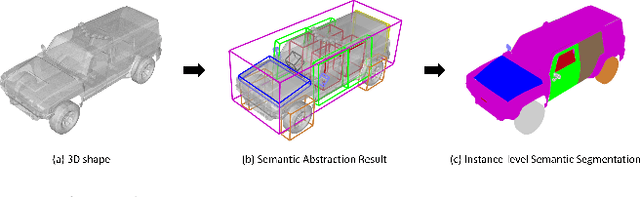
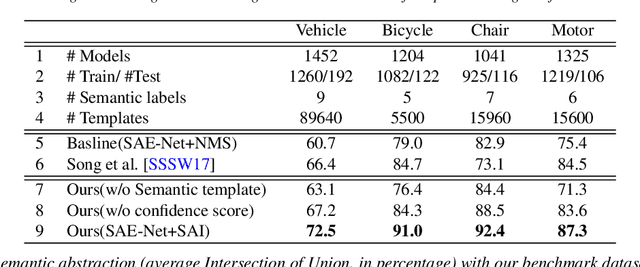
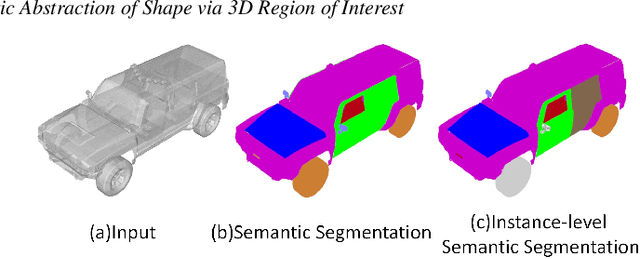
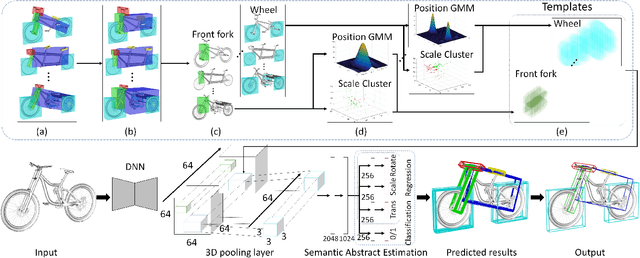
In this paper, we focus on the two tasks of 3D shape abstraction and semantic analysis. This is in contrast to current methods, which focus solely on either 3D shape abstraction or semantic analysis. In addition, previous methods have had difficulty producing instance-level semantic results, which has limited their application. We present a novel method for the joint estimation of a 3D shape abstraction and semantic analysis. Our approach first generates a number of 3D semantic candidate regions for a 3D shape; we then employ these candidates to directly predict the semantic categories and refine the parameters of the candidate regions simultaneously using a deep convolutional neural network. Finally, we design an algorithm to fuse the predicted results and obtain the final semantic abstraction, which is shown to be an improvement over a standard non maximum suppression. Experimental results demonstrate that our approach can produce state-of-the-art results. Moreover, we also find that our results can be easily applied to instance-level semantic part segmentation and shape matching.
Learning Fine-Grained Segmentation of 3D Shapes without Part Labels
Mar 24, 2021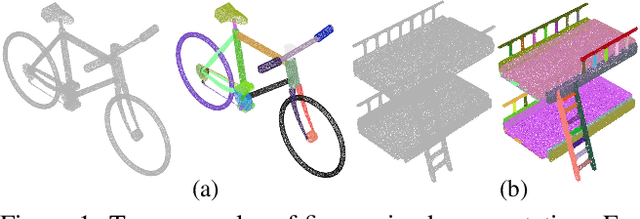
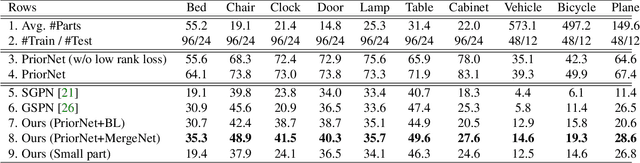
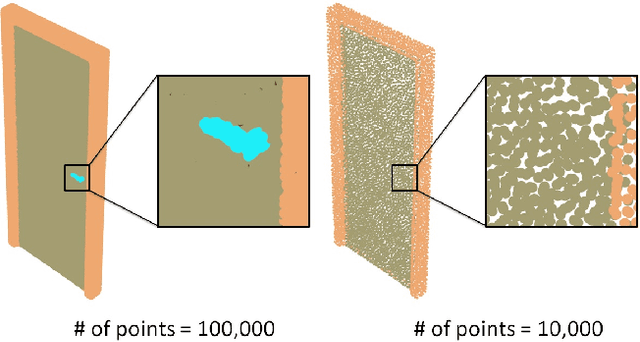
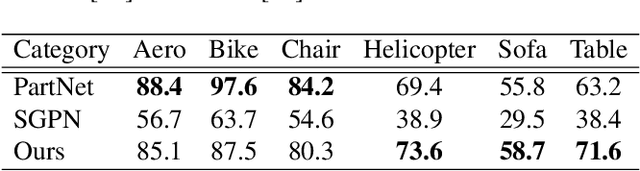
Learning-based 3D shape segmentation is usually formulated as a semantic labeling problem, assuming that all parts of training shapes are annotated with a given set of tags. This assumption, however, is impractical for learning fine-grained segmentation. Although most off-the-shelf CAD models are, by construction, composed of fine-grained parts, they usually miss semantic tags and labeling those fine-grained parts is extremely tedious. We approach the problem with deep clustering, where the key idea is to learn part priors from a shape dataset with fine-grained segmentation but no part labels. Given point sampled 3D shapes, we model the clustering priors of points with a similarity matrix and achieve part segmentation through minimizing a novel low rank loss. To handle highly densely sampled point sets, we adopt a divide-and-conquer strategy. We partition the large point set into a number of blocks. Each block is segmented using a deep-clustering-based part prior network trained in a category-agnostic manner. We then train a graph convolution network to merge the segments of all blocks to form the final segmentation result. Our method is evaluated with a challenging benchmark of fine-grained segmentation, showing state-of-the-art performance.