 Add to Chrome
 Add to Firefox
 Add to Edge
Tencent WorkBuddy Bench: A Multi-Domain Coding-Agent Benchmark with Contamination-Resistant Task Construction
Jul 23, 2026
We introduce Tencent WorkBuddy Bench, a multi-domain evaluation suite for coding agents; this report documents its construction methodology, scoring protocol, and a cross-model leaderboard. At its core is a unified evaluation framework for constructing and running distribution-informed coding-agent tasks across four work domains - Code, Web, Office, and Security. Rather than adapting public issue text, every task is reverse-engineered from a real commit, pull request, or business scenario and rewritten as a short, colloquial, role-played request, so that a task's prompt is not recoverable by web-searching the underlying issue, pull request, or commit thread. Because the dataset is released openly - task directories, environment images, evaluation harness, tests, and reference solutions - contamination resistance rests on this construction together with dataset versioning rather than on secrecy. The four subsets - repository-level engineering, front-end development, office and business workflows, and red-/blue-team security - probe complementary facets of real work, each with its own verification style. All are packaged in a uniform task-directory format and run, under a uniform and reproducible protocol, on two agent harnesses (CodeBuddy Code and Claude Code); the full open release makes the benchmark reproducible end to end and directly auditable, since any third party can re-run each task and inspect its content. Because each subset uses a different scoring instrument, scores are not comparable across subsets and the suite reports no suite-wide average. We report a cross-model leaderboard across several model families.

What Makes VLMs Robust? Towards Reconciling Robustness and Accuracy in Vision-Language Models
Mar 13, 2026Achieving adversarial robustness in Vision-Language Models (VLMs) inevitably compromises accuracy on clean data, presenting a long-standing and challenging trade-off. In this work, we revisit this trade-off by investigating a fundamental question: What makes VLMs robust? Through a detailed analysis of adversarially fine-tuned models, we examine how robustness mechanisms function internally and how they interact with clean accuracy. Our analysis reveals that adversarial robustness is not uniformly distributed across network depth. Instead, unexpectedly, it is primarily localized within the shallow layers, driven by a low-frequency spectral bias and input-insensitive attention patterns. Meanwhile, updates to the deep layers tend to undermine both clean accuracy and robust generalization. Motivated by these insights, we propose Adversarial Robustness Adaptation (R-Adapt), a simple yet effective framework that freezes all pre-trained weights and introduces minimal, insight-driven adaptations only in the initial layers. This design achieves an exceptional balance between adversarial robustness and clean accuracy. R-Adapt further supports training-free, model-guided, and data-driven paradigms, offering flexible pathways to seamlessly equip standard models with robustness. Extensive evaluations on 18 datasets and diverse tasks demonstrate our state-of-the-art performance under various attacks. Notably, R-Adapt generalizes efficiently to large vision-language models (e.g., LLaVA and Qwen-VL) to enhance their robustness. Our project page is available at https://summu77.github.io/R-Adapt.
Contrastive Spectral Rectification: Test-Time Defense towards Zero-shot Adversarial Robustness of CLIP
Jan 27, 2026Vision-language models (VLMs) such as CLIP have demonstrated remarkable zero-shot generalization, yet remain highly vulnerable to adversarial examples (AEs). While test-time defenses are promising, existing methods fail to provide sufficient robustness against strong attacks and are often hampered by high inference latency and task-specific applicability. To address these limitations, we start by investigating the intrinsic properties of AEs, which reveals that AEs exhibit severe feature inconsistency under progressive frequency attenuation. We further attribute this to the model's inherent spectral bias. Leveraging this insight, we propose an efficient test-time defense named Contrastive Spectral Rectification (CSR). CSR optimizes a rectification perturbation to realign the input with the natural manifold under a spectral-guided contrastive objective, which is applied input-adaptively. Extensive experiments across 16 classification benchmarks demonstrate that CSR outperforms the SOTA by an average of 18.1% against strong AutoAttack with modest inference overhead. Furthermore, CSR exhibits broad applicability across diverse visual tasks. Code is available at https://github.com/Summu77/CSR.
SecBench: A Comprehensive Multi-Dimensional Benchmarking Dataset for LLMs in Cybersecurity
Dec 30, 2024

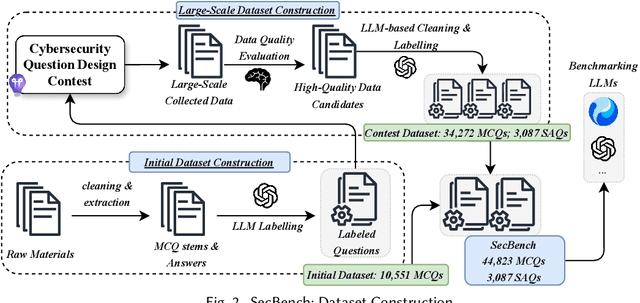
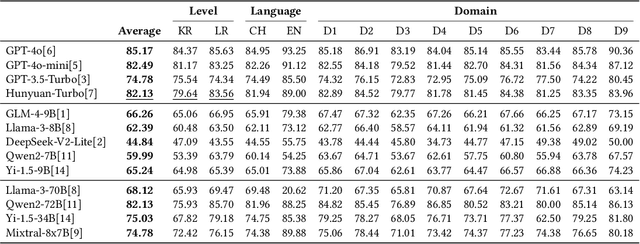
Evaluating Large Language Models (LLMs) is crucial for understanding their capabilities and limitations across various applications, including natural language processing and code generation. Existing benchmarks like MMLU, C-Eval, and HumanEval assess general LLM performance but lack focus on specific expert domains such as cybersecurity. Previous attempts to create cybersecurity datasets have faced limitations, including insufficient data volume and a reliance on multiple-choice questions (MCQs). To address these gaps, we propose SecBench, a multi-dimensional benchmarking dataset designed to evaluate LLMs in the cybersecurity domain. SecBench includes questions in various formats (MCQs and short-answer questions (SAQs)), at different capability levels (Knowledge Retention and Logical Reasoning), in multiple languages (Chinese and English), and across various sub-domains. The dataset was constructed by collecting high-quality data from open sources and organizing a Cybersecurity Question Design Contest, resulting in 44,823 MCQs and 3,087 SAQs. Particularly, we used the powerful while cost-effective LLMs to (1). label the data and (2). constructing a grading agent for automatic evaluation of SAQs.Benchmarking results on 13 SOTA LLMs demonstrate the usability of SecBench, which is arguably the largest and most comprehensive benchmark dataset for LLMs in cybersecurity. More information about SecBench can be found at our website, and the dataset can be accessed via the artifact link.
Diverse Generation while Maintaining Semantic Coordination: A Diffusion-Based Data Augmentation Method for Object Detection
Aug 06, 2024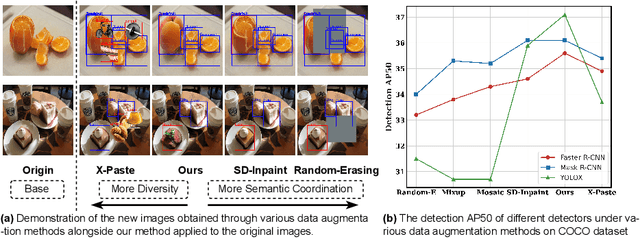
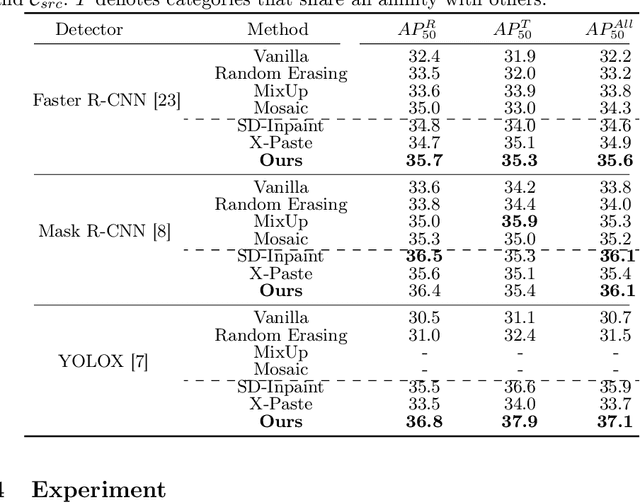
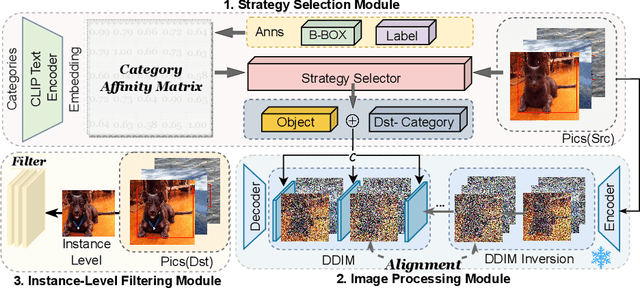
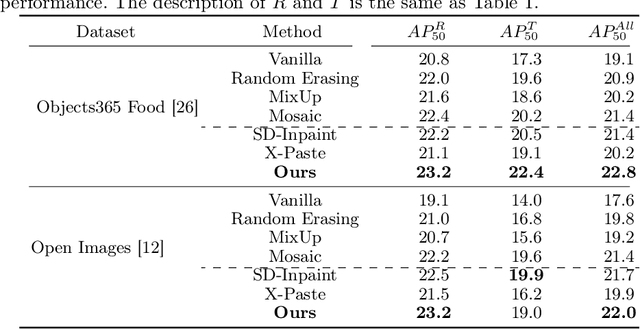
Recent studies emphasize the crucial role of data augmentation in enhancing the performance of object detection models. However,existing methodologies often struggle to effectively harmonize dataset diversity with semantic coordination.To bridge this gap, we introduce an innovative augmentation technique leveraging pre-trained conditional diffusion models to mediate this balance. Our approach encompasses the development of a Category Affinity Matrix, meticulously designed to enhance dataset diversity, and a Surrounding Region Alignment strategy, which ensures the preservation of semantic coordination in the augmented images. Extensive experimental evaluations confirm the efficacy of our method in enriching dataset diversity while seamlessly maintaining semantic coordination. Our method yields substantial average improvements of +1.4AP, +0.9AP, and +3.4AP over existing alternatives on three distinct object detection models, respectively.
TBDetector:Transformer-Based Detector for Advanced Persistent Threats with Provenance Graph
Apr 06, 2023


APT detection is difficult to detect due to the long-term latency, covert and slow multistage attack patterns of Advanced Persistent Threat (APT). To tackle these issues, we propose TBDetector, a transformer-based advanced persistent threat detection method for APT attack detection. Considering that provenance graphs provide rich historical information and have the powerful attacks historic correlation ability to identify anomalous activities, TBDetector employs provenance analysis for APT detection, which summarizes long-running system execution with space efficiency and utilizes transformer with self-attention based encoder-decoder to extract long-term contextual features of system states to detect slow-acting attacks. Furthermore, we further introduce anomaly scores to investigate the anomaly of different system states, where each state is calculated with an anomaly score corresponding to its similarity score and isolation score. To evaluate the effectiveness of the proposed method, we have conducted experiments on five public datasets, i.e., streamspot, cadets, shellshock, clearscope, and wget_baseline. Experimental results and comparisons with state-of-the-art methods have exhibited better performance of our proposed method.