 Add to Chrome
 Add to Firefox
 Add to Edge
Tencent WorkBuddy Bench: A Multi-Domain Coding-Agent Benchmark with Contamination-Resistant Task Construction
Jul 23, 2026
We introduce Tencent WorkBuddy Bench, a multi-domain evaluation suite for coding agents; this report documents its construction methodology, scoring protocol, and a cross-model leaderboard. At its core is a unified evaluation framework for constructing and running distribution-informed coding-agent tasks across four work domains - Code, Web, Office, and Security. Rather than adapting public issue text, every task is reverse-engineered from a real commit, pull request, or business scenario and rewritten as a short, colloquial, role-played request, so that a task's prompt is not recoverable by web-searching the underlying issue, pull request, or commit thread. Because the dataset is released openly - task directories, environment images, evaluation harness, tests, and reference solutions - contamination resistance rests on this construction together with dataset versioning rather than on secrecy. The four subsets - repository-level engineering, front-end development, office and business workflows, and red-/blue-team security - probe complementary facets of real work, each with its own verification style. All are packaged in a uniform task-directory format and run, under a uniform and reproducible protocol, on two agent harnesses (CodeBuddy Code and Claude Code); the full open release makes the benchmark reproducible end to end and directly auditable, since any third party can re-run each task and inspect its content. Because each subset uses a different scoring instrument, scores are not comparable across subsets and the suite reports no suite-wide average. We report a cross-model leaderboard across several model families.

Self-Distilled Trajectory-Aware Boltzmann Modeling: Bridging the Training-Inference Discrepancy in Diffusion Language Models
May 12, 2026Diffusion Language Models (DLMs) have recently emerged as a promising alternative to autoregressive language models, offering stronger global awareness and highly parallel generation. However, post-training DLMs with standard Negative Evidence Lower Bound (NELBO)-based supervised fine-tuning remains inefficient: training reconstructs randomly masked tokens in a single step, whereas inference follows a confidence-guided, multi-step easy-to-hard denoising trajectory. Recent trajectory-based self-distillation methods exploit such inference trajectories mainly for sampling-step compression and acceleration, often improving decoding efficiency without substantially enhancing the model's underlying capability, and may even degrade performance under full diffusion decoding. In this work, we ask whether self-distilled trajectories can be used not merely for faster inference, but for genuine knowledge acquisition. Although these trajectories lie on the pretrained DLM's own distributional manifold and thus offer a potentially lower optimization barrier, we find that naively fine-tuning on them with standard NELBO objectives yields only marginal gains. To address this limitation, we propose \textbf{T}rajectory-\textbf{A}ligned optimization via \textbf{Bo}ltzmann \textbf{M}odeling (\textbf{TABOM}), a self-distilled trajectory-based post-training framework that aligns training with the easy-to-hard structure of inference. TABOM models the inference unmasking preference as a Boltzmann distribution over predictive entropies and derives a tractable pairwise ranking objective to align the model's certainty ordering with the observed decoding trajectory. Empirically, TABOM achieves substantial gains in new domains, expands the effective knowledge boundary of DLMs, and significantly mitigates catastrophic forgetting compared with standard SFT.
CoVe: Training Interactive Tool-Use Agents via Constraint-Guided Verification
Mar 02, 2026Developing multi-turn interactive tool-use agents is challenging because real-world user needs are often complex and ambiguous, yet agents must execute deterministic actions to satisfy them. To address this gap, we introduce \textbf{CoVe} (\textbf{Co}nstraint-\textbf{Ve}rification), a post-training data synthesis framework designed for training interactive tool-use agents while ensuring both data complexity and correctness. CoVe begins by defining explicit task constraints, which serve a dual role: they guide the generation of complex trajectories and act as deterministic verifiers for assessing trajectory quality. This enables the creation of high-quality training trajectories for supervised fine-tuning (SFT) and the derivation of accurate reward signals for reinforcement learning (RL). Our evaluation on the challenging $τ^2$-bench benchmark demonstrates the effectiveness of the framework. Notably, our compact \textbf{CoVe-4B} model achieves success rates of 43.0\% and 59.4\% in the Airline and Retail domains, respectively; its overall performance significantly outperforms strong baselines of similar scale and remains competitive with models up to $17\times$ its size. These results indicate that CoVe provides an effective and efficient pathway for synthesizing training data for state-of-the-art interactive tool-use agents. To support future research, we open-source our code, trained model, and the full set of 12K high-quality trajectories used for training.
SecBench: A Comprehensive Multi-Dimensional Benchmarking Dataset for LLMs in Cybersecurity
Dec 30, 2024

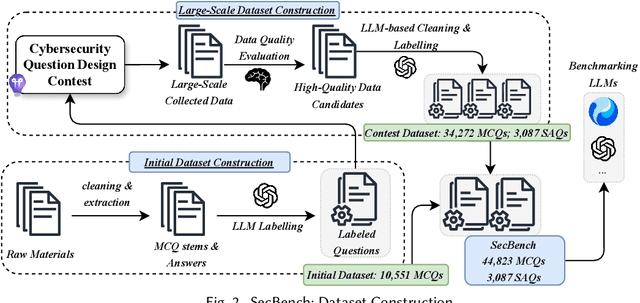
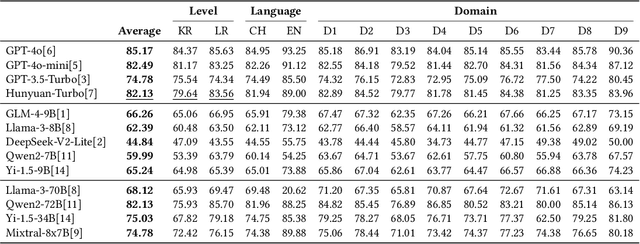
Evaluating Large Language Models (LLMs) is crucial for understanding their capabilities and limitations across various applications, including natural language processing and code generation. Existing benchmarks like MMLU, C-Eval, and HumanEval assess general LLM performance but lack focus on specific expert domains such as cybersecurity. Previous attempts to create cybersecurity datasets have faced limitations, including insufficient data volume and a reliance on multiple-choice questions (MCQs). To address these gaps, we propose SecBench, a multi-dimensional benchmarking dataset designed to evaluate LLMs in the cybersecurity domain. SecBench includes questions in various formats (MCQs and short-answer questions (SAQs)), at different capability levels (Knowledge Retention and Logical Reasoning), in multiple languages (Chinese and English), and across various sub-domains. The dataset was constructed by collecting high-quality data from open sources and organizing a Cybersecurity Question Design Contest, resulting in 44,823 MCQs and 3,087 SAQs. Particularly, we used the powerful while cost-effective LLMs to (1). label the data and (2). constructing a grading agent for automatic evaluation of SAQs.Benchmarking results on 13 SOTA LLMs demonstrate the usability of SecBench, which is arguably the largest and most comprehensive benchmark dataset for LLMs in cybersecurity. More information about SecBench can be found at our website, and the dataset can be accessed via the artifact link.
TBDetector:Transformer-Based Detector for Advanced Persistent Threats with Provenance Graph
Apr 06, 2023


APT detection is difficult to detect due to the long-term latency, covert and slow multistage attack patterns of Advanced Persistent Threat (APT). To tackle these issues, we propose TBDetector, a transformer-based advanced persistent threat detection method for APT attack detection. Considering that provenance graphs provide rich historical information and have the powerful attacks historic correlation ability to identify anomalous activities, TBDetector employs provenance analysis for APT detection, which summarizes long-running system execution with space efficiency and utilizes transformer with self-attention based encoder-decoder to extract long-term contextual features of system states to detect slow-acting attacks. Furthermore, we further introduce anomaly scores to investigate the anomaly of different system states, where each state is calculated with an anomaly score corresponding to its similarity score and isolation score. To evaluate the effectiveness of the proposed method, we have conducted experiments on five public datasets, i.e., streamspot, cadets, shellshock, clearscope, and wget_baseline. Experimental results and comparisons with state-of-the-art methods have exhibited better performance of our proposed method.