 Add to Chrome
 Add to Firefox
 Add to Edge
Ventor-QTest: Threat-Model-Driven Verification of Vendor-Hosted LLM APIs
Aug 17, 2026
As large language models become increasingly widespread, third-party providers that deploy open-weight models have become an important part of the ecosystem. Auditing the quality of their inference APIs is therefore an open problem. We formalize hosted model routing as a stochastic process and propose \mbox{\textbf{Ventor-QTest}}, a composite black-box audit that requires no probability information from the target API. Its repeated-request component sends each frozen constrained context to the target multiple times, reconstructs a categorical output distribution from the returned text counts, and reports \emph{average fidelity loss} (AFL) as a null-bias-corrected, within-window mean coarsened-KL statistic. Its long-sequence component uses independent runs to report \emph{extreme fidelity loss} (EFL) through the empirical upper tail of a run-level reference-centered-surprisal statistic. Across three logprob-capable route conditions, AFL shows strong linear descriptive agreement with a logprob-derived coarsened-KL comparator. Across seven route snapshots, 20-run sequence probes reveal route-specific EFL variation. AFL and EFL have little detectable route-level association with GPQA-Diamond accuracy. In contrast, pronounced EFL coincides with a decline in Terminal-Bench pass rate as task exposure increases. This pattern may arise because correctness in long-horizon tasks is more sensitive to extreme fidelity loss. These results motivate reporting AFL and EFL jointly, particularly when auditing long-horizon agentic tasks. The open-source implementation is available at https://github.com/Tencent/AI-Infra-Guard/tree/main/services/api_checker/ventor_qtest.

LDFE: Laplacian Decoupled Feature Enhancement Block for Dual-Stream CNN-based RGB-IR Object Detection
Jul 09, 2026The complementary information between RGB and IR images can significantly enhance object detection performance under extreme conditions. Existing methods prefer dual-stream CNN backbones built upon YOLO for feature extraction and focus on the design of feature fusion. In this paper, we introduce the Laplacian Decoupled Feature Enhancement block (LDFE) to fuse features from different stages of the dual-stream CNN backbone. By design, LDFE simultaneously considers the characteristics of modalities and structures for feature fusion by employing global-local decomposition, denoising, fusion, and reconstruction, sequentially. The LDFE first separates features into global and local components based on Laplacian Pyramid, and then performs denoising and fusion based on Global State Space Enhancement module (GS2E) and Local Convolutional Correlation Enhancement module (LC2E) separately. Specifically, the GS2E conducts a two-branch architecture for the main and auxiliary modalities. It dynamically suppresses noise in the main modality through cross-modal attention derived from the auxiliary modality, while employing a State Space Model to capture long-range dependencies within the global feature representations of the main modality. To obtain bidirectional interaction, the two modalities systematically alternate their main/auxiliary roles. Moreover, the LC2E suppresses noise in local features and leverages spatial and channel dimension along with triple convolution to extract fine-grained details for fusion. These innovative designs achieve a significant performance improvement, with mAP surpassing the SOTA methods 6.2%, 3.7%, 4.7%, 2.3%, 4.1% and 2.0% on M3FD, DroneVehicle, LLVIP, FLIR-Aligned, KAIST and VEDAI datasets,respectively.
Evaluation Report on MCP Servers
Apr 15, 2025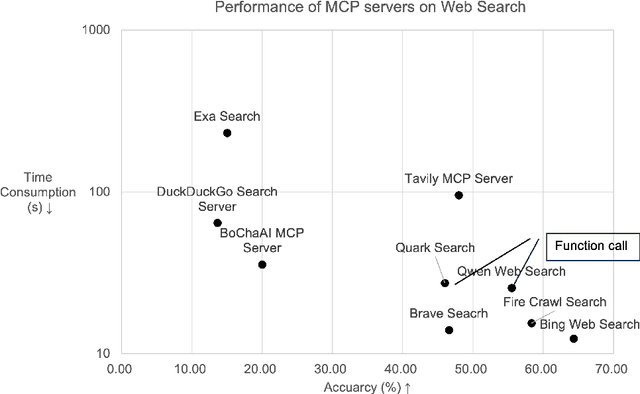
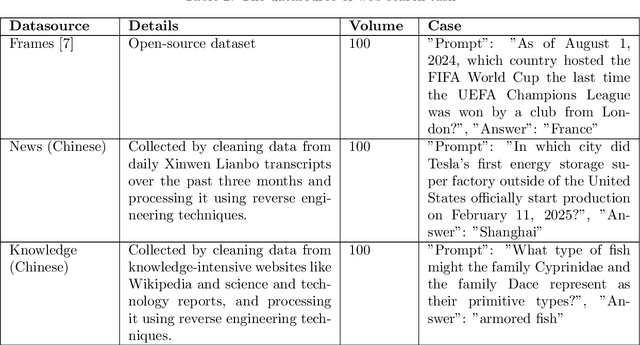
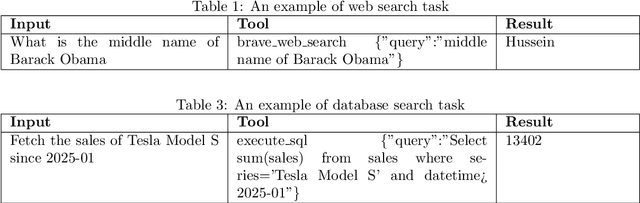
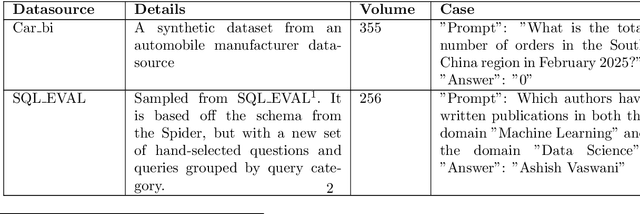
With the rise of LLMs, a large number of Model Context Protocol (MCP) services have emerged since the end of 2024. However, the effectiveness and efficiency of MCP servers have not been well studied. To study these questions, we propose an evaluation framework, called MCPBench. We selected several widely used MCP server and conducted an experimental evaluation on their accuracy, time, and token usage. Our experiments showed that the most effective MCP, Bing Web Search, achieved an accuracy of 64%. Importantly, we found that the accuracy of MCP servers can be substantially enhanced by involving declarative interface. This research paves the way for further investigations into optimized MCP implementations, ultimately leading to better AI-driven applications and data retrieval solutions.
SecBench: A Comprehensive Multi-Dimensional Benchmarking Dataset for LLMs in Cybersecurity
Dec 30, 2024

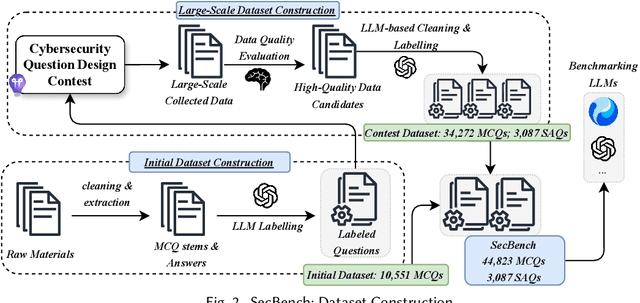
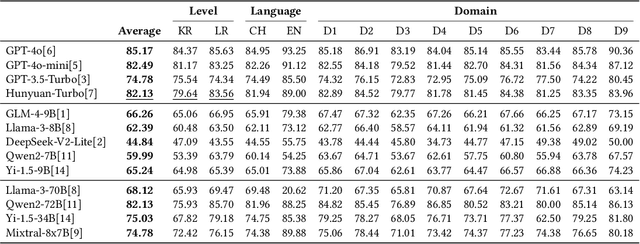
Evaluating Large Language Models (LLMs) is crucial for understanding their capabilities and limitations across various applications, including natural language processing and code generation. Existing benchmarks like MMLU, C-Eval, and HumanEval assess general LLM performance but lack focus on specific expert domains such as cybersecurity. Previous attempts to create cybersecurity datasets have faced limitations, including insufficient data volume and a reliance on multiple-choice questions (MCQs). To address these gaps, we propose SecBench, a multi-dimensional benchmarking dataset designed to evaluate LLMs in the cybersecurity domain. SecBench includes questions in various formats (MCQs and short-answer questions (SAQs)), at different capability levels (Knowledge Retention and Logical Reasoning), in multiple languages (Chinese and English), and across various sub-domains. The dataset was constructed by collecting high-quality data from open sources and organizing a Cybersecurity Question Design Contest, resulting in 44,823 MCQs and 3,087 SAQs. Particularly, we used the powerful while cost-effective LLMs to (1). label the data and (2). constructing a grading agent for automatic evaluation of SAQs.Benchmarking results on 13 SOTA LLMs demonstrate the usability of SecBench, which is arguably the largest and most comprehensive benchmark dataset for LLMs in cybersecurity. More information about SecBench can be found at our website, and the dataset can be accessed via the artifact link.
XiYan-SQL: A Multi-Generator Ensemble Framework for Text-to-SQL
Nov 13, 2024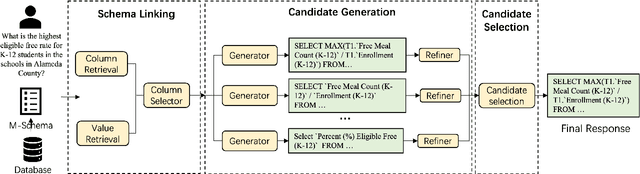
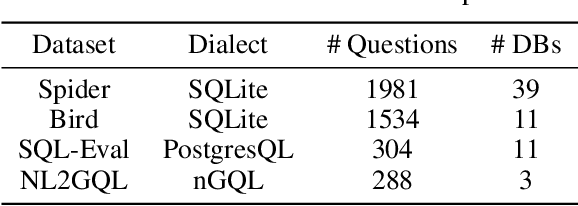
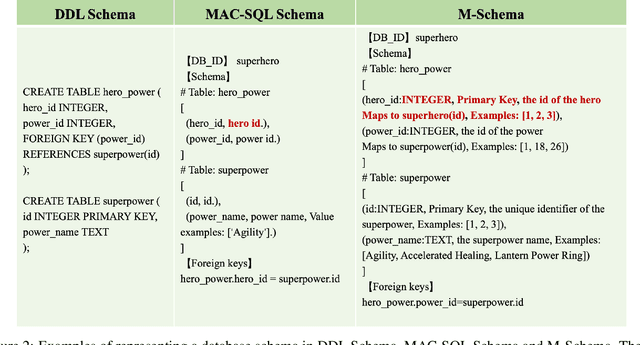
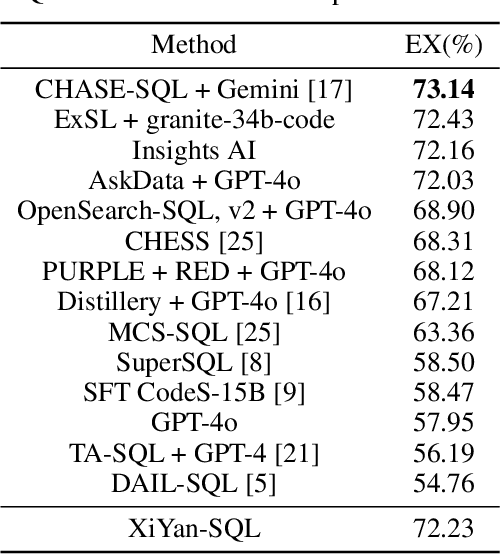
To tackle the challenges of large language model performance in natural language to SQL tasks, we introduce XiYan-SQL, an innovative framework that employs a multi-generator ensemble strategy to improve candidate generation. We introduce M-Schema, a semi-structured schema representation method designed to enhance the understanding of database structures. To enhance the quality and diversity of generated candidate SQL queries, XiYan-SQL integrates the significant potential of in-context learning (ICL) with the precise control of supervised fine-tuning. On one hand, we propose a series of training strategies to fine-tune models to generate high-quality candidates with diverse preferences. On the other hand, we implement the ICL approach with an example selection method based on named entity recognition to prevent overemphasis on entities. The refiner optimizes each candidate by correcting logical or syntactical errors. To address the challenge of identifying the best candidate, we fine-tune a selection model to distinguish nuances of candidate SQL queries. The experimental results on multiple dialect datasets demonstrate the robustness of XiYan-SQL in addressing challenges across different scenarios. Overall, our proposed XiYan-SQL achieves the state-of-the-art execution accuracy of 89.65% on the Spider test set, 69.86% on SQL-Eval, 41.20% on NL2GQL, and a competitive score of 72.23% on the Bird development benchmark. The proposed framework not only enhances the quality and diversity of SQL queries but also outperforms previous methods.