 Add to Chrome
 Add to Firefox
 Add to Edge
Mitral Regurgitation Recogniton based on Unsupervised Out-of-Distribution Detection with Residual Diffusion Amplification
Jul 31, 2024
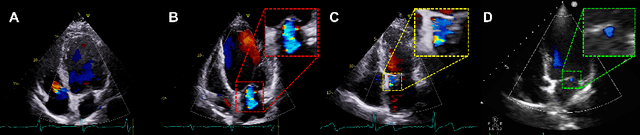
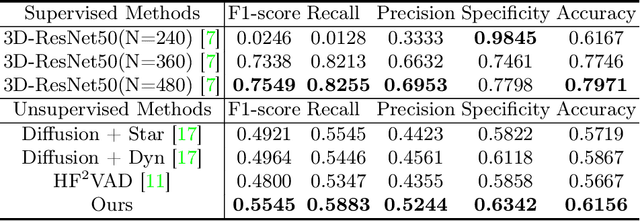
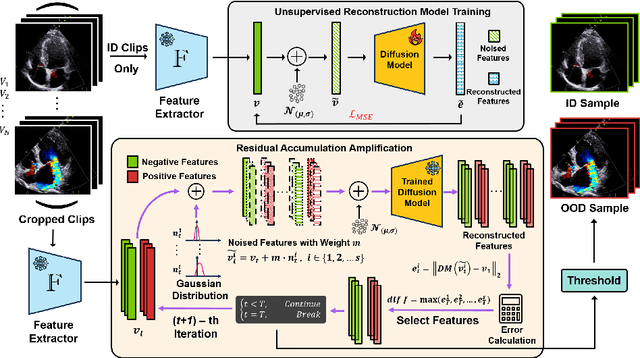

Mitral regurgitation (MR) is a serious heart valve disease. Early and accurate diagnosis of MR via ultrasound video is critical for timely clinical decision-making and surgical intervention. However, manual MR diagnosis heavily relies on the operator's experience, which may cause misdiagnosis and inter-observer variability. Since MR data is limited and has large intra-class variability, we propose an unsupervised out-of-distribution (OOD) detection method to identify MR rather than building a deep classifier. To our knowledge, we are the first to explore OOD in MR ultrasound videos. Our method consists of a feature extractor, a feature reconstruction model, and a residual accumulation amplification algorithm. The feature extractor obtains features from the video clips and feeds them into the feature reconstruction model to restore the original features. The residual accumulation amplification algorithm then iteratively performs noise feature reconstruction, amplifying the reconstructed error of OOD features. This algorithm is straightforward yet efficient and can seamlessly integrate as a plug-and-play component in reconstruction-based OOD detection methods. We validated the proposed method on a large ultrasound dataset containing 893 non-MR and 267 MR videos. Experimental results show that our OOD detection method can effectively identify MR samples.

PASSION: Towards Effective Incomplete Multi-Modal Medical Image Segmentation with Imbalanced Missing Rates
Jul 20, 2024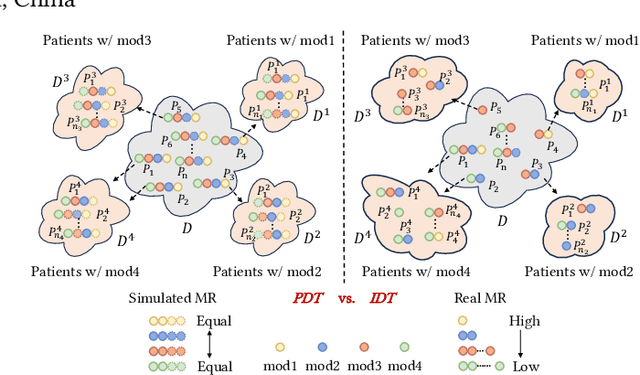

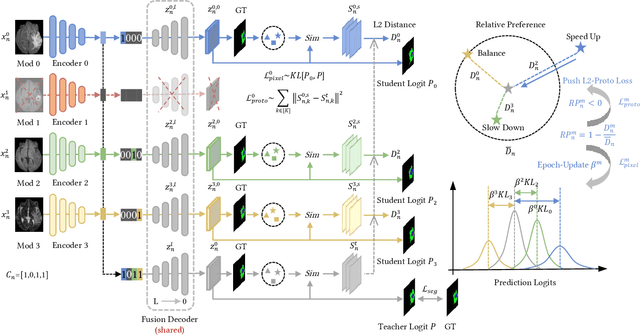
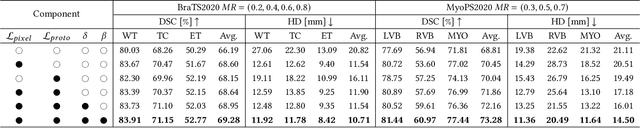
Incomplete multi-modal image segmentation is a fundamental task in medical imaging to refine deployment efficiency when only partial modalities are available. However, the common practice that complete-modality data is visible during model training is far from realistic, as modalities can have imbalanced missing rates in clinical scenarios. In this paper, we, for the first time, formulate such a challenging setting and propose Preference-Aware Self-diStillatION (PASSION) for incomplete multi-modal medical image segmentation under imbalanced missing rates. Specifically, we first construct pixel-wise and semantic-wise self-distillation to balance the optimization objective of each modality. Then, we define relative preference to evaluate the dominance of each modality during training, based on which to design task-wise and gradient-wise regularization to balance the convergence rates of different modalities. Experimental results on two publicly available multi-modal datasets demonstrate the superiority of PASSION against existing approaches for modality balancing. More importantly, PASSION is validated to work as a plug-and-play module for consistent performance improvement across different backbones. Code is available at https://github.com/Jun-Jie-Shi/PASSION.
Fine-grained Context and Multi-modal Alignment for Freehand 3D Ultrasound Reconstruction
Jul 05, 2024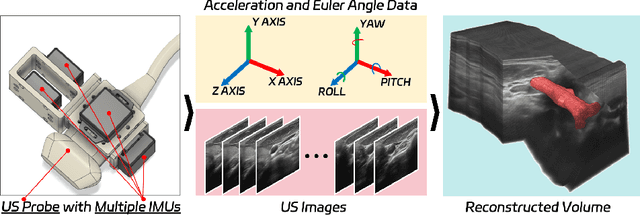
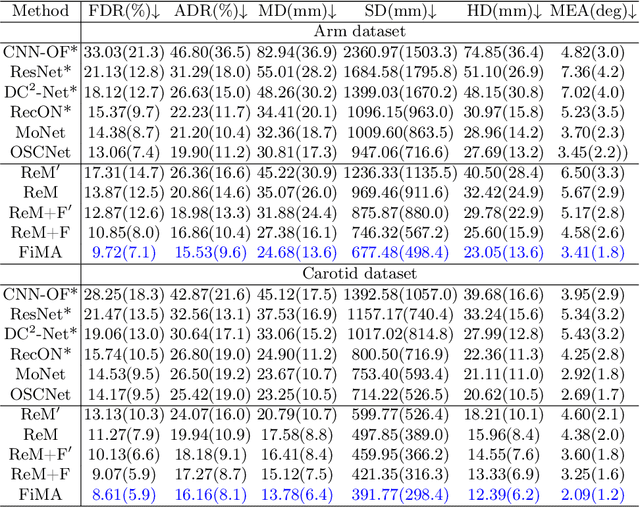
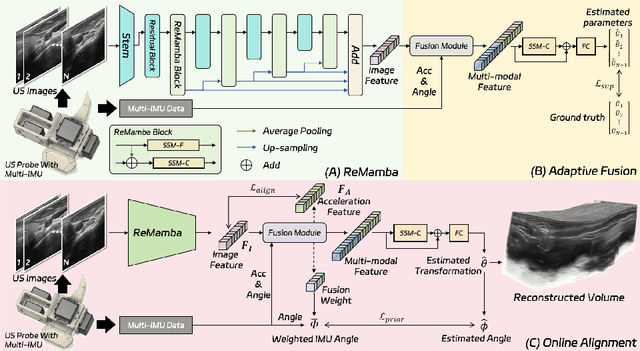
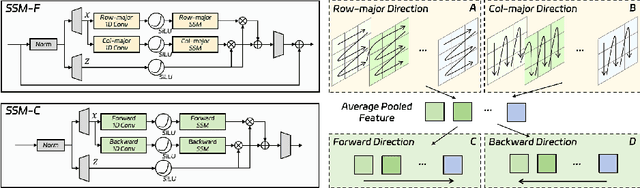
Fine-grained spatio-temporal learning is crucial for freehand 3D ultrasound reconstruction. Previous works mainly resorted to the coarse-grained spatial features and the separated temporal dependency learning and struggles for fine-grained spatio-temporal learning. Mining spatio-temporal information in fine-grained scales is extremely challenging due to learning difficulties in long-range dependencies. In this context, we propose a novel method to exploit the long-range dependency management capabilities of the state space model (SSM) to address the above challenge. Our contribution is three-fold. First, we propose ReMamba, which mines multi-scale spatio-temporal information by devising a multi-directional SSM. Second, we propose an adaptive fusion strategy that introduces multiple inertial measurement units as auxiliary temporal information to enhance spatio-temporal perception. Last, we design an online alignment strategy that encodes the temporal information as pseudo labels for multi-modal alignment to further improve reconstruction performance. Extensive experimental validations on two large-scale datasets show remarkable improvement from our method over competitors.
A Fast Dynamic Point Detection Method for LiDAR-Inertial Odometry in Driving Scenarios
Jul 04, 2024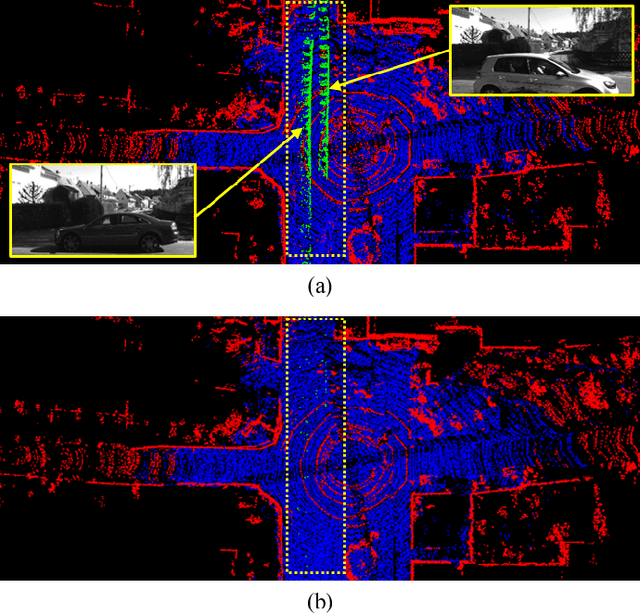
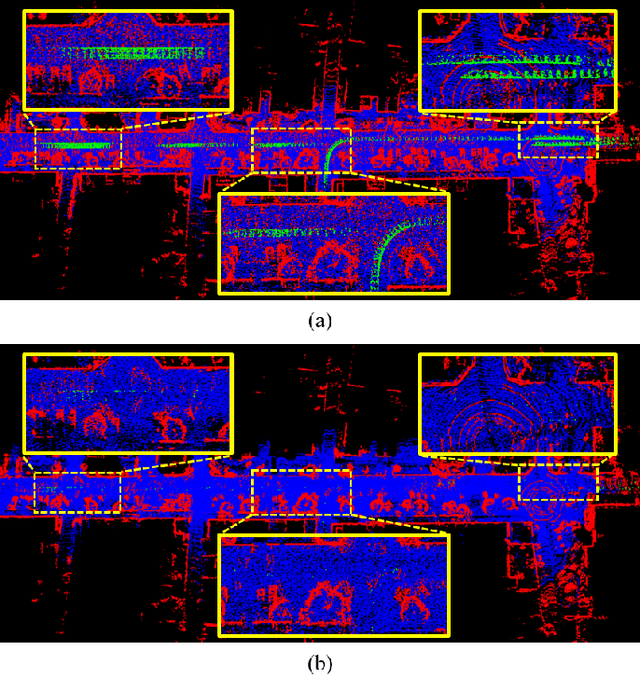
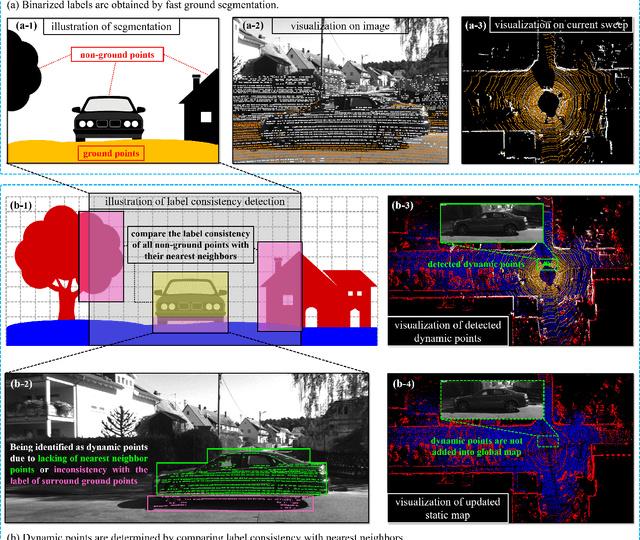
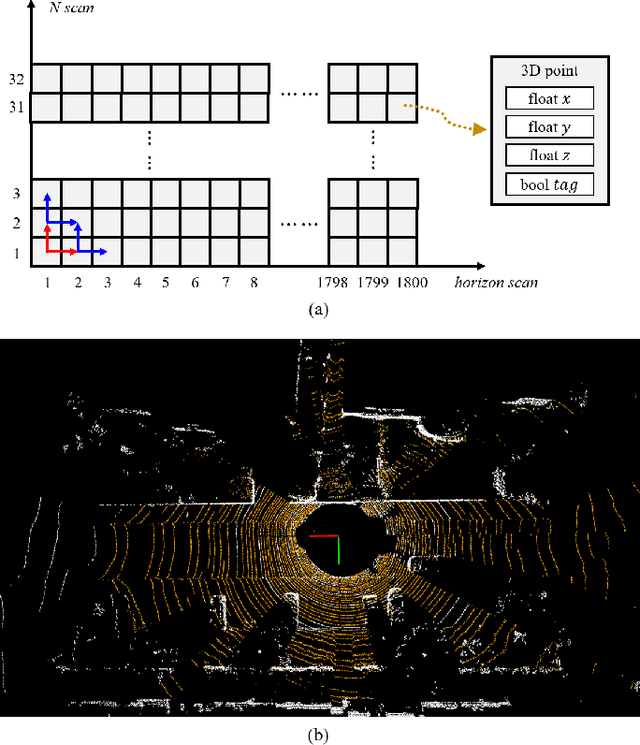
Existing 3D point-based dynamic point detection and removal methods have a significant time overhead, making them difficult to adapt to LiDAR-inertial odometry systems. This paper proposes a label consistency based dynamic point detection and removal method for handling moving vehicles and pedestrians in autonomous driving scenarios, and embeds the proposed dynamic point detection and removal method into a self-designed LiDAR-inertial odometry system. Experimental results on three public datasets demonstrate that our method can accomplish the dynamic point detection and removal with extremely low computational overhead (i.e., 1$\sim$9ms) in LIO systems, meanwhile achieve comparable preservation rate and rejection rate to state-of-the-art methods and significantly enhance the accuracy of pose estimation. We have released the source code of this work for the development of the community.
FedIA: Federated Medical Image Segmentation with Heterogeneous Annotation Completeness
Jul 02, 2024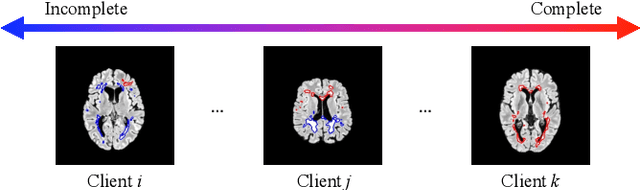
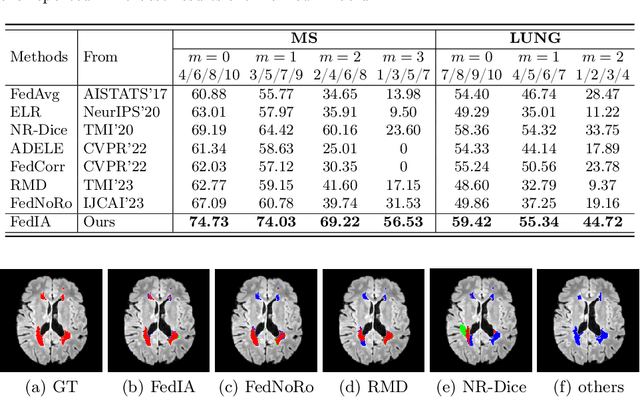
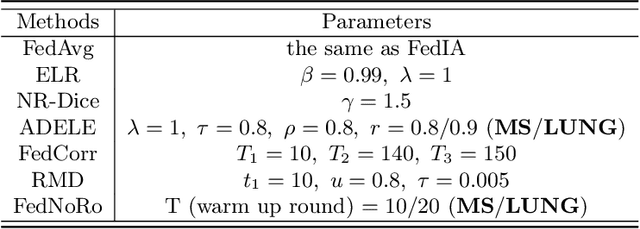
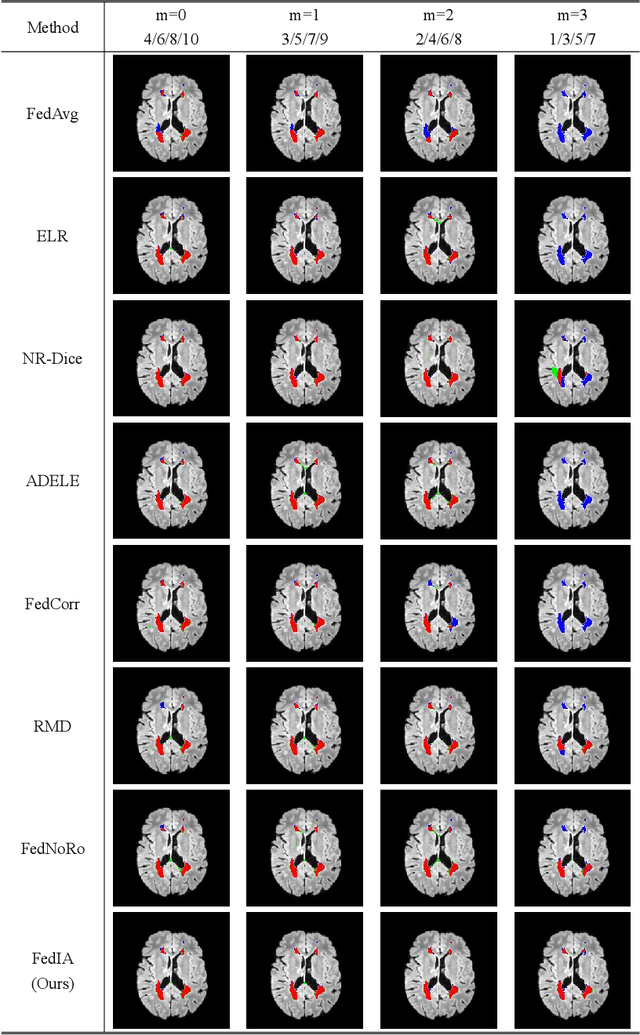
Federated learning has emerged as a compelling paradigm for medical image segmentation, particularly in light of increasing privacy concerns. However, most of the existing research relies on relatively stringent assumptions regarding the uniformity and completeness of annotations across clients. Contrary to this, this paper highlights a prevalent challenge in medical practice: incomplete annotations. Such annotations can introduce incorrectly labeled pixels, potentially undermining the performance of neural networks in supervised learning. To tackle this issue, we introduce a novel solution, named FedIA. Our insight is to conceptualize incomplete annotations as noisy data (\textit{i.e.}, low-quality data), with a focus on mitigating their adverse effects. We begin by evaluating the completeness of annotations at the client level using a designed indicator. Subsequently, we enhance the influence of clients with more comprehensive annotations and implement corrections for incomplete ones, thereby ensuring that models are trained on accurate data. Our method's effectiveness is validated through its superior performance on two extensively used medical image segmentation datasets, outperforming existing solutions. The code is available at https://github.com/HUSTxyy/FedIA.
FedMLP: Federated Multi-Label Medical Image Classification under Task Heterogeneity
Jun 27, 2024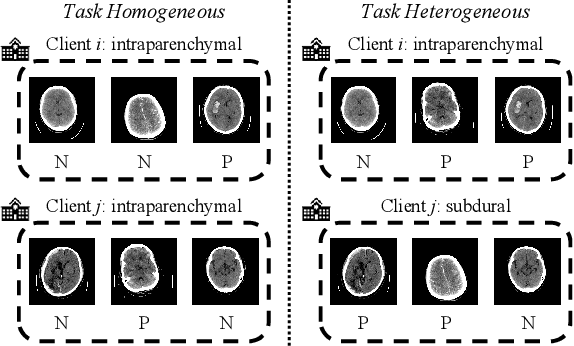
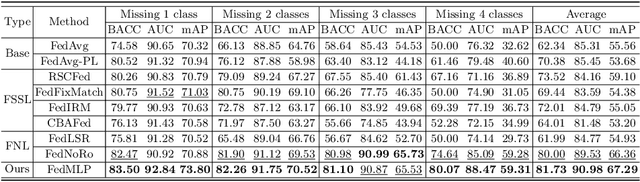
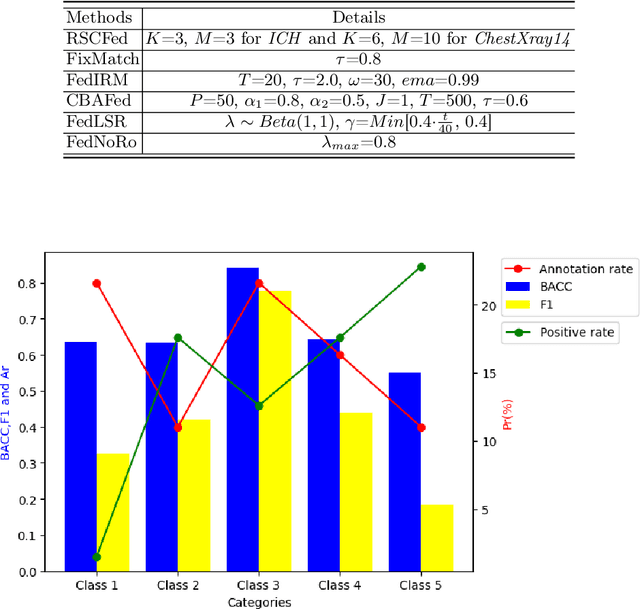
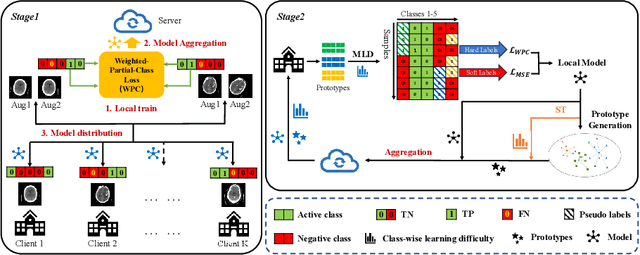
Cross-silo federated learning (FL) enables decentralized organizations to collaboratively train models while preserving data privacy and has made significant progress in medical image classification. One common assumption is task homogeneity where each client has access to all classes during training. However, in clinical practice, given a multi-label classification task, constrained by the level of medical knowledge and the prevalence of diseases, each institution may diagnose only partial categories, resulting in task heterogeneity. How to pursue effective multi-label medical image classification under task heterogeneity is under-explored. In this paper, we first formulate such a realistic label missing setting in the multi-label FL domain and propose a two-stage method FedMLP to combat class missing from two aspects: pseudo label tagging and global knowledge learning. The former utilizes a warmed-up model to generate class prototypes and select samples with high confidence to supplement missing labels, while the latter uses a global model as a teacher for consistency regularization to prevent forgetting missing class knowledge. Experiments on two publicly-available medical datasets validate the superiority of FedMLP against the state-of-the-art both federated semi-supervised and noisy label learning approaches under task heterogeneity. Code is available at https://github.com/szbonaldo/FedMLP.
Personalized Federated Continual Learning via Multi-granularity Prompt
Jun 27, 2024


Personalized Federated Continual Learning (PFCL) is a new practical scenario that poses greater challenges in sharing and personalizing knowledge. PFCL not only relies on knowledge fusion for server aggregation at the global spatial-temporal perspective but also needs model improvement for each client according to the local requirements. Existing methods, whether in Personalized Federated Learning (PFL) or Federated Continual Learning (FCL), have overlooked the multi-granularity representation of knowledge, which can be utilized to overcome Spatial-Temporal Catastrophic Forgetting (STCF) and adopt generalized knowledge to itself by coarse-to-fine human cognitive mechanisms. Moreover, it allows more effectively to personalized shared knowledge, thus serving its own purpose. To this end, we propose a novel concept called multi-granularity prompt, i.e., coarse-grained global prompt acquired through the common model learning process, and fine-grained local prompt used to personalize the generalized representation. The former focuses on efficiently transferring shared global knowledge without spatial forgetting, and the latter emphasizes specific learning of personalized local knowledge to overcome temporal forgetting. In addition, we design a selective prompt fusion mechanism for aggregating knowledge of global prompts distilled from different clients. By the exclusive fusion of coarse-grained knowledge, we achieve the transmission and refinement of common knowledge among clients, further enhancing the performance of personalization. Extensive experiments demonstrate the effectiveness of the proposed method in addressing STCF as well as improving personalized performance. Our code now is available at https://github.com/SkyOfBeginning/FedMGP.
Hyperbolic Knowledge Transfer in Cross-Domain Recommendation System
Jun 25, 2024Cross-Domain Recommendation (CDR) seeks to utilize knowledge from different domains to alleviate the problem of data sparsity in the target recommendation domain, and it has been gaining more attention in recent years. Although there have been notable advancements in this area, most current methods represent users and items in Euclidean space, which is not ideal for handling long-tail distributed data in recommendation systems. Additionally, adding data from other domains can worsen the long-tail characteristics of the entire dataset, making it harder to train CDR models effectively. Recent studies have shown that hyperbolic methods are particularly suitable for modeling long-tail distributions, which has led us to explore hyperbolic representations for users and items in CDR scenarios. However, due to the distinct characteristics of the different domains, applying hyperbolic representation learning to CDR tasks is quite challenging. In this paper, we introduce a new framework called Hyperbolic Contrastive Learning (HCTS), designed to capture the unique features of each domain while enabling efficient knowledge transfer between domains. We achieve this by embedding users and items from each domain separately and mapping them onto distinct hyperbolic manifolds with adjustable curvatures for prediction. To improve the representations of users and items in the target domain, we develop a hyperbolic contrastive learning module for knowledge transfer. Extensive experiments on real-world datasets demonstrate that hyperbolic manifolds are a promising alternative to Euclidean space for CDR tasks.
IFTD: Image Feature Triangle Descriptor for Loop Detection in Driving Scenes
Jun 12, 2024

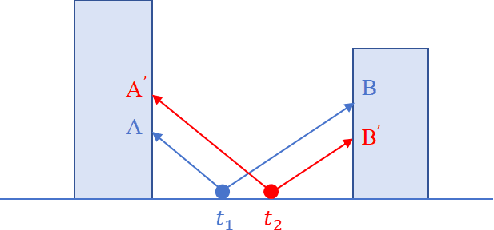
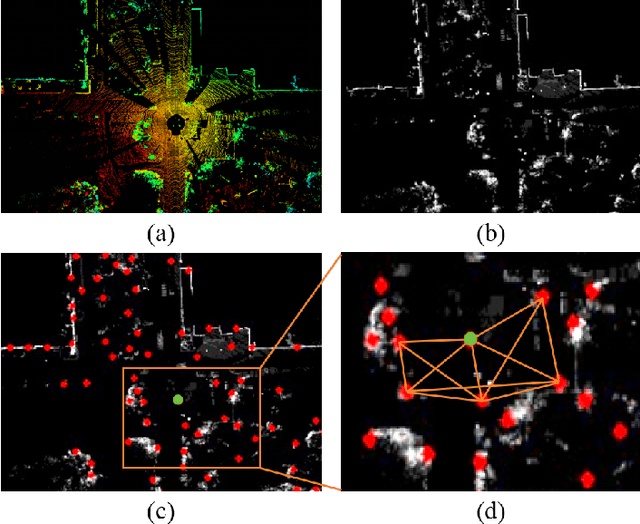
In this work, we propose a fast and robust Image Feature Triangle Descriptor (IFTD) based on the STD method, aimed at improving the efficiency and accuracy of place recognition in driving scenarios. We extract keypoints from BEV projection image of point cloud and construct these keypoints into triangle descriptors. By matching these feature triangles, we achieved precise place recognition and calculated the 4-DOF pose estimation between two keyframes. Furthermore, we employ image similarity inspection to perform the final place recognition. Experimental results on three public datasets demonstrate that our IFTD can achieve greater robustness and accuracy than state-of-the-art methods with low computational overhead.
DeepUniUSTransformer: Towards A Universal UltraSound Model with Prompted Guidance
Jun 03, 2024Ultrasound is a widely used imaging modality in clinical practice due to its low cost, portability, and safety. Current research in general AI for healthcare focuses on large language models and general segmentation models, with insufficient attention to solutions addressing both disease prediction and tissue segmentation. In this study, we propose a novel universal framework for ultrasound, namely DeepUniUSTransformer, which is a promptable model accommodating multiple clinical task. The universality of this model is derived from its versatility across various aspects. It proficiently manages any ultrasound nature, any anatomical position, any input type and excelling not only in segmentation tasks but also in computer-aided diagnosis tasks. We introduce a novel module that incorporates this information as a prompt and seamlessly embedding it within the model's learning process. To train and validate our proposed model, we curated a comprehensive ultrasound dataset from publicly accessible sources, encompassing up to 7 distinct anatomical positions with over 9.7K annotations. Experimental results demonstrate that our model surpasses both a model trained on a single dataset and an ablated version of the network lacking prompt guidance. We will continuously expand the dataset and optimize the task specific prompting mechanism towards the universality in medical ultrasound. Model weights, datasets, and code will be open source to the public.