 Add to Chrome
 Add to Firefox
 Add to Edge
Characterization of Multi-Model Agentic AI Systems on General Tasks via Trace-Driven Simulation
Jun 01, 2026
Agentic AI completes tasks through iterative planning, tool use, and reasoning based on observed outcomes. Despite its popularity, its system-level behavior remains poorly understood, particularly for complex datasets and agent architectures-owing to highly non-deterministic execution, prohibitive evaluation costs, and limited visibility into proprietary models. This paper presents GAIATrace, the first token-level trace dataset of two state-of-the-art agentic systems (MiroThinker and OWL) running GAIA, a benchmark composed of a heterogeneous mix of general-purpose tasks. Unlike prior trace datasets, GAIATrace captures full reasoning tokens, task-level structures, and activities of every major participating LLMs, enabling in-depth systems research. Complementing the dataset, we present Vidur-Agent, a trace-driven simulator that can replay GAIATrace to perform reproducible, low-cost system evaluation across diverse simulated environments. Using both artifacts, we characterize how modern agentic systems handle general tasks and how various system design choices shape their behavior, yielding several unique findings.

MahaVar: OOD Detection via Class-wise Mahalanobis Distance Variance under Neural Collapse
May 14, 2026Out-of-distribution (OOD) detection is a critical component for ensuring the reliability of deep neural networks in safety-critical applications. In this work, we present a key empirical observation: for in-distribution (ID) samples, class-wise Mahalanobis distances exhibit a pronounced sharp minimum structure, where the distance to the nearest class is small while distances to all other classes remain large, resulting in high variance across classes. In contrast, OOD samples tend to exhibit a less pronounced sharp minimum structure, producing comparatively lower variance across classes. We further provide a theoretical analysis grounding this observation in Neural Collapse geometry: under relaxed Neural Collapse assumptions on within-class compactness and inter-class separation, ID samples are shown to structurally exhibit high class-wise distance variance, offering a theoretical basis for its use as an OOD score. Motivated by this observation and its theoretical backing, we propose MahaVar, a simple and effective post-hoc OOD detector that augments the Mahalanobis distance with a class-wise distance variance term. Following the OpenOOD v1.5 benchmark protocol, MahaVar achieves state-of-the-art performance on CIFAR-100 and ImageNet, with consistent improvements in both AUROC and FPR@95 over existing Mahalanobis-based methods across all benchmarks.
PhysHanDI: Physics-Based Reconstruction of Hand-Deformable Object Interactions
May 10, 2026While existing methods for reconstructing hand-object interactions have made impressive progress, they either focus on rigid or part-wise rigid objects-limiting their ability to model real-world objects (e.g., cloth, stuffed animals) that exhibit highly non-rigid deformations-or model deformable objects without full 3D hand reconstruction. To bridge this gap, we present PhysHanDI (Physics-based Reconstruction of Hand and Deformable Object Interactions), a framework that enables full 3D reconstruction of both interacting hands and non-rigid objects. Our key idea is to physically simulate object deformations driven by forces induced from densely reconstructed 3D hand motions, ensuring that the reconstructed object dynamics are both physically plausible and coherent with the interacting hand movements. Furthermore, we demonstrate that such simulation of object deformations can, in turn, refine and improve hand reconstruction via inverse physics. In experiments, PhysHanDI outperforms the state-of-the-art baseline across reconstruction and future prediction.
Mitigating the Likelihood Paradox in Flow-based OOD Detection via Entropy Manipulation
Feb 10, 2026Deep generative models that can tractably compute input likelihoods, including normalizing flows, often assign unexpectedly high likelihoods to out-of-distribution (OOD) inputs. We mitigate this likelihood paradox by manipulating input entropy based on semantic similarity, applying stronger perturbations to inputs that are less similar to an in-distribution memory bank. We provide a theoretical analysis showing that entropy control increases the expected log-likelihood gap between in-distribution and OOD samples in favor of the in-distribution, and we explain why the procedure works without any additional training of the density model. We then evaluate our method against likelihood-based OOD detectors on standard benchmarks and find consistent AUROC improvements over baselines, supporting our explanation.
Why the Counterintuitive Phenomenon of Likelihood Rarely Appears in Tabular Anomaly Detection with Deep Generative Models?
Feb 10, 2026Deep generative models with tractable and analytically computable likelihoods, exemplified by normalizing flows, offer an effective basis for anomaly detection through likelihood-based scoring. We demonstrate that, unlike in the image domain where deep generative models frequently assign higher likelihoods to anomalous data, such counterintuitive behavior occurs far less often in tabular settings. We first introduce a domain-agnostic formulation that enables consistent detection and evaluation of the counterintuitive phenomenon, addressing the absence of precise definition. Through extensive experiments on 47 tabular datasets and 10 CV/NLP embedding datasets in ADBench, benchmarked against 13 baseline models, we demonstrate that the phenomenon, as defined, is consistently rare in general tabular data. We further investigate this phenomenon from both theoretical and empirical perspectives, focusing on the roles of data dimensionality and difference in feature correlation. Our results suggest that likelihood-only detection with normalizing flows offers a practical and reliable approach for anomaly detection in tabular domains.
Cocoon: A System Architecture for Differentially Private Training with Correlated Noises
Oct 08, 2025Machine learning (ML) models memorize and leak training data, causing serious privacy issues to data owners. Training algorithms with differential privacy (DP), such as DP-SGD, have been gaining attention as a solution. However, DP-SGD adds a noise at each training iteration, which degrades the accuracy of the trained model. To improve accuracy, a new family of approaches adds carefully designed correlated noises, so that noises cancel out each other across iterations. We performed an extensive characterization study of these new mechanisms, for the first time to the best of our knowledge, and show they incur non-negligible overheads when the model is large or uses large embedding tables. Motivated by the analysis, we propose Cocoon, a hardware-software co-designed framework for efficient training with correlated noises. Cocoon accelerates models with embedding tables through pre-computing and storing correlated noises in a coalesced format (Cocoon-Emb), and supports large models through a custom near-memory processing device (Cocoon-NMP). On a real system with an FPGA-based NMP device prototype, Cocoon improves the performance by 2.33-10.82x(Cocoon-Emb) and 1.55-3.06x (Cocoon-NMP).
PARTE: Part-Guided Texturing for 3D Human Reconstruction from a Single Image
Jul 24, 2025The misaligned human texture across different human parts is one of the main limitations of existing 3D human reconstruction methods. Each human part, such as a jacket or pants, should maintain a distinct texture without blending into others. The structural coherence of human parts serves as a crucial cue to infer human textures in the invisible regions of a single image. However, most existing 3D human reconstruction methods do not explicitly exploit such part segmentation priors, leading to misaligned textures in their reconstructions. In this regard, we present PARTE, which utilizes 3D human part information as a key guide to reconstruct 3D human textures. Our framework comprises two core components. First, to infer 3D human part information from a single image, we propose a 3D part segmentation module (PartSegmenter) that initially reconstructs a textureless human surface and predicts human part labels based on the textureless surface. Second, to incorporate part information into texture reconstruction, we introduce a part-guided texturing module (PartTexturer), which acquires prior knowledge from a pre-trained image generation network on texture alignment of human parts. Extensive experiments demonstrate that our framework achieves state-of-the-art quality in 3D human reconstruction. The project page is available at https://hygenie1228.github.io/PARTE/.
DeClotH: Decomposable 3D Cloth and Human Body Reconstruction from a Single Image
Mar 25, 2025Most existing methods of 3D clothed human reconstruction from a single image treat the clothed human as a single object without distinguishing between cloth and human body. In this regard, we present DeClotH, which separately reconstructs 3D cloth and human body from a single image. This task remains largely unexplored due to the extreme occlusion between cloth and the human body, making it challenging to infer accurate geometries and textures. Moreover, while recent 3D human reconstruction methods have achieved impressive results using text-to-image diffusion models, directly applying such an approach to this problem often leads to incorrect guidance, particularly in reconstructing 3D cloth. To address these challenges, we propose two core designs in our framework. First, to alleviate the occlusion issue, we leverage 3D template models of cloth and human body as regularizations, which provide strong geometric priors to prevent erroneous reconstruction by the occlusion. Second, we introduce a cloth diffusion model specifically designed to provide contextual information about cloth appearance, thereby enhancing the reconstruction of 3D cloth. Qualitative and quantitative experiments demonstrate that our proposed approach is highly effective in reconstructing both 3D cloth and the human body. More qualitative results are provided at https://hygenie1228.github.io/DeClotH/.
Stochastic Extragradient with Flip-Flop Shuffling & Anchoring: Provable Improvements
Dec 31, 2024In minimax optimization, the extragradient (EG) method has been extensively studied because it outperforms the gradient descent-ascent method in convex-concave (C-C) problems. Yet, stochastic EG (SEG) has seen limited success in C-C problems, especially for unconstrained cases. Motivated by the recent progress of shuffling-based stochastic methods, we investigate the convergence of shuffling-based SEG in unconstrained finite-sum minimax problems, in search of convergent shuffling-based SEG. Our analysis reveals that both random reshuffling and the recently proposed flip-flop shuffling alone can suffer divergence in C-C problems. However, with an additional simple trick called anchoring, we develop the SEG with flip-flop anchoring (SEG-FFA) method which successfully converges in C-C problems. We also show upper and lower bounds in the strongly-convex-strongly-concave setting, demonstrating that SEG-FFA has a provably faster convergence rate compared to other shuffling-based methods.
Multi-hypotheses Conditioned Point Cloud Diffusion for 3D Human Reconstruction from Occluded Images
Sep 27, 2024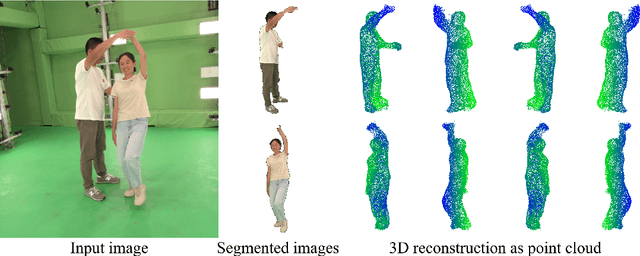

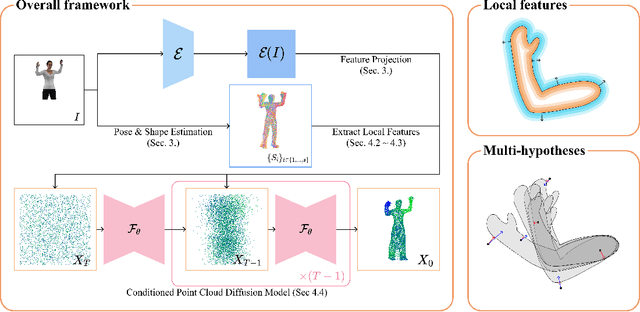
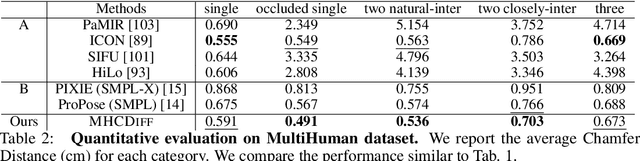
3D human shape reconstruction under severe occlusion due to human-object or human-human interaction is a challenging problem. Parametric models i.e., SMPL(-X), which are based on the statistics across human shapes, can represent whole human body shapes but are limited to minimally-clothed human shapes. Implicit-function-based methods extract features from the parametric models to employ prior knowledge of human bodies and can capture geometric details such as clothing and hair. However, they often struggle to handle misaligned parametric models and inpaint occluded regions given a single RGB image. In this work, we propose a novel pipeline, MHCDIFF, Multi-hypotheses Conditioned Point Cloud Diffusion, composed of point cloud diffusion conditioned on probabilistic distributions for pixel-aligned detailed 3D human reconstruction under occlusion. Compared to previous implicit-function-based methods, the point cloud diffusion model can capture the global consistent features to generate the occluded regions, and the denoising process corrects the misaligned SMPL meshes. The core of MHCDIFF is extracting local features from multiple hypothesized SMPL(-X) meshes and aggregating the set of features to condition the diffusion model. In the experiments on CAPE and MultiHuman datasets, the proposed method outperforms various SOTA methods based on SMPL, implicit functions, point cloud diffusion, and their combined, under synthetic and real occlusions.