 Add to Chrome
 Add to Firefox
 Add to Edge
ML-for-ML
Aug 06, 2026
AI training workloads are growing rapidly, making their time, energy, and infrastructure costs increasingly important. In shared cloud clusters, training and fine-tuning jobs compete with co-running workloads for network resources, while network mechanisms and ML training choices are typically optimized separately: networking controls how bytes move, whereas ML systems control when and how much communication occurs. We argue that this separation leaves end-to-end performance on the table. We present ML-for-ML, a cross-layer perspective in which network-side and ML-side knobs are selected jointly under a shared time-to-target-loss objective. Our preliminary prototype shows that by co-optimizing the ML and network parameters, we reach the target loss up to 42% faster.

Scalable LLM Agent Tool Access in the Cloud
Jul 17, 2026LLM agents increasingly rely on tool calling to act on external systems, and the Model Context Protocol (MCP) has quickly become its de facto interface. Operating MCP at cloud scale, however, becomes difficult. On the tool provider side, legacy services are not directly callable through MCP; the rapid protocol development also creates ongoing compatibility cost. On the agent side, the number of accessible tool is limited by the LLM context window and inference overhead; mounting a large tool set increases token usage and inference latency and can reduce task success rate. Moreover, for stateful MCP backends with multiple replicas, preserving session affinity increases client-side complexity. We present a cloud-scale gateway system for MCP service. It breaks the direct-connect model on the data plane and offloads legacy service integration, consolidating incompatible MCP variants, access control, tool recommendation, and session-aware routing to the gateway. Hybrid retrieval sustains 98% Top-15 recall; it scales agent tool access to 3,000+ with high tool selection accuracy, and reduces tool selection time by $8.9\times$ and token usage by $23.8\times$, with low per-call overhead, stable under scale-out. Finally, we share the lessons learned from deploying the gateway system in production.
Running Neural Networks on the NIC
Sep 04, 2020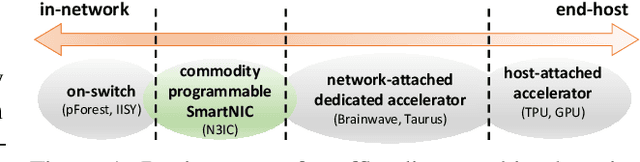
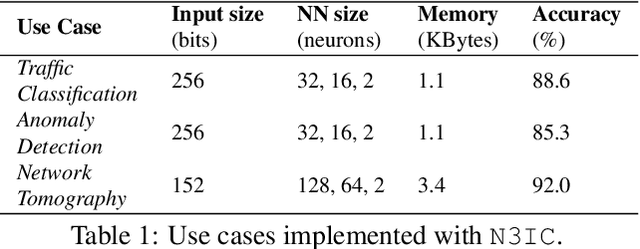
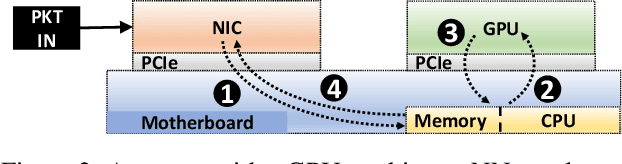
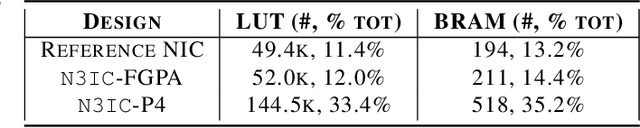
In this paper we show that the data plane of commodity programmable (Network Interface Cards) NICs can run neural network inference tasks required by packet monitoring applications, with low overhead. This is particularly important as the data transfer costs to the host system and dedicated machine learning accelerators, e.g., GPUs, can be more expensive than the processing task itself. We design and implement our system -- N3IC -- on two different NICs and we show that it can greatly benefit three different network monitoring use cases that require machine learning inference as first-class-primitive. N3IC can perform inference for millions of network flows per second, while forwarding traffic at 40Gb/s. Compared to an equivalent solution implemented on a general purpose CPU, N3IC can provide 100x lower processing latency, with 1.5x increase in throughput.