 Add to Chrome
 Add to Firefox
 Add to Edge
CoinVE-200K: A Large-Scale High-Quality Dataset for Compositional Instruction-Guided Video Editing
Aug 18, 2026
The quality and diversity of instruction-based video editing datasets are steadily improving, yet existing datasets mainly focus on single editing operations and fall short in supporting compositional instruction-guided video editing. In particular, multiple editing intents must be jointly understood and faithfully executed within the same video. To address this issue, we introduce CoinVE-200K, a large-scale, high-quality dataset for Compositional Instruction-Guided Video Editing. CoinVE-200K contains 1080p video-editing pairs of up to 201 frames, covering diverse compositional scenarios where each sample involves 2 to 5 atomic editing operations. The instructions target humans, objects, and backgrounds, and cover edit types such as addition, removal, modification, and stylization. All samples are built through a carefully designed generation and filtering pipeline to ensure instruction faithfulness, visual quality, temporal consistency, and compositional diversity. We also introduce CoinVE-Bench, a benchmark for compositional-instruction video editing across diverse subjects, operation types, and instruction complexities. Furthermore, we present CoinVE-Edit, a 22B compositional video editing model built upon Wan2.1-T2V-14B and Qwen3-VL-8B-Instruct. CoinVE-Edit disentangles region-aware attention for different editing instructions, enabling precise multi-region editing while preserving irrelevant content and temporal coherence. Experiments on CoinVE-Bench show that CoinVE-Edit achieves strong performance in instruction following, compositional editing accuracy, visual quality, and temporal consistency.

Marrying Optimal Transport and ODEs for Unified Continuous-Time 4D Reconstruction and Tracking
Aug 10, 2026Existing unified 4D reconstruction and point tracking approaches typically rely on heuristic interpolations or just predict at integer timestamps, lacking kinematic coherence and failing to model dynamics at any arbitrary timestamp. In this paper, we propose Uni4R, a framework that unifies these tasks by learning continuous velocity fields through the synergy of Optimal Transport (OT) and Ordinary Differential Equation (ODE). Importantly, this continuous velocity field acts as a kinematic prior that mutually benefits both 4D reconstruction and point tracking. Specifically, we propose the Flow Matching Guided Decoder (FMGD). A global velocity branch first extracts anchor features that capture the global dynamic state of the sequence. Then, FMGD leverages Flow Matching (FM) theory to formulate a probability path defined by OT on the anchor feature manifold, instantiating it as FM-guided velocity features for velocity prediction. This establishes a robust kinematic inductive bias. Meanwhile, a point reconstruction branch provides geometric features. The local velocity prediction module then joint above features and time embeddings, to decode velocities at arbitrary timestamps. To overcome the absence of high-quality ground-truth velocities in fractional frames, we propose an integral-consistency training strategy. This strategy uses an ODE solver to integrate velocities to recover target pointmaps, enabling the model to be supervised end-to-end directly from integer timestamps. Experimental results demonstrate that Uni4R achieves SOTA performance in both 4D reconstruction and point tracking, and achieves SOTA in our new kinematics-aware benchmark at continuous time.
GlowGS: Generative Semantic Feature Learning for 3D Gaussian Splatting in Nighttime Glow Scenes
May 22, 2026Existing 3DGS methods effectively render high-quality novel views in clear-day scenes. However, they struggle with night scenes, particularly in glow regions, due to the lack of structural features such as textures and edges, which are key cues for splatting-based reconstruction. To address this problem, we leverage a diffusion model and a Vision Foundation Model (VFM) to compensate for missing structural cues. Our method consists of two key novel ideas: semantic feature generation and novel-view semantic learning. First, semantic feature generation produces high-quality semantic features as implicit structural cues for novel views. Specifically, a diffusion model synthesizes novel views with unknown camera poses from training views, while a VFM evaluates their quality. Once high-quality novel views are identified, the VFM extracts robust features to construct the semantic feature bank. Second, novel-view semantic learning enables 3DGS to optimize rendered novel views without requiring ground truth. It achieves this by extracting semantic features from a rendered novel view, searching the feature bank for the most similar features, and minimizing their distance. This process enforces implicit structural constraints, ensuring semantically coherent, artifact-free rendered views. Extensive experiments demonstrate the effectiveness of our GlowGS in generating semantically accurate 3D views, showing significant improvements over existing methods.
Smart-Insertion-V: Photorealistic Video Insertion via a Closed-Loop Feedback Dual-Stream Framework
May 22, 2026Mask-free video object insertion has emerged as a challenging task, requiring harmonious integration of reference objects into source videos. However, existing methods struggle when references exhibit severe stylistic domain gaps with the source scene. To overcome this, we propose \textit{\textbf{Smart-Insertion-V}}, an end-to-end \textbf{Dual-Stream} framework that concurrently conducts video insertion and image style transfer. Within this framework, the image stream synchronously guides the video generation process, while a \textbf{Closed-loop Feedback} mechanism is further incorporated to ensure robust insertion. Inevitably, integrating these diverse conditioning signals results in feature entanglement and style leakage. To tackle this issue, we design \textbf{Dual-World-View RoPE} to distinguish different signals via spatial-temporal offsets without incurring heavy training overhead. Furthermore, to facilitate spatial grounding and stylistic adaptation, we introduce a \textbf{Decoupled Guidance Module} that leverages a Vision-Language Model for semantic reasoning while preserving original temporal guidance with native text encoder. To bridge data gap for harmonious reference insertion task, we propose a data curation pipeline and will release an \textbf{open-source dataset}. Experiments demonstrate that our method can insert objects into plausible positions while achieving the most harmonious results.
GeoQuery: Geometry-Query Diffusion for Sparse-View Reconstruction
May 12, 20263D Gaussian Splatting (3DGS) has emerged as a prominent paradigm for 3D reconstruction and novel view synthesis. However, it remains vulnerable to severe artifacts when trained under sparse-view constraints. While recent methods attempt to rectify artifacts in rendered views using image diffusion models, they typically rely on multi-view self-attention to retrieve information from reference images. We observe that this mechanism often fails when the rendered novel views output by 3DGS are heavily corrupted: damaged query features lead to erroneous cross-view retrieval, resulting in inconsistent rendering refinement. To address this, we propose GeoQuery, a geometry-guided diffusion framework that integrates generative priors with explicit geometric cues via a novel Geometry-guided Cross-view Attention (GCA) mechanism. First, by leveraging predicted depth maps and camera poses, we construct a geometry-induced correspondence field to sample reference features, forming a geometry-aligned proxy query that replaces the corrupted rendering features. Furthermore, we design a new cross-view feature aggregation pipeline, in which we restrict the cross-view attention to a local window around each proxy query to effectively retrieve useful features while suppressing spurious matches. GeoQuery can be seamlessly integrated into existing diffusion-based pipelines, enabling robust reconstruction even under extreme view sparsity. Extensive experiments on sparse-view novel view synthesis and rendering artifact removal demonstrate the effectiveness of our approach.
Let Your Image Move with Your Motion! -- Implicit Multi-Object Multi-Motion Transfer
Mar 01, 2026Motion transfer has emerged as a promising direction for controllable video generation, yet existing methods largely focus on single-object scenarios and struggle when multiple objects require distinct motion patterns. In this work, we present FlexiMMT, the first implicit image-to-video (I2V) motion transfer framework that explicitly enables multi-object, multi-motion transfer. Given a static multi-object image and multiple reference videos, FlexiMMT independently extracts motion representations and accurately assigns them to different objects, supporting flexible recombination and arbitrary motion-to-object mappings. To address the core challenge of cross-object motion entanglement, we introduce a Motion Decoupled Mask Attention Mechanism that uses object-specific masks to constrain attention, ensuring that motion and text tokens only influence their designated regions. We further propose a Differentiated Mask Propagation Mechanism that derives object-specific masks directly from diffusion attention and progressively propagates them across frames efficiently. Extensive experiments demonstrate that FlexiMMT achieves precise, compositional, and state-of-the-art performance in I2V-based multi-object multi-motion transfer.
Tele-Omni: a Unified Multimodal Framework for Video Generation and Editing
Feb 10, 2026Recent advances in diffusion-based video generation have substantially improved visual fidelity and temporal coherence. However, most existing approaches remain task-specific and rely primarily on textual instructions, limiting their ability to handle multimodal inputs, contextual references, and diverse video generation and editing scenarios within a unified framework. Moreover, many video editing methods depend on carefully engineered pipelines tailored to individual operations, which hinders scalability and composability. In this paper, we propose Tele-Omni, a unified multimodal framework for video generation and editing that follows multimodal instructions, including text, images, and reference videos, within a single model. Tele-Omni leverages pretrained multimodal large language models to parse heterogeneous instructions and infer structured generation or editing intents, while diffusion-based generators perform high-quality video synthesis conditioned on these structured signals. To enable joint training across heterogeneous video tasks, we introduce a task-aware data processing pipeline that unifies multimodal inputs into a structured instruction format while preserving task-specific constraints. Tele-Omni supports a wide range of video-centric tasks, including text-to-video generation, image-to-video generation, first-last-frame video generation, in-context video generation, and in-context video editing. By decoupling instruction parsing from video synthesis and combining it with task-aware data design, Tele-Omni achieves flexible multimodal control while maintaining strong temporal coherence and visual consistency. Experimental results demonstrate that Tele-Omni achieves competitive performance across multiple tasks.
3DSwapping: Texture Swapping For 3D Object From Single Reference Image
Mar 24, 20253D texture swapping allows for the customization of 3D object textures, enabling efficient and versatile visual transformations in 3D editing. While no dedicated method exists, adapted 2D editing and text-driven 3D editing approaches can serve this purpose. However, 2D editing requires frame-by-frame manipulation, causing inconsistencies across views, while text-driven 3D editing struggles to preserve texture characteristics from reference images. To tackle these challenges, we introduce 3DSwapping, a 3D texture swapping method that integrates: 1) progressive generation, 2) view-consistency gradient guidance, and 3) prompt-tuned gradient guidance. To ensure view consistency, our progressive generation process starts by editing a single reference image and gradually propagates the edits to adjacent views. Our view-consistency gradient guidance further reinforces consistency by conditioning the generation model on feature differences between consistent and inconsistent outputs. To preserve texture characteristics, we introduce prompt-tuning-based gradient guidance, which learns a token that precisely captures the difference between the reference image and the 3D object. This token then guides the editing process, ensuring more consistent texture preservation across views. Overall, 3DSwapping integrates these novel strategies to achieve higher-fidelity texture transfer while preserving structural coherence across multiple viewpoints. Extensive qualitative and quantitative evaluations confirm that our three novel components enable convincing and effective 2D texture swapping for 3D objects. Code will be available upon acceptance.
SSNeRF: Sparse View Semi-supervised Neural Radiance Fields with Augmentation
Aug 17, 2024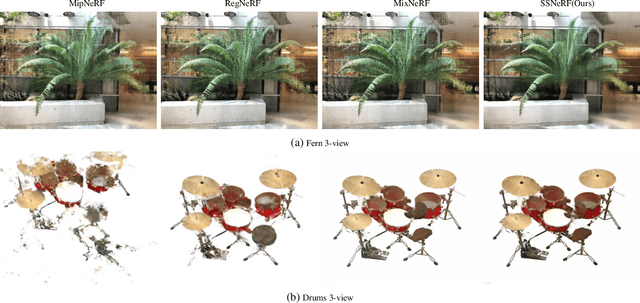
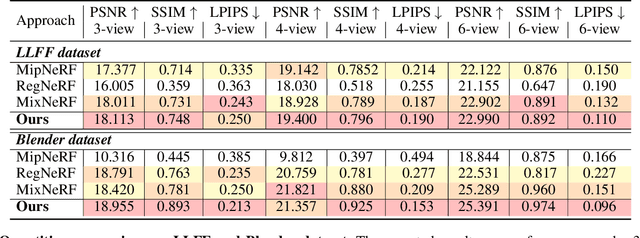
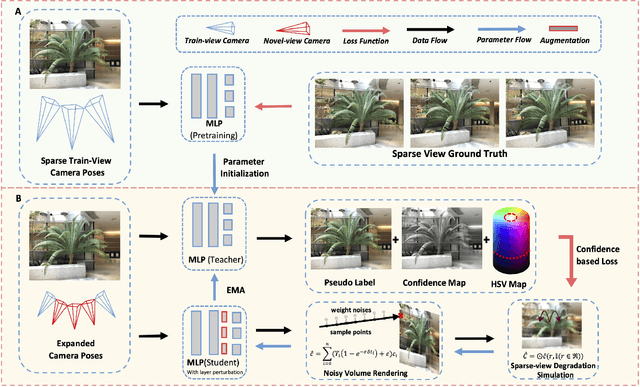
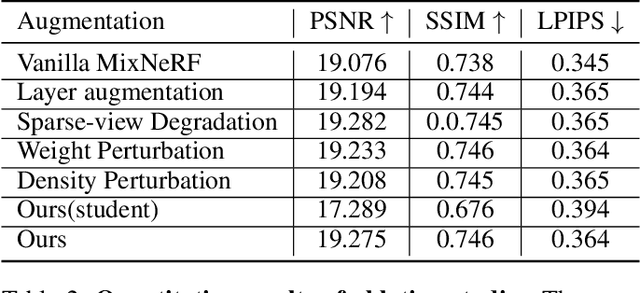
Sparse view NeRF is challenging because limited input images lead to an under constrained optimization problem for volume rendering. Existing methods address this issue by relying on supplementary information, such as depth maps. However, generating this supplementary information accurately remains problematic and often leads to NeRF producing images with undesired artifacts. To address these artifacts and enhance robustness, we propose SSNeRF, a sparse view semi supervised NeRF method based on a teacher student framework. Our key idea is to challenge the NeRF module with progressively severe sparse view degradation while providing high confidence pseudo labels. This approach helps the NeRF model become aware of noise and incomplete information associated with sparse views, thus improving its robustness. The novelty of SSNeRF lies in its sparse view specific augmentations and semi supervised learning mechanism. In this approach, the teacher NeRF generates novel views along with confidence scores, while the student NeRF, perturbed by the augmented input, learns from the high confidence pseudo labels. Our sparse view degradation augmentation progressively injects noise into volume rendering weights, perturbs feature maps in vulnerable layers, and simulates sparse view blurriness. These augmentation strategies force the student NeRF to recognize degradation and produce clearer rendered views. By transferring the student's parameters to the teacher, the teacher gains increased robustness in subsequent training iterations. Extensive experiments demonstrate the effectiveness of our SSNeRF in generating novel views with less sparse view degradation. We will release code upon acceptance.
Towards Better Text-to-Image Generation Alignment via Attention Modulation
Apr 22, 2024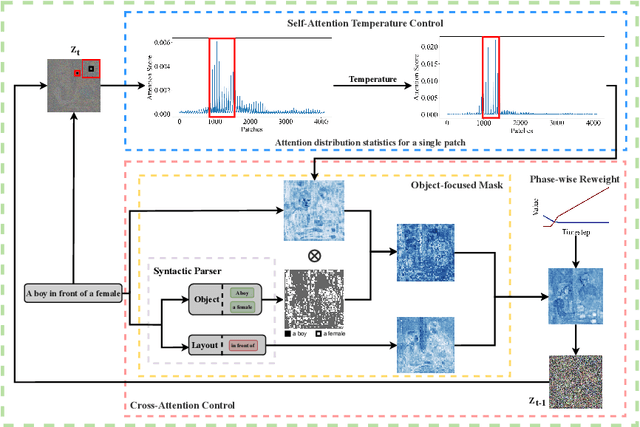
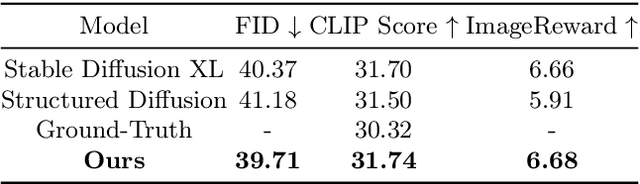
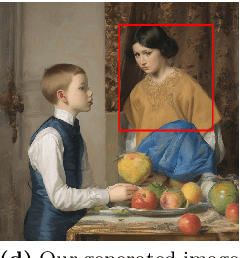
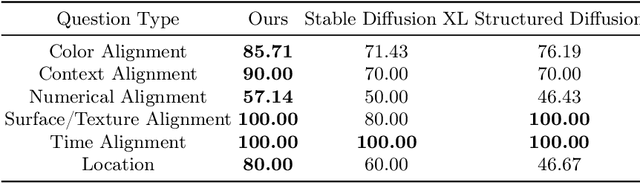
In text-to-image generation tasks, the advancements of diffusion models have facilitated the fidelity of generated results. However, these models encounter challenges when processing text prompts containing multiple entities and attributes. The uneven distribution of attention results in the issues of entity leakage and attribute misalignment. Training from scratch to address this issue requires numerous labeled data and is resource-consuming. Motivated by this, we propose an attribution-focusing mechanism, a training-free phase-wise mechanism by modulation of attention for diffusion model. One of our core ideas is to guide the model to concentrate on the corresponding syntactic components of the prompt at distinct timesteps. To achieve this, we incorporate a temperature control mechanism within the early phases of the self-attention modules to mitigate entity leakage issues. An object-focused masking scheme and a phase-wise dynamic weight control mechanism are integrated into the cross-attention modules, enabling the model to discern the affiliation of semantic information between entities more effectively. The experimental results in various alignment scenarios demonstrate that our model attain better image-text alignment with minimal additional computational cost.