 Add to Chrome
 Add to Firefox
 Add to Edge
ChineseHarm-Bench: A Chinese Harmful Content Detection Benchmark
Jun 12, 2025
Large language models (LLMs) have been increasingly applied to automated harmful content detection tasks, assisting moderators in identifying policy violations and improving the overall efficiency and accuracy of content review. However, existing resources for harmful content detection are predominantly focused on English, with Chinese datasets remaining scarce and often limited in scope. We present a comprehensive, professionally annotated benchmark for Chinese content harm detection, which covers six representative categories and is constructed entirely from real-world data. Our annotation process further yields a knowledge rule base that provides explicit expert knowledge to assist LLMs in Chinese harmful content detection. In addition, we propose a knowledge-augmented baseline that integrates both human-annotated knowledge rules and implicit knowledge from large language models, enabling smaller models to achieve performance comparable to state-of-the-art LLMs. Code and data are available at https://github.com/zjunlp/ChineseHarm-bench.

ConStyX: Content Style Augmentation for Generalizable Medical Image Segmentation
Jun 12, 2025Medical images are usually collected from multiple domains, leading to domain shifts that impair the performance of medical image segmentation models. Domain Generalization (DG) aims to address this issue by training a robust model with strong generalizability. Recently, numerous domain randomization-based DG methods have been proposed. However, these methods suffer from the following limitations: 1) constrained efficiency of domain randomization due to their exclusive dependence on image style perturbation, and 2) neglect of the adverse effects of over-augmented images on model training. To address these issues, we propose a novel domain randomization-based DG method, called content style augmentation (ConStyX), for generalizable medical image segmentation. Specifically, ConStyX 1) augments the content and style of training data, allowing the augmented training data to better cover a wider range of data domains, and 2) leverages well-augmented features while mitigating the negative effects of over-augmented features during model training. Extensive experiments across multiple domains demonstrate that our ConStyX achieves superior generalization performance. The code is available at https://github.com/jwxsp1/ConStyX.
PlayerOne: Egocentric World Simulator
Jun 11, 2025We introduce PlayerOne, the first egocentric realistic world simulator, facilitating immersive and unrestricted exploration within vividly dynamic environments. Given an egocentric scene image from the user, PlayerOne can accurately construct the corresponding world and generate egocentric videos that are strictly aligned with the real scene human motion of the user captured by an exocentric camera. PlayerOne is trained in a coarse-to-fine pipeline that first performs pretraining on large-scale egocentric text-video pairs for coarse-level egocentric understanding, followed by finetuning on synchronous motion-video data extracted from egocentric-exocentric video datasets with our automatic construction pipeline. Besides, considering the varying importance of different components, we design a part-disentangled motion injection scheme, enabling precise control of part-level movements. In addition, we devise a joint reconstruction framework that progressively models both the 4D scene and video frames, ensuring scene consistency in the long-form video generation. Experimental results demonstrate its great generalization ability in precise control of varying human movements and worldconsistent modeling of diverse scenarios. It marks the first endeavor into egocentric real-world simulation and can pave the way for the community to delve into fresh frontiers of world modeling and its diverse applications.
Step-Audio-AQAA: a Fully End-to-End Expressive Large Audio Language Model
Jun 10, 2025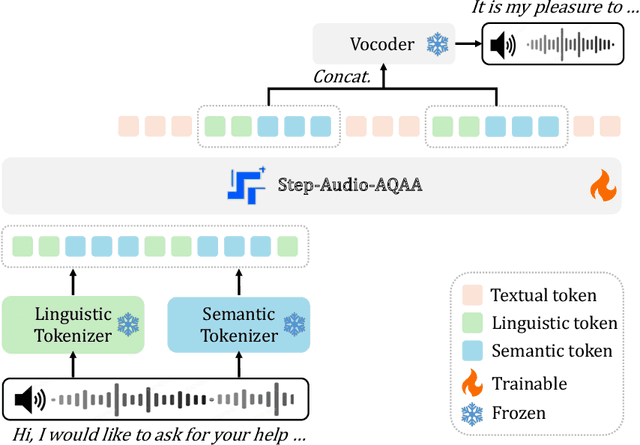
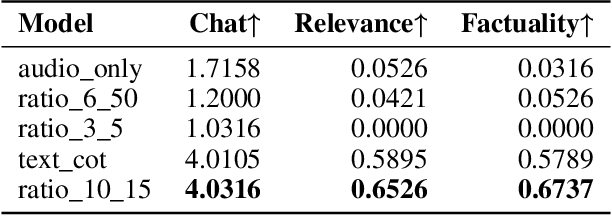
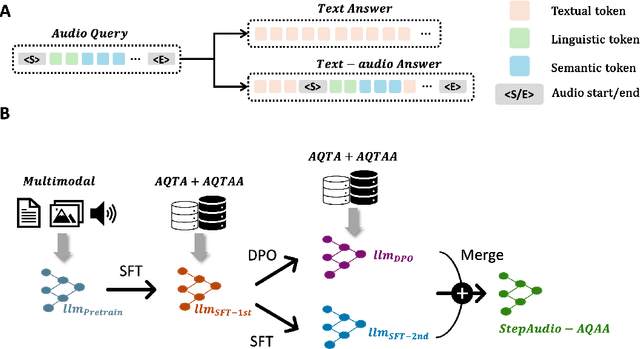

Large Audio-Language Models (LALMs) have significantly advanced intelligent human-computer interaction, yet their reliance on text-based outputs limits their ability to generate natural speech responses directly, hindering seamless audio interactions. To address this, we introduce Step-Audio-AQAA, a fully end-to-end LALM designed for Audio Query-Audio Answer (AQAA) tasks. The model integrates a dual-codebook audio tokenizer for linguistic and semantic feature extraction, a 130-billion-parameter backbone LLM and a neural vocoder for high-fidelity speech synthesis. Our post-training approach employs interleaved token-output of text and audio to enhance semantic coherence and combines Direct Preference Optimization (DPO) with model merge to improve performance. Evaluations on the StepEval-Audio-360 benchmark demonstrate that Step-Audio-AQAA excels especially in speech control, outperforming the state-of-art LALMs in key areas. This work contributes a promising solution for end-to-end LALMs and highlights the critical role of token-based vocoder in enhancing overall performance for AQAA tasks.
Prefix Grouper: Efficient GRPO Training through Shared-Prefix Forward
Jun 05, 2025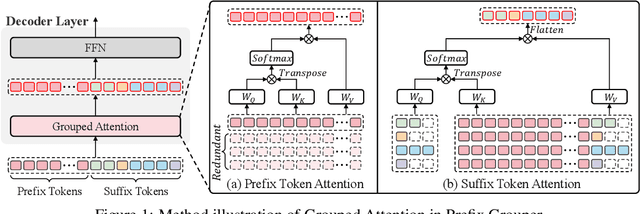
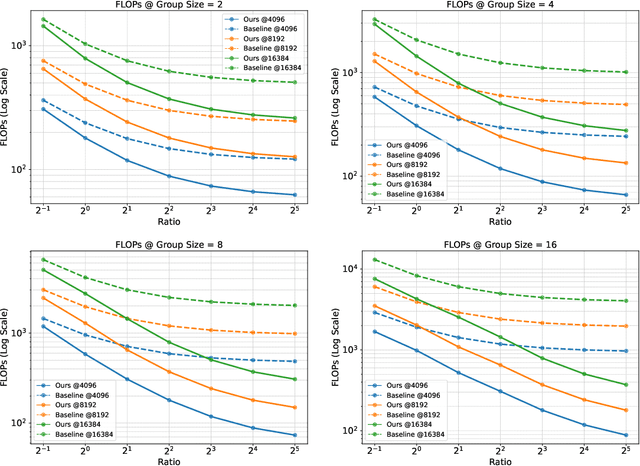
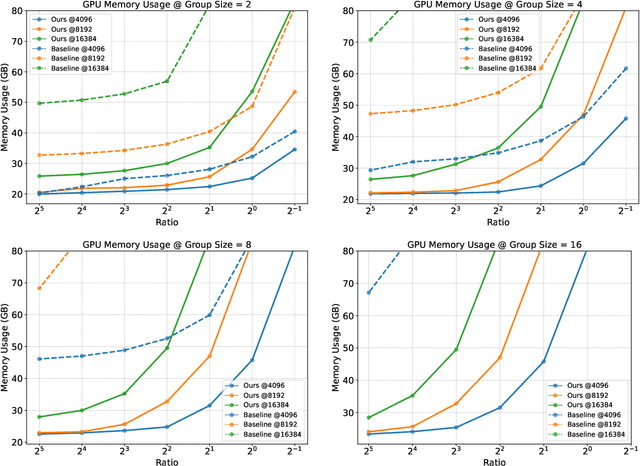
Group Relative Policy Optimization (GRPO) enhances policy learning by computing gradients from relative comparisons among candidate outputs that share a common input prefix. Despite its effectiveness, GRPO introduces substantial computational overhead when processing long shared prefixes, which must be redundantly encoded for each group member. This inefficiency becomes a major scalability bottleneck in long-context learning scenarios. We propose Prefix Grouper, an efficient GRPO training algorithm that eliminates redundant prefix computation via a Shared-Prefix Forward strategy. In particular, by restructuring self-attention into two parts, our method enables the shared prefix to be encoded only once, while preserving full differentiability and compatibility with end-to-end training. We provide both theoretical and empirical evidence that Prefix Grouper is training-equivalent to standard GRPO: it yields identical forward outputs and backward gradients, ensuring that the optimization dynamics and final policy performance remain unchanged. Empirically, our experiments confirm that Prefix Grouper achieves consistent results while significantly reducing the computational cost of training, particularly in long-prefix scenarios. The proposed method is fully plug-and-play: it is compatible with existing GRPO-based architectures and can be seamlessly integrated into current training pipelines as a drop-in replacement, requiring no structural modifications and only minimal changes to input construction and attention computation. Prefix Grouper enables the use of larger group sizes under the same computational budget, thereby improving the scalability of GRPO to more complex tasks and larger models. Code is now available at https://github.com/johncaged/PrefixGrouper
LayerFlow: A Unified Model for Layer-aware Video Generation
Jun 04, 2025We present LayerFlow, a unified solution for layer-aware video generation. Given per-layer prompts, LayerFlow generates videos for the transparent foreground, clean background, and blended scene. It also supports versatile variants like decomposing a blended video or generating the background for the given foreground and vice versa. Starting from a text-to-video diffusion transformer, we organize the videos for different layers as sub-clips, and leverage layer embeddings to distinguish each clip and the corresponding layer-wise prompts. In this way, we seamlessly support the aforementioned variants in one unified framework. For the lack of high-quality layer-wise training videos, we design a multi-stage training strategy to accommodate static images with high-quality layer annotations. Specifically, we first train the model with low-quality video data. Then, we tune a motion LoRA to make the model compatible with static frames. Afterward, we train the content LoRA on the mixture of image data with high-quality layered images along with copy-pasted video data. During inference, we remove the motion LoRA thus generating smooth videos with desired layers.
Multilook Coherent Imaging: Theoretical Guarantees and Algorithms
May 29, 2025Multilook coherent imaging is a widely used technique in applications such as digital holography, ultrasound imaging, and synthetic aperture radar. A central challenge in these systems is the presence of multiplicative noise, commonly known as speckle, which degrades image quality. Despite the widespread use of coherent imaging systems, their theoretical foundations remain relatively underexplored. In this paper, we study both the theoretical and algorithmic aspects of likelihood-based approaches for multilook coherent imaging, providing a rigorous framework for analysis and method development. Our theoretical contributions include establishing the first theoretical upper bound on the Mean Squared Error (MSE) of the maximum likelihood estimator under the deep image prior hypothesis. Our results capture the dependence of MSE on the number of parameters in the deep image prior, the number of looks, the signal dimension, and the number of measurements per look. On the algorithmic side, we employ projected gradient descent (PGD) as an efficient method for computing the maximum likelihood solution. Furthermore, we introduce two key ideas to enhance the practical performance of PGD. First, we incorporate the Newton-Schulz algorithm to compute matrix inverses within the PGD iterations, significantly reducing computational complexity. Second, we develop a bagging strategy to mitigate projection errors introduced during PGD updates. We demonstrate that combining these techniques with PGD yields state-of-the-art performance. Our code is available at https://github.com/Computational-Imaging-RU/Bagged-DIP-Speckle.
ScEdit: Script-based Assessment of Knowledge Editing
May 29, 2025Knowledge Editing (KE) has gained increasing attention, yet current KE tasks remain relatively simple. Under current evaluation frameworks, many editing methods achieve exceptionally high scores, sometimes nearing perfection. However, few studies integrate KE into real-world application scenarios (e.g., recent interest in LLM-as-agent). To support our analysis, we introduce a novel script-based benchmark -- ScEdit (Script-based Knowledge Editing Benchmark) -- which encompasses both counterfactual and temporal edits. We integrate token-level and text-level evaluation methods, comprehensively analyzing existing KE techniques. The benchmark extends traditional fact-based ("What"-type question) evaluation to action-based ("How"-type question) evaluation. We observe that all KE methods exhibit a drop in performance on established metrics and face challenges on text-level metrics, indicating a challenging task. Our benchmark is available at https://github.com/asdfo123/ScEdit.
CityGo: Lightweight Urban Modeling and Rendering with Proxy Buildings and Residual Gaussians
May 28, 2025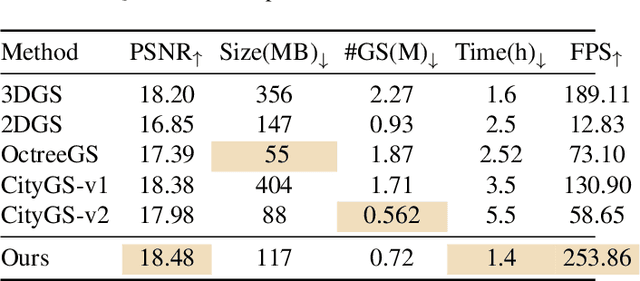
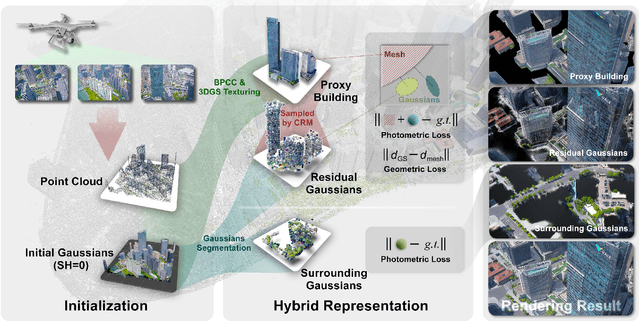

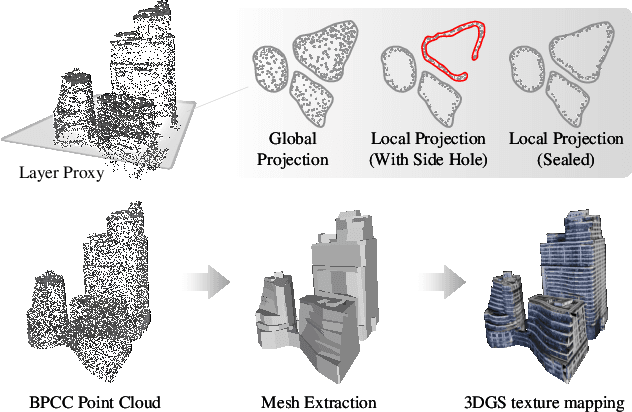
Accurate and efficient modeling of large-scale urban scenes is critical for applications such as AR navigation, UAV based inspection, and smart city digital twins. While aerial imagery offers broad coverage and complements limitations of ground-based data, reconstructing city-scale environments from such views remains challenging due to occlusions, incomplete geometry, and high memory demands. Recent advances like 3D Gaussian Splatting (3DGS) improve scalability and visual quality but remain limited by dense primitive usage, long training times, and poor suit ability for edge devices. We propose CityGo, a hybrid framework that combines textured proxy geometry with residual and surrounding 3D Gaussians for lightweight, photorealistic rendering of urban scenes from aerial perspectives. Our approach first extracts compact building proxy meshes from MVS point clouds, then uses zero order SH Gaussians to generate occlusion-free textures via image-based rendering and back-projection. To capture high-frequency details, we introduce residual Gaussians placed based on proxy-photo discrepancies and guided by depth priors. Broader urban context is represented by surrounding Gaussians, with importance-aware downsampling applied to non-critical regions to reduce redundancy. A tailored optimization strategy jointly refines proxy textures and Gaussian parameters, enabling real-time rendering of complex urban scenes on mobile GPUs with significantly reduced training and memory requirements. Extensive experiments on real-world aerial datasets demonstrate that our hybrid representation significantly reduces training time, achieving on average 1.4x speedup, while delivering comparable visual fidelity to pure 3D Gaussian Splatting approaches. Furthermore, CityGo enables real-time rendering of large-scale urban scenes on mobile consumer GPUs, with substantially reduced memory usage and energy consumption.
Continuum-armed Bandit Optimization with Batch Pairwise Comparison Oracles
May 28, 2025This paper studies a bandit optimization problem where the goal is to maximize a function $f(x)$ over $T$ periods for some unknown strongly concave function $f$. We consider a new pairwise comparison oracle, where the decision-maker chooses a pair of actions $(x, x')$ for a consecutive number of periods and then obtains an estimate of $f(x)-f(x')$. We show that such a pairwise comparison oracle finds important applications to joint pricing and inventory replenishment problems and network revenue management. The challenge in this bandit optimization is twofold. First, the decision-maker not only needs to determine a pair of actions $(x, x')$ but also a stopping time $n$ (i.e., the number of queries based on $(x, x')$). Second, motivated by our inventory application, the estimate of the difference $f(x)-f(x')$ is biased, which is different from existing oracles in stochastic optimization literature. To address these challenges, we first introduce a discretization technique and local polynomial approximation to relate this problem to linear bandits. Then we developed a tournament successive elimination technique to localize the discretized cell and run an interactive batched version of LinUCB algorithm on cells. We establish regret bounds that are optimal up to poly-logarithmic factors. Furthermore, we apply our proposed algorithm and analytical framework to the two operations management problems and obtain results that improve state-of-the-art results in the existing literature.