 Add to Chrome
 Add to Firefox
 Add to Edge
Best-Arm Identification with Noisy Actuation
Apr 02, 2026
In this paper, we consider a multi-armed bandit (MAB) instance and study how to identify the best arm when arm commands are conveyed from a central learner to a distributed agent over a discrete memoryless channel (DMC). Depending on the agent capabilities, we provide communication schemes along with their analysis, which interestingly relate to the zero-error capacity of the underlying DMC.

Near-Optimal Sample Complexity for Online Constrained MDPs
Feb 16, 2026Safety is a fundamental challenge in reinforcement learning (RL), particularly in real-world applications such as autonomous driving, robotics, and healthcare. To address this, Constrained Markov Decision Processes (CMDPs) are commonly used to enforce safety constraints while optimizing performance. However, existing methods often suffer from significant safety violations or require a high sample complexity to generate near-optimal policies. We address two settings: relaxed feasibility, where small violations are allowed, and strict feasibility, where no violation is allowed. We propose a model-based primal-dual algorithm that balances regret and bounded constraint violations, drawing on techniques from online RL and constrained optimization. For relaxed feasibility, we prove that our algorithm returns an $\varepsilon$-optimal policy with $\varepsilon$-bounded violation with arbitrarily high probability, requiring $\tilde{O}\left(\frac{SAH^3}{\varepsilon^2}\right)$ learning episodes, matching the lower bound for unconstrained MDPs. For strict feasibility, we prove that our algorithm returns an $\varepsilon$-optimal policy with zero violation with arbitrarily high probability, requiring $\tilde{O}\left(\frac{SAH^5}{\varepsilon^2ζ^2}\right)$ learning episodes, where $ζ$ is the problem-dependent Slater constant characterizing the size of the feasible region. This result matches the lower bound for learning CMDPs with access to a generative model. Our results demonstrate that learning CMDPs in an online setting is as easy as learning with a generative model and is no more challenging than learning unconstrained MDPs when small violations are allowed.
LACONIC: Length-Aware Constrained Reinforcement Learning for LLM
Feb 16, 2026Reinforcement learning (RL) has enhanced the capabilities of large language models (LLMs) through reward-driven training. Nevertheless, this process can introduce excessively long responses, inflating inference latency and computational overhead. Prior length-control approaches typically rely on fixed heuristic reward shaping, which can misalign with the task objective and require brittle tuning. In this work, we propose LACONIC, a reinforcement learning method that enforces a target token budget during training. Specifically, we update policy models using an augmented objective that combines the task reward with a length-based cost. To balance brevity and task performance, the cost scale is adaptively adjusted throughout training. This yields robust length control while preserving task reward. We provide a theoretical guarantee that support the method. Across mathematical reasoning models and datasets, LACONIC preserves or improves pass@1 while reducing output length by over 50%. It maintains out-of-domain performance on general knowledge and multilingual benchmarks with 44% fewer tokens. Moreover, LACONIC integrates into standard RL-tuning with no inference changes and minimal deployment overhead.
Sample Complexity Bounds for Linear Constrained MDPs with a Generative Model
Jul 02, 2025We consider infinite-horizon $\gamma$-discounted (linear) constrained Markov decision processes (CMDPs) where the objective is to find a policy that maximizes the expected cumulative reward subject to expected cumulative constraints. Given access to a generative model, we propose to solve CMDPs with a primal-dual framework that can leverage any black-box unconstrained MDP solver. For linear CMDPs with feature dimension $d$, we instantiate the framework by using mirror descent value iteration (\texttt{MDVI})~\citep{kitamura2023regularization} an example MDP solver. We provide sample complexity bounds for the resulting CMDP algorithm in two cases: (i) relaxed feasibility, where small constraint violations are allowed, and (ii) strict feasibility, where the output policy is required to exactly satisfy the constraint. For (i), we prove that the algorithm can return an $\epsilon$-optimal policy with high probability by using $\tilde{O}\left(\frac{d^2}{(1-\gamma)^4\epsilon^2}\right)$ samples. We note that these results exhibit a near-optimal dependence on both $d$ and $\epsilon$. For (ii), we show that the algorithm requires $\tilde{O}\left(\frac{d^2}{(1-\gamma)^6\epsilon^2\zeta^2}\right)$ samples, where $\zeta$ is the problem-dependent Slater constant that characterizes the size of the feasible region. Finally, we instantiate our framework for tabular CMDPs and show that it can be used to recover near-optimal sample complexities in this setting.
Does Feedback Help in Bandits with Arm Erasures?
Apr 29, 2025We study a distributed multi-armed bandit (MAB) problem over arm erasure channels, motivated by the increasing adoption of MAB algorithms over communication-constrained networks. In this setup, the learner communicates the chosen arm to play to an agent over an erasure channel with probability $\epsilon \in [0,1)$; if an erasure occurs, the agent continues pulling the last successfully received arm; the learner always observes the reward of the arm pulled. In past work, we considered the case where the agent cannot convey feedback to the learner, and thus the learner does not know whether the arm played is the requested or the last successfully received one. In this paper, we instead consider the case where the agent can send feedback to the learner on whether the arm request was received, and thus the learner exactly knows which arm was played. Surprisingly, we prove that erasure feedback does not improve the worst-case regret upper bound order over the previously studied no-feedback setting. In particular, we prove a regret lower bound of $\Omega(\sqrt{KT} + K / (1 - \epsilon))$, where $K$ is the number of arms and $T$ the time horizon, that matches no-feedback upper bounds up to logarithmic factors. We note however that the availability of feedback enables simpler algorithm designs that may achieve better constants (albeit not better order) regret bounds; we design one such algorithm and evaluate its performance numerically.
NoWag: A Unified Framework for Shape Preserving Compression of Large Language Models
Apr 20, 2025Large language models (LLMs) exhibit remarkable performance across various natural language processing tasks but suffer from immense computational and memory demands, limiting their deployment in resource-constrained environments. To address this challenge, we propose NoWag: (Normalized Weight and Activation Guided Compression), a unified framework for zero-shot shape preserving compression algorithms. We compressed Llama-2 7B/13B/70B and Llama-3 8/70BB models, using two popular forms of shape-preserving compression, vector quantization NoWag-VQ (NoWag for Vector Quantization), and unstructured/semi-structured pruning NoWag-P (NoWag for Pruning). We found that NoWag-VQ significantly outperforms state-of-the-art zero shot VQ, and that NoWag-P performs competitively against state-of-the-art methods. These results suggest commonalities between these compression paradigms that could inspire future work. Our code is available at https://github.com/LawrenceRLiu/NoWag
Hyper: Hyperparameter Robust Efficient Exploration in Reinforcement Learning
Dec 04, 2024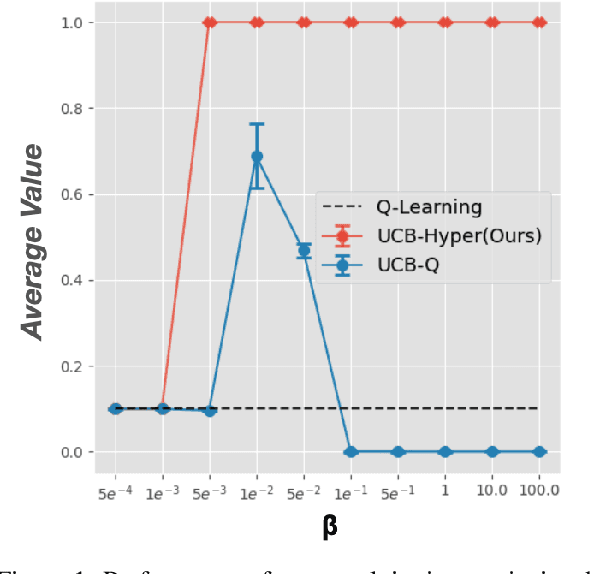
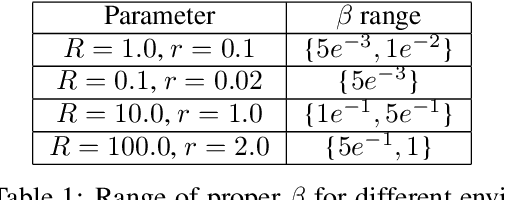
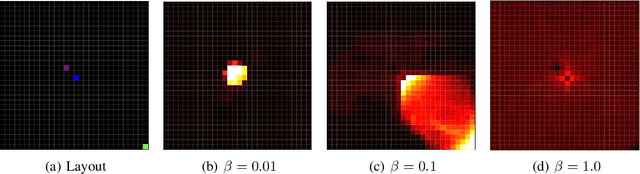
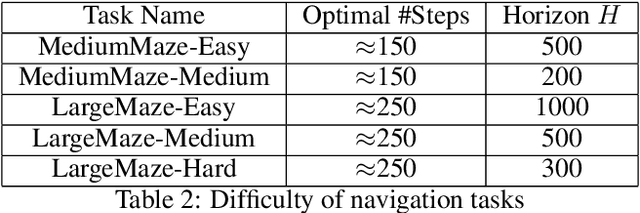
The exploration \& exploitation dilemma poses significant challenges in reinforcement learning (RL). Recently, curiosity-based exploration methods achieved great success in tackling hard-exploration problems. However, they necessitate extensive hyperparameter tuning on different environments, which heavily limits the applicability and accessibility of this line of methods. In this paper, we characterize this problem via analysis of the agent behavior, concluding the fundamental difficulty of choosing a proper hyperparameter. We then identify the difficulty and the instability of the optimization when the agent learns with curiosity. We propose our method, hyperparameter robust exploration (\textbf{Hyper}), which extensively mitigates the problem by effectively regularizing the visitation of the exploration and decoupling the exploitation to ensure stable training. We theoretically justify that \textbf{Hyper} is provably efficient under function approximation setting and empirically demonstrate its appealing performance and robustness in various environments.
Misspecified $Q$-Learning with Sparse Linear Function Approximation: Tight Bounds on Approximation Error
Jul 18, 2024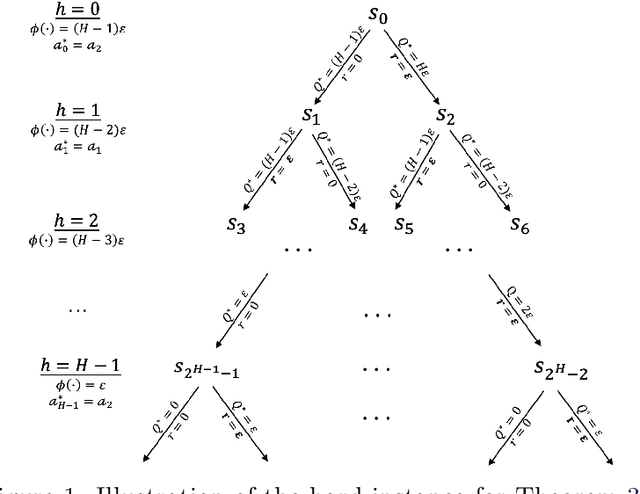
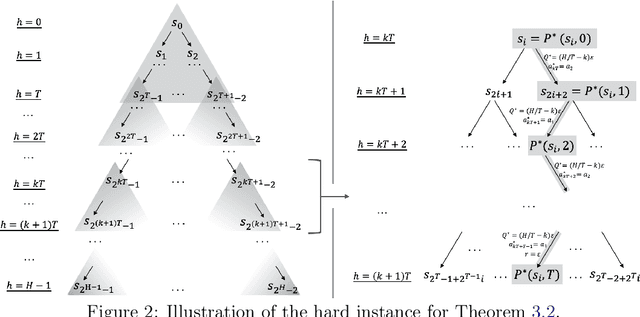
The recent work by Dong & Yang (2023) showed for misspecified sparse linear bandits, one can obtain an $O\left(\epsilon\right)$-optimal policy using a polynomial number of samples when the sparsity is a constant, where $\epsilon$ is the misspecification error. This result is in sharp contrast to misspecified linear bandits without sparsity, which require an exponential number of samples to get the same guarantee. In order to study whether the analog result is possible in the reinforcement learning setting, we consider the following problem: assuming the optimal $Q$-function is a $d$-dimensional linear function with sparsity $k$ and misspecification error $\epsilon$, whether we can obtain an $O\left(\epsilon\right)$-optimal policy using number of samples polynomially in the feature dimension $d$. We first demonstrate why the standard approach based on Bellman backup or the existing optimistic value function elimination approach such as OLIVE (Jiang et al., 2017) achieves suboptimal guarantees for this problem. We then design a novel elimination-based algorithm to show one can obtain an $O\left(H\epsilon\right)$-optimal policy with sample complexity polynomially in the feature dimension $d$ and planning horizon $H$. Lastly, we complement our upper bound with an $\widetilde{\Omega}\left(H\epsilon\right)$ suboptimality lower bound, giving a complete picture of this problem.
Learning for Bandits under Action Erasures
Jun 26, 2024We consider a novel multi-arm bandit (MAB) setup, where a learner needs to communicate the actions to distributed agents over erasure channels, while the rewards for the actions are directly available to the learner through external sensors. In our model, while the distributed agents know if an action is erased, the central learner does not (there is no feedback), and thus does not know whether the observed reward resulted from the desired action or not. We propose a scheme that can work on top of any (existing or future) MAB algorithm and make it robust to action erasures. Our scheme results in a worst-case regret over action-erasure channels that is at most a factor of $O(1/\sqrt{1-\epsilon})$ away from the no-erasure worst-case regret of the underlying MAB algorithm, where $\epsilon$ is the erasure probability. We also propose a modification of the successive arm elimination algorithm and prove that its worst-case regret is $\Tilde{O}(\sqrt{KT}+K/(1-\epsilon))$, which we prove is optimal by providing a matching lower bound.
Confident Natural Policy Gradient for Local Planning in $q_π$-realizable Constrained MDPs
Jun 26, 2024The constrained Markov decision process (CMDP) framework emerges as an important reinforcement learning approach for imposing safety or other critical objectives while maximizing cumulative reward. However, the current understanding of how to learn efficiently in a CMDP environment with a potentially infinite number of states remains under investigation, particularly when function approximation is applied to the value functions. In this paper, we address the learning problem given linear function approximation with $q_{\pi}$-realizability, where the value functions of all policies are linearly representable with a known feature map, a setting known to be more general and challenging than other linear settings. Utilizing a local-access model, we propose a novel primal-dual algorithm that, after $\tilde{O}(\text{poly}(d) \epsilon^{-3})$ queries, outputs with high probability a policy that strictly satisfies the constraints while nearly optimizing the value with respect to a reward function. Here, $d$ is the feature dimension and $\epsilon > 0$ is a given error. The algorithm relies on a carefully crafted off-policy evaluation procedure to evaluate the policy using historical data, which informs policy updates through policy gradients and conserves samples. To our knowledge, this is the first result achieving polynomial sample complexity for CMDP in the $q_{\pi}$-realizable setting.