 Add to Chrome
 Add to Firefox
 Add to Edge
Inference-Time Concept Suppression and Video-Centric Evaluation for Text-to-Video Models
Jul 15, 2026
Text-to-video (T2V) generators can synthesize realistic and temporally coherent videos, but controllably removing a target concept from a generator remains difficult. Unlike text-to-image concept erasure, T2V unlearning must suppress a target concept that may persist across frames while preserving non-target subjects, actions, scenes, and temporal structure. We propose \textbf{SIRUS}, a training-free inference-time framework for concept-level T2V unlearning. Given textual aliases of a target concept, SIRUS localizes target-related prompt evidence and suppresses target expression during sampling, without updating the text encoder or denoising network. We further introduce a video-oriented evaluation framework for T2V unlearning that separately measures target forgetting, non-target preservation, video quality, jailbreak robustness, and efficiency, using video-level failure criteria, frame-level residue statistics, paired preservation analysis, VBench-based quality diagnostics, and deployment overhead measurement. Across five safety, object, and style concepts on CogVideoX, SIRUS reaches 70.4\% average forgetting success and 25.7\% average frame hit, compared with 44.4\% / 47.2\% for VideoEraser, while reducing the average VBench quality drop from -0.043 to -0.016, yielding the strongest forgetting-quality trade-off among fully evaluated baselines. Transfer experiments on Wan2.2 further suggest that SIRUS generalizes across modern T2V backbones.

AdaPCLA: Adaptive Prior-Calibrated Logit Adjustment for Long-Tailed Longitudinal EHR Generation
Jul 14, 2026Generative modeling of longitudinal Electronic Health Records is increasingly important for privacy-preserving research, yet standard autoregressive models tend to underrepresent the co-occurrence structure of tail events (i.e., diseases, symptoms), reducing the fidelity and faithfulness of generated data for rare subpopulations. To this end, we propose AdaPCLA framework, which enables generative models to adaptively fit and generate EHR data through a data distribution-aware training strategy; this is achieved by internalizing data knowledge parameters by simulated annealing training. It also supports training-free adaptation to a diverse clinical population for generation through zero-shot distribution control. Moreover, our theoretical analysis characterizes rare-code logit updates through the label-wise empirical NTK and derives a prior-internalization bound for how annealing speed and NTK conditioning affect retained prior signals. Experiments on real-world data show that AdaPCLA achieves consistent gains in tail plausibility, downstream utility, and zero-shot control; in particular, it improves TailPairSeen over HALO by 114.2% on MIMIC-III and 65.1% on MIMIC-IV, outperforms GPT-style generation by 3.5% F1 for zero-shot cross-population adaptation.
Signal-Guided Optimization for Machine Unlearning
Jul 13, 2026Current machine unlearning methods predominantly rely on global, coarse-grained intervention strategies. They lack precise pilot signals to guide the unlearning process and fail to provide differentiable guidance across different unlearning tasks. Due to the varying memorization strengths of samples during original training, such a uniform strategy leads to two problems: some samples are over-unlearned, which harms model utility; while others are under-unlearned, leaving residual information that can be exploited by privacy attacks. In this paper, we propose GSUO, a guidance-signal-aware unlearning optimization framework that designs task-specific fine-grained guidance signals to steer the unlearning process and is applicable to both random-subset and class-wise forgetting tasks. Extensive experiments demonstrate that GSUO outperforms 14 baselines in terms of both unlearning effectiveness and generalization, while achieving high efficiency and significant speedups, validating its effectiveness for reliable machine unlearning.
Activation Steering Induces Emergent Misalignment: A More Comprehensive Evaluation
Jun 07, 2026Activation steering has emerged as a popular inference-time technique for modulating the behavior of large language models (LLMs). By constructing a steering vector from examples of a target behavior and injecting it into intermediate activations during inference, activation steering enables flexible behavioral control while avoiding the permanent parameter updates required by finetuning. Meanwhile, recent work has identified emergent misalignment (EM) as a significant safety concern, wherein models finetuned on unsafe examples from a narrow task may unexpectedly generalize to broadly unsafe behavior on unrelated tasks. Although finetuning-induced EM has been extensively studied, whether activation steering can induce EM remains comparatively under-explored, despite its increasing use as a model-control technique. In this paper, we present a comprehensive study of activation-steering-induced emergent misalignment, substantially expanding the evaluation scope beyond existing pioneering work. First, we show that activation steering can induce broad misalignment, even in the recent Qwen-3.5 series. Moreover, activation-steered models produce harmful responses with stronger semantic relevance and higher coherence than their finetuned counterparts, making the resulting misalignment potentially more harmful. Second, we characterize properties of AS-induced EM by analyzing key steering-specific factors, including steering magnitude, the low-rank structure of the steering subspace, and the number of epochs during steering-vector construction. Third, we evaluate the robustness and sensitivity of AS-induced EM across diverse model families, model scales, target tasks, and intervention layers. Our findings reveal activation steering as a significant yet under-examined source of emergent misalignment and provide an activation-space perspective for understanding the mechanisms and safety risks of EM.
Exploiting Verification-Generation Gap: Test-Time Reinforcement Learning with Confidence-Conditioned Verification
Jun 02, 2026Test-time reinforcement learning has emerged as a promising paradigm for enhancing the complex reasoning abilities of large language models in a completely label-free manner. Despite existing studies focusing on Pass@1 performance, optimizing Pass@k remains under-explored yet critical in label-free settings, which measures generation coverage for sustained exploration. Optimizing Pass@k in label-free setting is highly non-trivial, as directly applying the Pass@k advantage designs effective for RLVR yields unsatisfactory performance. Through in-depth empirical analysis, we discover the root causes hindering performance: pseudo-label estimations for low-confidence samples have a high probability of being incorrect, while candidate answers for high-confidence samples suffer from severe diversity collapse. To overcome these hurdles, we propose TTRL-CoCoV (Test-Time Reinforcement Learning with Confidence-Conditioned Verification), a novel confidence-adaptive framework that expands Pass@k coverage and improves Pass@1 performance. Based on our key insight that verification capability generally leads generation capability, TTRL-CoCoV employs a confidence-conditioned mechanism: for high-confidence samples, it bootstraps verifier and applies an exploration-enhancing reward to prevent diversity collapse; for low-confidence samples, it delegates pseudo-label selection to the verifier to filter incorrect pseudo-labels; and for medium-confidence samples, it bypasses verification entirely. Extensive experiments demonstrate that TTRL-CoCoV outperforms the best competing methods across 6 widely-recognized benchmarks, achieves average absolute gains of +9.8% in Pass@1 and +18.7% in Pass@16 over TTRL, and even achieves absolute Pass@1 improvements of up to +5.0% across multiple reasoning benchmarks when compared against fully supervised RL methods. Our code repository: https://github.com/shanjf666/CoCoV.
TSQAgent: Rating Time Series Data Quality via Dedicated Agentic Reasoning
Jun 02, 2026Assessing the quality of time series (TS) data is fundamental yet inherently challenging due to the multifaceted nature of quality dimensions. Recently, large language models (LLMs) have emerged as a promising paradigm for TS quality assessment via pairwise comparison and per-dimension evaluation. However, existing approaches rely on manually predefined quality dimensions and purely text-based reasoning, leaving it unknown whether LLMs can identify truly relevant quality dimensions or perform grounded and quantitative quality comparisons. To investigate this, we construct TSQBench, a dedicated benchmark for evaluating LLMs on two progressive capabilities: (i) understanding and identifying relevant quality dimensions, and (ii) performing quality comparison under specific dimensions. Our analysis reveals that current LLMs consistently struggle with both dimension identification and evidence-grounded quality comparison. To address these limitations, we propose TSQAgent, a novel agentic reasoning framework for TS quality rating consisting of three collaborative roles: Perceiver for focused dimension selection, Inspector for dimension-wise quantitative analysis, and Adjudicator that aggregates and refines the final judgment. In particular, we introduce an agentic reasoning strategy that instills the ability to identify and prioritize the most relevant quality dimensions, and further propose an agent workflow equipped with external analytical tools to enable precise quantitative comparisons over selected dimensions. Experiments on both the proposed benchmark and eleven real-world datasets demonstrate that our framework not only substantially improves LLMs' capabilities in quality understanding and quantitative comparison but also effectively translates these improvements into better quality-aware data selection, leading to enhanced downstream performance and data efficiency.
Empowering VLMs for Few-Shot Multimodal Time Series Classification via Tailored Agentic Reasoning
May 10, 2026In this paper, we propose the first VL$\underline{\textbf{M}}$ $\underline{\textbf{a}}$gentic $\underline{\textbf{r}}$easoning framework for few-$\underline{\textbf{s}}$hot multimodal $\underline{\textbf{T}}$ime $\underline{\textbf{S}}$eries $\underline{\textbf{C}}$lassification ($\textbf{MarsTSC}$), which introduces a self-evolving knowledge bank as a dynamic context iteratively refined via reflective agentic reasoning. The framework comprises three collaborative roles: i) Generator conducts reliable classification via reasoning; ii) Reflector diagnoses the root causes of reasoning errors to yield discriminative insights targeting the temporal features overlooked by Generator; iii) Modifier applies verified updates to the knowledge bank to prevent context collapse. We further introduce a test-time update strategy to enable cautious, continuous knowledge bank refinement to mitigate few-shot bias and distribution shift. Extensive experiments across 12 mainstream time series benchmarks demonstrate that $\textbf{MarsTSC}$ delivers substantial and consistent performance gains across 6 VLM backbones, outperforming both classical and foundation model-based time series baselines under few-shot conditions, while producing interpretable rationales that ground each classification decision in human-readable feature evidence.
Solla: Towards a Speech-Oriented LLM That Hears Acoustic Context
Mar 19, 2025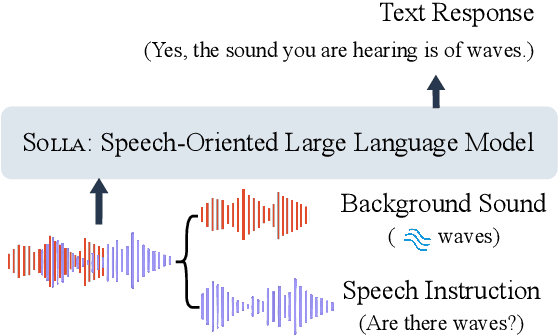
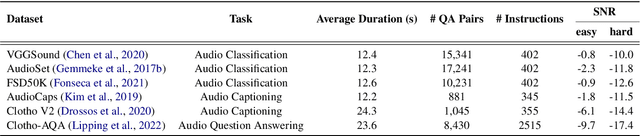
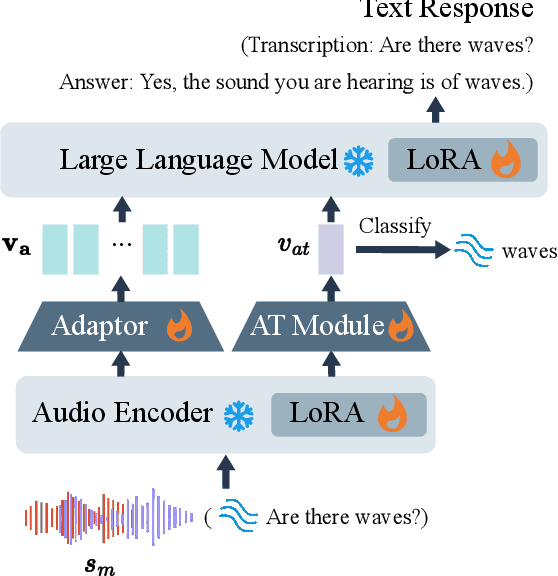
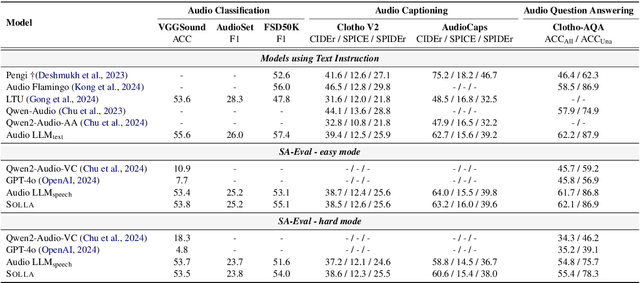
Large Language Models (LLMs) have recently shown remarkable ability to process not only text but also multimodal inputs such as speech and audio. However, most existing models primarily focus on analyzing input signals using text instructions, overlooking scenarios in which speech instructions and audio are mixed and serve as inputs to the model. To address these challenges, we introduce Solla, a novel framework designed to understand speech-based questions and hear the acoustic context concurrently. Solla incorporates an audio tagging module to effectively identify and represent audio events, as well as an ASR-assisted prediction method to improve comprehension of spoken content. To rigorously evaluate Solla and other publicly available models, we propose a new benchmark dataset called SA-Eval, which includes three tasks: audio event classification, audio captioning, and audio question answering. SA-Eval has diverse speech instruction with various speaking styles, encompassing two difficulty levels, easy and hard, to capture the range of real-world acoustic conditions. Experimental results show that Solla performs on par with or outperforms baseline models on both the easy and hard test sets, underscoring its effectiveness in jointly understanding speech and audio.
ID$^3$: Identity-Preserving-yet-Diversified Diffusion Models for Synthetic Face Recognition
Sep 26, 2024


Synthetic face recognition (SFR) aims to generate synthetic face datasets that mimic the distribution of real face data, which allows for training face recognition models in a privacy-preserving manner. Despite the remarkable potential of diffusion models in image generation, current diffusion-based SFR models struggle with generalization to real-world faces. To address this limitation, we outline three key objectives for SFR: (1) promoting diversity across identities (inter-class diversity), (2) ensuring diversity within each identity by injecting various facial attributes (intra-class diversity), and (3) maintaining identity consistency within each identity group (intra-class identity preservation). Inspired by these goals, we introduce a diffusion-fueled SFR model termed $\text{ID}^3$. $\text{ID}^3$ employs an ID-preserving loss to generate diverse yet identity-consistent facial appearances. Theoretically, we show that minimizing this loss is equivalent to maximizing the lower bound of an adjusted conditional log-likelihood over ID-preserving data. This equivalence motivates an ID-preserving sampling algorithm, which operates over an adjusted gradient vector field, enabling the generation of fake face recognition datasets that approximate the distribution of real-world faces. Extensive experiments across five challenging benchmarks validate the advantages of $\text{ID}^3$.
Data-Free Federated Class Incremental Learning with Diffusion-Based Generative Memory
May 22, 2024Federated Class Incremental Learning (FCIL) is a critical yet largely underexplored issue that deals with the dynamic incorporation of new classes within federated learning (FL). Existing methods often employ generative adversarial networks (GANs) to produce synthetic images to address privacy concerns in FL. However, GANs exhibit inherent instability and high sensitivity, compromising the effectiveness of these methods. In this paper, we introduce a novel data-free federated class incremental learning framework with diffusion-based generative memory (DFedDGM) to mitigate catastrophic forgetting by generating stable, high-quality images through diffusion models. We design a new balanced sampler to help train the diffusion models to alleviate the common non-IID problem in FL, and introduce an entropy-based sample filtering technique from an information theory perspective to enhance the quality of generative samples. Finally, we integrate knowledge distillation with a feature-based regularization term for better knowledge transfer. Our framework does not incur additional communication costs compared to the baseline FedAvg method. Extensive experiments across multiple datasets demonstrate that our method significantly outperforms existing baselines, e.g., over a 4% improvement in average accuracy on the Tiny-ImageNet dataset.