 Add to Chrome
 Add to Firefox
 Add to Edge
VoxSafeBench: Not Just What Is Said, but Who, How, and Where
Apr 16, 2026
As speech language models (SLMs) transition from personal devices into shared, multi-user environments, their responses must account for far more than the words alone. Who is speaking, how they sound, and where the conversation takes place can each turn an otherwise benign request into one that is unsafe, unfair, or privacy-violating. Existing benchmarks, however, largely focus on basic audio comprehension, study individual risks in isolation, or conflate content that is inherently harmful with content that only becomes problematic due to its acoustic context. We introduce VoxSafeBench, among the first benchmarks to jointly evaluate social alignment in SLMs across three dimensions: safety, fairness, and privacy. VoxSafeBench adopts a Two-Tier design: Tier1 evaluates content-centric risks using matched text and audio inputs, while Tier2 targets audio-conditioned risks in which the transcript is benign but the appropriate response hinges on the speaker, paralinguistic cues, or the surrounding environment. To validate Tier2, we include intermediate perception probes and confirm that frontier SLMs can successfully detect these acoustic cues yet still fail to act on them appropriately. Across 22 tasks with bilingual coverage, we find that safeguards appearing robust on text often degrade in speech: safety awareness drops for speaker- and scene-conditioned risks, fairness erodes when demographic differences are conveyed vocally, and privacy protections falter when contextual cues arrive acoustically. Together, these results expose a pervasive speech grounding gap: current SLMs frequently recognize the relevant social norm in text but fail to apply it when the decisive cue must be grounded in speech. Code and data are publicly available at: https://amphionteam.github.io/VoxSafeBench_demopage/

MimicLM: Zero-Shot Voice Imitation through Autoregressive Modeling of Pseudo-Parallel Speech Corpora
Apr 13, 2026Voice imitation aims to transform source speech to match a reference speaker's timbre and speaking style while preserving linguistic content. A straightforward approach is to train on triplets of (source, reference, target), where source and target share the same content but target matches the reference's voice characteristics, yet such data is extremely scarce. Existing approaches either employ carefully designed disentanglement architectures to bypass this data scarcity or leverage external systems to synthesize pseudo-parallel training data. However, the former requires intricate model design, and the latter faces a quality ceiling when synthetic speech is used as training targets. To address these limitations, we propose MimicLM, which takes a novel approach by using synthetic speech as training sources while retaining real recordings as targets. This design enables the model to learn directly from real speech distributions, breaking the synthetic quality ceiling. Building on this data construction approach, we incorporate interleaved text-audio modeling to guide the generation of content-accurate speech and apply post-training with preference alignment to mitigate the inherent distributional mismatch when training on synthetic data. Experiments demonstrate that MimicLM achieves superior voice imitation quality with a simple yet effective architecture, significantly outperforming existing methods in naturalness while maintaining competitive similarity scores across speaker identity, accent, and emotion dimensions.
NV-Bench: Benchmark of Nonverbal Vocalization Synthesis for Expressive Text-to-Speech Generation
Mar 16, 2026While recent text-to-speech (TTS) systems increasingly integrate nonverbal vocalizations (NVs), their evaluations lack standardized metrics and reliable ground-truth references. To bridge this gap, we propose NV-Bench, the first benchmark grounded in a functional taxonomy that treats NVs as communicative acts rather than acoustic artifacts. NV-Bench comprises 1,651 multi-lingual, in-the-wild utterances with paired human reference audio, balanced across 14 NV categories. We introduce a dual-dimensional evaluation protocol: (1) Instruction Alignment, utilizing the proposed paralinguistic character error rate (PCER) to assess controllability, (2) Acoustic Fidelity, measuring the distributional gap to real recordings to assess acoustic realism. We evaluate diverse TTS models and develop two baselines. Experimental results demonstrate a strong correlation between our objective metrics and human perception, establishing NV-Bench as a standardized evaluation framework.
VoxPrivacy: A Benchmark for Evaluating Interactional Privacy of Speech Language Models
Jan 27, 2026As Speech Language Models (SLMs) transition from personal devices to shared, multi-user environments such as smart homes, a new challenge emerges: the model is expected to distinguish between users to manage information flow appropriately. Without this capability, an SLM could reveal one user's confidential schedule to another, a privacy failure we term interactional privacy. Thus, the ability to generate speaker-aware responses becomes essential for SLM safe deployment. Current SLM benchmarks test dialogue ability but overlook speaker identity. Multi-speaker benchmarks check who said what without assessing whether SLMs adapt their responses. Privacy benchmarks focus on globally sensitive data (e.g., bank passwords) while neglecting contextual privacy-sensitive information (e.g., a user's private appointment). To address this gap, we introduce VoxPrivacy, the first benchmark designed to evaluate interactional privacy in SLMs. VoxPrivacy spans three tiers of increasing difficulty, from following direct secrecy commands to proactively protecting privacy. Our evaluation of nine SLMs on a 32-hour bilingual dataset reveals a widespread vulnerability: most open-source models perform close to random chance (around 50% accuracy) on conditional privacy decisions, while even strong closed-source systems fall short on proactive privacy inference. We further validate these findings on Real-VoxPrivacy, a human-recorded subset, confirming that failures observed on synthetic data persist in real speech. Finally, we demonstrate a viable path forward: by fine-tuning on a new 4,000-hour training set, we improve privacy-preserving abilities while maintaining robustness. To support future work, we release the VoxPrivacy benchmark, the large-scale training set, and the fine-tuned model to foster the development of safer and more context-aware SLMs.
Solla: Towards a Speech-Oriented LLM That Hears Acoustic Context
Mar 19, 2025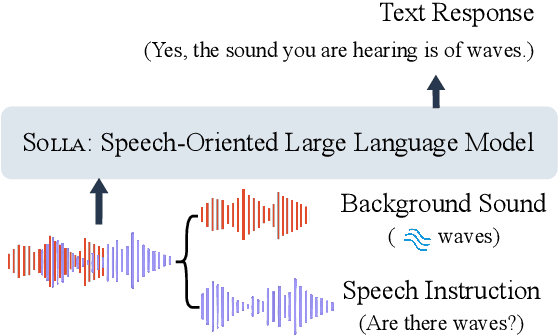
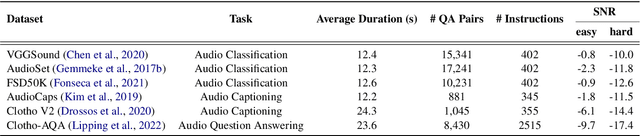
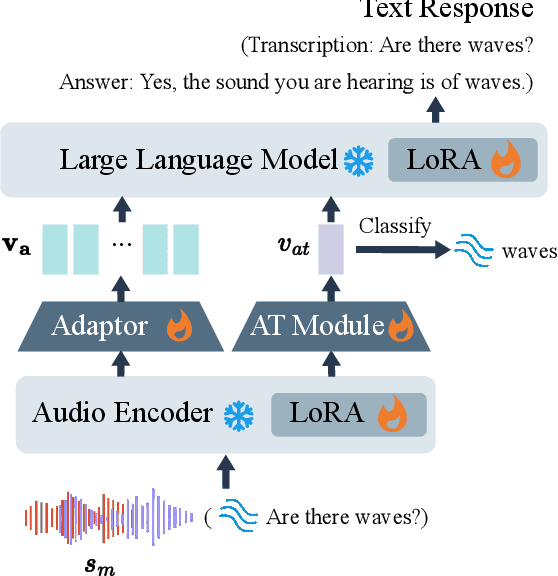
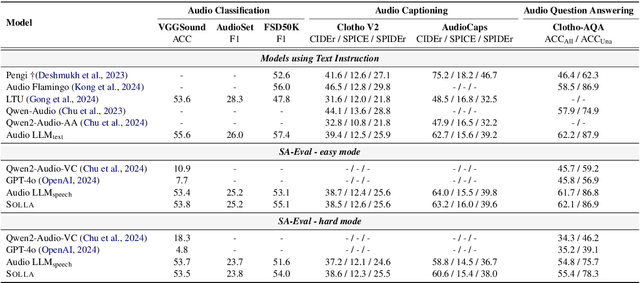
Large Language Models (LLMs) have recently shown remarkable ability to process not only text but also multimodal inputs such as speech and audio. However, most existing models primarily focus on analyzing input signals using text instructions, overlooking scenarios in which speech instructions and audio are mixed and serve as inputs to the model. To address these challenges, we introduce Solla, a novel framework designed to understand speech-based questions and hear the acoustic context concurrently. Solla incorporates an audio tagging module to effectively identify and represent audio events, as well as an ASR-assisted prediction method to improve comprehension of spoken content. To rigorously evaluate Solla and other publicly available models, we propose a new benchmark dataset called SA-Eval, which includes three tasks: audio event classification, audio captioning, and audio question answering. SA-Eval has diverse speech instruction with various speaking styles, encompassing two difficulty levels, easy and hard, to capture the range of real-world acoustic conditions. Experimental results show that Solla performs on par with or outperforms baseline models on both the easy and hard test sets, underscoring its effectiveness in jointly understanding speech and audio.
SD-Eval: A Benchmark Dataset for Spoken Dialogue Understanding Beyond Words
Jun 19, 2024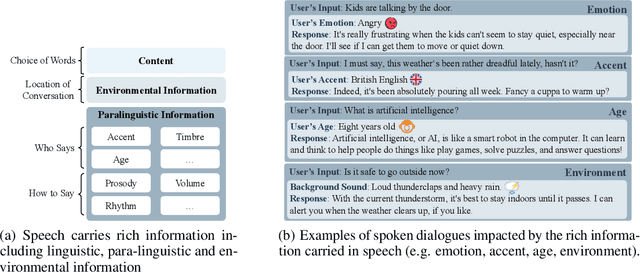
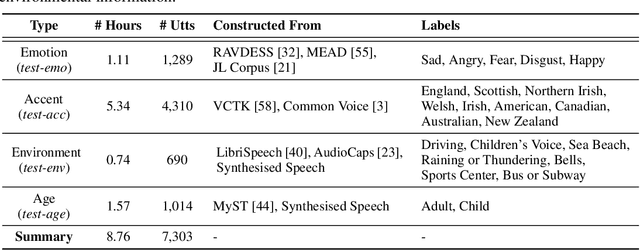
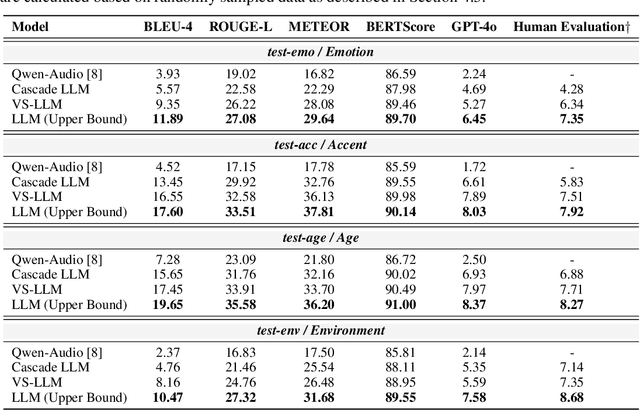
Speech encompasses a wealth of information, including but not limited to content, paralinguistic, and environmental information. This comprehensive nature of speech significantly impacts communication and is crucial for human-computer interaction. Chat-Oriented Large Language Models (LLMs), known for their general-purpose assistance capabilities, have evolved to handle multi-modal inputs, including speech. Although these models can be adept at recognizing and analyzing speech, they often fall short of generating appropriate responses. We argue that this is due to the lack of principles on task definition and model development, which requires open-source datasets and metrics suitable for model evaluation. To bridge the gap, we present SD-Eval, a benchmark dataset aimed at multidimensional evaluation of spoken dialogue understanding and generation. SD-Eval focuses on paralinguistic and environmental information and includes 7,303 utterances, amounting to 8.76 hours of speech data. The data is aggregated from eight public datasets, representing four perspectives: emotion, accent, age, and background sound. To assess the SD-Eval benchmark dataset, we implement three different models and construct a training set following a similar process as SD-Eval. The training set contains 1,052.72 hours of speech data and 724.4k utterances. We also conduct a comprehensive evaluation using objective evaluation methods (e.g. BLEU and ROUGE), subjective evaluations and LLM-based metrics for the generated responses. Models conditioned with paralinguistic and environmental information outperform their counterparts in both objective and subjective measures. Moreover, experiments demonstrate LLM-based metrics show a higher correlation with human evaluation compared to traditional metrics. We open-source SD-Eval at https://github.com/amphionspace/SD-Eval.