 Add to Chrome
 Add to Firefox
 Add to Edge
Can We Defend Against AI-Generated Video Attacks on Real-World Crisis Events? A Systematic Evaluation of Detectors, Generators and Social Dissemination
Aug 14, 2026
Recent video generators can fabricate realistic depictions of wars, disasters, public emergencies, and other real-world crises, creating substantial risks of misinformation. Existing benchmarks, however, provide limited evidence on detector and generator behavior in such settings, including how detectability varies with generation conditions, how people perceive generated videos, and whether detectors remain reliable during social dissemination. To address this gap, we introduce RA-Bench, a benchmark for AI-generated video detection that uses Real videos as Anchors. RA-Bench contains 17,886 videos, comprising 1,830 real-video anchors across 10 social-risk categories and 16,056 generated clips from four open-source and five closed-source generators. Based on RA-Bench, we organize our evaluation along three dimensions. We first assess detector generalization across seven traditional detectors, ten zero-shot multimodal models under three review settings, and two MLLMs specifically fine-tuned on AI-generated video detection. Across these methods, none of the three detector families generalizes consistently across RA-Bench instances. We then examine how detectability varies with generation quality, conditioning information, and sampling seeds. These analyses show that generation properties affect detector families differently, while source-level detection patterns remain stable across seeds. Finally, we study human authenticity judgments and detector reliability during social dissemination. We find that videos that mislead people are also difficult for current detectors, and that social dissemination makes detection harder. Together, these findings show that current methods struggle to detect realistic AI-generated videos, highlighting the need for detectors robust to evolving video generators.

A Unified and Reproducible Experimentation Framework for Speech Understanding
May 29, 2026Speech foundation models and Speech LLMs have advanced speech understanding, yet deployment-oriented model selection is hindered by non-comparable evaluations caused by mismatched post-processing, and by training results that are hard to reproduce across data scales and pipelines. We present SURE, a unified experimentation framework that standardizes prediction formats, normalization, and scoring. SURE evaluates strong systems across paradigms, from conventional pipelines to Speech LLMs, on representative tasks under realistic acoustic and linguistic stressors. Beyond evaluation, SURE introduces an agent-assisted training conversion flow that maps paper and code into versioned, runnable training pipelines under a unified protocol on matched open-data subsets. Overall, SURE improves comparability and reproducibility for deployment-oriented evaluation.
Unified Spatiotemporal Token Compression for Video-LLMs at Ultra-Low Retention
Mar 23, 2026Video large language models (Video-LLMs) face high computational costs due to large volumes of visual tokens. Existing token compression methods typically adopt a two-stage spatiotemporal compression strategy, relying on stage-specific metrics and an implicit assumption of spatiotemporal separability. Under extremely low retention ratios, however, such approaches often result in unbalanced allocation and loss of visual evidence essential for question answering. We reformulate token compression as a spatiotemporal allocation task within a global token retention pool. We propose a unified selection mechanism that integrates attention weights and semantic similarity to globally select tokens with high contribution and low redundancy. Unselected tokens are merged via clustering and refilled, preserving information integrity. Inside the LLM, we further introduce text-aware merging to perform secondary compression based on query relevance. Without requiring retraining, our method serves as a plug-and-play module compatible with existing Video-LLMs. Experiments show that retaining only about 2% of visual tokens preserves 90.1% of baseline performance across multiple benchmarks, while reducing FLOPs to roughly 2.6%. These benefits generalize across diverse backbones, decreasing end-to-end inference latency and memory consumption. Our unified spatiotemporal token compression strategy establishes the state-of-the-art in video understanding under ultra-low token retention.
Large Language Model for Lossless Image Compression with Visual Prompts
Feb 22, 2025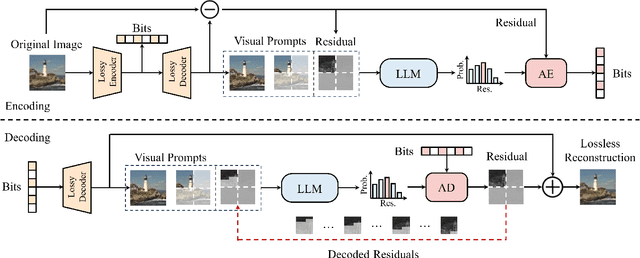
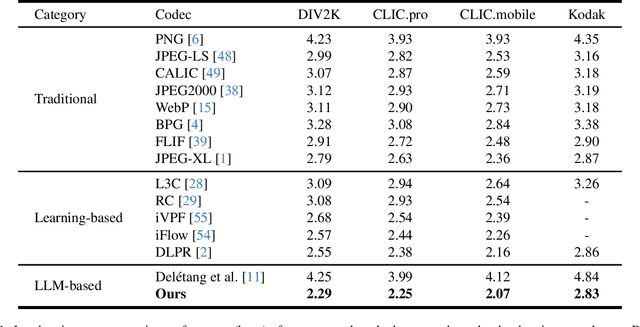
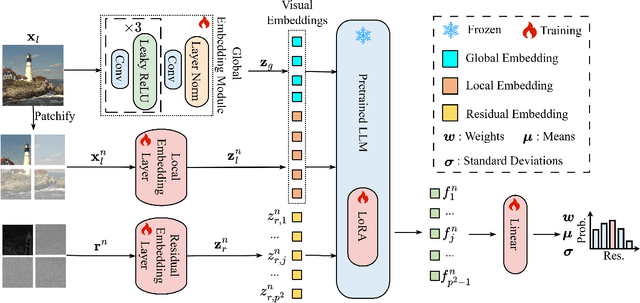
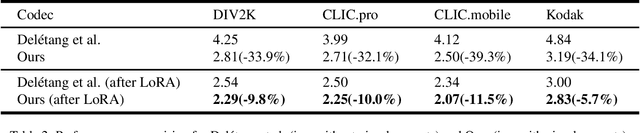
Recent advancements in deep learning have driven significant progress in lossless image compression. With the emergence of Large Language Models (LLMs), preliminary attempts have been made to leverage the extensive prior knowledge embedded in these pretrained models to enhance lossless image compression, particularly by improving the entropy model. However, a significant challenge remains in bridging the gap between the textual prior knowledge within LLMs and lossless image compression. To tackle this challenge and unlock the potential of LLMs, this paper introduces a novel paradigm for lossless image compression that incorporates LLMs with visual prompts. Specifically, we first generate a lossy reconstruction of the input image as visual prompts, from which we extract features to serve as visual embeddings for the LLM. The residual between the original image and the lossy reconstruction is then fed into the LLM along with these visual embeddings, enabling the LLM to function as an entropy model to predict the probability distribution of the residual. Extensive experiments on multiple benchmark datasets demonstrate our method achieves state-of-the-art compression performance, surpassing both traditional and learning-based lossless image codecs. Furthermore, our approach can be easily extended to images from other domains, such as medical and screen content images, achieving impressive performance. These results highlight the potential of LLMs for lossless image compression and may inspire further research in related directions.
Panonut360: A Head and Eye Tracking Dataset for Panoramic Video
Mar 26, 2024With the rapid development and widespread application of VR/AR technology, maximizing the quality of immersive panoramic video services that match users' personal preferences and habits has become a long-standing challenge. Understanding the saliency region where users focus, based on data collected with HMDs, can promote multimedia encoding, transmission, and quality assessment. At the same time, large-scale datasets are essential for researchers and developers to explore short/long-term user behavior patterns and train AI models related to panoramic videos. However, existing panoramic video datasets often include low-frequency user head or eye movement data through short-term videos only, lacking sufficient data for analyzing users' Field of View (FoV) and generating video saliency regions. Driven by these practical factors, in this paper, we present a head and eye tracking dataset involving 50 users (25 males and 25 females) watching 15 panoramic videos. The dataset provides details on the viewport and gaze attention locations of users. Besides, we present some statistics samples extracted from the dataset. For example, the deviation between head and eye movements challenges the widely held assumption that gaze attention decreases from the center of the FoV following a Gaussian distribution. Our analysis reveals a consistent downward offset in gaze fixations relative to the FoV in experimental settings involving multiple users and videos. That's why we name the dataset Panonut, a saliency weighting shaped like a donut. Finally, we also provide a script that generates saliency distributions based on given head or eye coordinates and pre-generated saliency distribution map sets of each video from the collected eye tracking data. The dataset is available on website: https://dianvrlab.github.io/Panonut360/.