 Add to Chrome
 Add to Firefox
 Add to Edge
Generative AI and Federated Learning for Intrusion Detection Systems: A Survey
Jul 01, 2026
Intrusion Detection Systems (IDSs) are essential for monitoring network traffic and identifying malicious activities in modern cyber-physical, Internet of Things (IoT), enterprise, and distributed network environments. However, developing reliable IDS models remains challenging because attack behaviors evolve over time, realistic datasets are difficult to obtain, traffic records may be incomplete, attack classes are often imbalanced, and privacy constraints limit centralized data collection. Recent advances in generative artificial intelligence (AI) and Federated Learning (FL) provide new opportunities to address these limitations. Generative models can support anomaly detection, synthetic traffic generation, data augmentation, data imputation, adversarial traffic generation, and IDS alert explanation. FL enables distributed IDS training without directly sharing local network traffic, making it suitable for privacy-sensitive and geographically distributed environments. This survey provides a structured review of generative AI and FL techniques for IDS. We first summarize representative IDS research directions, including adversarial machine learning, anomaly-based detection, IoT-oriented IDS, explainable IDS, and benchmark datasets. We then categorize generative AI applications in IDS according to model families and task objectives, covering autoencoder-based models, Generative Adversarial Networks (GANs), diffusion models, and Large Language Models (LLMs). Finally, we review emerging studies that integrate generative AI with FL-based IDS and discuss open challenges, including synthetic data quality, realistic traffic generation, dual-use adversarial risks, non-IID client distributions, communication-efficient model sharing, federated IDS benchmarking, and domain-specific LLMs for network security.

MCP-in-SoS: Risk assessment framework for open-source MCP servers
Mar 10, 2026Model Context Protocol (MCP) servers have rapidly emerged over the past year as a widely adopted way to enable Large Language Model (LLM) agents to access dynamic, real-world tools. As MCP servers proliferate and become easy to adopt via open-source releases, understanding their security risks becomes essential for dependable production agent deployments. Recent work has developed MCP threat taxonomies, proposed mitigations, and demonstrated practical attacks. However, to the best of our knowledge, no prior study has conducted a systematic, large-scale assessment of weaknesses in open-source MCP servers. Motivated by this gap, we apply static code analysis to identify Common Weakness Enumeration (CWE) weaknesses and map them to common attack patterns and threat categories using the MITRE Common Attack Pattern Enumerations and Classifications (CAPEC) to ground risk in real-world threats. We then introduce a risk-assessment framework for the MCP landscape that combines these threats using a multi-metric scoring of likelihood and impact. Our findings show that many open-source MCP servers contain exploitable weaknesses that can compromise confidentiality, integrity, and availability, underscoring the need for secure-by-design MCP server development.
NetDiffuser: Deceiving DNN-Based Network Attack Detection Systems with Diffusion-Generated Adversarial Traffic
Mar 09, 2026Deep learning (DL)-based Network Intrusion Detection System (NIDS) has demonstrated great promise in detecting malicious network traffic. However, they face significant security risks due to their vulnerability to adversarial examples (AEs). Most existing adversarial attacks maliciously perturb data to maximize misclassification errors. Among AEs, natural adversarial examples (NAEs) are particularly difficult to detect because they closely resemble real data, making them challenging for both humans and machine learning models to distinguish from legitimate inputs. Creating NAEs is crucial for testing and strengthening NIDS defenses. This paper proposes NetDiffuser1, a novel framework for generating NAEs capable of deceiving NIDS. NetDiffuser consists of two novel components. First, a new feature categorization algorithm is designed to identify relatively independent features in network traffic. Perturbing these features minimizes changes while preserving network flow validity. The second component is a novel application of diffusion models to inject semantically consistent perturbations for generating NAEs. NetDiffuser performance was extensively evaluated using three benchmark NIDS datasets across various model architectures and state-of-the-art adversarial detectors. Our experimental results show that NetDiffuser achieves up to a 29.93% higher attack success rate and reduces AE detection performance by at least 0.267 (in some cases up to 0.534) in the Area under the Receiver Operating Characteristic Curve (AUC-ROC) score compared to the baseline attacks.
LATTEO: A Framework to Support Learning Asynchronously Tempered with Trusted Execution and Obfuscation
Feb 07, 2025The privacy vulnerabilities of the federated learning (FL) paradigm, primarily caused by gradient leakage, have prompted the development of various defensive measures. Nonetheless, these solutions have predominantly been crafted for and assessed in the context of synchronous FL systems, with minimal focus on asynchronous FL. This gap arises in part due to the unique challenges posed by the asynchronous setting, such as the lack of coordinated updates, increased variability in client participation, and the potential for more severe privacy risks. These concerns have stymied the adoption of asynchronous FL. In this work, we first demonstrate the privacy vulnerabilities of asynchronous FL through a novel data reconstruction attack that exploits gradient updates to recover sensitive client data. To address these vulnerabilities, we propose a privacy-preserving framework that combines a gradient obfuscation mechanism with Trusted Execution Environments (TEEs) for secure asynchronous FL aggregation at the network edge. To overcome the limitations of conventional enclave attestation, we introduce a novel data-centric attestation mechanism based on Multi-Authority Attribute-Based Encryption. This mechanism enables clients to implicitly verify TEE-based aggregation services, effectively handle on-demand client participation, and scale seamlessly with an increasing number of asynchronous connections. Our gradient obfuscation mechanism reduces the structural similarity index of data reconstruction by 85% and increases reconstruction error by 400%, while our framework improves attestation efficiency by lowering average latency by up to 1500% compared to RA-TLS, without additional overhead.
Fides: A Generative Framework for Result Validation of Outsourced Machine Learning Workloads via TEE
Mar 31, 2023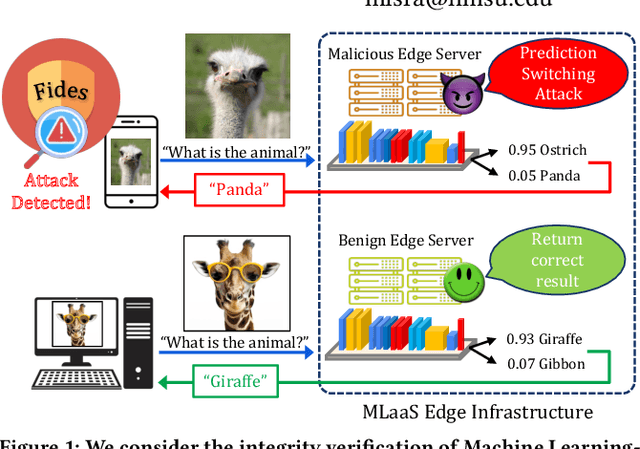
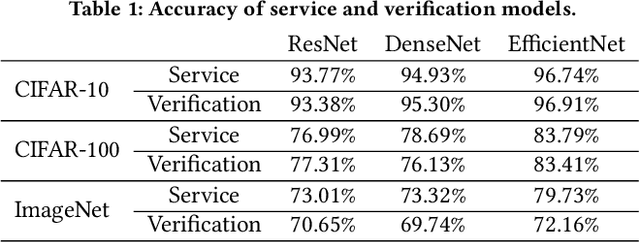
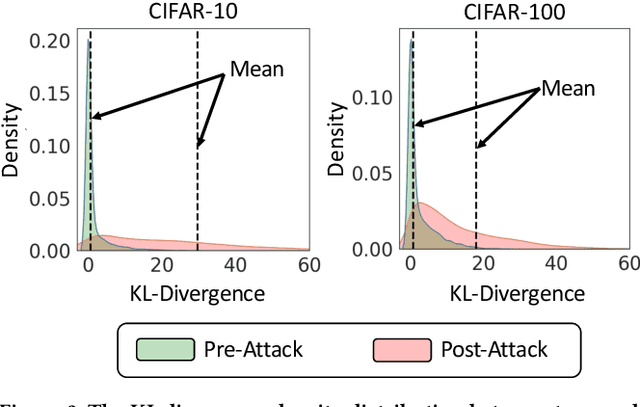
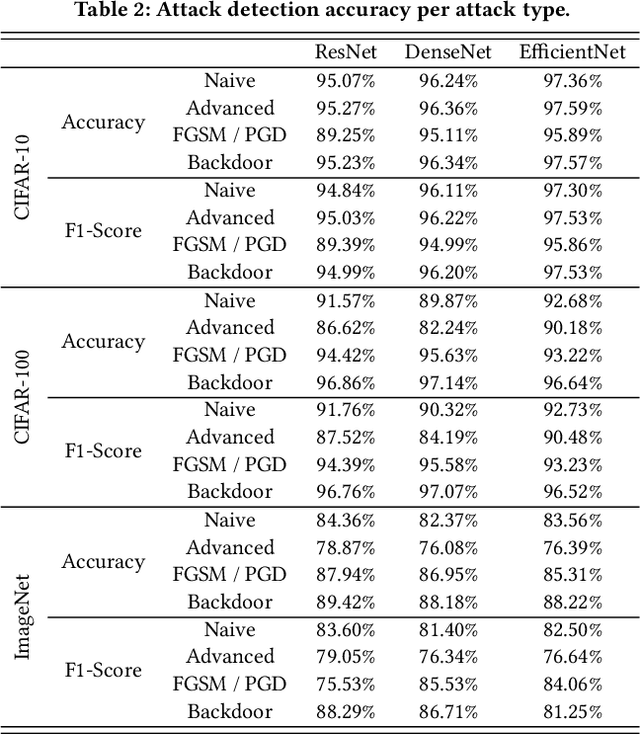
The growing popularity of Machine Learning (ML) has led to its deployment in various sensitive domains, which has resulted in significant research focused on ML security and privacy. However, in some applications, such as autonomous driving, integrity verification of the outsourced ML workload is more critical-a facet that has not received much attention. Existing solutions, such as multi-party computation and proof-based systems, impose significant computation overhead, which makes them unfit for real-time applications. We propose Fides, a novel framework for real-time validation of outsourced ML workloads. Fides features a novel and efficient distillation technique-Greedy Distillation Transfer Learning-that dynamically distills and fine-tunes a space and compute-efficient verification model for verifying the corresponding service model while running inside a trusted execution environment. Fides features a client-side attack detection model that uses statistical analysis and divergence measurements to identify, with a high likelihood, if the service model is under attack. Fides also offers a re-classification functionality that predicts the original class whenever an attack is identified. We devised a generative adversarial network framework for training the attack detection and re-classification models. The extensive evaluation shows that Fides achieves an accuracy of up to 98% for attack detection and 94% for re-classification.
AMI-FML: A Privacy-Preserving Federated Machine Learning Framework for AMI
Sep 13, 2021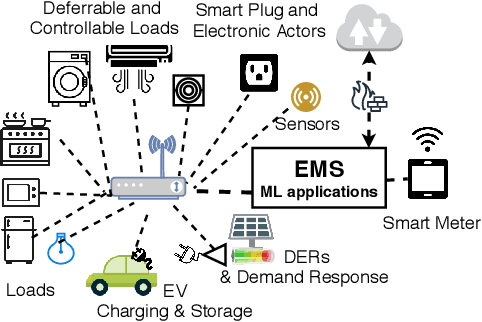
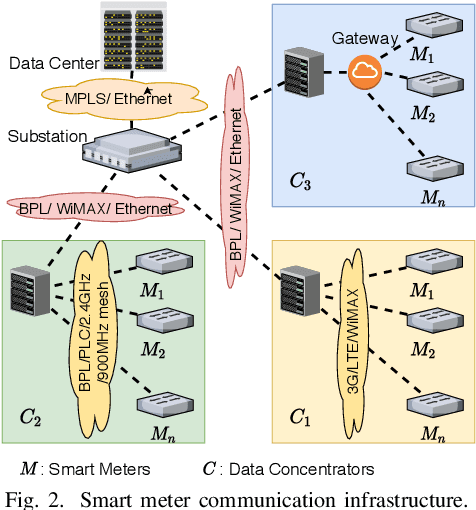
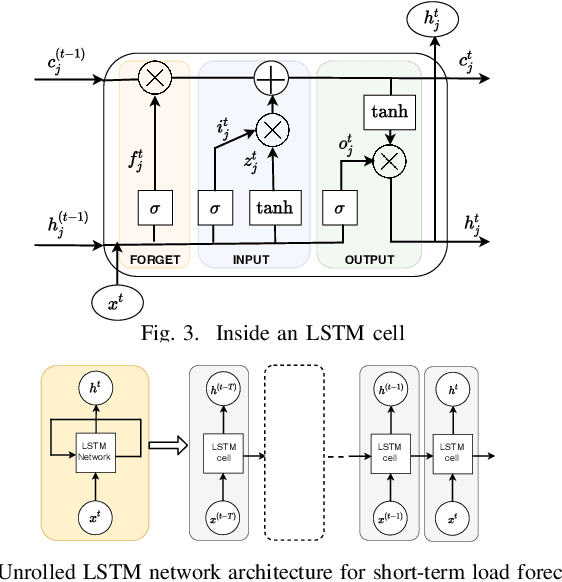
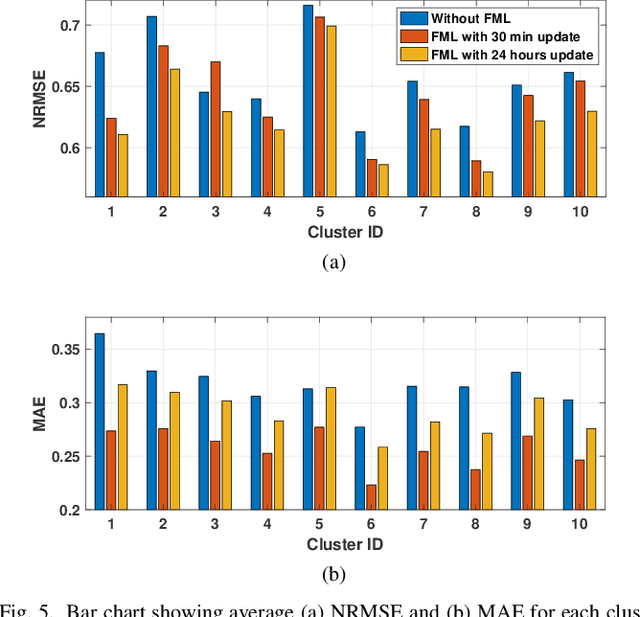
Machine learning (ML) based smart meter data analytics is very promising for energy management and demand-response applications in the advanced metering infrastructure(AMI). A key challenge in developing distributed ML applications for AMI is to preserve user privacy while allowing active end-users participation. This paper addresses this challenge and proposes a privacy-preserving federated learning framework for ML applications in the AMI. We consider each smart meter as a federated edge device hosting an ML application that exchanges information with a central aggregator or a data concentrator, periodically. Instead of transferring the raw data sensed by the smart meters, the ML model weights are transferred to the aggregator to preserve privacy. The aggregator processes these parameters to devise a robust ML model that can be substituted at each edge device. We also discuss strategies to enhance privacy and improve communication efficiency while sharing the ML model parameters, suited for relatively slow network connections in the AMI. We demonstrate the proposed framework on a use case federated ML (FML) application that improves short-term load forecasting (STLF). We use a long short-term memory(LSTM) recurrent neural network (RNN) model for STLF. In our architecture, we assume that there is an aggregator connected to a group of smart meters. The aggregator uses the learned model gradients received from the federated smart meters to generate an aggregate, robust RNN model which improves the forecasting accuracy for individual and aggregated STLF. Our results indicate that with FML, forecasting accuracy is increased while preserving the data privacy of the end-users.