 Add to Chrome
 Add to Firefox
 Add to Edge
Bi-Level Collaborative Learning for Few-Shot Scribble-Supervised Medical Image Segmentation
Jul 28, 2026
Scribble annotations offer an efficient alternative to costly pixel-wise labeling for medical image segmentation, yet in real clinical scenarios, scribble-annotated samples are often still limited, imposing the dual challenges of sparse supervision and annotated sample scarcity. These compounded constraints severely deprive models of the structural evidence needed for complete region recovery and precise boundary delineation. To break this bottleneck, we propose a bi-level collaborative learning framework for few-shot scribble-supervised medical image segmentation. Specifically, an upper-level learnable superpixel model is introduced to provide region-structural priors for lower-level segmentation, while superpixel-based region-wise pseudo-label propagation and a spatial-prior-guided filtering strategy are performed to generate reliable dense pseudo-labels for segmentation learning. Meanwhile, the anatomical semantics learned by the lower-level segmentation model under the guidance of the current superpixels are fed back to the upper level, further driving it to learn region-structural representations better aligned with the segmentation task. Through bidirectional interaction and collaborative learning between the upper and lower levels, the proposed framework significantly outperforms existing state-of-the-art scribble-supervised methods on the ACDC and Prostate datasets under the few-shot scribble-supervised setting.

GNN-Coder: Boosting Semantic Code Retrieval with Combined GNNs and Transformer
Feb 21, 2025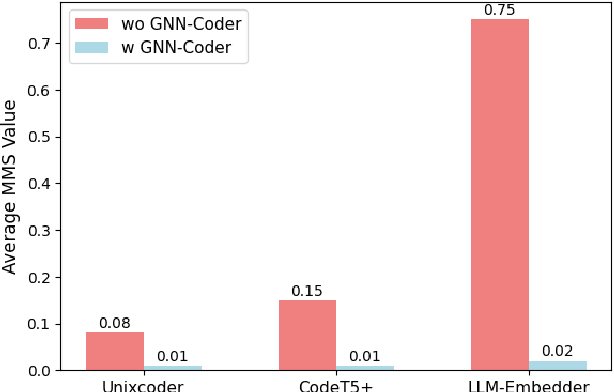
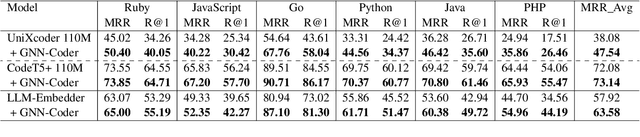
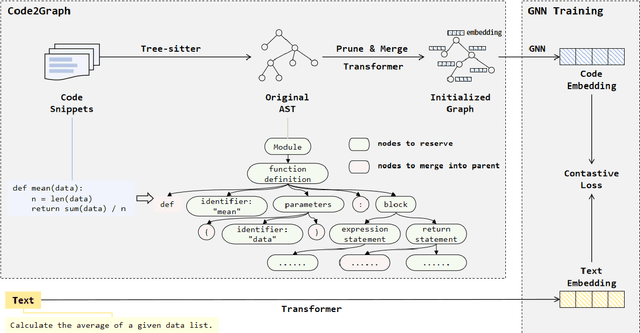
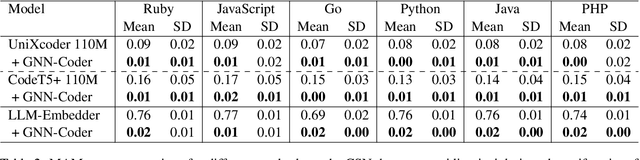
Code retrieval is a crucial component in modern software development, particularly in large-scale projects. However, existing approaches relying on sequence-based models often fail to fully exploit the structural dependencies inherent in code, leading to suboptimal retrieval performance, particularly with structurally complex code fragments. In this paper, we introduce GNN-Coder, a novel framework based on Graph Neural Network (GNN) to utilize Abstract Syntax Tree (AST). We make the first attempt to study how GNN-integrated Transformer can promote the development of semantic retrieval tasks by capturing the structural and semantic features of code. We further propose an innovative graph pooling method tailored for AST, utilizing the number of child nodes as a key feature to highlight the intrinsic topological relationships within the AST. This design effectively integrates both sequential and hierarchical representations, enhancing the model's ability to capture code structure and semantics. Additionally, we introduce the Mean Angular Margin (MAM), a novel metric for quantifying the uniformity of code embedding distributions, providing a standardized measure of feature separability. The proposed method achieves a lower MAM, indicating a more discriminative feature representation. This underscores GNN-Coder's superior ability to distinguish between code snippets, thereby enhancing retrieval accuracy. Experimental results show that GNN-Coder significantly boosts retrieval performance, with a 1\%-10\% improvement in MRR on the CSN dataset, and a notable 20\% gain in zero-shot performance on the CosQA dataset.
Process-Supervised Reinforcement Learning for Code Generation
Feb 03, 2025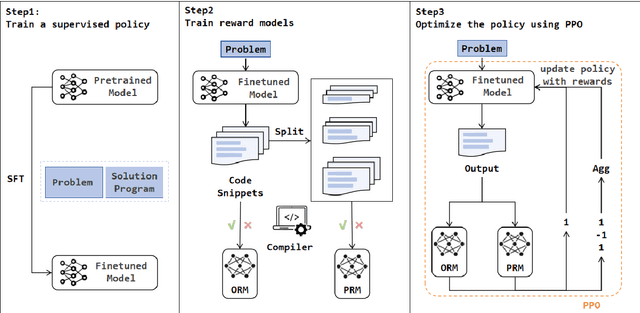
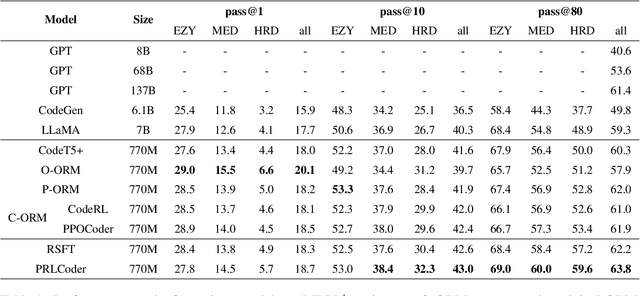
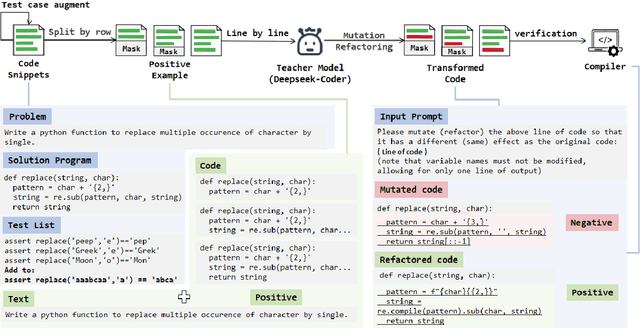
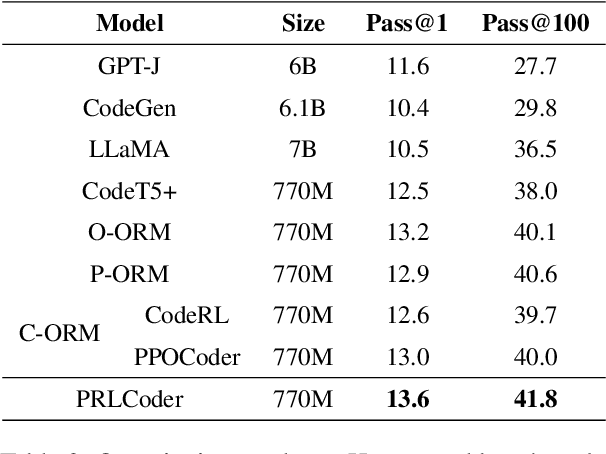
Existing reinforcement learning strategies based on outcome supervision have proven effective in enhancing the performance of large language models(LLMs) for code generation. While reinforcement learning based on process supervision has shown great promise in handling multi-step reasoning tasks, its effectiveness in code generation remains largely underexplored and underjustified. The primary obstacle stems from the resource-intensive nature of constructing high-quality process-supervised data, which demands substantial human expertise and computational resources. In response to this challenge, we propose a "statement mutation/refactoring-compile and execution verification" strategy: mutating and refactoring code line-by-line through a teacher model, and utilizing compiler execution results to automatically label each line, resulting in line-by-line process-supervised data, which is pivotal for training a process-supervised reward model. The trained reward model is then integrated into the PRLCoder framework, followed by experimental validation on several benchmarks. Experimental results demonstrate that process-supervised reinforcement learning significantly surpasses methods relying solely on outcome supervision. Notably, in tackling complex code generation tasks, process-supervised reinforcement learning shows a clear advantage, ensuring both the integrity of the code generation process and the correctness of the generation results.