 Add to Chrome
 Add to Firefox
 Add to Edge
DynaTok: Token-Based 4D Reconstruction from Partial Point Clouds
Jun 10, 2026
We address 4D reconstruction from partial point cloud sequences, where depth-sensor observations are incomplete, unordered, and lack explicit temporal correspondences. This geometry-only setting is challenging due to missing observations and ambiguous dynamics. While recent progress has largely relied on image-based methods, existing point-based approaches typically focus on single objects, assume relatively complete inputs, or require explicit correspondences. To address these limitations, we propose DynaTok, a point-based framework for correspondence-free 4D reconstruction from partial point cloud sequences without images. DynaTok encodes frames into compact latent tokens, aggregates incomplete observations over time with a Transformer-based spatiotemporal encoder, and decouples geometry and motion through residual tokens in a unified model. A flow-matching decoder then reconstructs complete, temporally consistent 4D point-cloud sequences conditioned on the latent tokens. Experiments on object- and scene-level benchmarks demonstrate improved reconstruction quality and temporal coherence from partial point cloud observations. Project page: https://wrchen530.github.io/dynatok/.

BA-T: An Iterative Transformer for Two-View Bundle Adjustment
Jun 02, 2026Feed-forward models for 3D reconstruction have achieved strong performance using deep cross-view attention to exchange information across images. However, these approaches often depend on heavy decoder stacks and lack a structured mechanism for geometry refinement, resulting in poor multi-view consistency. We address this by drawing inspiration from classical bundle adjustment (BA), which can be viewed as an iterative information propagation process between poses and local geometry. Inspired by BA, we propose BA-T, an iterative Transformer that implements BA-style structured updates as a repeatable layer in implicit token space. Instead of relying on deep attention stacks, BA-T refines predictions based on latent residual by a single lightweight layer. Experiments demonstrate that BA-T progressively improves pose and reconstruction accuracy across iterations, achieves stronger cross-view consistency than conventional decoders, and matches or surpasses substantially larger models while using only 16% of their decoder parameters. BA-T provides a compact, efficient, and structural alternative to depth-heavy attention, enabling accurate 3D reconstruction within a lightweight architecture. The code will be made publicly at https://github.com/zhangganlin/BA-T.
CalibAnyView: Beyond Single-View Camera Calibration in the Wild
May 14, 2026Camera calibration is a fundamental prerequisite for reliable geometric perception, yet classical approaches rely on controlled acquisition setups that are impractical for in-the-wild imagery. Recent learning-based methods have shown promising results for single-view calibration, but inherently neglect geometric consistency across multiple views. We introduce CalibAnyView, a unified formulation that supports an arbitrary number of input views ($N \geq 1$) by explicitly modeling cross-view geometric consistency. To facilitate this, we construct a large-scale multi-view video dataset covering diverse real-world scenarios, including multiple camera models, dynamic scenes, realistic motion trajectories, and heterogeneous lens distortions. Building on this dataset, we develop a multi-view transformer that predicts dense perspective fields, which are further integrated into a geometric optimization framework to jointly estimate camera intrinsics and gravity direction. Extensive experiments demonstrate that CalibAnyView consistently outperforms state-of-the-art methods, achieves strong robustness under single-view settings, and further improves with multi-view inference, providing a reliable foundation for downstream tasks such as 3D reconstruction and robotic perception in the wild.
NOVA3R: Non-pixel-aligned Visual Transformer for Amodal 3D Reconstruction
Mar 05, 2026We present NOVA3R, an effective approach for non-pixel-aligned 3D reconstruction from a set of unposed images in a feed-forward manner. Unlike pixel-aligned methods that tie geometry to per-ray predictions, our formulation learns a global, view-agnostic scene representation that decouples reconstruction from pixel alignment. This addresses two key limitations in pixel-aligned 3D: (1) it recovers both visible and invisible points with a complete scene representation, and (2) it produces physically plausible geometry with fewer duplicated structures in overlapping regions. To achieve this, we introduce a scene-token mechanism that aggregates information across unposed images and a diffusion-based 3D decoder that reconstructs complete, non-pixel-aligned point clouds. Extensive experiments on both scene-level and object-level datasets demonstrate that NOVA3R outperforms state-of-the-art methods in terms of reconstruction accuracy and completeness.
Back on Track: Bundle Adjustment for Dynamic Scene Reconstruction
Apr 20, 2025Traditional SLAM systems, which rely on bundle adjustment, struggle with highly dynamic scenes commonly found in casual videos. Such videos entangle the motion of dynamic elements, undermining the assumption of static environments required by traditional systems. Existing techniques either filter out dynamic elements or model their motion independently. However, the former often results in incomplete reconstructions, whereas the latter can lead to inconsistent motion estimates. Taking a novel approach, this work leverages a 3D point tracker to separate the camera-induced motion from the observed motion of dynamic objects. By considering only the camera-induced component, bundle adjustment can operate reliably on all scene elements as a result. We further ensure depth consistency across video frames with lightweight post-processing based on scale maps. Our framework combines the core of traditional SLAM -- bundle adjustment -- with a robust learning-based 3D tracker front-end. Integrating motion decomposition, bundle adjustment and depth refinement, our unified framework, BA-Track, accurately tracks the camera motion and produces temporally coherent and scale-consistent dense reconstructions, accommodating both static and dynamic elements. Our experiments on challenging datasets reveal significant improvements in camera pose estimation and 3D reconstruction accuracy.
AnyCam: Learning to Recover Camera Poses and Intrinsics from Casual Videos
Mar 30, 2025Estimating camera motion and intrinsics from casual videos is a core challenge in computer vision. Traditional bundle-adjustment based methods, such as SfM and SLAM, struggle to perform reliably on arbitrary data. Although specialized SfM approaches have been developed for handling dynamic scenes, they either require intrinsics or computationally expensive test-time optimization and often fall short in performance. Recently, methods like Dust3r have reformulated the SfM problem in a more data-driven way. While such techniques show promising results, they are still 1) not robust towards dynamic objects and 2) require labeled data for supervised training. As an alternative, we propose AnyCam, a fast transformer model that directly estimates camera poses and intrinsics from a dynamic video sequence in feed-forward fashion. Our intuition is that such a network can learn strong priors over realistic camera poses. To scale up our training, we rely on an uncertainty-based loss formulation and pre-trained depth and flow networks instead of motion or trajectory supervision. This allows us to use diverse, unlabelled video datasets obtained mostly from YouTube. Additionally, we ensure that the predicted trajectory does not accumulate drift over time through a lightweight trajectory refinement step. We test AnyCam on established datasets, where it delivers accurate camera poses and intrinsics both qualitatively and quantitatively. Furthermore, even with trajectory refinement, AnyCam is significantly faster than existing works for SfM in dynamic settings. Finally, by combining camera information, uncertainty, and depth, our model can produce high-quality 4D pointclouds.
DynSUP: Dynamic Gaussian Splatting from An Unposed Image Pair
Dec 01, 2024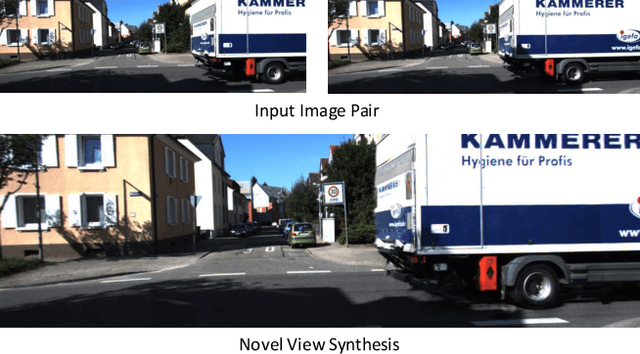
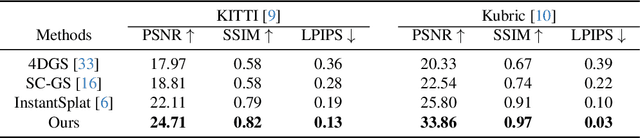
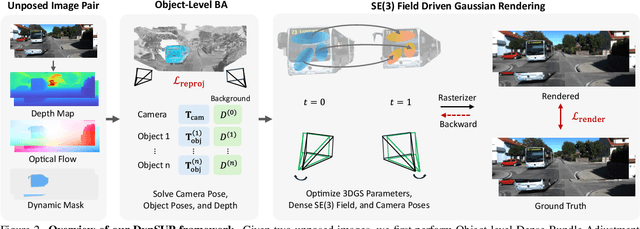
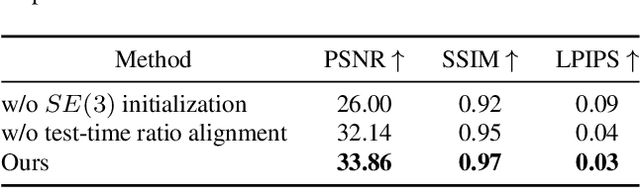
Recent advances in 3D Gaussian Splatting have shown promising results. Existing methods typically assume static scenes and/or multiple images with prior poses. Dynamics, sparse views, and unknown poses significantly increase the problem complexity due to insufficient geometric constraints. To overcome this challenge, we propose a method that can use only two images without prior poses to fit Gaussians in dynamic environments. To achieve this, we introduce two technical contributions. First, we propose an object-level two-view bundle adjustment. This strategy decomposes dynamic scenes into piece-wise rigid components, and jointly estimates the camera pose and motions of dynamic objects. Second, we design an SE(3) field-driven Gaussian training method. It enables fine-grained motion modeling through learnable per-Gaussian transformations. Our method leads to high-fidelity novel view synthesis of dynamic scenes while accurately preserving temporal consistency and object motion. Experiments on both synthetic and real-world datasets demonstrate that our method significantly outperforms state-of-the-art approaches designed for the cases of static environments, multiple images, and/or known poses. Our project page is available at https://colin-de.github.io/DynSUP/.
LEAP-VO: Long-term Effective Any Point Tracking for Visual Odometry
Jan 03, 2024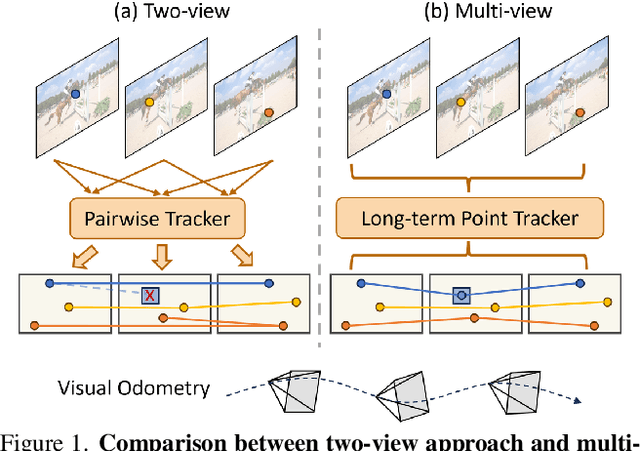
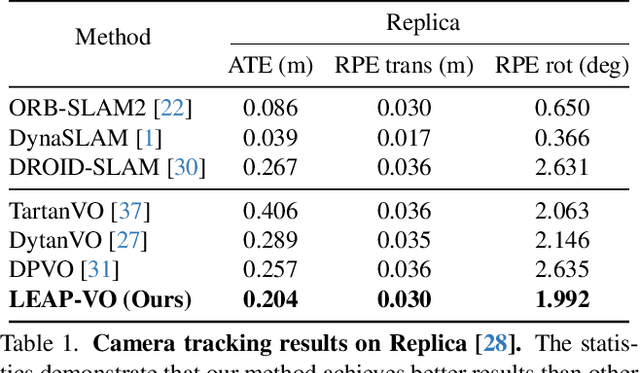
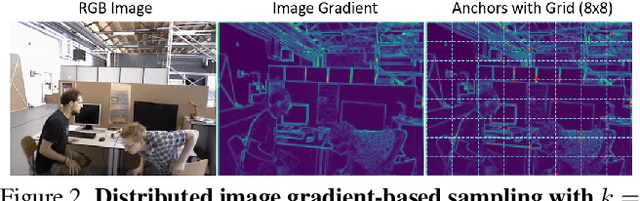

Visual odometry estimates the motion of a moving camera based on visual input. Existing methods, mostly focusing on two-view point tracking, often ignore the rich temporal context in the image sequence, thereby overlooking the global motion patterns and providing no assessment of the full trajectory reliability. These shortcomings hinder performance in scenarios with occlusion, dynamic objects, and low-texture areas. To address these challenges, we present the Long-term Effective Any Point Tracking (LEAP) module. LEAP innovatively combines visual, inter-track, and temporal cues with mindfully selected anchors for dynamic track estimation. Moreover, LEAP's temporal probabilistic formulation integrates distribution updates into a learnable iterative refinement module to reason about point-wise uncertainty. Based on these traits, we develop LEAP-VO, a robust visual odometry system adept at handling occlusions and dynamic scenes. Our mindful integration showcases a novel practice by employing long-term point tracking as the front-end. Extensive experiments demonstrate that the proposed pipeline significantly outperforms existing baselines across various visual odometry benchmarks.
Leveraging Neural Radiance Fields for Uncertainty-Aware Visual Localization
Oct 10, 2023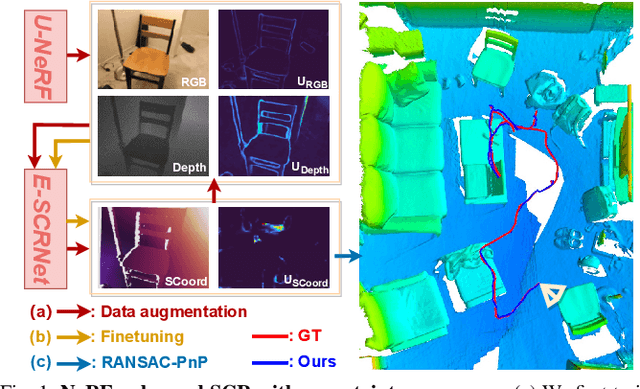
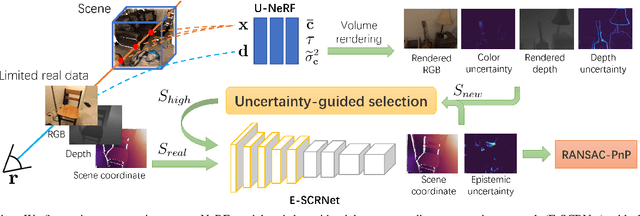
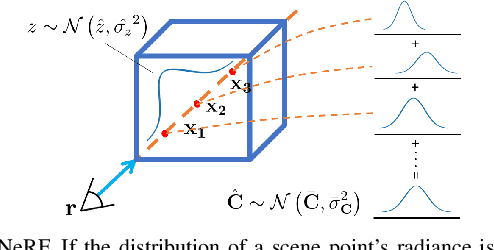
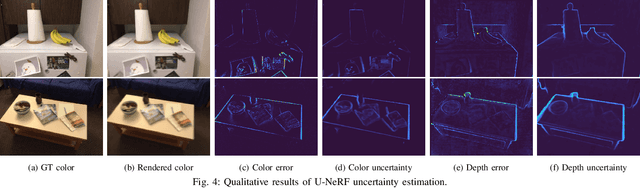
As a promising fashion for visual localization, scene coordinate regression (SCR) has seen tremendous progress in the past decade. Most recent methods usually adopt neural networks to learn the mapping from image pixels to 3D scene coordinates, which requires a vast amount of annotated training data. We propose to leverage Neural Radiance Fields (NeRF) to generate training samples for SCR. Despite NeRF's efficiency in rendering, many of the rendered data are polluted by artifacts or only contain minimal information gain, which can hinder the regression accuracy or bring unnecessary computational costs with redundant data. These challenges are addressed in three folds in this paper: (1) A NeRF is designed to separately predict uncertainties for the rendered color and depth images, which reveal data reliability at the pixel level. (2) SCR is formulated as deep evidential learning with epistemic uncertainty, which is used to evaluate information gain and scene coordinate quality. (3) Based on the three arts of uncertainties, a novel view selection policy is formed that significantly improves data efficiency. Experiments on public datasets demonstrate that our method could select the samples that bring the most information gain and promote the performance with the highest efficiency.
Uncertainty-Driven Dense Two-View Structure from Motion
Feb 12, 2023This work introduces an effective and practical solution to the dense two-view structure from motion (SfM) problem. One vital question addressed is how to mindfully use per-pixel optical flow correspondence between two frames for accurate pose estimation -- as perfect per-pixel correspondence between two images is difficult, if not impossible, to establish. With the carefully estimated camera pose and predicted per-pixel optical flow correspondences, a dense depth of the scene is computed. Later, an iterative refinement procedure is introduced to further improve optical flow matching confidence, camera pose, and depth, exploiting their inherent dependency in rigid SfM. The fundamental idea presented is to benefit from per-pixel uncertainty in the optical flow estimation and provide robustness to the dense SfM system via an online refinement. Concretely, we introduce our uncertainty-driven Dense Two-View SfM pipeline (DTV-SfM), consisting of an uncertainty-aware dense optical flow estimation approach that provides per-pixel correspondence with their confidence score of matching; a weighted dense bundle adjustment formulation that depends on optical flow uncertainty and bidirectional optical flow consistency to refine both pose and depth; a depth estimation network that considers its consistency with the estimated poses and optical flow respecting epipolar constraint. Extensive experiments show that the proposed approach achieves remarkable depth accuracy and state-of-the-art camera pose results superseding SuperPoint and SuperGlue accuracy when tested on benchmark datasets such as DeMoN, YFCC100M, and ScanNet. Code and more materials are available at http://vis.xyz/pub/dtv-sfm.