 Add to Chrome
 Add to Firefox
 Add to Edge
RayTun3R: Online Camera Adaptation in 3D Foundation Models
Jul 02, 2026
Recent 3D foundation models, such as DUSt3R, MASt3R, VGGT, $π^3$, and Depth Anything 3, provide strong feed-forward depth and pose estimates on pinhole imagery, but degrade sharply under fisheye camera geometry. We show that this failure is partly caused by a pinhole camera bias in the positional encodings of pretrained 3D foundation models, and propose RayTun3R, a lightweight camera adaptation approach. It keeps the pretrained network fixed and adapts only lightweight components tied to token position and camera geometry. RayTun3R learns parameter-efficient residual corrections to absolute and rotary positional encodings, together with parameter-free tokenization and corrections to prediction-grid coordinates that remove residual pinhole assumptions. The resulting adapter contains only 10,752 trainable parameters and can be learned from a short temporal segment using geometric losses. Once adapted, RayTun3R transfers effectively to the remaining frames of the sequence without incurring additional runtime costs. Across diverse fisheye datasets with fields of view from $110^\circ$ to $200^\circ$, our adapter reduces rotation error by $2$-$12\times$ relative to the unadapted model, outperforms LoRA while using $\sim\!14\times$ fewer trainable parameters, improves pose over adaptation-free baselines while avoiding their multi-view inference cost, and remains competitive on depth accuracy.

Segmenting, Fast and Slow: Real-Time Open-Vocabulary Video Instance Segmentation with Dual-Path Processing
Jun 30, 2026Object-centric models inspired by DETR have become the dominant paradigm for open-vocabulary video instance segmentation (OV-VIS). While recent efforts have reduced the computational cost of pixel decoding, textual modality fusion, and object decoding to make these architectures more suitable for mobile devices, real-time on-device inference at high frame rates remains an open challenge. In this paper, we introduce SegFS, a dual-stream fast-slow framework that significantly improves efficiency without sacrificing accuracy. On sparse keyframes, an open-vocabulary object-based model predicts instance-level representations. These representations are then projected back into the backbone feature space to condition a lightweight fast network, which efficiently relocalizes and segments the instances in subsequent frames. By shifting instance propagation from object decoding to feature-space conditioning, our approach decouples multimodal semantic understanding from dense mask prediction and enables efficient temporal propagation. The proposed fast branch achieves up to 14x lower latency than the mobile-oriented MOBIUS model, while maintaining competitive segmentation performance on standard OV-VIS benchmarks.
Scene-Centric Unsupervised Video Panoptic Segmentation
Jun 03, 2026Video panoptic segmentation (VPS) aims to jointly detect, segment, and track all objects while partitioning the video into semantically consistent regions. We introduce the task setting of unsupervised VPS, omitting any human supervision. Existing unsupervised scene understanding works mainly focused on image segmentation tasks; the video domain remains underexplored. We propose VideoCUPS, the first unsupervised VPS approach. VideoCUPS generates temporally consistent panoptic video pseudo-labels from scene-centric videos by exploiting unsupervised depth, motion, and visual cues. Training on these pseudo-labels using a novel Video DropLoss yields an accurate, unsupervised VPS model. To benchmark progress, we introduce a comprehensive evaluation protocol and four competitive baselines, extending state-of-the-art unsupervised panoptic image and instance video segmentation models to VPS. VideoCUPS outperforms all baselines and demonstrates strong label-efficient learning. With VideoCUPS, our evaluation protocol, and baselines, we provide a strong foundation for future research on unsupervised VPS.
Generative Shape Reconstruction with Geometry-Guided Langevin Dynamics
Mar 27, 2026Reconstructing complete 3D shapes from incomplete or noisy observations is a fundamentally ill-posed problem that requires balancing measurement consistency with shape plausibility. Existing methods for shape reconstruction can achieve strong geometric fidelity in ideal conditions but fail under realistic conditions with incomplete measurements or noise. At the same time, recent generative models for 3D shapes can synthesize highly realistic and detailed shapes but fail to be consistent with observed measurements. In this work, we introduce GG-Langevin: Geometry-Guided Langevin dynamics, a probabilistic approach that unifies these complementary perspectives. By traversing the trajectories of Langevin dynamics induced by a diffusion model, while preserving measurement consistency at every step, we generatively reconstruct shapes that fit both the measurements and the data-informed prior. We demonstrate through extensive experiments that GG-Langevin achieves higher geometric accuracy and greater robustness to missing data than existing methods for surface reconstruction.
FlowFeat: Pixel-Dense Embedding of Motion Profiles
Nov 10, 2025Dense and versatile image representations underpin the success of virtually all computer vision applications. However, state-of-the-art networks, such as transformers, produce low-resolution feature grids, which are suboptimal for dense prediction tasks. To address this limitation, we present FlowFeat, a high-resolution and multi-task feature representation. The key ingredient behind FlowFeat is a novel distillation technique that embeds a distribution of plausible apparent motions, or motion profiles. By leveraging optical flow networks and diverse video data, we develop an effective self-supervised training framework that statistically approximates the apparent motion. With its remarkable level of spatial detail, FlowFeat encodes a compelling degree of geometric and semantic cues while exhibiting high temporal consistency. Empirically, FlowFeat significantly enhances the representational power of five state-of-the-art encoders and alternative upsampling strategies across three dense tasks: video object segmentation, monocular depth estimation and semantic segmentation. Training FlowFeat is computationally inexpensive and robust to inaccurate flow estimation, remaining highly effective even when using unsupervised flow networks. Our work takes a step forward towards reliable and versatile dense image representations.
Back on Track: Bundle Adjustment for Dynamic Scene Reconstruction
Apr 20, 2025Traditional SLAM systems, which rely on bundle adjustment, struggle with highly dynamic scenes commonly found in casual videos. Such videos entangle the motion of dynamic elements, undermining the assumption of static environments required by traditional systems. Existing techniques either filter out dynamic elements or model their motion independently. However, the former often results in incomplete reconstructions, whereas the latter can lead to inconsistent motion estimates. Taking a novel approach, this work leverages a 3D point tracker to separate the camera-induced motion from the observed motion of dynamic objects. By considering only the camera-induced component, bundle adjustment can operate reliably on all scene elements as a result. We further ensure depth consistency across video frames with lightweight post-processing based on scale maps. Our framework combines the core of traditional SLAM -- bundle adjustment -- with a robust learning-based 3D tracker front-end. Integrating motion decomposition, bundle adjustment and depth refinement, our unified framework, BA-Track, accurately tracks the camera motion and produces temporally coherent and scale-consistent dense reconstructions, accommodating both static and dynamic elements. Our experiments on challenging datasets reveal significant improvements in camera pose estimation and 3D reconstruction accuracy.
Scene-Centric Unsupervised Panoptic Segmentation
Apr 02, 2025Unsupervised panoptic segmentation aims to partition an image into semantically meaningful regions and distinct object instances without training on manually annotated data. In contrast to prior work on unsupervised panoptic scene understanding, we eliminate the need for object-centric training data, enabling the unsupervised understanding of complex scenes. To that end, we present the first unsupervised panoptic method that directly trains on scene-centric imagery. In particular, we propose an approach to obtain high-resolution panoptic pseudo labels on complex scene-centric data, combining visual representations, depth, and motion cues. Utilizing both pseudo-label training and a panoptic self-training strategy yields a novel approach that accurately predicts panoptic segmentation of complex scenes without requiring any human annotations. Our approach significantly improves panoptic quality, e.g., surpassing the recent state of the art in unsupervised panoptic segmentation on Cityscapes by 9.4% points in PQ.
It's a (Blind) Match! Towards Vision-Language Correspondence without Parallel Data
Mar 31, 2025The platonic representation hypothesis suggests that vision and language embeddings become more homogeneous as model and dataset sizes increase. In particular, pairwise distances within each modality become more similar. This suggests that as foundation models mature, it may become possible to match vision and language embeddings in a fully unsupervised fashion, i.e. without parallel data. We present the first feasibility study, and investigate conformity of existing vision and language foundation models in the context of unsupervised, or "blind", matching. First, we formulate unsupervised matching as a quadratic assignment problem and introduce a novel heuristic that outperforms previous solvers. We also develop a technique to find optimal matching problems, for which a non-trivial match is very likely. Second, we conduct an extensive study deploying a range of vision and language models on four datasets. Our analysis reveals that for many problem instances, vision and language representations can be indeed matched without supervision. This finding opens up the exciting possibility of embedding semantic knowledge into other modalities virtually annotation-free. As a proof of concept, we showcase an unsupervised classifier, which achieves non-trivial classification accuracy without any image-text annotation.
CARLA Drone: Monocular 3D Object Detection from a Different Perspective
Aug 21, 2024
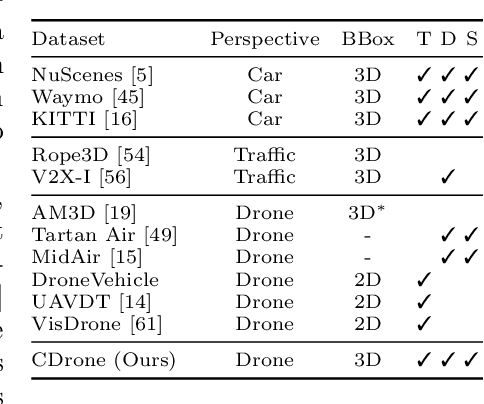
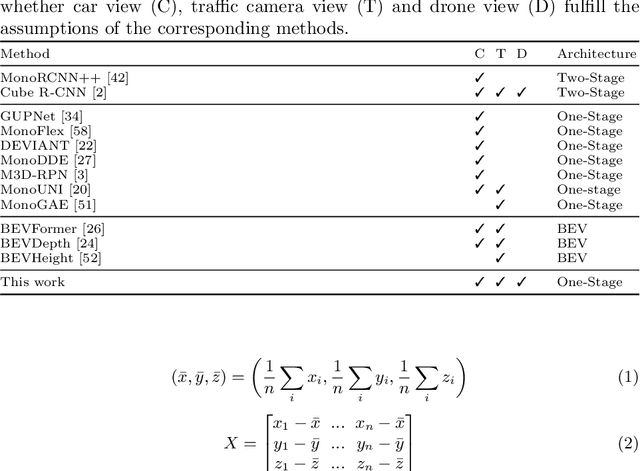
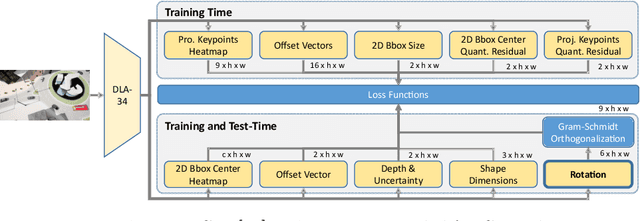
Existing techniques for monocular 3D detection have a serious restriction. They tend to perform well only on a limited set of benchmarks, faring well either on ego-centric car views or on traffic camera views, but rarely on both. To encourage progress, this work advocates for an extended evaluation of 3D detection frameworks across different camera perspectives. We make two key contributions. First, we introduce the CARLA Drone dataset, CDrone. Simulating drone views, it substantially expands the diversity of camera perspectives in existing benchmarks. Despite its synthetic nature, CDrone represents a real-world challenge. To show this, we confirm that previous techniques struggle to perform well both on CDrone and a real-world 3D drone dataset. Second, we develop an effective data augmentation pipeline called GroundMix. Its distinguishing element is the use of the ground for creating 3D-consistent augmentation of a training image. GroundMix significantly boosts the detection accuracy of a lightweight one-stage detector. In our expanded evaluation, we achieve the average precision on par with or substantially higher than the previous state of the art across all tested datasets.
DiffCD: A Symmetric Differentiable Chamfer Distance for Neural Implicit Surface Fitting
Jul 24, 2024Neural implicit surfaces can be used to recover accurate 3D geometry from imperfect point clouds. In this work, we show that state-of-the-art techniques work by minimizing an approximation of a one-sided Chamfer distance. This shape metric is not symmetric, as it only ensures that the point cloud is near the surface but not vice versa. As a consequence, existing methods can produce inaccurate reconstructions with spurious surfaces. Although one approach against spurious surfaces has been widely used in the literature, we theoretically and experimentally show that it is equivalent to regularizing the surface area, resulting in over-smoothing. As a more appealing alternative, we propose DiffCD, a novel loss function corresponding to the symmetric Chamfer distance. In contrast to previous work, DiffCD also assures that the surface is near the point cloud, which eliminates spurious surfaces without the need for additional regularization. We experimentally show that DiffCD reliably recovers a high degree of shape detail, substantially outperforming existing work across varying surface complexity and noise levels. Project code is available at https://github.com/linusnie/diffcd.