 Add to Chrome
 Add to Firefox
 Add to Edge
BlueMagpie-TTS: A Token-Efficient Tokenizer, Language Model, and TTS for Taiwanese-Accent Code-Switching Speech
Jul 07, 2026
Off-the-shelf TTS systems are poorly adapted to Taiwanese Mandarin. Their accent defaults to other Mandarin variants, their tokenizers over-segment common Taiwanese text, and their pronunciation degrades at code-switching boundaries where Chinese and English alternate within one utterance. These problems share one root: the text side lacks adaptation to the Taiwanese context. We address the text side from the bottom up. PangolinTokenizer, a byte-level BPE tokenizer trained on Taiwan-context data, reaches the lowest token rate (0.485 tokens/character) with the smallest vocabulary among nine tokenizers. Barbet, a billion-parameter Traditional-Chinese language model trained on PangolinTokenizer, serves as the text-semantic frontend and ranks first among comparable public models on a 14-task evaluation. BlueMagpie-TTS attaches Barbet to the pretrained acoustic stack of VoxCPM2 through a learned bridge, keeping the acoustic stack fixed. On a 1000-sentence Taiwan-localized test set, it lowers CER from 11.45% to 4.81% and WER from 14.83% to 5.36%, relative reductions of 58.0% and 63.9%. In a blind listening study on 500 of these sentences with ten listeners, 65.6% of majority votes prefer BlueMagpie-TTS.

BreezyVoice: Adapting TTS for Taiwanese Mandarin with Enhanced Polyphone Disambiguation -- Challenges and Insights
Jan 29, 2025We present BreezyVoice, a Text-to-Speech (TTS) system specifically adapted for Taiwanese Mandarin, highlighting phonetic control abilities to address the unique challenges of polyphone disambiguation in the language. Building upon CosyVoice, we incorporate a $S^{3}$ tokenizer, a large language model (LLM), an optimal-transport conditional flow matching model (OT-CFM), and a grapheme to phoneme prediction model, to generate realistic speech that closely mimics human utterances. Our evaluation demonstrates BreezyVoice's superior performance in both general and code-switching contexts, highlighting its robustness and effectiveness in generating high-fidelity speech. Additionally, we address the challenges of generalizability in modeling long-tail speakers and polyphone disambiguation. Our approach significantly enhances performance and offers valuable insights into the workings of neural codec TTS systems.
Building a Taiwanese Mandarin Spoken Language Model: A First Attempt
Nov 11, 2024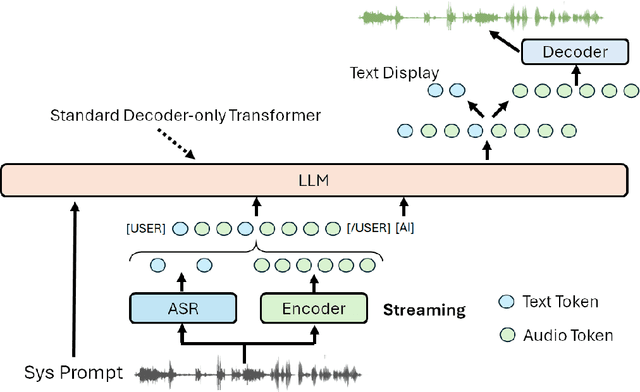


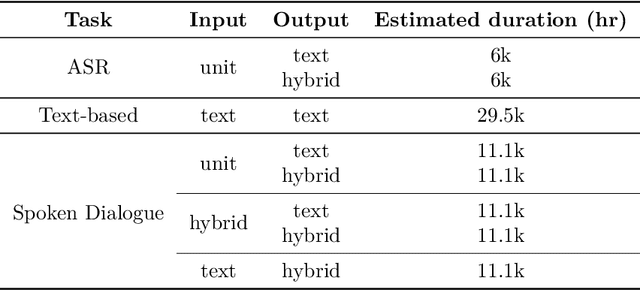
This technical report presents our initial attempt to build a spoken large language model (LLM) for Taiwanese Mandarin, specifically tailored to enable real-time, speech-to-speech interaction in multi-turn conversations. Our end-to-end model incorporates a decoder-only transformer architecture and aims to achieve seamless interaction while preserving the conversational flow, including full-duplex capabilities allowing simultaneous speaking and listening. The paper also details the training process, including data preparation with synthesized dialogues and adjustments for real-time interaction. We also developed a platform to evaluate conversational fluency and response coherence in multi-turn dialogues. We hope the release of the report can contribute to the future development of spoken LLMs in Taiwanese Mandarin.