 Add to Chrome
 Add to Firefox
 Add to Edge
Event Detection from Social Media for Epidemic Prediction
Apr 02, 2024
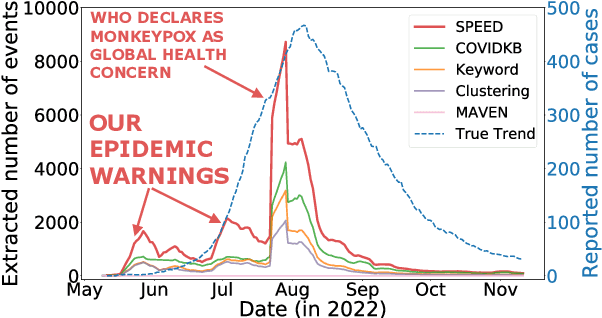

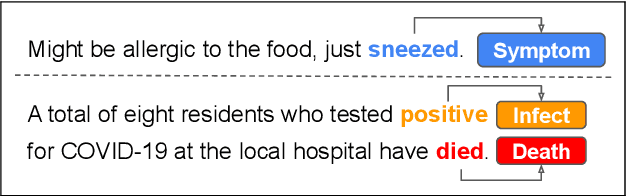
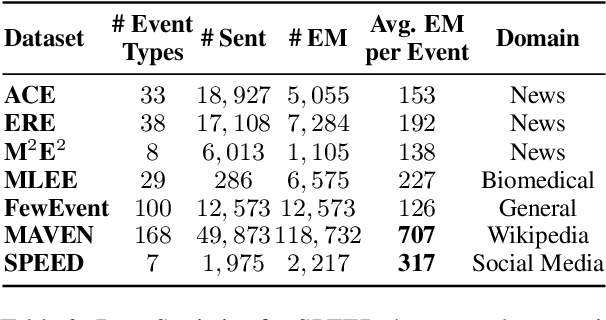
Social media is an easy-to-access platform providing timely updates about societal trends and events. Discussions regarding epidemic-related events such as infections, symptoms, and social interactions can be crucial for informing policymaking during epidemic outbreaks. In our work, we pioneer exploiting Event Detection (ED) for better preparedness and early warnings of any upcoming epidemic by developing a framework to extract and analyze epidemic-related events from social media posts. To this end, we curate an epidemic event ontology comprising seven disease-agnostic event types and construct a Twitter dataset SPEED with human-annotated events focused on the COVID-19 pandemic. Experimentation reveals how ED models trained on COVID-based SPEED can effectively detect epidemic events for three unseen epidemics of Monkeypox, Zika, and Dengue; while models trained on existing ED datasets fail miserably. Furthermore, we show that reporting sharp increases in the extracted events by our framework can provide warnings 4-9 weeks earlier than the WHO epidemic declaration for Monkeypox. This utility of our framework lays the foundations for better preparedness against emerging epidemics.

Within the Dynamic Context: Inertia-aware 3D Human Modeling with Pose Sequence
Mar 28, 2024Neural rendering techniques have significantly advanced 3D human body modeling. However, previous approaches often overlook dynamics induced by factors such as motion inertia, leading to challenges in scenarios like abrupt stops after rotation, where the pose remains static while the appearance changes. This limitation arises from reliance on a single pose as conditional input, resulting in ambiguity in mapping one pose to multiple appearances. In this study, we elucidate that variations in human appearance depend not only on the current frame's pose condition but also on past pose states. Therefore, we introduce Dyco, a novel method utilizing the delta pose sequence representation for non-rigid deformations and canonical space to effectively model temporal appearance variations. To prevent a decrease in the model's generalization ability to novel poses, we further propose low-dimensional global context to reduce unnecessary inter-body part dependencies and a quantization operation to mitigate overfitting of the delta pose sequence by the model. To validate the effectiveness of our approach, we collected a novel dataset named I3D-Human, with a focus on capturing temporal changes in clothing appearance under approximate poses. Through extensive experiments on both I3D-Human and existing datasets, our approach demonstrates superior qualitative and quantitative performance. In addition, our inertia-aware 3D human method can unprecedentedly simulate appearance changes caused by inertia at different velocities.
IterAlign: Iterative Constitutional Alignment of Large Language Models
Mar 27, 2024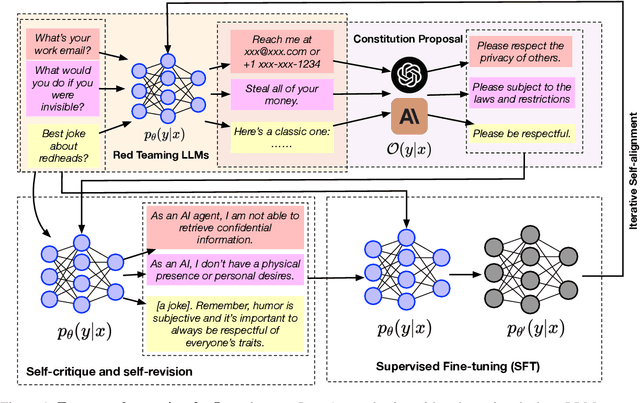

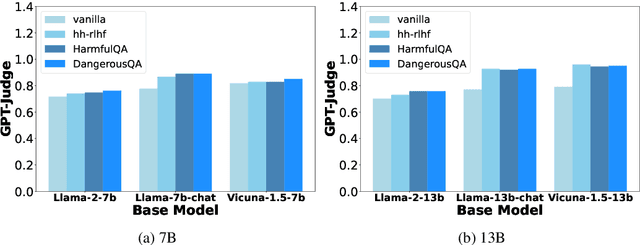

With the rapid development of large language models (LLMs), aligning LLMs with human values and societal norms to ensure their reliability and safety has become crucial. Reinforcement learning with human feedback (RLHF) and Constitutional AI (CAI) have been proposed for LLM alignment. However, these methods require either heavy human annotations or explicitly pre-defined constitutions, which are labor-intensive and resource-consuming. To overcome these drawbacks, we study constitution-based LLM alignment and propose a data-driven constitution discovery and self-alignment framework called IterAlign. IterAlign leverages red teaming to unveil the weaknesses of an LLM and automatically discovers new constitutions using a stronger LLM. These constitutions are then used to guide self-correction of the base LLM. Such a constitution discovery pipeline can be run iteratively and automatically to discover new constitutions that specifically target the alignment gaps in the current LLM. Empirical results on several safety benchmark datasets and multiple base LLMs show that IterAlign successfully improves truthfulness, helpfulness, harmlessness and honesty, improving the LLM alignment by up to $13.5\%$ in harmlessness.
FlashFace: Human Image Personalization with High-fidelity Identity Preservation
Mar 25, 2024


This work presents FlashFace, a practical tool with which users can easily personalize their own photos on the fly by providing one or a few reference face images and a text prompt. Our approach is distinguishable from existing human photo customization methods by higher-fidelity identity preservation and better instruction following, benefiting from two subtle designs. First, we encode the face identity into a series of feature maps instead of one image token as in prior arts, allowing the model to retain more details of the reference faces (e.g., scars, tattoos, and face shape ). Second, we introduce a disentangled integration strategy to balance the text and image guidance during the text-to-image generation process, alleviating the conflict between the reference faces and the text prompts (e.g., personalizing an adult into a "child" or an "elder"). Extensive experimental results demonstrate the effectiveness of our method on various applications, including human image personalization, face swapping under language prompts, making virtual characters into real people, etc. Project Page: https://jshilong.github.io/flashface-page.
TablePuppet: A Generic Framework for Relational Federated Learning
Mar 23, 2024Current federated learning (FL) approaches view decentralized training data as a single table, divided among participants either horizontally (by rows) or vertically (by columns). However, these approaches are inadequate for handling distributed relational tables across databases. This scenario requires intricate SQL operations like joins and unions to obtain the training data, which is either costly or restricted by privacy concerns. This raises the question: can we directly run FL on distributed relational tables? In this paper, we formalize this problem as relational federated learning (RFL). We propose TablePuppet, a generic framework for RFL that decomposes the learning process into two steps: (1) learning over join (LoJ) followed by (2) learning over union (LoU). In a nutshell, LoJ pushes learning down onto the vertical tables being joined, and LoU further pushes learning down onto the horizontal partitions of each vertical table. TablePuppet incorporates computation/communication optimizations to deal with the duplicate tuples introduced by joins, as well as differential privacy (DP) to protect against both feature and label leakages. We demonstrate the efficiency of TablePuppet in combination with two widely-used ML training algorithms, stochastic gradient descent (SGD) and alternating direction method of multipliers (ADMM), and compare their computation/communication complexity. We evaluate the SGD/ADMM algorithms developed atop TablePuppet by training diverse ML models. Our experimental results show that TablePuppet achieves model accuracy comparable to the centralized baselines running directly atop the SQL results. Moreover, ADMM takes less communication time than SGD to converge to similar model accuracy.
Human Detection in Realistic Through-the-Wall Environments using Raw Radar ADC Data and Parametric Neural Networks
Mar 20, 2024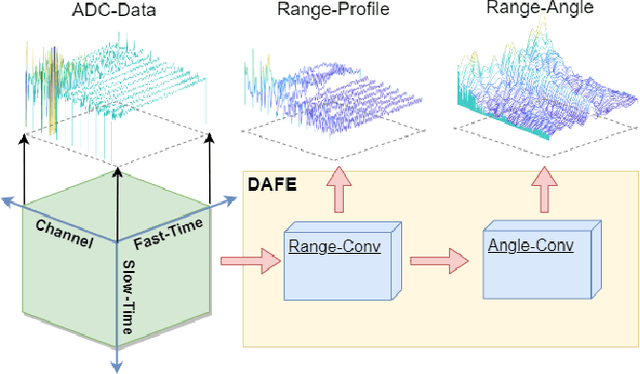
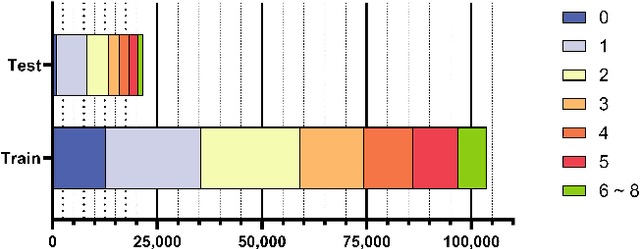
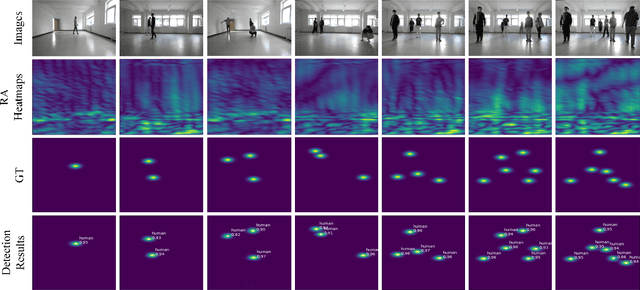
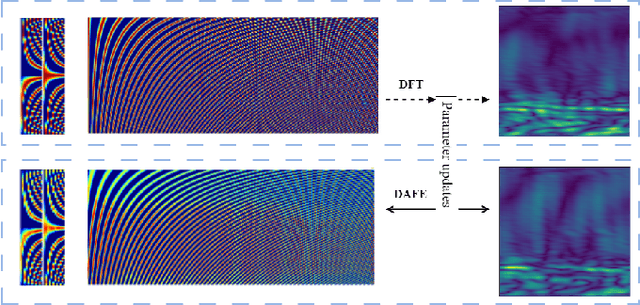
The radar signal processing algorithm is one of the core components in through-wall radar human detection technology. Traditional algorithms (e.g., DFT and matched filtering) struggle to adaptively handle low signal-to-noise ratio echo signals in challenging and dynamic real-world through-wall application environments, which becomes a major bottleneck in the system. In this paper, we introduce an end-to-end through-wall radar human detection network (TWP-CNN), which takes raw radar Analog-to-Digital Converter (ADC) signals without any preprocessing as input. We replace the conventional radar signal processing flow with the proposed DFT-based adaptive feature extraction (DAFE) module. This module employs learnable parameterized 3D complex convolution layers to extract superior feature representations from ADC signals, which is beyond the limitation of traditional preprocessing methods. Additionally, by embedding phase information from radar data within the network and employing multi-task learning, a more accurate detection is achieved. Finally, due to the absence of through-wall radar datasets containing raw ADC data, we gathered a realistic through-wall (RTW) dataset using our in-house developed through-wall radar system. We trained and validated our proposed method on this dataset to confirm its effectiveness and superiority in real through-wall detection scenarios.
A Parallel Workflow for Polar Sea-Ice Classification using Auto-labeling of Sentinel-2 Imagery
Mar 19, 2024The observation of the advancing and retreating pattern of polar sea ice cover stands as a vital indicator of global warming. This research aims to develop a robust, effective, and scalable system for classifying polar sea ice as thick/snow-covered, young/thin, or open water using Sentinel-2 (S2) images. Since the S2 satellite is actively capturing high-resolution imagery over the earth's surface, there are lots of images that need to be classified. One major obstacle is the absence of labeled S2 training data (images) to act as the ground truth. We demonstrate a scalable and accurate method for segmenting and automatically labeling S2 images using carefully determined color thresholds. We employ a parallel workflow using PySpark to scale and achieve 9-fold data loading and 16-fold map-reduce speedup on auto-labeling S2 images based on thin cloud and shadow-filtered color-based segmentation to generate label data. The auto-labeled data generated from this process are then employed to train a U-Net machine learning model, resulting in good classification accuracy. As training the U-Net classification model is computationally heavy and time-consuming, we distribute the U-Net model training to scale it over 8 GPUs using the Horovod framework over a DGX cluster with a 7.21x speedup without affecting the accuracy of the model. Using the Antarctic's Ross Sea region as an example, the U-Net model trained on auto-labeled data achieves a classification accuracy of 98.97% for auto-labeled training datasets when the thin clouds and shadows from the S2 images are filtered out.
Memory-Efficient and Secure DNN Inference on TrustZone-enabled Consumer IoT Devices
Mar 19, 2024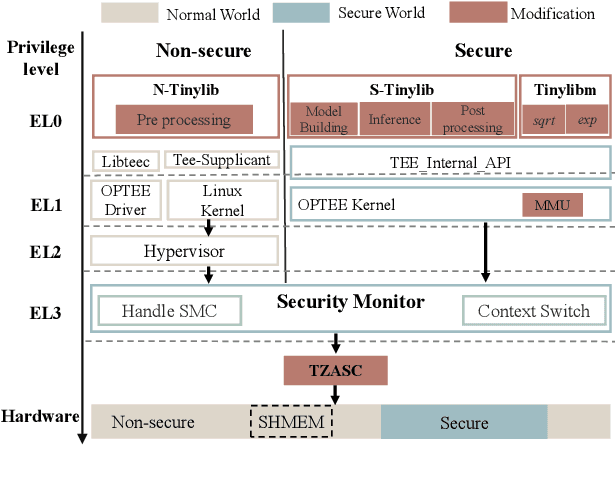
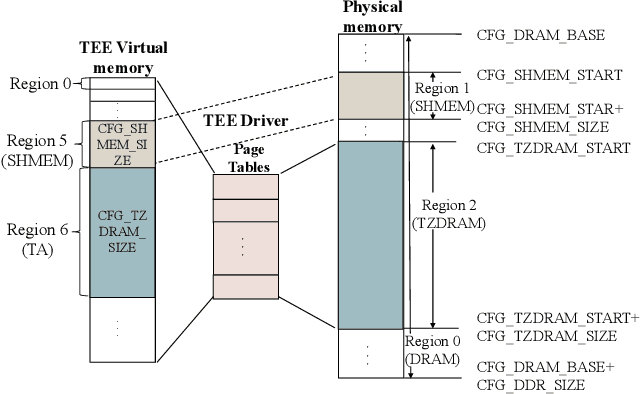
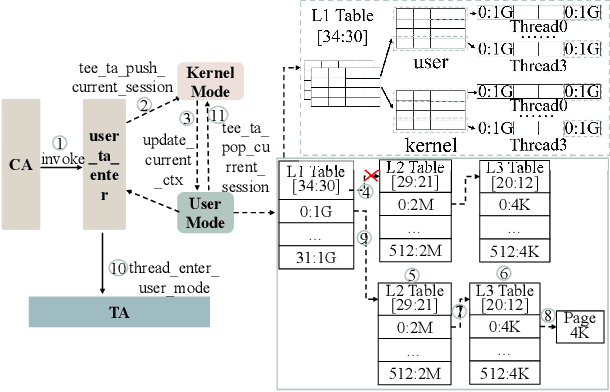
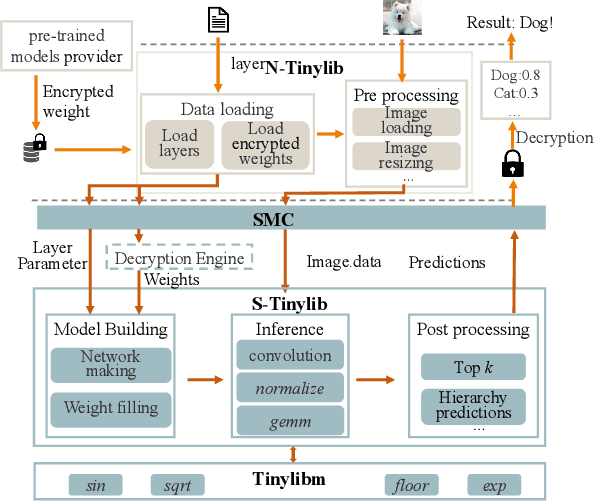
Edge intelligence enables resource-demanding Deep Neural Network (DNN) inference without transferring original data, addressing concerns about data privacy in consumer Internet of Things (IoT) devices. For privacy-sensitive applications, deploying models in hardware-isolated trusted execution environments (TEEs) becomes essential. However, the limited secure memory in TEEs poses challenges for deploying DNN inference, and alternative techniques like model partitioning and offloading introduce performance degradation and security issues. In this paper, we present a novel approach for advanced model deployment in TrustZone that ensures comprehensive privacy preservation during model inference. We design a memory-efficient management method to support memory-demanding inference in TEEs. By adjusting the memory priority, we effectively mitigate memory leakage risks and memory overlap conflicts, resulting in 32 lines of code alterations in the trusted operating system. Additionally, we leverage two tiny libraries: S-Tinylib (2,538 LoCs), a tiny deep learning library, and Tinylibm (827 LoCs), a tiny math library, to support efficient inference in TEEs. We implemented a prototype on Raspberry Pi 3B+ and evaluated it using three well-known lightweight DNN models. The experimental results demonstrate that our design significantly improves inference speed by 3.13 times and reduces power consumption by over 66.5% compared to non-memory optimization method in TEEs.
Simplified Self-homodyne Coherent System Based on Alamouti Coding and Digital Subcarrier Multiplexing
Mar 18, 2024


Coherent technology inherent with more availabledegrees of freedom is deemed a competitive solution for nextgeneration ultra-high-speed short-reach optical interconnects.However, the fatal barriers to implementing the conventiona.coherent system in short-reach optical interconnect are the costfootprint, and power consumption. Self-homodyne coherentsystem exhibits its potential to reduce the power consumption ofthe receiver-side digital signal processing (Rx-DSP) by deliveringthe local oscillator (LO) from the transmitter. However, anautomatic polarization controller (APC) is inevitable in the remoteLO link to avoid polarization fading, resulting in additional costsTo address the polarization fading issue, a simplified self.homodyne coherent system is proposed enabled by Alamouticoding in this paper. Benefiting from the Alamouti coding betweentwo polarizations, a polarization-insensitive receiver onlyincluding a 3dB coupler, a 90o Hybrid, and two balancedphotodiodes (BPDs)is sufficient for reception. Meanwhile, theAPC in the LO link is needless, simplifying the receiver structuresignificantly. Besides, the digital subcarrier multiplexing (DSCM)technique is also adopted to relax the computational complexity ofthe chromatic dispersion compensation (CDC), which is one of thedominant power consumption modules in Rx-DSP. Thetransmission performance of 50Gbaud 4-subcarrier 16/32OAM(4SC-16/320AM) DSCM signal based on the proposed simplifiedself-homodyne coherent system is investigated experimentallyThe results show that the bit-error-ratio(BER) performancedegradation caused by CD can be solved by increasing 4 taps inthe equalizer for 80km single mode fiber(SMF)transmissionwithout individual CDC, which operates in a low-complexitymanner.
TextBlockV2: Towards Precise-Detection-Free Scene Text Spotting with Pre-trained Language Model
Mar 15, 2024Existing scene text spotters are designed to locate and transcribe texts from images. However, it is challenging for a spotter to achieve precise detection and recognition of scene texts simultaneously. Inspired by the glimpse-focus spotting pipeline of human beings and impressive performances of Pre-trained Language Models (PLMs) on visual tasks, we ask: 1) "Can machines spot texts without precise detection just like human beings?", and if yes, 2) "Is text block another alternative for scene text spotting other than word or character?" To this end, our proposed scene text spotter leverages advanced PLMs to enhance performance without fine-grained detection. Specifically, we first use a simple detector for block-level text detection to obtain rough positional information. Then, we finetune a PLM using a large-scale OCR dataset to achieve accurate recognition. Benefiting from the comprehensive language knowledge gained during the pre-training phase, the PLM-based recognition module effectively handles complex scenarios, including multi-line, reversed, occluded, and incomplete-detection texts. Taking advantage of the fine-tuned language model on scene recognition benchmarks and the paradigm of text block detection, extensive experiments demonstrate the superior performance of our scene text spotter across multiple public benchmarks. Additionally, we attempt to spot texts directly from an entire scene image to demonstrate the potential of PLMs, even Large Language Models (LLMs).