 Add to Chrome
 Add to Firefox
 Add to Edge
EnvHarness: Awakening Static Worlds for Agent Learning
Aug 20, 2026
LLM agents learn by interacting with environments, yet these environments are hand-built and static: blind to an agent's weaknesses, and quickly left behind as it improves. While recent environment generation methods attempt to address this, they require domain-specific pipelines, rely on expensive or unreliable verifiers, and still produce static environments. To alleviate the engineering burden of rebuilding environments from scratch, we propose Environment Harness (EnvHarness), a programmable layer of plug-in components that wraps a static environment to reshape its behavior without modifying the underlying logic. Operating through standard interfaces, EnvHarness applies across diverse domains while ensuring every reshaped environment retains its original verifier. To automate this process, we introduce EnvRigger, which treats the target policy as a black box, observing its execution trajectories to synthesize EnvHarness components targeting diagnosed flaws, and validating them via fresh rollouts. Across five benchmarks in four domains, EnvHarness outperforms both original environments and domain-specific environment generation pipelines, achieving up to a 9.0-point improvement on held-out instances with 9.8% fewer execution steps. Furthermore, EnvHarness provides a superior optimization signal for reinforcement learning, enabling continuous, targeted co-evolution of the policy and its environment.

FinanceHarness: Autonomous Financial Deep Research Framework
Jul 30, 2026Powered by advances in LLMs and autonomous agents, deep research has become one of the most widely adopted agentic products. However, most deep research systems write general-purpose reports, which are inadequate for financial deep research. Financial research demands specialized knowledge to analyze historical patterns and forecast upcoming events. Automating financial deep research therefore requires both a layered harness to drive the research agent and a verifiable, point-in-time benchmark that prevents leakage of future information. We present FinanceHarness, a harness that runs finance-oriented tools and practitioner-guided workflows, automating financial deep research end to end: environment and data construction, the agent execution loop, and reward modeling. We further propose FinanceGym, comprising thesis-driven research questions and rubrics that combine pre-cutoff and post-cutoff criteria. Professional expert validation yields an 82% pass rate. Even leading LLMs and agents score below 40% on the rubrics, showing that FinanceGym is challenging and leaves substantial headroom. With the same open-weight backbone, FinanceHarness improves the overall rubric score from 25.3% to 32.4%. FinanceHarness is available at https://github.com/Yijia-Xiao/FinanceHarness.
RubricEM: Meta-RL with Rubric-guided Policy Decomposition beyond Verifiable Rewards
May 11, 2026Training deep research agents, namely systems that plan, search, evaluate evidence, and synthesize long-form reports, pushes reinforcement learning beyond the regime of verifiable rewards. Their outputs lack ground-truth answers, their trajectories span many tool-augmented decisions, and standard post-training offers little mechanism for turning past attempts into reusable experience. In this work, we argue that rubrics should serve not merely as final-answer evaluators, but as the shared interface that structures policy execution, judge feedback, and agent memory. Based on this view, we introduce RubricEM, a rubric-guided reinforcement learning framework that combines stagewise policy decomposition with reflection-based meta-policy evolution. RubricEM first makes research trajectories stage-aware by conditioning planning, evidence gathering, review, and synthesis on self-generated rubrics. It then assigns credit with Stage-Structured GRPO, which uses stagewise rubric judgments to provide denser semantic feedback for long-horizon optimization. In parallel, RubricEM trains a shared-backbone reflection meta-policy that distills judged trajectories into reusable rubric-grounded guidance for future attempts. The resulting RubricEM-8B achieves strong performance across four long-form research benchmarks, outperforming comparable open models and approaching proprietary deep-research systems. Beyond final performance, we perform thorough analyses to understand the key ingredients of RubricEM.
SkillOS: Learning Skill Curation for Self-Evolving Agents
May 07, 2026LLM-based agents are increasingly deployed to handle streaming tasks, yet they often remain one-off problem solvers that fail to learn from past interactions. Reusable skills distilled from experience provide a natural substrate for self-evolution, where high-quality skill curation serves as the key bottleneck. Existing approaches either rely on manual skill curation, prescribe heuristic skill operations, or train for short-horizon skill operations. However, they still struggle to learn complex long-term curation policies from indirect and delayed feedback. To tackle this challenge, we propose SkillOS, an experience-driven RL training recipe for learning skill curation in self-evolving agents. SkillOS pairs a frozen agent executor that retrieves and applies skills with a trainable skill curator that updates an external SkillRepo from accumulated experience. To provide learning signals for curation, we design composite rewards and train on grouped task streams based on skill-relevant task dependencies, where earlier trajectories update the SkillRepo, and later related tasks evaluate these updates. Across multi-turn agentic tasks and single-turn reasoning tasks, SkillOS consistently outperforms memory-free and strong memory-based baselines in both effectiveness and efficiency, with the learned skill curator generalizing across different executor backbones and task domains. Further analyses show that the learned curator produces more targeted skill use, while the skills in SkillRepo evolve into more richly structured Markdown files that encode higher-level meta-skills over time.
SAGE: Steerable Agentic Data Generation for Deep Search with Execution Feedback
Jan 26, 2026Deep search agents, which aim to answer complex questions requiring reasoning across multiple documents, can significantly speed up the information-seeking process. Collecting human annotations for this application is prohibitively expensive due to long and complex exploration trajectories. We propose an agentic pipeline that automatically generates high quality, difficulty-controlled deep search question-answer pairs for a given corpus and a target difficulty level. Our pipeline, SAGE, consists of a data generator which proposes QA pairs and a search agent which attempts to solve the generated question and provide execution feedback for the data generator. The two components interact over multiple rounds to iteratively refine the question-answer pairs until they satisfy the target difficulty level. Our intrinsic evaluation shows SAGE generates questions that require diverse reasoning strategies, while significantly increases the correctness and difficulty of the generated data. Our extrinsic evaluation demonstrates up to 23% relative performance gain on popular deep search benchmarks by training deep search agents with our synthetic data. Additional experiments show that agents trained on our data can adapt from fixed-corpus retrieval to Google Search at inference time, without further training.
Supervised Reinforcement Learning: From Expert Trajectories to Step-wise Reasoning
Oct 29, 2025Large Language Models (LLMs) often struggle with problems that require multi-step reasoning. For small-scale open-source models, Reinforcement Learning with Verifiable Rewards (RLVR) fails when correct solutions are rarely sampled even after many attempts, while Supervised Fine-Tuning (SFT) tends to overfit long demonstrations through rigid token-by-token imitation. To address this gap, we propose Supervised Reinforcement Learning (SRL), a framework that reformulates problem solving as generating a sequence of logical "actions". SRL trains the model to generate an internal reasoning monologue before committing to each action. It provides smoother rewards based on the similarity between the model's actions and expert actions extracted from the SFT dataset in a step-wise manner. This supervision offers richer learning signals even when all rollouts are incorrect, while encouraging flexible reasoning guided by expert demonstrations. As a result, SRL enables small models to learn challenging problems previously unlearnable by SFT or RLVR. Moreover, initializing training with SRL before refining with RLVR yields the strongest overall performance. Beyond reasoning benchmarks, SRL generalizes effectively to agentic software engineering tasks, establishing it as a robust and versatile training framework for reasoning-oriented LLMs.
In Prospect and Retrospect: Reflective Memory Management for Long-term Personalized Dialogue Agents
Mar 11, 2025Large Language Models (LLMs) have made significant progress in open-ended dialogue, yet their inability to retain and retrieve relevant information from long-term interactions limits their effectiveness in applications requiring sustained personalization. External memory mechanisms have been proposed to address this limitation, enabling LLMs to maintain conversational continuity. However, existing approaches struggle with two key challenges. First, rigid memory granularity fails to capture the natural semantic structure of conversations, leading to fragmented and incomplete representations. Second, fixed retrieval mechanisms cannot adapt to diverse dialogue contexts and user interaction patterns. In this work, we propose Reflective Memory Management (RMM), a novel mechanism for long-term dialogue agents, integrating forward- and backward-looking reflections: (1) Prospective Reflection, which dynamically summarizes interactions across granularities-utterances, turns, and sessions-into a personalized memory bank for effective future retrieval, and (2) Retrospective Reflection, which iteratively refines the retrieval in an online reinforcement learning (RL) manner based on LLMs' cited evidence. Experiments show that RMM demonstrates consistent improvement across various metrics and benchmarks. For example, RMM shows more than 10% accuracy improvement over the baseline without memory management on the LongMemEval dataset.
Reverse Thinking Makes LLMs Stronger Reasoners
Nov 29, 2024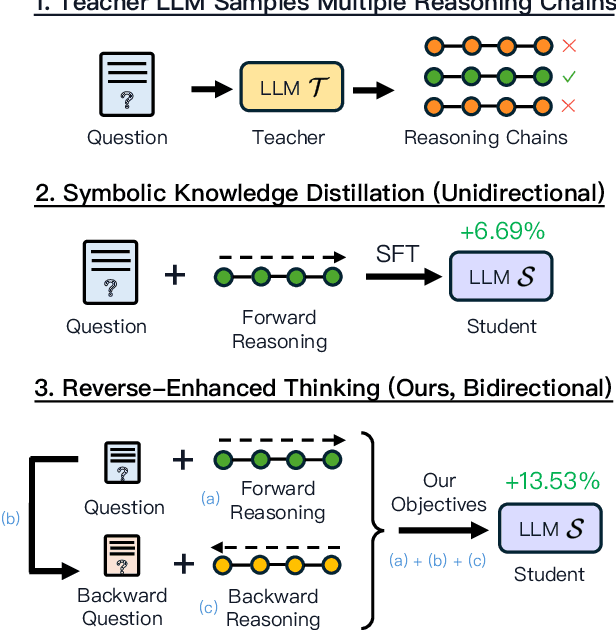


Reverse thinking plays a crucial role in human reasoning. Humans can reason not only from a problem to a solution but also in reverse, i.e., start from the solution and reason towards the problem. This often enhances overall reasoning performance as it enables consistency checks between their forward and backward thinking. To enable Large Language Models (LLMs) to perform reverse thinking, we introduce Reverse-Enhanced Thinking (RevThink), a framework composed of data augmentation and learning objectives. In RevThink, we augment the dataset by collecting structured forward-backward reasoning from a teacher model, consisting of: (1) the original question, (2) forward reasoning, (3) backward question, and (4) backward reasoning. We then employ three objectives to train a smaller student model in a multi-task learning fashion: (a) generate forward reasoning from a question, (b) generate a backward question from a question, and (c) generate backward reasoning from the backward question. Experiments across 12 datasets covering commonsense, math, and logical reasoning show an average 13.53% improvement over the student model's zero-shot performance and a 6.84% improvement over the strongest knowledge distillation baselines. Moreover, our method demonstrates sample efficiency -- using only 10% of the correct forward reasoning from the training data, it outperforms a standard fine-tuning method trained on 10x more forward reasoning. RevThink also exhibits strong generalization to out-of-distribution held-out datasets.
Speculative Knowledge Distillation: Bridging the Teacher-Student Gap Through Interleaved Sampling
Oct 15, 2024


Recent advances in knowledge distillation (KD) have enabled smaller student models to approach the performance of larger teacher models. However, popular methods such as supervised KD and on-policy KD, are adversely impacted by the knowledge gaps between teacher-student in practical scenarios. Supervised KD suffers from a distribution mismatch between training with a static dataset and inference over final student-generated outputs. Conversely, on-policy KD, which uses student-generated samples for training, can suffer from low-quality training examples with which teacher models are not familiar, resulting in inaccurate teacher feedback. To address these limitations, we introduce Speculative Knowledge Distillation (SKD), a novel approach that leverages cooperation between student and teacher models to generate high-quality training data on-the-fly while aligning with the student's inference-time distribution. In SKD, the student proposes tokens, and the teacher replaces poorly ranked ones based on its own distribution, transferring high-quality knowledge adaptively. We evaluate SKD on various text generation tasks, including translation, summarization, math, and instruction following, and show that SKD consistently outperforms existing KD methods across different domains, data sizes, and model initialization strategies.
Dancing in Chains: Reconciling Instruction Following and Faithfulness in Language Models
Jul 31, 2024Modern language models (LMs) need to follow human instructions while being faithful; yet, they often fail to achieve both. Here, we provide concrete evidence of a trade-off between instruction following (i.e., follow open-ended instructions) and faithfulness (i.e., ground responses in given context) when training LMs with these objectives. For instance, fine-tuning LLaMA-7B on instruction following datasets renders it less faithful. Conversely, instruction-tuned Vicuna-7B shows degraded performance at following instructions when further optimized on tasks that require contextual grounding. One common remedy is multi-task learning (MTL) with data mixing, yet it remains far from achieving a synergic outcome. We propose a simple yet effective method that relies on Rejection Sampling for Continued Self-instruction Tuning (ReSet), which significantly outperforms vanilla MTL. Surprisingly, we find that less is more, as training ReSet with high-quality, yet substantially smaller data (three-fold less) yields superior results. Our findings offer a better understanding of objective discrepancies in alignment training of LMs.