 Add to Chrome
 Add to Firefox
 Add to Edge
WorldSample: Closed-loop Real-robot RL with World Modelling
Jul 02, 2026
Reinforcement learning (RL) can overcome the demonstration-coverage limitation of imitation learning (IL) by allowing robots to improve through trial-and-error interaction beyond the states observed in demonstrations. However, deploying RL on real robots remains constrained by high interaction costs, since each physical rollout is costly and reflects only one realized action-outcome path. To address this challenge, we propose WorldSample, a physically grounded data augmentation framework for real-robot RL that closes a real-synthetic loop between physical rollouts, world-model generation, and policy improvement. Grounded on real rollouts, WorldSample generates high-fidelity synthetic transitions through a post-trained world model, which greatly lowers the visual hallucination. Specifically, rather than simply using these transitions as real-world experience, WorldSample introduces Policy-Paced Learning (PPL) to regulate the training process through sample selection and scheduling, balancing useful augmentation against value overestimation and mitigating the hallucination-induced noise. Experiments on robot manipulation tasks involving contact-rich and precise tasks show that WorldSample improves policy success rate by 28% while reducing training steps by 59% compared with baselines. Furthermore, WorldSample improves world model visual fidelity by 19.4dB in PSNR and 0.47 in SSIM over demonstration-only post-training, validating the effectiveness of the real-synthetic loop for both policy and world model performance.

Preference-Calibrated Human-in-the-Loop Reinforcement Learning for Robotic Manipulation
Jun 02, 2026Human-in-the-loop reinforcement learning (HIL-RL) improves sample efficiency in real-robot manipulation through online human intervention. However, successful trajectories may include suboptimal actions that deviate from the desired task-execution path and force human intervention. Existing HIL-RL methods typically apply the consistent credit assignment principle to all transitions, uniformly propagating discounted terminal rewards through suboptimal segments, ignoring the actual contribution of each transition to task success. This overestimates Q-values for critic learning and indirectly misguides actor updates toward suboptimal behavior patterns. To this end, we propose PACT, a Preference-calibrated Actor-Critic Training framework that leverages the implicit preference signals induced by intervention to perform credit reassignment on identified suboptimal segments while directly guiding policy training for unbiased critic-actor learning. Specifically, we first design a progress model that learns from human demonstration and identifies suboptimal segments for credit correction. Then, from the human action and resampled policy action at the intervention state, we build preference pairs to define a counterfactual advantage that penalizes Bellman targets of the identified suboptimal segment, enabling directional credit calibration. Moreover, we directly align the policy with human corrective actions in the bounded mean space, providing an additional signal beyond critic-guided updates. Across five real-robot manipulation tasks, PACT improves the average success rate by 24.5% and achieves 1.3 times faster convergence, thereby improving both RL sample efficiency and performance. Code is available at https://anonymous.4open.science/r/HILRL-A1X-BC05.
OpenHelix: A Short Survey, Empirical Analysis, and Open-Source Dual-System VLA Model for Robotic Manipulation
May 06, 2025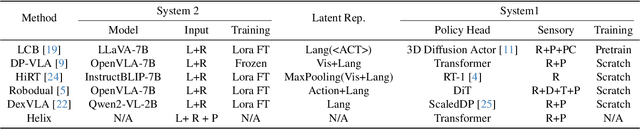
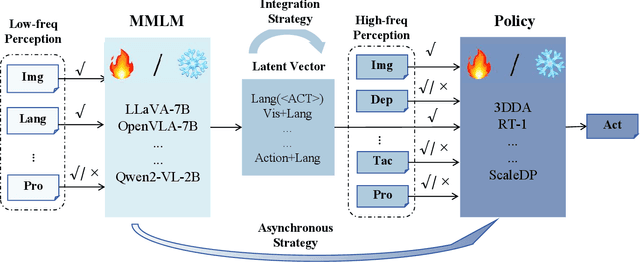
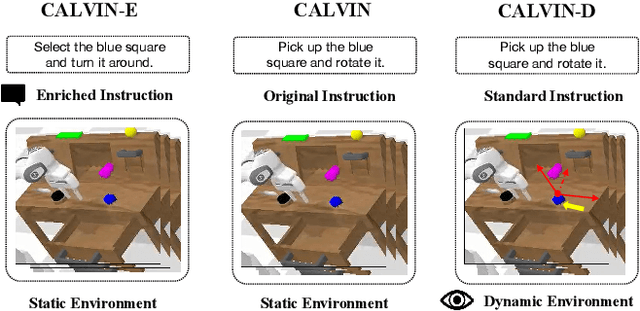
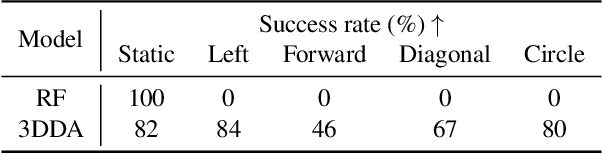
Dual-system VLA (Vision-Language-Action) architectures have become a hot topic in embodied intelligence research, but there is a lack of sufficient open-source work for further performance analysis and optimization. To address this problem, this paper will summarize and compare the structural designs of existing dual-system architectures, and conduct systematic empirical evaluations on the core design elements of existing dual-system architectures. Ultimately, it will provide a low-cost open-source model for further exploration. Of course, this project will continue to update with more experimental conclusions and open-source models with improved performance for everyone to choose from. Project page: https://openhelix-robot.github.io/.
Score and Distribution Matching Policy: Advanced Accelerated Visuomotor Policies via Matched Distillation
Dec 13, 2024Visual-motor policy learning has advanced with architectures like diffusion-based policies, known for modeling complex robotic trajectories. However, their prolonged inference times hinder high-frequency control tasks requiring real-time feedback. While consistency distillation (CD) accelerates inference, it introduces errors that compromise action quality. To address these limitations, we propose the Score and Distribution Matching Policy (SDM Policy), which transforms diffusion-based policies into single-step generators through a two-stage optimization process: score matching ensures alignment with true action distributions, and distribution matching minimizes KL divergence for consistency. A dual-teacher mechanism integrates a frozen teacher for stability and an unfrozen teacher for adversarial training, enhancing robustness and alignment with target distributions. Evaluated on a 57-task simulation benchmark, SDM Policy achieves a 6x inference speedup while having state-of-the-art action quality, providing an efficient and reliable framework for high-frequency robotic tasks.