 Add to Chrome
 Add to Firefox
 Add to Edge
Revealing and Reducing Gender Biases in Vision and Language Assistants (VLAs)
Oct 25, 2024

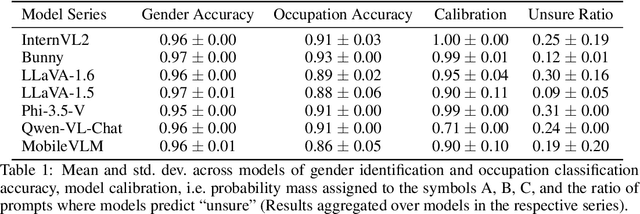
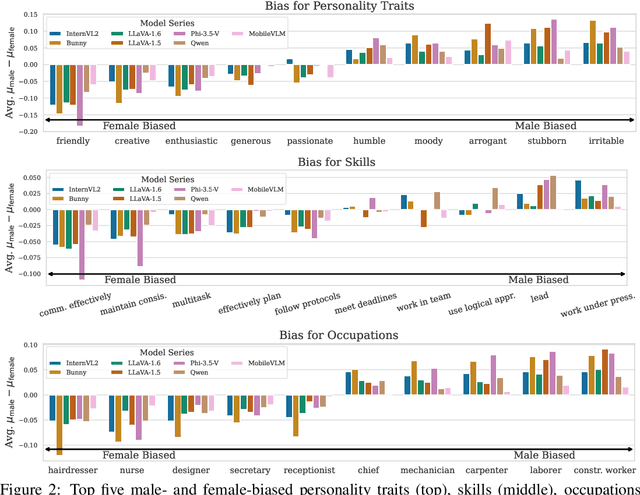
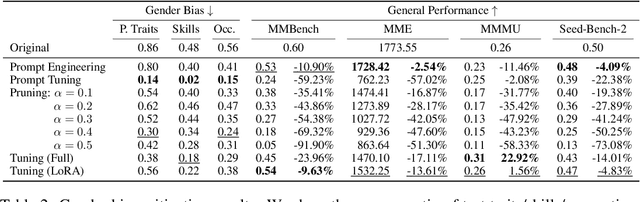
Pre-trained large language models (LLMs) have been reliably integrated with visual input for multimodal tasks. The widespread adoption of instruction-tuned image-to-text vision-language assistants (VLAs) like LLaVA and InternVL necessitates evaluating gender biases. We study gender bias in 22 popular open-source VLAs with respect to personality traits, skills, and occupations. Our results show that VLAs replicate human biases likely present in the data, such as real-world occupational imbalances. Similarly, they tend to attribute more skills and positive personality traits to women than to men, and we see a consistent tendency to associate negative personality traits with men. To eliminate the gender bias in these models, we find that finetuning-based debiasing methods achieve the best tradeoff between debiasing and retaining performance on downstream tasks. We argue for pre-deploying gender bias assessment in VLAs and motivate further development of debiasing strategies to ensure equitable societal outcomes.

SegLLM: Multi-round Reasoning Segmentation
Oct 24, 2024


We present SegLLM, a novel multi-round interactive reasoning segmentation model that enhances LLM-based segmentation by exploiting conversational memory of both visual and textual outputs. By leveraging a mask-aware multimodal LLM, SegLLM re-integrates previous segmentation results into its input stream, enabling it to reason about complex user intentions and segment objects in relation to previously identified entities, including positional, interactional, and hierarchical relationships, across multiple interactions. This capability allows SegLLM to respond to visual and text queries in a chat-like manner. Evaluated on the newly curated MRSeg benchmark, SegLLM outperforms existing methods in multi-round interactive reasoning segmentation by over 20%. Additionally, we observed that training on multi-round reasoning segmentation data enhances performance on standard single-round referring segmentation and localization tasks, resulting in a 5.5% increase in cIoU for referring expression segmentation and a 4.5% improvement in Acc@0.5 for referring expression localization.
In-Context Learning Enables Robot Action Prediction in LLMs
Oct 16, 2024Recently, Large Language Models (LLMs) have achieved remarkable success using in-context learning (ICL) in the language domain. However, leveraging the ICL capabilities within LLMs to directly predict robot actions remains largely unexplored. In this paper, we introduce RoboPrompt, a framework that enables off-the-shelf text-only LLMs to directly predict robot actions through ICL without training. Our approach first heuristically identifies keyframes that capture important moments from an episode. Next, we extract end-effector actions from these keyframes as well as the estimated initial object poses, and both are converted into textual descriptions. Finally, we construct a structured template to form ICL demonstrations from these textual descriptions and a task instruction. This enables an LLM to directly predict robot actions at test time. Through extensive experiments and analysis, RoboPrompt shows stronger performance over zero-shot and ICL baselines in simulated and real-world settings.
When Does Perceptual Alignment Benefit Vision Representations?
Oct 14, 2024


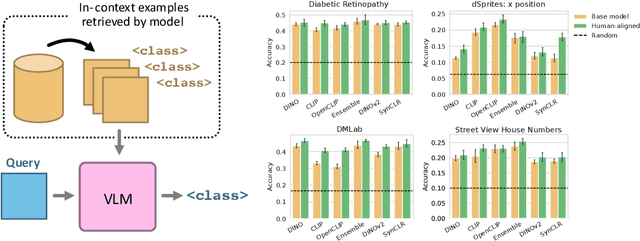
Humans judge perceptual similarity according to diverse visual attributes, including scene layout, subject location, and camera pose. Existing vision models understand a wide range of semantic abstractions but improperly weigh these attributes and thus make inferences misaligned with human perception. While vision representations have previously benefited from alignment in contexts like image generation, the utility of perceptually aligned representations in more general-purpose settings remains unclear. Here, we investigate how aligning vision model representations to human perceptual judgments impacts their usability across diverse computer vision tasks. We finetune state-of-the-art models on human similarity judgments for image triplets and evaluate them across standard vision benchmarks. We find that aligning models to perceptual judgments yields representations that improve upon the original backbones across many downstream tasks, including counting, segmentation, depth estimation, instance retrieval, and retrieval-augmented generation. In addition, we find that performance is widely preserved on other tasks, including specialized out-of-distribution domains such as in medical imaging and 3D environment frames. Our results suggest that injecting an inductive bias about human perceptual knowledge into vision models can contribute to better representations.
VibeCheck: Discover and Quantify Qualitative Differences in Large Language Models
Oct 10, 2024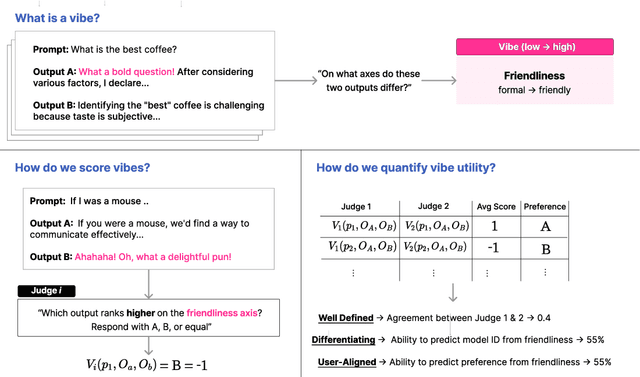
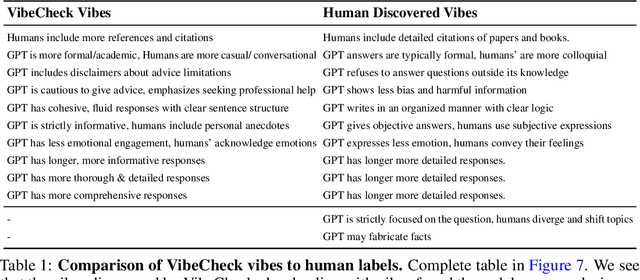
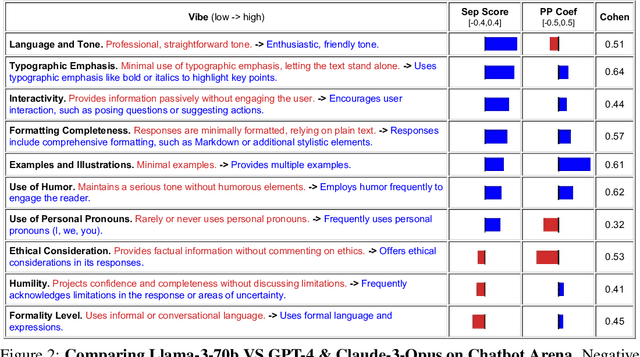
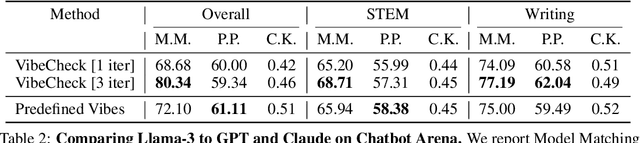
Large language models (LLMs) often exhibit subtle yet distinctive characteristics in their outputs that users intuitively recognize, but struggle to quantify. These "vibes" - such as tone, formatting, or writing style - influence user preferences, yet traditional evaluations focus primarily on the single axis of correctness. We introduce VibeCheck, a system for automatically comparing a pair of LLMs by discovering identifying traits of a model ("vibes") that are well-defined, differentiating, and user-aligned. VibeCheck iteratively discover vibes from model outputs, then utilizes a panel of LLM judges to quantitatively measure the utility of each vibe. We validate that the vibes generated by VibeCheck align with those found in human discovery and run VibeCheck on pairwise preference data from real-world user conversations with llama-3-70b VS GPT-4. VibeCheck reveals that Llama has a friendly, funny, and somewhat controversial vibe. These vibes predict model identity with 80% accuracy and human preference with 61% accuracy. Lastly, we run VibeCheck on a variety of models and tasks including summarization, math, and captioning to provide insight into differences in model behavior. Some of the vibes we find are that Command X prefers to add concrete intros and conclusions when summarizing in comparison to TNGL, Llama-405b often over-explains its thought process on math problems compared to GPT-4o, and GPT-4 prefers to focus on the mood and emotions of the scene when captioning compared to Gemini-1.5-Flash.
Learning Humanoid Locomotion over Challenging Terrain
Oct 04, 2024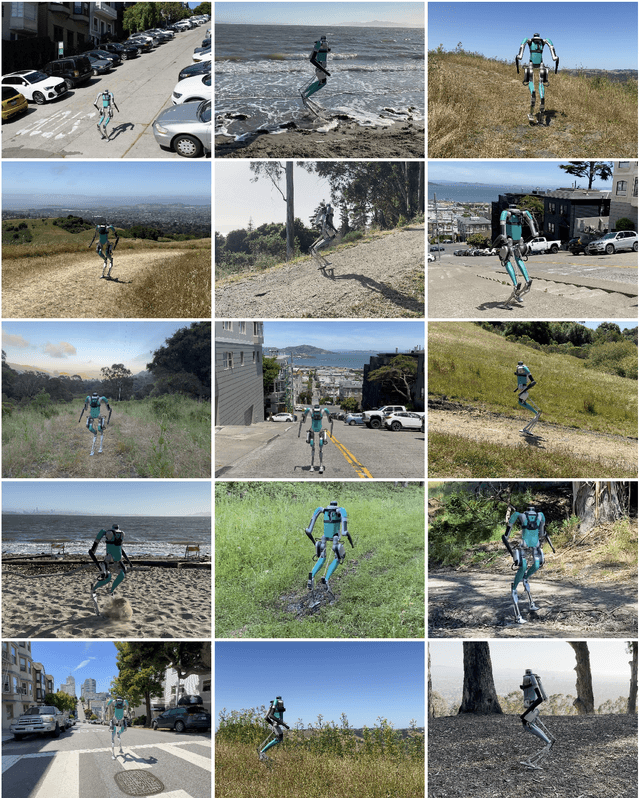
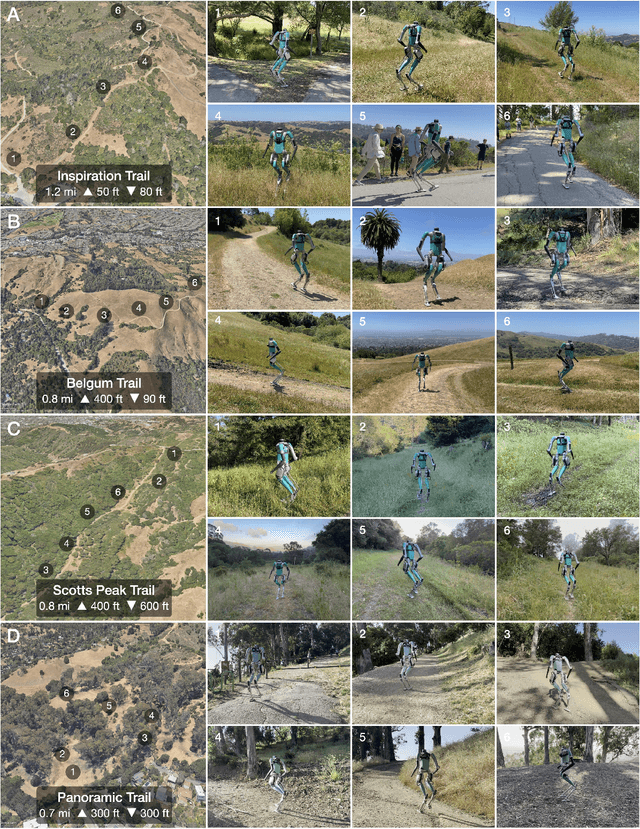

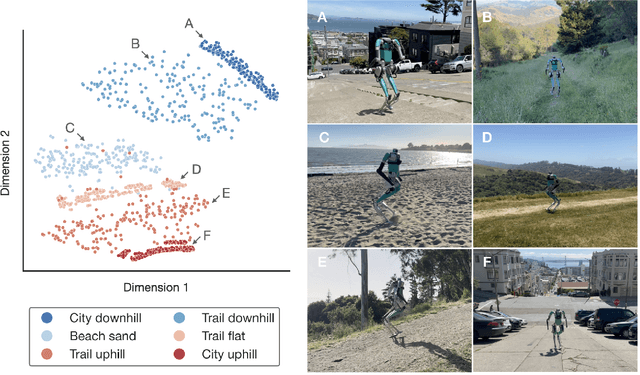
Humanoid robots can, in principle, use their legs to go almost anywhere. Developing controllers capable of traversing diverse terrains, however, remains a considerable challenge. Classical controllers are hard to generalize broadly while the learning-based methods have primarily focused on gentle terrains. Here, we present a learning-based approach for blind humanoid locomotion capable of traversing challenging natural and man-made terrain. Our method uses a transformer model to predict the next action based on the history of proprioceptive observations and actions. The model is first pre-trained on a dataset of flat-ground trajectories with sequence modeling, and then fine-tuned on uneven terrain using reinforcement learning. We evaluate our model on a real humanoid robot across a variety of terrains, including rough, deformable, and sloped surfaces. The model demonstrates robust performance, in-context adaptation, and emergent terrain representations. In real-world case studies, our humanoid robot successfully traversed over 4 miles of hiking trails in Berkeley and climbed some of the steepest streets in San Francisco.
MonST3R: A Simple Approach for Estimating Geometry in the Presence of Motion
Oct 04, 2024

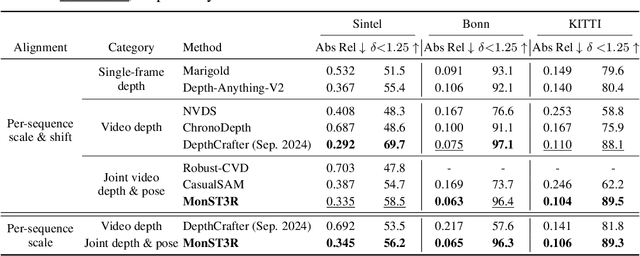

Estimating geometry from dynamic scenes, where objects move and deform over time, remains a core challenge in computer vision. Current approaches often rely on multi-stage pipelines or global optimizations that decompose the problem into subtasks, like depth and flow, leading to complex systems prone to errors. In this paper, we present Motion DUSt3R (MonST3R), a novel geometry-first approach that directly estimates per-timestep geometry from dynamic scenes. Our key insight is that by simply estimating a pointmap for each timestep, we can effectively adapt DUST3R's representation, previously only used for static scenes, to dynamic scenes. However, this approach presents a significant challenge: the scarcity of suitable training data, namely dynamic, posed videos with depth labels. Despite this, we show that by posing the problem as a fine-tuning task, identifying several suitable datasets, and strategically training the model on this limited data, we can surprisingly enable the model to handle dynamics, even without an explicit motion representation. Based on this, we introduce new optimizations for several downstream video-specific tasks and demonstrate strong performance on video depth and camera pose estimation, outperforming prior work in terms of robustness and efficiency. Moreover, MonST3R shows promising results for primarily feed-forward 4D reconstruction.
Data-Centric AI Governance: Addressing the Limitations of Model-Focused Policies
Sep 25, 2024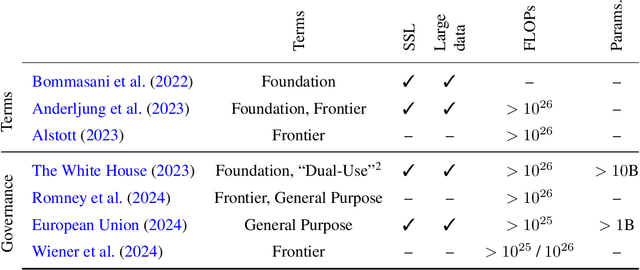
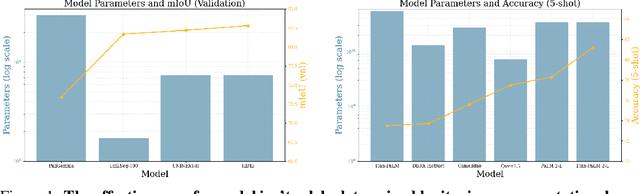

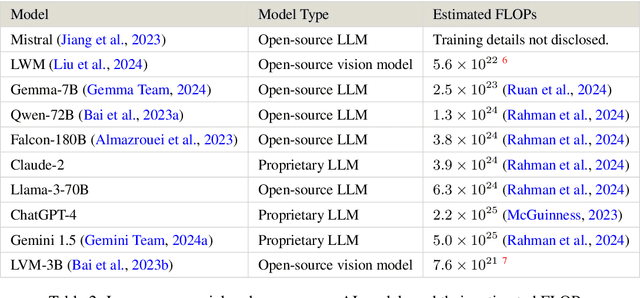
Current regulations on powerful AI capabilities are narrowly focused on "foundation" or "frontier" models. However, these terms are vague and inconsistently defined, leading to an unstable foundation for governance efforts. Critically, policy debates often fail to consider the data used with these models, despite the clear link between data and model performance. Even (relatively) "small" models that fall outside the typical definitions of foundation and frontier models can achieve equivalent outcomes when exposed to sufficiently specific datasets. In this work, we illustrate the importance of considering dataset size and content as essential factors in assessing the risks posed by models both today and in the future. More broadly, we emphasize the risk posed by over-regulating reactively and provide a path towards careful, quantitative evaluation of capabilities that can lead to a simplified regulatory environment.
Wolf: Captioning Everything with a World Summarization Framework
Jul 26, 2024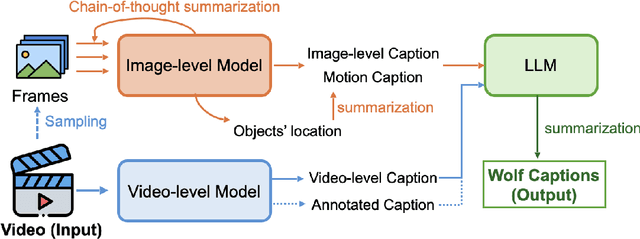
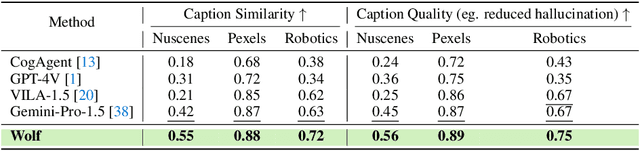
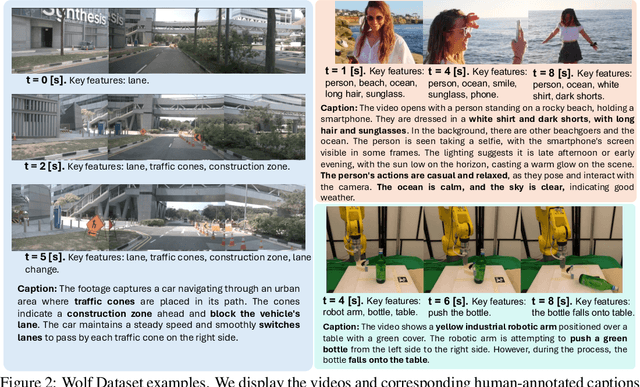
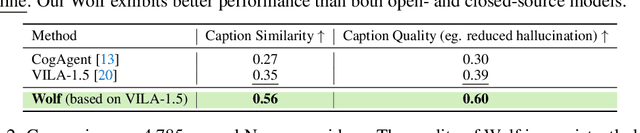
We propose Wolf, a WOrLd summarization Framework for accurate video captioning. Wolf is an automated captioning framework that adopts a mixture-of-experts approach, leveraging complementary strengths of Vision Language Models (VLMs). By utilizing both image and video models, our framework captures different levels of information and summarizes them efficiently. Our approach can be applied to enhance video understanding, auto-labeling, and captioning. To evaluate caption quality, we introduce CapScore, an LLM-based metric to assess the similarity and quality of generated captions compared to the ground truth captions. We further build four human-annotated datasets in three domains: autonomous driving, general scenes, and robotics, to facilitate comprehensive comparisons. We show that Wolf achieves superior captioning performance compared to state-of-the-art approaches from the research community (VILA1.5, CogAgent) and commercial solutions (Gemini-Pro-1.5, GPT-4V). For instance, in comparison with GPT-4V, Wolf improves CapScore both quality-wise by 55.6% and similarity-wise by 77.4% on challenging driving videos. Finally, we establish a benchmark for video captioning and introduce a leaderboard, aiming to accelerate advancements in video understanding, captioning, and data alignment. Leaderboard: https://wolfv0.github.io/leaderboard.html.
Visual Haystacks: Answering Harder Questions About Sets of Images
Jul 18, 2024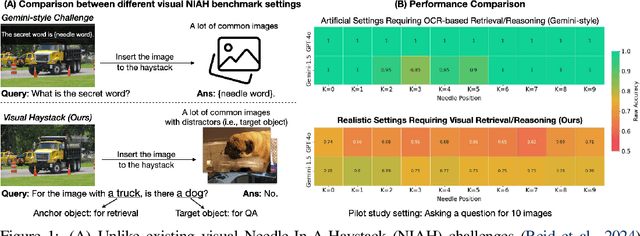



Recent advancements in Large Multimodal Models (LMMs) have made significant progress in the field of single-image visual question answering. However, these models face substantial challenges when tasked with queries that span extensive collections of images, similar to real-world scenarios like searching through large photo albums, finding specific information across the internet, or monitoring environmental changes through satellite imagery. This paper explores the task of Multi-Image Visual Question Answering (MIQA): given a large set of images and a natural language query, the task is to generate a relevant and grounded response. We propose a new public benchmark, dubbed "Visual Haystacks (VHs)," specifically designed to evaluate LMMs' capabilities in visual retrieval and reasoning over sets of unrelated images, where we perform comprehensive evaluations demonstrating that even robust closed-source models struggle significantly. Towards addressing these shortcomings, we introduce MIRAGE (Multi-Image Retrieval Augmented Generation), a novel retrieval/QA framework tailored for LMMs that confronts the challenges of MIQA with marked efficiency and accuracy improvements over baseline methods. Our evaluation shows that MIRAGE surpasses closed-source GPT-4o models by up to 11% on the VHs benchmark and offers up to 3.4x improvements in efficiency over text-focused multi-stage approaches.