 Add to Chrome
 Add to Firefox
 Add to Edge
Contrastive Action-Image Pre-training for Visuomotor Control
Jun 15, 2026
Existing vision encoders for robotics face a fundamental bottleneck: robotic datasets lack the scale necessary for large-scale pre-training. Prior work circumvents this data scarcity by turning to internet-scale image and language data or egocentric human video. While these models show promise, neither paradigm learns from paired vision and action data, which downstream visuomotor control policies require. However, robot trajectories, the most direct source of this paired signal, are not available at pre-training scale, motivating us to extract action signals from abundant human video instead. To this end, we introduce CAIP (Contrastive Action-Image Pre-training), a vision encoder that treats human hand poses from large-scale egocentric video as a proxy for end-effector actions. By extracting 3D hand keypoints, a representation that aligns naturally with downstream robot action spaces, CAIP learns a unified action-image representation through a contrastive objective. Leveraging 32,041 hours of egocentric human video and only 88 hours of robotic manipulation data, CAIP outperforms state-of-the-art vision encoders including DINOv2, SigLIP, MVP, and R3M. Evaluated on a challenging real-world dexterous manipulation setup using Dexmate Vega and Sharpa Wave hands, CAIP yields performance gains of more than 30% on tasks involving folding, pouring, and fine-grained manipulation. Our results show that our method of contrastive action-centric pre-training yields a scalable path to achieving robust visual representations better suited for physical interaction.

T-Rex: Tactile-Reactive Dexterous Manipulation
Jun 15, 2026The ability to react dynamically to tactile signals has long been considered crucial to agile human-level dexterity. Yet contemporary learning-based Vision-Language-Action (VLA) models for robotic manipulation generally either overlook the tactile modality or are limited to encoders with static cues, due in part to the scarcity of diverse training data and standardized evaluation, architectural constraints in current VLA models, and limitations of static tactile encoders. In this paper, we push the frontier of tactile-reactive manipulation by addressing all of these limitations. We propose a large-scale, 100-hour tactile-rich dataset collected via a novel, data-efficient recipe that prioritizes elementary motor primitives. To effectively exploit naturally high-frequency touch signals without sacrificing the existing capabilities of existing VLAs, we introduce a variable-rate Mixture-of-Transformers (MoT) architecture equipped with a novel temporal tactile VQ-VAE encoder. We demonstrate the effectiveness of tactile-reactive policies on 12 manipulation tasks requiring delicate force control and deformable object manipulation, achieving over 30% higher average success rate than the strongest baseline.
Guidance Contrastive Token Credit Assignment for Discrete Policy Optimization
May 28, 2026Group-advantage-based reinforcement learning methods, such as GRPO and DAPO, have demonstrated strong performance across diverse domains, including mathematical reasoning and text-to-image generation. However, their reliance on sample-level rewards introduces a key limitation as uniform credit assignment across all tokens fails to capture fine-grained, token-level contributions. To address this issue, we propose Guidance Contrastive Policy Optimization (GCPO), a novel algorithm that enables per-token credit assignment by contrasting model predictions under positive and negative prompts. Rather than uniformly broadcasting sample-level advantages, GCPO assigns token-level advantages proportional to the difference between these contrastive predictions, allowing more precise and informative learning signals. Empirically, we find that GCPO emphasizes semantically relevant regions such as visual areas aligned with textual prompts in text-to-image generation, and critical keywords within reasoning traces for chain-of-thought tasks. Through extensive experiments, GCPO consistently outperforms GRPO and DAPO baselines on both text-to-image generation and chain-of-thought reasoning benchmarks, demonstrating its effectiveness as a general and scalable optimization strategy for discrete policy learning.
MobileWorldBench: Towards Semantic World Modeling For Mobile Agents
Dec 16, 2025World models have shown great utility in improving the task performance of embodied agents. While prior work largely focuses on pixel-space world models, these approaches face practical limitations in GUI settings, where predicting complex visual elements in future states is often difficult. In this work, we explore an alternative formulation of world modeling for GUI agents, where state transitions are described in natural language rather than predicting raw pixels. First, we introduce MobileWorldBench, a benchmark that evaluates the ability of vision-language models (VLMs) to function as world models for mobile GUI agents. Second, we release MobileWorld, a large-scale dataset consisting of 1.4M samples, that significantly improves the world modeling capabilities of VLMs. Finally, we propose a novel framework that integrates VLM world models into the planning framework of mobile agents, demonstrating that semantic world models can directly benefit mobile agents by improving task success rates. The code and dataset is available at https://github.com/jacklishufan/MobileWorld
LaViDa: A Large Diffusion Language Model for Multimodal Understanding
May 22, 2025Modern Vision-Language Models (VLMs) can solve a wide range of tasks requiring visual reasoning. In real-world scenarios, desirable properties for VLMs include fast inference and controllable generation (e.g., constraining outputs to adhere to a desired format). However, existing autoregressive (AR) VLMs like LLaVA struggle in these aspects. Discrete diffusion models (DMs) offer a promising alternative, enabling parallel decoding for faster inference and bidirectional context for controllable generation through text-infilling. While effective in language-only settings, DMs' potential for multimodal tasks is underexplored. We introduce LaViDa, a family of VLMs built on DMs. We build LaViDa by equipping DMs with a vision encoder and jointly fine-tune the combined parts for multimodal instruction following. To address challenges encountered, LaViDa incorporates novel techniques such as complementary masking for effective training, prefix KV cache for efficient inference, and timestep shifting for high-quality sampling. Experiments show that LaViDa achieves competitive or superior performance to AR VLMs on multi-modal benchmarks such as MMMU, while offering unique advantages of DMs, including flexible speed-quality tradeoff, controllability, and bidirectional reasoning. On COCO captioning, LaViDa surpasses Open-LLaVa-Next-8B by +4.1 CIDEr with 1.92x speedup. On bidirectional tasks, it achieves +59% improvement on Constrained Poem Completion. These results demonstrate LaViDa as a strong alternative to AR VLMs. Code and models will be released in the camera-ready version.
Reflect-DiT: Inference-Time Scaling for Text-to-Image Diffusion Transformers via In-Context Reflection
Mar 15, 2025The predominant approach to advancing text-to-image generation has been training-time scaling, where larger models are trained on more data using greater computational resources. While effective, this approach is computationally expensive, leading to growing interest in inference-time scaling to improve performance. Currently, inference-time scaling for text-to-image diffusion models is largely limited to best-of-N sampling, where multiple images are generated per prompt and a selection model chooses the best output. Inspired by the recent success of reasoning models like DeepSeek-R1 in the language domain, we introduce an alternative to naive best-of-N sampling by equipping text-to-image Diffusion Transformers with in-context reflection capabilities. We propose Reflect-DiT, a method that enables Diffusion Transformers to refine their generations using in-context examples of previously generated images alongside textual feedback describing necessary improvements. Instead of passively relying on random sampling and hoping for a better result in a future generation, Reflect-DiT explicitly tailors its generations to address specific aspects requiring enhancement. Experimental results demonstrate that Reflect-DiT improves performance on the GenEval benchmark (+0.19) using SANA-1.0-1.6B as a base model. Additionally, it achieves a new state-of-the-art score of 0.81 on GenEval while generating only 20 samples per prompt, surpassing the previous best score of 0.80, which was obtained using a significantly larger model (SANA-1.5-4.8B) with 2048 samples under the best-of-N approach.
OmniFlow: Any-to-Any Generation with Multi-Modal Rectified Flows
Dec 02, 2024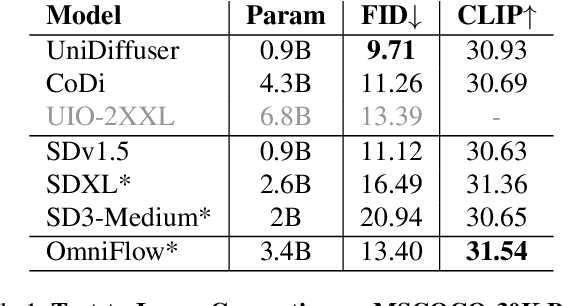
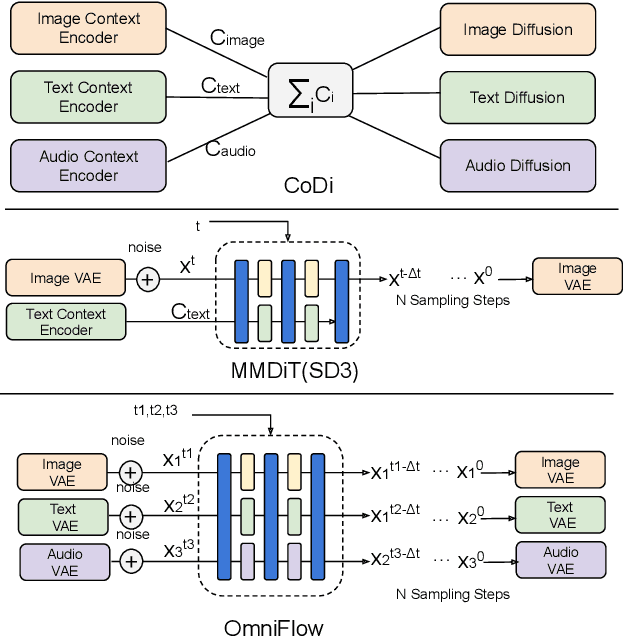

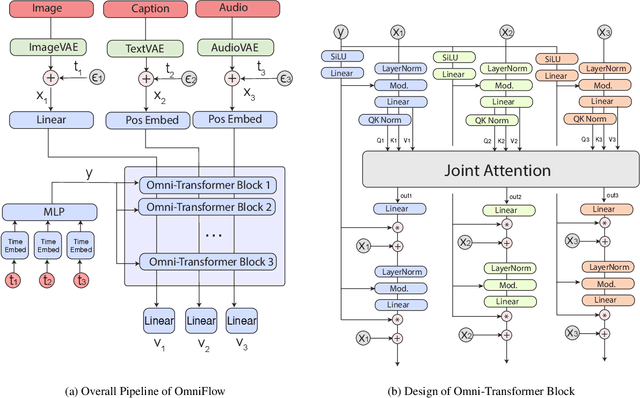
We introduce OmniFlow, a novel generative model designed for any-to-any generation tasks such as text-to-image, text-to-audio, and audio-to-image synthesis. OmniFlow advances the rectified flow (RF) framework used in text-to-image models to handle the joint distribution of multiple modalities. It outperforms previous any-to-any models on a wide range of tasks, such as text-to-image and text-to-audio synthesis. Our work offers three key contributions: First, we extend RF to a multi-modal setting and introduce a novel guidance mechanism, enabling users to flexibly control the alignment between different modalities in the generated outputs. Second, we propose a novel architecture that extends the text-to-image MMDiT architecture of Stable Diffusion 3 and enables audio and text generation. The extended modules can be efficiently pretrained individually and merged with the vanilla text-to-image MMDiT for fine-tuning. Lastly, we conduct a comprehensive study on the design choices of rectified flow transformers for large-scale audio and text generation, providing valuable insights into optimizing performance across diverse modalities. The Code will be available at https://github.com/jacklishufan/OmniFlows.
SegLLM: Multi-round Reasoning Segmentation
Oct 24, 2024


We present SegLLM, a novel multi-round interactive reasoning segmentation model that enhances LLM-based segmentation by exploiting conversational memory of both visual and textual outputs. By leveraging a mask-aware multimodal LLM, SegLLM re-integrates previous segmentation results into its input stream, enabling it to reason about complex user intentions and segment objects in relation to previously identified entities, including positional, interactional, and hierarchical relationships, across multiple interactions. This capability allows SegLLM to respond to visual and text queries in a chat-like manner. Evaluated on the newly curated MRSeg benchmark, SegLLM outperforms existing methods in multi-round interactive reasoning segmentation by over 20%. Additionally, we observed that training on multi-round reasoning segmentation data enhances performance on standard single-round referring segmentation and localization tasks, resulting in a 5.5% increase in cIoU for referring expression segmentation and a 4.5% improvement in Acc@0.5 for referring expression localization.
Hyperbolic Learning with Multimodal Large Language Models
Aug 09, 2024Hyperbolic embeddings have demonstrated their effectiveness in capturing measures of uncertainty and hierarchical relationships across various deep-learning tasks, including image segmentation and active learning. However, their application in modern vision-language models (VLMs) has been limited. A notable exception is MERU, which leverages the hierarchical properties of hyperbolic space in the CLIP ViT-large model, consisting of hundreds of millions parameters. In our work, we address the challenges of scaling multi-modal hyperbolic models by orders of magnitude in terms of parameters (billions) and training complexity using the BLIP-2 architecture. Although hyperbolic embeddings offer potential insights into uncertainty not present in Euclidean embeddings, our analysis reveals that scaling these models is particularly difficult. We propose a novel training strategy for a hyperbolic version of BLIP-2, which allows to achieve comparable performance to its Euclidean counterpart, while maintaining stability throughout the training process and showing a meaningful indication of uncertainty with each embedding.
Aligning Diffusion Models by Optimizing Human Utility
Apr 06, 2024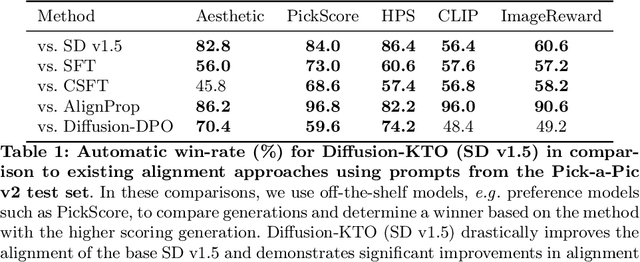
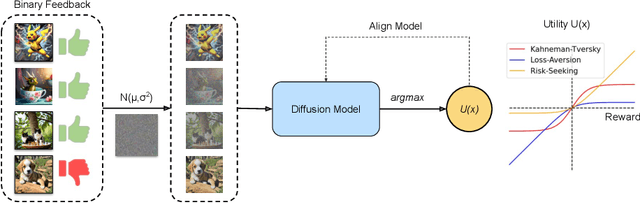
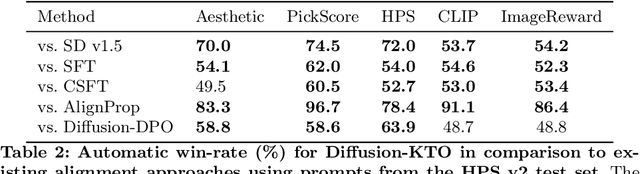
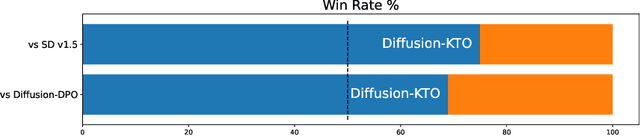
We present Diffusion-KTO, a novel approach for aligning text-to-image diffusion models by formulating the alignment objective as the maximization of expected human utility. Since this objective applies to each generation independently, Diffusion-KTO does not require collecting costly pairwise preference data nor training a complex reward model. Instead, our objective requires simple per-image binary feedback signals, e.g. likes or dislikes, which are abundantly available. After fine-tuning using Diffusion-KTO, text-to-image diffusion models exhibit superior performance compared to existing techniques, including supervised fine-tuning and Diffusion-DPO, both in terms of human judgment and automatic evaluation metrics such as PickScore and ImageReward. Overall, Diffusion-KTO unlocks the potential of leveraging readily available per-image binary signals and broadens the applicability of aligning text-to-image diffusion models with human preferences.