 Add to Chrome
 Add to Firefox
 Add to Edge
Integrating Vision-Centric Text Understanding for Conversational Recommender Systems
Jan 20, 2026
Conversational Recommender Systems (CRSs) have attracted growing attention for their ability to deliver personalized recommendations through natural language interactions. To more accurately infer user preferences from multi-turn conversations, recent works increasingly expand conversational context (e.g., by incorporating diverse entity information or retrieving related dialogues). While such context enrichment can assist preference modeling, it also introduces longer and more heterogeneous inputs, leading to practical issues such as input length constraints, text style inconsistency, and irrelevant textual noise, thereby raising the demand for stronger language understanding ability. In this paper, we propose STARCRS, a Screen-Text-AwaRe Conversational Recommender System that integrates two complementary text understanding modes: (1) a screen-reading pathway that encodes auxiliary textual information as visual tokens, mimicking skim reading on a screen, and (2) an LLM-based textual pathway that focuses on a limited set of critical content for fine-grained reasoning. We design a knowledge-anchored fusion framework that combines contrastive alignment, cross-attention interaction, and adaptive gating to integrate the two modes for improved preference modeling and response generation. Extensive experiments on two widely used benchmarks demonstrate that STARCRS consistently improves both recommendation accuracy and generated response quality.

Efficient Content-based Recommendation Model Training via Noise-aware Coreset Selection
Jan 15, 2026Content-based recommendation systems (CRSs) utilize content features to predict user-item interactions, serving as essential tools for helping users navigate information-rich web services. However, ensuring the effectiveness of CRSs requires large-scale and even continuous model training to accommodate diverse user preferences, resulting in significant computational costs and resource demands. A promising approach to this challenge is coreset selection, which identifies a small but representative subset of data samples that preserves model quality while reducing training overhead. Yet, the selected coreset is vulnerable to the pervasive noise in user-item interactions, particularly when it is minimally sized. To this end, we propose Noise-aware Coreset Selection (NaCS), a specialized framework for CRSs. NaCS constructs coresets through submodular optimization based on training gradients, while simultaneously correcting noisy labels using a progressively trained model. Meanwhile, we refine the selected coreset by filtering out low-confidence samples through uncertainty quantification, thereby avoid training with unreliable interactions. Through extensive experiments, we show that NaCS produces higher-quality coresets for CRSs while achieving better efficiency than existing coreset selection techniques. Notably, NaCS recovers 93-95\% of full-dataset training performance using merely 1\% of the training data. The source code is available at \href{https://github.com/chenxing1999/nacs}{https://github.com/chenxing1999/nacs}.
Reasoning Pattern Alignment Merging for Adaptive Reasoning
Jan 07, 2026Recent large reasoning models (LRMs) have made substantial progress in complex reasoning tasks, yet they often generate lengthy reasoning paths for every query, incurring unnecessary computation and latency. Existing speed-up approaches typically rely on retraining the model or designing sophisticated prompting, which are either prohibitively expensive or highly sensitive to the input and prompt formulation. In this work, we study model merging as a lightweight alternative for efficient reasoning: by combining a long chain-of-thought (Long-CoT) reasoning model with a Short-CoT instruction model, we obtain an adaptive reasoner without training from scratch or requiring large-scale additional data. Building on this idea, we propose Reasoning Pattern Alignment Merging (RPAM), a layer-wise model merging framework based on feature alignment to facilitate query-adaptive reasoning. RPAM first constructs a small pattern-labeled calibration set that assigns each query an appropriate reasoning pattern. It then optimizes layer-wise merging coefficients by aligning the merged model's intermediate representations with those of the selected model, while a contrastive objective explicitly pushes them away from the non-selected model. Experiments on seven widely used reasoning benchmarks show that RPAM substantially reduces inference cost while maintaining strong performance. Upon article acceptance, we will provide open-source code to reproduce experiments for RPAM.
A Multi-agent Text2SQL Framework using Small Language Models and Execution Feedback
Dec 21, 2025Text2SQL, the task of generating SQL queries from natural language text, is a critical challenge in data engineering. Recently, Large Language Models (LLMs) have demonstrated superior performance for this task due to their advanced comprehension and generation capabilities. However, privacy and cost considerations prevent companies from using Text2SQL solutions based on external LLMs offered as a service. Rather, small LLMs (SLMs) that are openly available and can hosted in-house are adopted. These SLMs, in turn, lack the generalization capabilities of larger LLMs, which impairs their effectiveness for complex tasks such as Text2SQL. To address these limitations, we propose MATS, a novel Text2SQL framework designed specifically for SLMs. MATS uses a multi-agent mechanism that assigns specialized roles to auxiliary agents, reducing individual workloads and fostering interaction. A training scheme based on reinforcement learning aligns these agents using feedback obtained during execution, thereby maintaining competitive performance despite a limited LLM size. Evaluation results using on benchmark datasets show that MATS, deployed on a single- GPU server, yields accuracy that are on-par with large-scale LLMs when using significantly fewer parameters. Our source code and data are available at https://github.com/thanhdath/mats-sql.
CoDeQ: End-to-End Joint Model Compression with Dead-Zone Quantizer for High-Sparsity and Low-Precision Networks
Dec 15, 2025While joint pruning--quantization is theoretically superior to sequential application, current joint methods rely on auxiliary procedures outside the training loop for finding compression parameters. This reliance adds engineering complexity and hyperparameter tuning, while also lacking a direct data-driven gradient signal, which might result in sub-optimal compression. In this paper, we introduce CoDeQ, a simple, fully differentiable method for joint pruning--quantization. Our approach builds on a key observation: the dead-zone of a scalar quantizer is equivalent to magnitude pruning, and can be used to induce sparsity directly within the quantization operator. Concretely, we parameterize the dead-zone width and learn it via backpropagation, alongside the quantization parameters. This design provides explicit control of sparsity, regularized by a single global hyperparameter, while decoupling sparsity selection from bit-width selection. The result is a method for Compression with Dead-zone Quantizer (CoDeQ) that supports both fixed-precision and mixed-precision quantization (controlled by an optional second hyperparameter). It simultaneously determines the sparsity pattern and quantization parameters in a single end-to-end optimization. Consequently, CoDeQ does not require any auxiliary procedures, making the method architecture-agnostic and straightforward to implement. On ImageNet with ResNet-18, CoDeQ reduces bit operations to ~5% while maintaining close to full precision accuracy in both fixed and mixed-precision regimes.
Dental3R: Geometry-Aware Pairing for Intraoral 3D Reconstruction from Sparse-View Photographs
Nov 18, 2025Intraoral 3D reconstruction is fundamental to digital orthodontics, yet conventional methods like intraoral scanning are inaccessible for remote tele-orthodontics, which typically relies on sparse smartphone imagery. While 3D Gaussian Splatting (3DGS) shows promise for novel view synthesis, its application to the standard clinical triad of unposed anterior and bilateral buccal photographs is challenging. The large view baselines, inconsistent illumination, and specular surfaces common in intraoral settings can destabilize simultaneous pose and geometry estimation. Furthermore, sparse-view photometric supervision often induces a frequency bias, leading to over-smoothed reconstructions that lose critical diagnostic details. To address these limitations, we propose \textbf{Dental3R}, a pose-free, graph-guided pipeline for robust, high-fidelity reconstruction from sparse intraoral photographs. Our method first constructs a Geometry-Aware Pairing Strategy (GAPS) to intelligently select a compact subgraph of high-value image pairs. The GAPS focuses on correspondence matching, thereby improving the stability of the geometry initialization and reducing memory usage. Building on the recovered poses and point cloud, we train the 3DGS model with a wavelet-regularized objective. By enforcing band-limited fidelity using a discrete wavelet transform, our approach preserves fine enamel boundaries and interproximal edges while suppressing high-frequency artifacts. We validate our approach on a large-scale dataset of 950 clinical cases and an additional video-based test set of 195 cases. Experimental results demonstrate that Dental3R effectively handles sparse, unposed inputs and achieves superior novel view synthesis quality for dental occlusion visualization, outperforming state-of-the-art methods.
Silhouette-to-Contour Registration: Aligning Intraoral Scan Models with Cephalometric Radiographs
Nov 18, 2025Reliable 3D-2D alignment between intraoral scan (IOS) models and lateral cephalometric radiographs is critical for orthodontic diagnosis, yet conventional intensity-driven registration methods struggle under real clinical conditions, where cephalograms exhibit projective magnification, geometric distortion, low-contrast dental crowns, and acquisition-dependent variation. These factors hinder the stability of appearance-based similarity metrics and often lead to convergence failures or anatomically implausible alignments. To address these limitations, we propose DentalSCR, a pose-stable, contour-guided framework for accurate and interpretable silhouette-to-contour registration. Our method first constructs a U-Midline Dental Axis (UMDA) to establish a unified cross-arch anatomical coordinate system, thereby stabilizing initialization and standardizing projection geometry across cases. Using this reference frame, we generate radiograph-like projections via a surface-based DRR formulation with coronal-axis perspective and Gaussian splatting, which preserves clinical source-object-detector magnification and emphasizes external silhouettes. Registration is then formulated as a 2D similarity transform optimized with a symmetric bidirectional Chamfer distance under a hierarchical coarse-to-fine schedule, enabling both large capture range and subpixel-level contour agreement. We evaluate DentalSCR on 34 expert-annotated clinical cases. Experimental results demonstrate substantial reductions in landmark error-particularly at posterior teeth-tighter dispersion on the lower jaw, and low Chamfer and controlled Hausdorff distances at the curve level. These findings indicate that DentalSCR robustly handles real-world cephalograms and delivers high-fidelity, clinically inspectable 3D--2D alignment, outperforming conventional baselines.
ArchMap: Arch-Flattening and Knowledge-Guided Vision Language Model for Tooth Counting and Structured Dental Understanding
Nov 18, 2025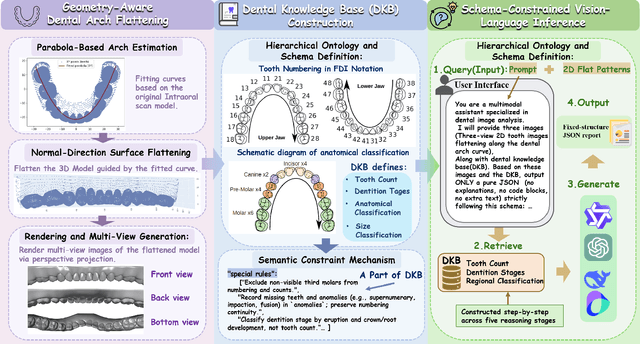
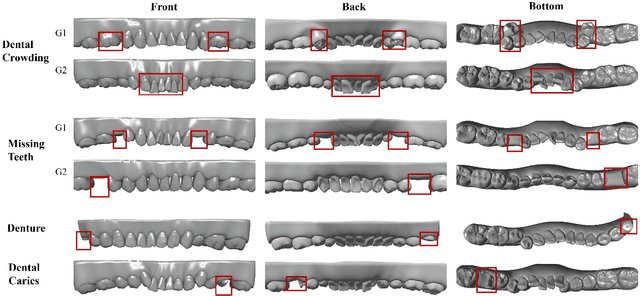
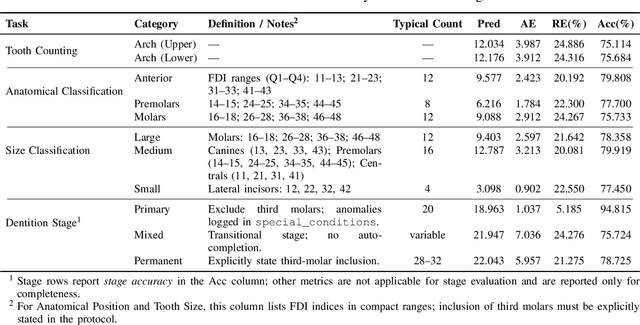
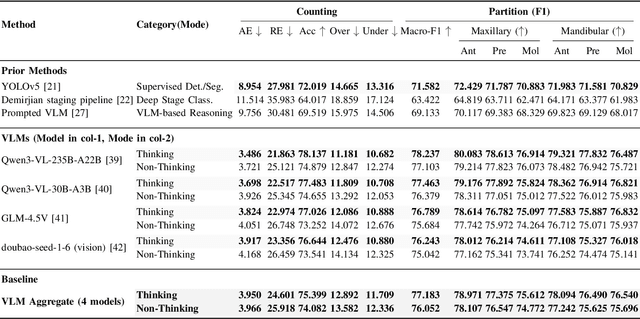
A structured understanding of intraoral 3D scans is essential for digital orthodontics. However, existing deep-learning approaches rely heavily on modality-specific training, large annotated datasets, and controlled scanning conditions, which limit generalization across devices and hinder deployment in real clinical workflows. Moreover, raw intraoral meshes exhibit substantial variation in arch pose, incomplete geometry caused by occlusion or tooth contact, and a lack of texture cues, making unified semantic interpretation highly challenging. To address these limitations, we propose ArchMap, a training-free and knowledge-guided framework for robust structured dental understanding. ArchMap first introduces a geometry-aware arch-flattening module that standardizes raw 3D meshes into spatially aligned, continuity-preserving multi-view projections. We then construct a Dental Knowledge Base (DKB) encoding hierarchical tooth ontology, dentition-stage policies, and clinical semantics to constrain the symbolic reasoning space. We validate ArchMap on 1060 pre-/post-orthodontic cases, demonstrating robust performance in tooth counting, anatomical partitioning, dentition-stage classification, and the identification of clinical conditions such as crowding, missing teeth, prosthetics, and caries. Compared with supervised pipelines and prompted VLM baselines, ArchMap achieves higher accuracy, reduced semantic drift, and superior stability under sparse or artifact-prone conditions. As a fully training-free system, ArchMap demonstrates that combining geometric normalization with ontology-guided multimodal reasoning offers a practical and scalable solution for the structured analysis of 3D intraoral scans in modern digital orthodontics.
EndoIR: Degradation-Agnostic All-in-One Endoscopic Image Restoration via Noise-Aware Routing Diffusion
Nov 11, 2025Endoscopic images often suffer from diverse and co-occurring degradations such as low lighting, smoke, and bleeding, which obscure critical clinical details. Existing restoration methods are typically task-specific and often require prior knowledge of the degradation type, limiting their robustness in real-world clinical use. We propose EndoIR, an all-in-one, degradation-agnostic diffusion-based framework that restores multiple degradation types using a single model. EndoIR introduces a Dual-Domain Prompter that extracts joint spatial-frequency features, coupled with an adaptive embedding that encodes both shared and task-specific cues as conditioning for denoising. To mitigate feature confusion in conventional concatenation-based conditioning, we design a Dual-Stream Diffusion architecture that processes clean and degraded inputs separately, with a Rectified Fusion Block integrating them in a structured, degradation-aware manner. Furthermore, Noise-Aware Routing Block improves efficiency by dynamically selecting only noise-relevant features during denoising. Experiments on SegSTRONG-C and CEC datasets demonstrate that EndoIR achieves state-of-the-art performance across multiple degradation scenarios while using fewer parameters than strong baselines, and downstream segmentation experiments confirm its clinical utility.
RLVE: Scaling Up Reinforcement Learning for Language Models with Adaptive Verifiable Environments
Nov 10, 2025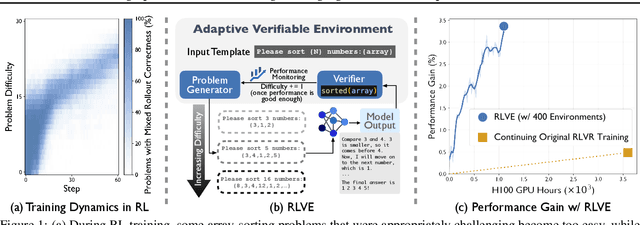
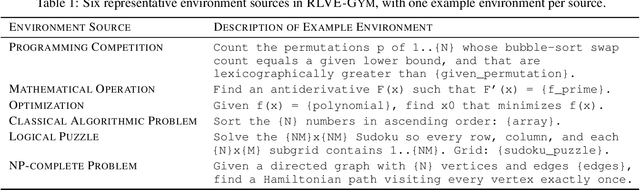
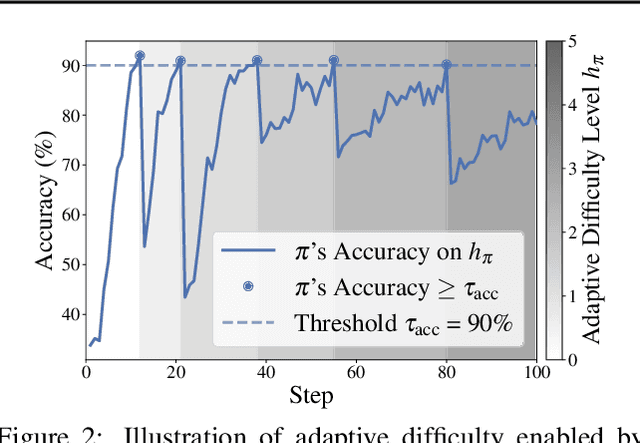
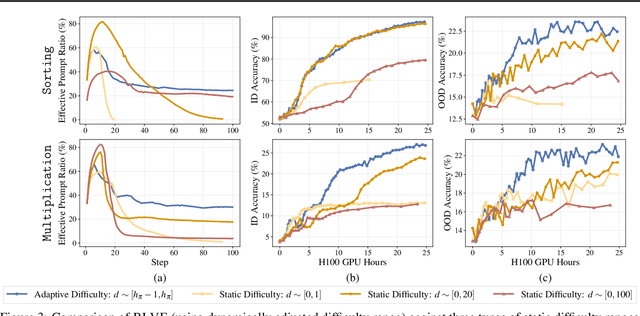
We introduce Reinforcement Learning (RL) with Adaptive Verifiable Environments (RLVE), an approach using verifiable environments that procedurally generate problems and provide algorithmically verifiable rewards, to scale up RL for language models (LMs). RLVE enables each verifiable environment to dynamically adapt its problem difficulty distribution to the policy model's capabilities as training progresses. In contrast, static data distributions often lead to vanishing learning signals when problems are either too easy or too hard for the policy. To implement RLVE, we create RLVE-Gym, a large-scale suite of 400 verifiable environments carefully developed through manual environment engineering. Using RLVE-Gym, we show that environment scaling, i.e., expanding the collection of training environments, consistently improves generalizable reasoning capabilities. RLVE with joint training across all 400 environments in RLVE-Gym yields a 3.37% absolute average improvement across six reasoning benchmarks, starting from one of the strongest 1.5B reasoning LMs. By comparison, continuing this LM's original RL training yields only a 0.49% average absolute gain despite using over 3x more compute. We release our code publicly.