 Add to Chrome
 Add to Firefox
 Add to Edge
Equivariant Scalar Fields for Molecular Docking with Fast Fourier Transforms
Dec 07, 2023
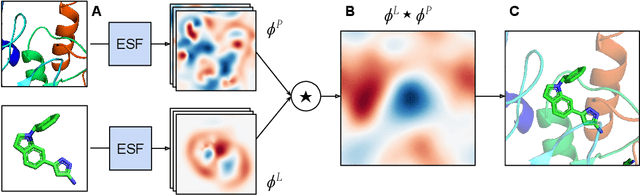
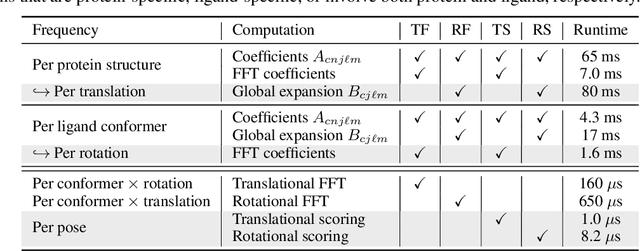
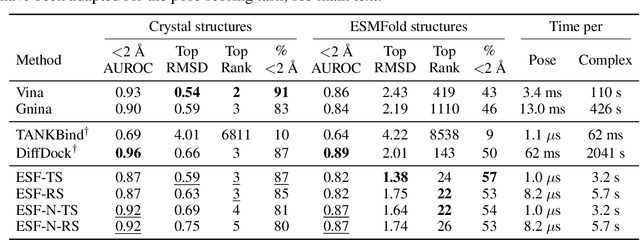
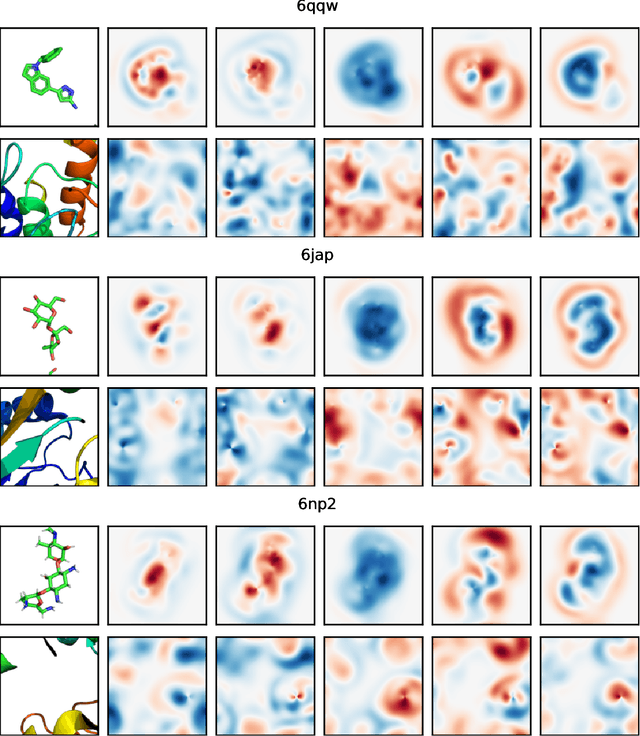
Molecular docking is critical to structure-based virtual screening, yet the throughput of such workflows is limited by the expensive optimization of scoring functions involved in most docking algorithms. We explore how machine learning can accelerate this process by learning a scoring function with a functional form that allows for more rapid optimization. Specifically, we define the scoring function to be the cross-correlation of multi-channel ligand and protein scalar fields parameterized by equivariant graph neural networks, enabling rapid optimization over rigid-body degrees of freedom with fast Fourier transforms. The runtime of our approach can be amortized at several levels of abstraction, and is particularly favorable for virtual screening settings with a common binding pocket. We benchmark our scoring functions on two simplified docking-related tasks: decoy pose scoring and rigid conformer docking. Our method attains similar but faster performance on crystal structures compared to the widely-used Vina and Gnina scoring functions, and is more robust on computationally predicted structures. Code is available at https://github.com/bjing2016/scalar-fields.

Fast non-autoregressive inverse folding with discrete diffusion
Dec 05, 2023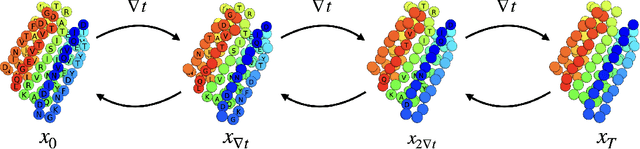

Generating protein sequences that fold into a intended 3D structure is a fundamental step in de novo protein design. De facto methods utilize autoregressive generation, but this eschews higher order interactions that could be exploited to improve inference speed. We describe a non-autoregressive alternative that performs inference using a constant number of calls resulting in a 23 times speed up without a loss in performance on the CATH benchmark. Conditioned on the 3D structure, we fine-tune ProteinMPNN to perform discrete diffusion with a purity prior over the index sampling order. Our approach gives the flexibility in trading off inference speed and accuracy by modulating the diffusion speed. Code: https://github.com/johnyang101/pmpnndiff
Risk-Controlling Model Selection via Guided Bayesian Optimization
Dec 04, 2023Adjustable hyperparameters of machine learning models typically impact various key trade-offs such as accuracy, fairness, robustness, or inference cost. Our goal in this paper is to find a configuration that adheres to user-specified limits on certain risks while being useful with respect to other conflicting metrics. We solve this by combining Bayesian Optimization (BO) with rigorous risk-controlling procedures, where our core idea is to steer BO towards an efficient testing strategy. Our BO method identifies a set of Pareto optimal configurations residing in a designated region of interest. The resulting candidates are statistically verified and the best-performing configuration is selected with guaranteed risk levels. We demonstrate the effectiveness of our approach on a range of tasks with multiple desiderata, including low error rates, equitable predictions, handling spurious correlations, managing rate and distortion in generative models, and reducing computational costs.
Removing Biases from Molecular Representations via Information Maximization
Dec 01, 2023High-throughput drug screening -- using cell imaging or gene expression measurements as readouts of drug effect -- is a critical tool in biotechnology to assess and understand the relationship between the chemical structure and biological activity of a drug. Since large-scale screens have to be divided into multiple experiments, a key difficulty is dealing with batch effects, which can introduce systematic errors and non-biological associations in the data. We propose InfoCORE, an Information maximization approach for COnfounder REmoval, to effectively deal with batch effects and obtain refined molecular representations. InfoCORE establishes a variational lower bound on the conditional mutual information of the latent representations given a batch identifier. It adaptively reweighs samples to equalize their implied batch distribution. Extensive experiments on drug screening data reveal InfoCORE's superior performance in a multitude of tasks including molecular property prediction and molecule-phenotype retrieval. Additionally, we show results for how InfoCORE offers a versatile framework and resolves general distribution shifts and issues of data fairness by minimizing correlation with spurious features or removing sensitive attributes. The code is available at https://github.com/uhlerlab/InfoCORE.
Learning Interatomic Potentials at Multiple Scales
Oct 20, 2023The need to use a short time step is a key limit on the speed of molecular dynamics (MD) simulations. Simulations governed by classical potentials are often accelerated by using a multiple-time-step (MTS) integrator that evaluates certain potential energy terms that vary more slowly than others less frequently. This approach is enabled by the simple but limiting analytic forms of classical potentials. Machine learning interatomic potentials (MLIPs), in particular recent equivariant neural networks, are much more broadly applicable than classical potentials and can faithfully reproduce the expensive but accurate reference electronic structure calculations used to train them. They still, however, require the use of a single short time step, as they lack the inherent term-by-term scale separation of classical potentials. This work introduces a method to learn a scale separation in complex interatomic interactions by co-training two MLIPs. Initially, a small and efficient model is trained to reproduce short-time-scale interactions. Subsequently, a large and expressive model is trained jointly to capture the remaining interactions not captured by the small model. When running MD, the MTS integrator then evaluates the smaller model for every time step and the larger model less frequently, accelerating simulation. Compared to a conventionally trained MLIP, our approach can achieve a significant speedup (~3x in our experiments) without a loss of accuracy on the potential energy or simulation-derived quantities.
Particle Guidance: non-I.I.D. Diverse Sampling with Diffusion Models
Oct 19, 2023
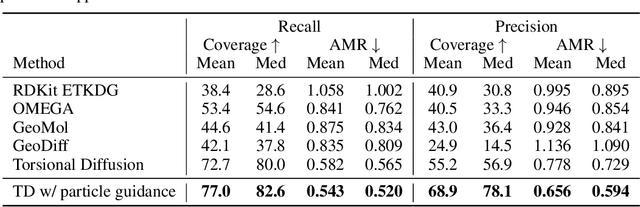
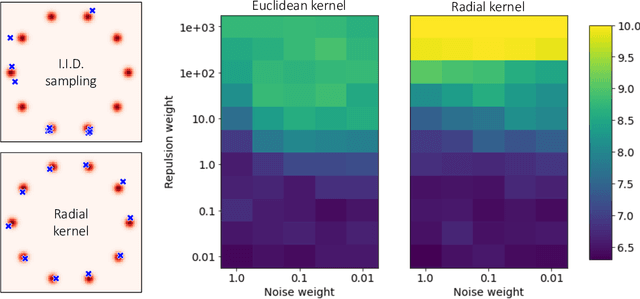

In light of the widespread success of generative models, a significant amount of research has gone into speeding up their sampling time. However, generative models are often sampled multiple times to obtain a diverse set incurring a cost that is orthogonal to sampling time. We tackle the question of how to improve diversity and sample efficiency by moving beyond the common assumption of independent samples. We propose particle guidance, an extension of diffusion-based generative sampling where a joint-particle time-evolving potential enforces diversity. We analyze theoretically the joint distribution that particle guidance generates, its implications on the choice of potential, and the connections with methods in other disciplines. Empirically, we test the framework both in the setting of conditional image generation, where we are able to increase diversity without affecting quality, and molecular conformer generation, where we reduce the state-of-the-art median error by 13% on average.
MOFDiff: Coarse-grained Diffusion for Metal-Organic Framework Design
Oct 16, 2023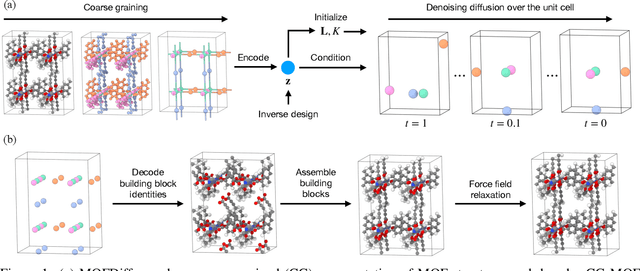
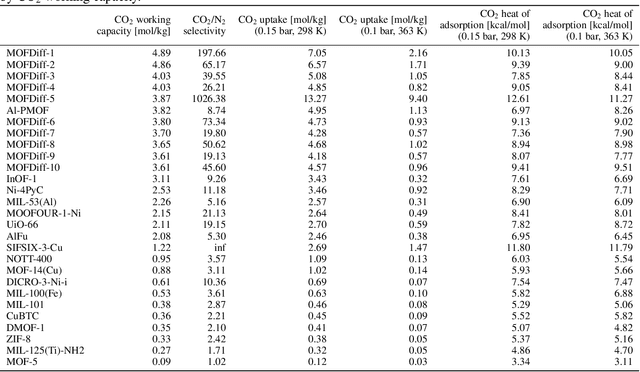
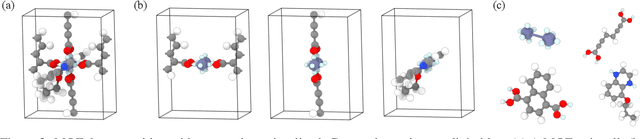
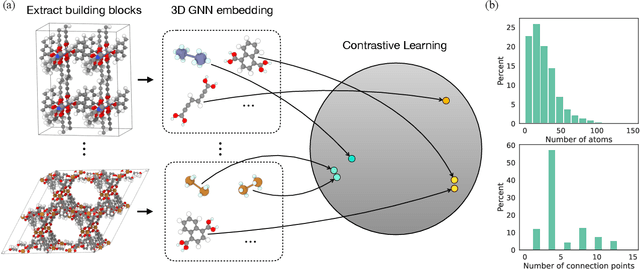
Metal-organic frameworks (MOFs) are of immense interest in applications such as gas storage and carbon capture due to their exceptional porosity and tunable chemistry. Their modular nature has enabled the use of template-based methods to generate hypothetical MOFs by combining molecular building blocks in accordance with known network topologies. However, the ability of these methods to identify top-performing MOFs is often hindered by the limited diversity of the resulting chemical space. In this work, we propose MOFDiff: a coarse-grained (CG) diffusion model that generates CG MOF structures through a denoising diffusion process over the coordinates and identities of the building blocks. The all-atom MOF structure is then determined through a novel assembly algorithm. Equivariant graph neural networks are used for the diffusion model to respect the permutational and roto-translational symmetries. We comprehensively evaluate our model's capability to generate valid and novel MOF structures and its effectiveness in designing outstanding MOF materials for carbon capture applications with molecular simulations.
Harmonic Self-Conditioned Flow Matching for Multi-Ligand Docking and Binding Site Design
Oct 09, 2023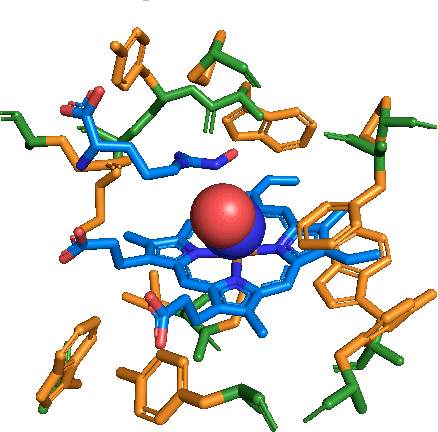

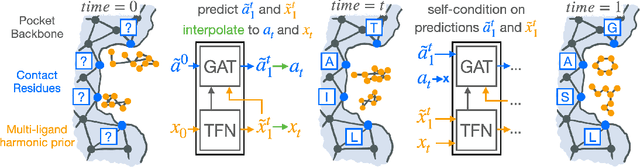

A significant amount of protein function requires binding small molecules, including enzymatic catalysis. As such, designing binding pockets for small molecules has several impactful applications ranging from drug synthesis to energy storage. Towards this goal, we first develop HarmonicFlow, an improved generative process over 3D protein-ligand binding structures based on our self-conditioned flow matching objective. FlowSite extends this flow model to jointly generate a protein pocket's discrete residue types and the molecule's binding 3D structure. We show that HarmonicFlow improves upon the state-of-the-art generative processes for docking in simplicity, generality, and performance. Enabled by this structure modeling, FlowSite designs binding sites substantially better than baseline approaches and provides the first general solution for binding site design.
Compositional Sculpting of Iterative Generative Processes
Sep 28, 2023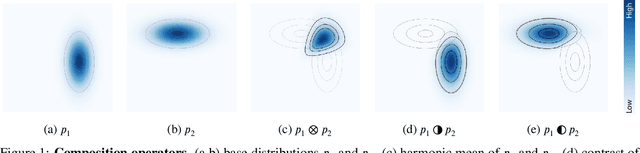
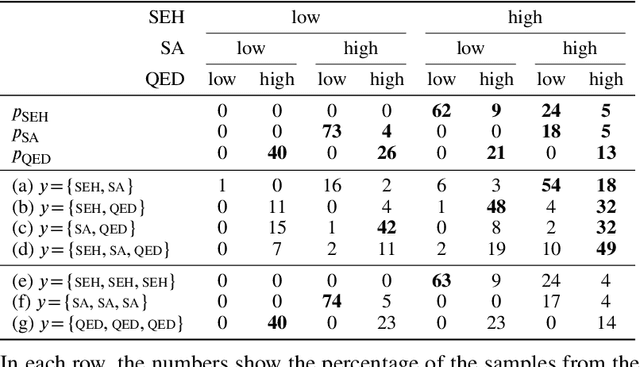
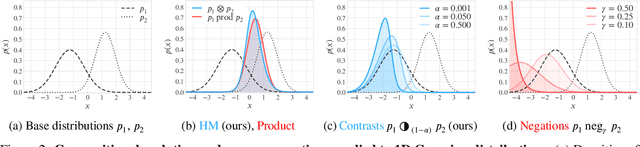
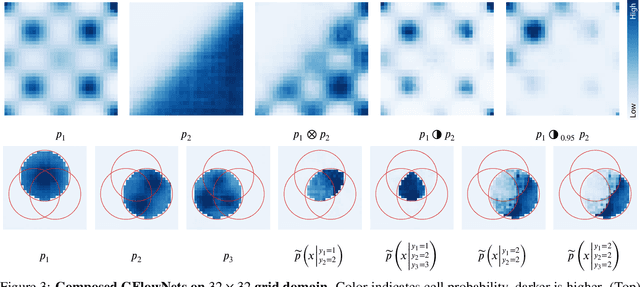
High training costs of generative models and the need to fine-tune them for specific tasks have created a strong interest in model reuse and composition. A key challenge in composing iterative generative processes, such as GFlowNets and diffusion models, is that to realize the desired target distribution, all steps of the generative process need to be coordinated, and satisfy delicate balance conditions. In this work, we propose Compositional Sculpting: a general approach for defining compositions of iterative generative processes. We then introduce a method for sampling from these compositions built on classifier guidance. We showcase ways to accomplish compositional sculpting in both GFlowNets and diffusion models. We highlight two binary operations $\unicode{x2014}$ the harmonic mean ($p_1 \otimes p_2$) and the contrast ($p_1 \unicode{x25D1}\,p_2$) between pairs, and the generalization of these operations to multiple component distributions. We offer empirical results on image and molecular generation tasks.
Compositional Foundation Models for Hierarchical Planning
Sep 21, 2023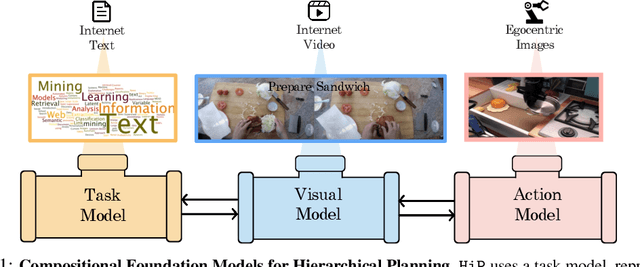
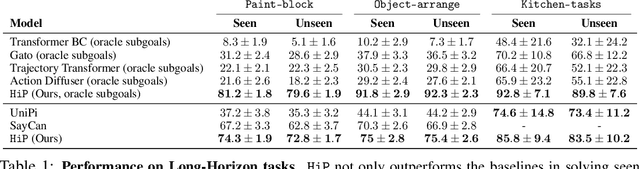
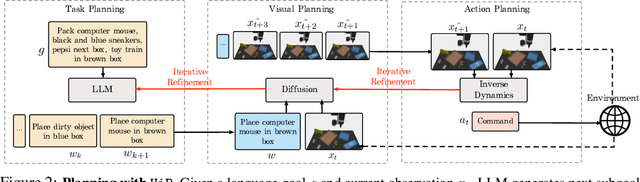

To make effective decisions in novel environments with long-horizon goals, it is crucial to engage in hierarchical reasoning across spatial and temporal scales. This entails planning abstract subgoal sequences, visually reasoning about the underlying plans, and executing actions in accordance with the devised plan through visual-motor control. We propose Compositional Foundation Models for Hierarchical Planning (HiP), a foundation model which leverages multiple expert foundation model trained on language, vision and action data individually jointly together to solve long-horizon tasks. We use a large language model to construct symbolic plans that are grounded in the environment through a large video diffusion model. Generated video plans are then grounded to visual-motor control, through an inverse dynamics model that infers actions from generated videos. To enable effective reasoning within this hierarchy, we enforce consistency between the models via iterative refinement. We illustrate the efficacy and adaptability of our approach in three different long-horizon table-top manipulation tasks.