 Add to Chrome
 Add to Firefox
 Add to Edge
Layer-Parallel Inference Reduces Encrypted Nonlinear Depth in Transformers
Jul 06, 2026
Fully homomorphic encryption (FHE) enables computation on encrypted data, but practical encrypted Transformer inference is bottlenecked by the sequential composition of many nonlinear blocks. We study whether Structured Newton Layer Parallelism (SNLP) can make this inter-layer composition more FHE-friendly: each Transformer block still requires polynomial approximations for operations such as softmax and RMSNorm, but SNLP reduces the layerwise sequential nonlinear depth from L stages to a small number of solver iterations plus linear structured corrections. Using a simulation framework based on Chebyshev polynomial approximations, we measure error accumulation under sequential versus SNLP inference across 8 models and 4 architecture families. On a 0.5B IDN-trained model, SNLP reduces symbolic bootstraps from 53 to 20 (2.65x) with only +1.2% perplexity degradation, while lowering error amplification (1.36x vs. 1.42x). Across all tested models, SNLP has lower amplification than sequential inference. Ablations show that softmax approximation dominates the error budget and CKKS arithmetic noise is negligible in our setting, suggesting that SNLP is complementary to block-level FHE-friendly operator design rather than a replacement for it.

sGPO: Trading Inference FLOPs for Training Efficiency in RLVR
Jun 07, 2026Standard Reinforcement Learning with Verifiable Rewards (RLVR) training allocates a fixed rollout budget to every query, without regard for what each query's difficulty means for the current policy. This leads to two symmetric failure modes: easy queries produce near-zero advantage because the policy already solves them, while unsolvable queries produce no signal because the policy never solves them. Both regimes waste training FLOPs without contributing to a learning gradient. We introduce sorted Group Policy Optimization (sGPO), a compute-efficient strategy that trades a small budget of inference FLOPs for a large reduction in wasted training FLOPs. The key insight is that cheap inference compute can serve as a single offline proxy for query difficulty. By generating a small batch of parallel samples per query under the initial policy, we obtain a model-aware empirical success rate. This motivates setting the training rollout group size to the inverse of this success rate, a practical rule that maximizes sample efficiency by extracting the most advantage per generated rollout. This single profiling pass simultaneously drives data filtering (removing trivial queries and sub-sampling unsolvable ones), adaptive group size allocation, and curriculum construction (scheduling queries from easy to hard). sGPO matches or exceeds baseline performance while reducing total training compute by a factor of three, with the upfront inference profiling cost included.
Intrinsic Selection and Particle Resampling for Inference-Time Scaling Beyond Domain Verifiability
Jun 07, 2026Inference-Time Scaling (ITS) has largely succeeded in verifiable domains like math and coding, where cheap verification enables scalable output selection. However, extending ITS to tasks prone to systematic failure - driven by faulty initial assumptions or unmet multidimensional constraints - typically relies on costly external solvers or brittle, model-based verifiers. Our key insight is that the intrinsic statistics of parallel sample sets, specifically length-adjusted tail entropy, provide a robust discriminative signal for solution quality without access to ground truth. Crucially, these statistics serve as a difficulty gate for adaptive compute allocation, dynamically routing problems across scaling regimes. First, Intrinsic Selection (iS) ranks candidates post-hoc, matching consensus-based algorithms across three domains and improving engineering design selection by 20% over pass@1 baselines. Second, Intrinsic Particle Filtering (iPF) generalizes this to step-level resampling, guiding generation toward high-confidence reasoning trajectories to improve pass@1 by 6.1 points on average on hard math problems. Finally, Particle Distillation (dPF) injects privileged guidance via early logit blending and KL-guided resampling, steering generation past systematic reasoning errors to satisfy expert rubrics, yielding up to 26.5% gains on complex clinical responses. Our pipeline applies seamlessly across broad-purpose, domain-specialized, and multimodal architectures, successfully extending ITS to open-ended domains without requiring trained reward models or exact ground-truth verification.
GIFT: Bootstrapping Image-to-CAD Program Synthesis via Geometric Feedback
Mar 28, 2026Generating executable CAD programs from images requires alignment between visual geometry and symbolic program representations, a capability that current methods fail to learn reliably as design complexity increases. Existing fine-tuning approaches rely on either limited supervised datasets or expensive post-training pipelines, resulting in brittle systems that restrict progress in generative CAD design. We argue that the primary bottleneck lies not in model or algorithmic capacity, but in the scarcity of diverse training examples that align visual geometry with program syntax. This limitation is especially acute because the collection of diverse and verified engineering datasets is both expensive and difficult to scale, constraining the development of robust generative CAD models. We introduce Geometric Inference Feedback Tuning (GIFT), a data augmentation framework that leverages geometric feedback to turn test-time compute into a bootstrapped set of high-quality training samples. GIFT combines two mechanisms: Soft-Rejection Sampling (GIFT-REJECT), which retains diverse high-fidelity programs beyond exact ground-truth matches, and Failure-Driven Augmentation (GIFT-FAIL), which converts near-miss predictions into synthetic training examples that improve robustness on challenging geometries. By amortizing inference-time search into the model parameters, GIFT captures the benefits of test-time scaling while reducing inference compute by 80%. It improves mean IoU by 12% over a strong supervised baseline and remains competitive with more complex multimodal systems, without requiring additional human annotation or specialized architectures.
S2D2: Fast Decoding for Diffusion LLMs via Training-Free Self-Speculation
Mar 26, 2026Block-diffusion language models offer a promising path toward faster-than-autoregressive generation by combining block-wise autoregressive decoding with within-block parallel denoising. However, in the few-step regime needed for practical acceleration, standard confidence-thresholded decoding is often brittle: aggressive thresholds hurt quality, while conservative thresholds require unnecessary denoising steps. Existing approaches that address this issue either require additional training or incur extra test-time compute. We present S2D2, a training-free self-speculative decoding framework for block-diffusion language models. Our key observation is that a block-diffusion model becomes autoregressive when the block size is reduced to one, allowing the same pretrained model to act as both drafter and verifier. S2D2 inserts a speculative verification step into standard block-diffusion decoding and uses lightweight routing policies to decide when verification is worth its cost. This yields a hybrid decoding trajectory in which diffusion proposes tokens in parallel, while the autoregressive mode acts as a local sequence-level critic. Across three mainstream block-diffusion families, S2D2 consistently improves the accuracy-speed tradeoff over strong confidence-thresholding baselines. On SDAR, we observe up to $4.7\times$ speedup over autoregressive decoding, and up to $1.57\times$ over a tuned dynamic decoding baseline while improving accuracy by up to $4.5$ points. On LLaDA2.1-Mini, S2D2 remains complementary to built-in self-correction, including a conservative setting where it is $4.4\times$ faster than the static baseline with slightly higher accuracy.
Agent Factories for High Level Synthesis: How Far Can General-Purpose Coding Agents Go in Hardware Optimization?
Mar 26, 2026We present an empirical study of how far general-purpose coding agents -- without hardware-specific training -- can optimize hardware designs from high-level algorithmic specifications. We introduce an agent factory, a two-stage pipeline that constructs and coordinates multiple autonomous optimization agents. In Stage~1, the pipeline decomposes a design into sub-kernels, independently optimizes each using pragma and code-level transformations, and formulates an Integer Linear Program (ILP) to assemble globally promising configurations under an area constraint. In Stage~2, it launches $N$ expert agents over the top ILP solutions, each exploring cross-function optimizations such as pragma recombination, loop fusion, and memory restructuring that are not captured by sub-kernel decomposition. We evaluate the approach on 12 kernels from HLS-Eval and Rodinia-HLS using Claude Code (Opus~4.5/4.6) with AMD Vitis HLS. Scaling from 1 to 10 agents yields a mean $8.27\times$ speedup over baseline, with larger gains on harder benchmarks: streamcluster exceeds $20\times$ and kmeans reaches approximately $10\times$. Across benchmarks, agents consistently rediscover known hardware optimization patterns without domain-specific training, and the best designs often do not originate from top-ranked ILP candidates, indicating that global optimization exposes improvements missed by sub-kernel search. These results establish agent scaling as a practical and effective axis for HLS optimization.
T3D: Few-Step Diffusion Language Models via Trajectory Self-Distillation with Direct Discriminative Optimization
Feb 13, 2026Diffusion large language models (DLLMs) have the potential to enable fast text generation by decoding multiple tokens in parallel. However, in practice, their inference efficiency is constrained by the need for many refinement steps, while aggressively reducing the number of steps leads to a substantial degradation in generation quality. To alleviate this, we propose a trajectory self-distillation framework that improves few-step decoding by distilling the model's own generative trajectories. We incorporate Direct Discriminative Optimization (DDO), a reverse-KL objective that promotes mode-seeking distillation and encourages the student to concentrate on high-probability teacher modes. Across benchmarks, our approach consistently outperforms strong few-step baselines and standard training under tight step budgets. Although full-step decoding remains superior, we substantially narrow the gap, establishing a strong foundation towards practical few-step DLLMs. The source code is available at https://github.com/Tyrion58/T3D.
Sculpting Subspaces: Constrained Full Fine-Tuning in LLMs for Continual Learning
Apr 09, 2025Continual learning in large language models (LLMs) is prone to catastrophic forgetting, where adapting to new tasks significantly degrades performance on previously learned ones. Existing methods typically rely on low-rank, parameter-efficient updates that limit the model's expressivity and introduce additional parameters per task, leading to scalability issues. To address these limitations, we propose a novel continual full fine-tuning approach leveraging adaptive singular value decomposition (SVD). Our method dynamically identifies task-specific low-rank parameter subspaces and constrains updates to be orthogonal to critical directions associated with prior tasks, thus effectively minimizing interference without additional parameter overhead or storing previous task gradients. We evaluate our approach extensively on standard continual learning benchmarks using both encoder-decoder (T5-Large) and decoder-only (LLaMA-2 7B) models, spanning diverse tasks including classification, generation, and reasoning. Empirically, our method achieves state-of-the-art results, up to 7% higher average accuracy than recent baselines like O-LoRA, and notably maintains the model's general linguistic capabilities, instruction-following accuracy, and safety throughout the continual learning process by reducing forgetting to near-negligible levels. Our adaptive SVD framework effectively balances model plasticity and knowledge retention, providing a practical, theoretically grounded, and computationally scalable solution for continual learning scenarios in large language models.
SQuat: Subspace-orthogonal KV Cache Quantization
Mar 31, 2025The key-value (KV) cache accelerates LLMs decoding by storing KV tensors from previously generated tokens. It reduces redundant computation at the cost of increased memory usage. To mitigate this overhead, existing approaches compress KV tensors into lower-bit representations; however, quantization errors can accumulate as more tokens are generated, potentially resulting in undesired outputs. In this paper, we introduce SQuat (Subspace-orthogonal KV cache quantization). It first constructs a subspace spanned by query tensors to capture the most critical task-related information. During key tensor quantization, it enforces that the difference between the (de)quantized and original keys remains orthogonal to this subspace, minimizing the impact of quantization errors on the attention mechanism's outputs. SQuat requires no model fine-tuning, no additional calibration dataset for offline learning, and is grounded in a theoretical framework we develop. Through numerical experiments, we show that our method reduces peak memory by 2.17 to 2.82, improves throughput by 2.45 to 3.60, and achieves more favorable benchmark scores than existing KV cache quantization algorithms.
Activation-Informed Merging of Large Language Models
Feb 04, 2025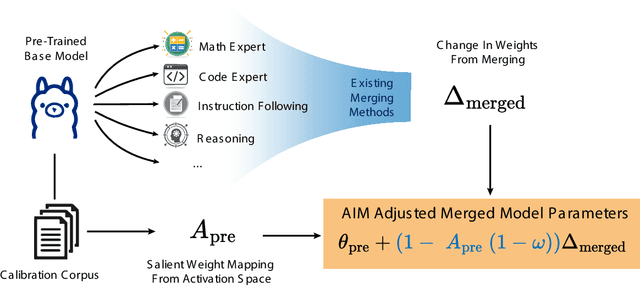
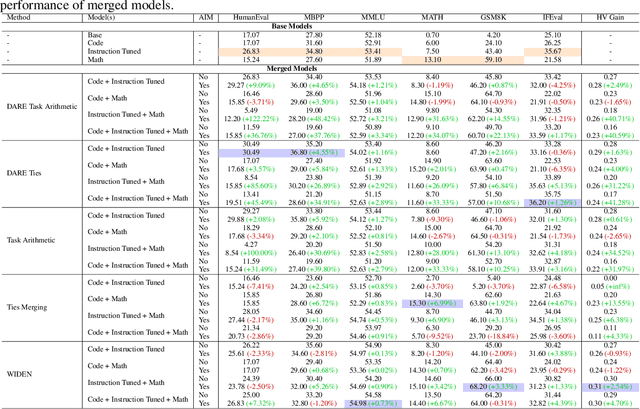
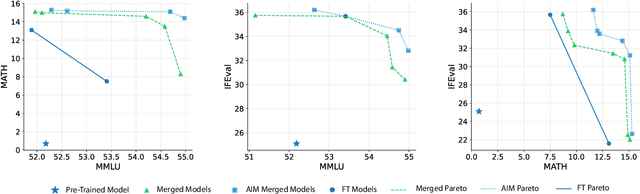
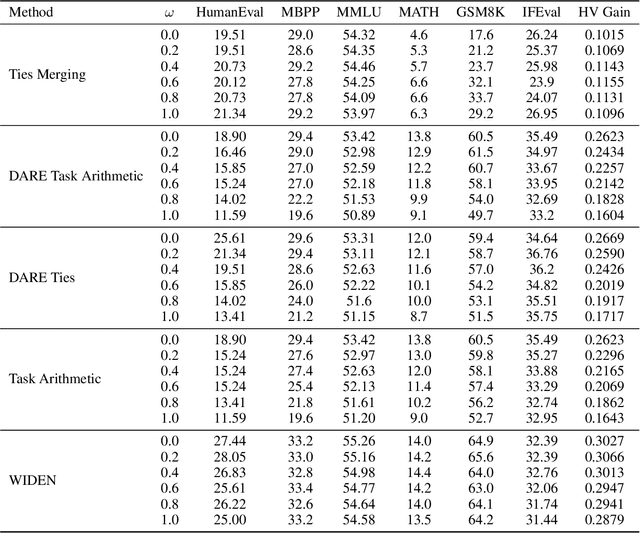
Model merging, a method that combines the parameters and embeddings of multiple fine-tuned large language models (LLMs), offers a promising approach to enhance model performance across various tasks while maintaining computational efficiency. This paper introduces Activation-Informed Merging (AIM), a technique that integrates the information from the activation space of LLMs into the merging process to improve performance and robustness. AIM is designed as a flexible, complementary solution that is applicable to any existing merging method. It aims to preserve critical weights from the base model, drawing on principles from continual learning~(CL) and model compression. Utilizing a task-agnostic calibration set, AIM selectively prioritizes essential weights during merging. We empirically demonstrate that AIM significantly enhances the performance of merged models across multiple benchmarks. Our findings suggest that considering the activation-space information can provide substantial advancements in the model merging strategies for LLMs with up to 40\% increase in benchmark performance.