 Add to Chrome
 Add to Firefox
 Add to Edge
Reading is not Reasoning: Bridging the Agentic Policy Gap in Vision-Text Compression
Aug 09, 2026
Multi-step language-model agents repeatedly process growing interaction histories, leading to substantial context costs. Vision--text compression reduces these costs by rendering history as images, but the resulting modality shift creates a marked capability gap. Through controlled evaluations of history recovery, matched-state decisions, and complete trajectories, we show that this gap cannot be explained by OCR quality alone. Visual-history agents exhibit systematic drift in action selection, query formulation, stopping, and evidence use, revealing an agentic policy gap. We introduce \textbf{CAPS}, a two-stage \textbf{C}ross-modal \textbf{A}gentic \textbf{P}olicy \textbf{S}elf-distillation framework that uses the same model's stronger text-history policy to supervise its visual-history counterpart. Offline trajectory self-distillation transfers successful text-policy behavior to visual-history inputs, while online policy self-distillation provides dense supervision on states visited by the visual-history policy during reinforcement learning. On SearchQA, CAPS improves over AgentOCR by 5.0\% and 3.4\% with 3B and 7B backbones, respectively. On full-history ALFWorld, the corresponding gains are 15.6\% and 14.5\%. Across settings, CAPS reduces average memory-context cost by up to 63.3\% and peak cost by up to 83.4\% relative to matched text-history policies. These results show that explicit cross-modal policy self-distillation can preserve agent capability under vision--text compression. Our code will be made publicly available in a future release.

RoRA: Role-Oriented Regional Allocation for Visual Token Pruning in MLLMs
Aug 07, 2026Multimodal large language models (MLLMs) encode images as long visual token sequences, making prefilling and KV-cache storage expensive. Existing training-free pruning methods select tokens by importance, diversity, or spatial coverage, but treat retained tokens as interchangeable and do not explicitly track which object-related regions are already covered. We present RoRA, a training-free framework that casts visual token pruning as role-oriented regional evidence allocation. Given a fixed budget, RoRA partitions tokens into a protected semantic core, complementary context, and fine-grained detail. It first calibrates text-conditioned attention with a positional prior and a prompt-calibrated object prior, then builds Attention-Anchored Regions (AARs) from high-confidence anchors as lightweight proxies for covered object support. Context is explored mainly outside AARs, while a small AAR-guided budget restores local detail; pairwise similarity is used only for context-stage redundancy filtering. Under matched budgets, RoRA consistently outperforms strong training-free baselines across LLaVA and Qwen-VL families, retaining most of the unpruned accuracy even at aggressive pruning ratios, e.g., 96.5% of full performance at 88.9% pruning on LLaVA-1.5, and improving over D2Pruner by about 5% on Qwen3-VL at 75-90% pruning. At a 66.7% pruning ratio, RoRA requires only 0.7 ms for token selection and reduces end-to-end inference time by 24.6%, corresponding to a 1.33x speedup over unpruned inference on an NVIDIA H800.
CROSS: Cascaded Distillation and Dual-Constraint Grounding for Remote Sensing Referring Segmentation
Aug 05, 2026Referring Remote Sensing Image Segmentation (RRSIS) has achieved significant progress through the integration of VLMs and the Segment Anything Model (SAM). However, this progress largely relies on strong pre-trained capabilities, while leaving two fundamental limitations insufficiently addressed: (1) Architectural Weak-Coupling, where the unidirectional flow forces reliance on coarse VLM prompts and wastes SAM's pixel-level structural guidance, causing localization drift; and (2) Object-Centric Semantic Bias, where models overemphasize dominant object semantics while remaining insensitive to spatial reasoning crucial for RRSIS. Motivated by these observations, we propose CROSS, a tightly integrated paradigm for RRSIS. First, we introduce Linguistic-Guided Cascaded Distillation (LGCD) to bridge the architectural gap, which distills SAM's geometric affinities as soft regularizers into VLM intermediate layers, injecting dense structural priors to refine localization. Second, Perspective-Spatial Contrastive Learning (PSCL) imposes cross-anchored constraints by mining mask-filtered deceptive distractors and spatial-linguistic counterfactuals as hard negatives, explicitly shattering semantic shortcuts to enforce genuine logical consistency. Extensive experiments on RRSIS benchmarks demonstrate that CROSS achieves state-of-the-art performance and maintains precise localization even under severe spatial description perturbations, standing as a robust new paradigm for RRSIS.
From Question Answering to Task Completion: A Survey on Agent System and Harness Design
Jun 14, 2026LLM-based agents mark a shift from passive question answering to active task completion: they perceive environments, invoke tools, maintain state, and act over extended horizons. As agent systems have evolved from prompt engineering to workflows and context engineering, harness engineering, and agent-native training with co-evolution, a central question has become increasingly important: where does the bottleneck in agent performance reside, in the foundation model, in the execution harness, or in the coupling between them? This survey examines LLM-based agents through a model-harness lens. We first clarify the functional definition of agents and the implementation view of an LLM-based agent as a foundation model coupled with an execution harness. We then analyze the limits of model-centric scaling, trace four paradigms of agent engineering, and decompose the execution harness into six coupled runtime responsibilities: observation, context, control, action, state, and verification. Using this decomposition, we map task properties and domain pressures to harness configurations, review benchmark and evaluation practices, and synthesize model-harness evidence on how runtime design affects long-horizon task completion, efficiency, and reliability. Finally, we identify open challenges in value-aware evaluation, safety, harness generalization, and model-harness co-evolution. Rather than treating agents as models with auxiliary tools, this survey argues that agent quality -- including success, efficiency, safety, and generalization -- emerges from the interaction between model capability, runtime infrastructure, task structure, and evaluation design. A collection of papers discussed in this survey is provided in https://github.com/ggjy/Awesome-Agent-Engineering.
Generating High-Precision Force Fields for Molecular Dynamics Simulations to Study Chemical Reaction Mechanisms using Molecular Configuration Transformer
Dec 31, 2023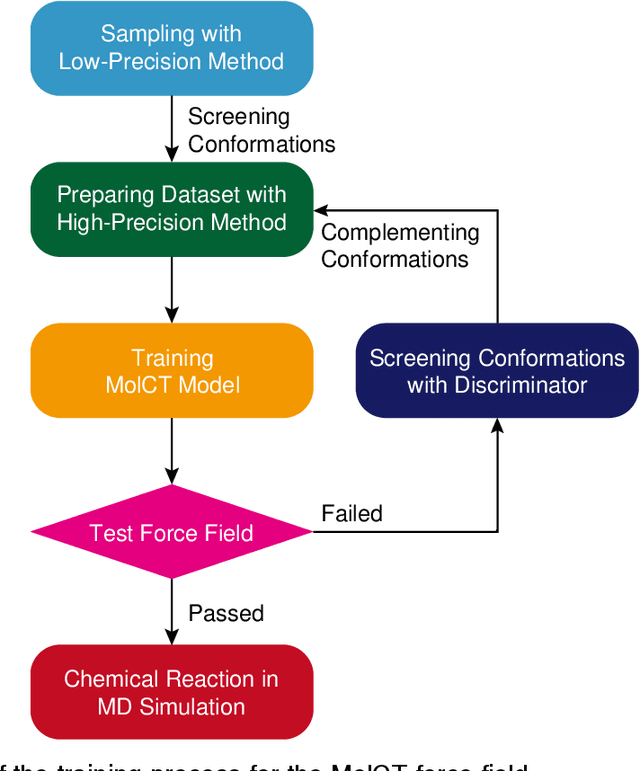
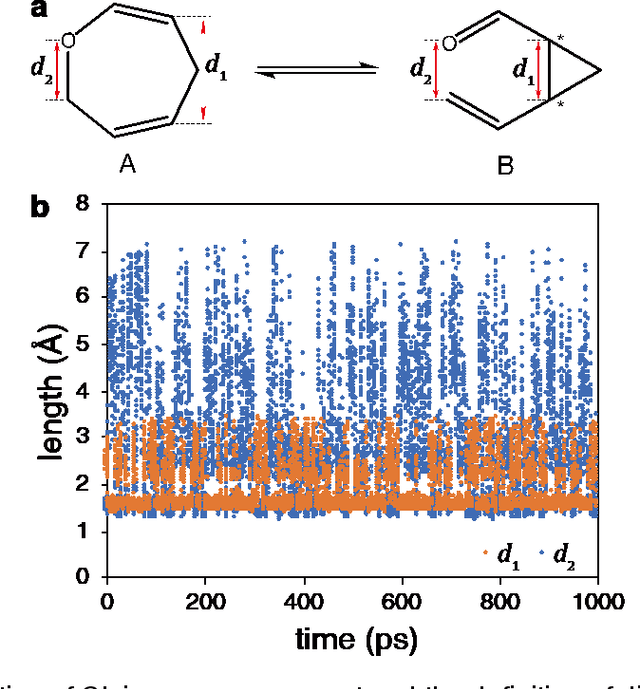

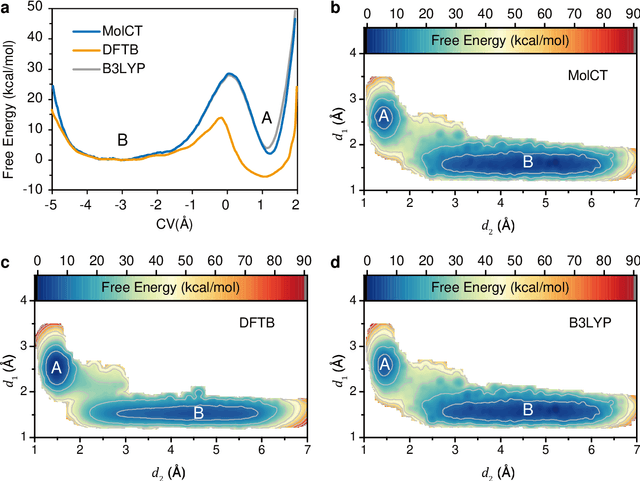
Theoretical studies on chemical reaction mechanisms have been crucial in organic chemistry. Traditionally, calculating the manually constructed molecular conformations of transition states for chemical reactions using quantum chemical calculations is the most commonly used method. However, this way is heavily dependent on individual experience and chemical intuition. In our previous study, we proposed a research paradigm that uses enhanced sampling in QM/MM molecular dynamics simulations to study chemical reactions. This approach can directly simulate the entire process of a chemical reaction. However, the computational speed limits the use of high-precision potential energy functions for simulations. To address this issue, we present a scheme for training high-precision force fields for molecular modeling using our developed graph-neural-network-based molecular model, molecular configuration transformer. This potential energy function allows for highly accurate simulations at a low computational cost, leading to more precise calculations of the mechanism of chemical reactions. We have used this approach to study a Cope rearrangement reaction and a Carbonyl insertion reaction catalyzed by Manganese. This "AI+Physics" based simulation approach is expected to become a new trend in the theoretical study of organic chemical reaction mechanisms.
Receiver Operating Characteristic Curves and Confidence Bands for Support Vector Machines
Jul 17, 2018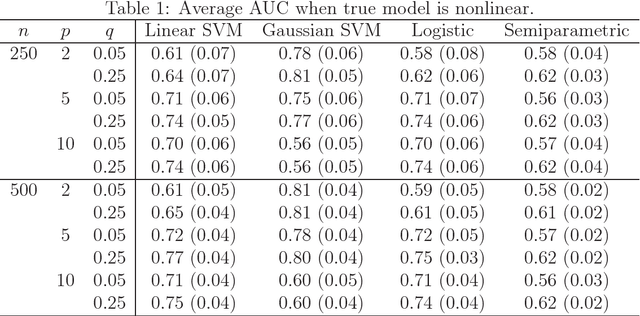
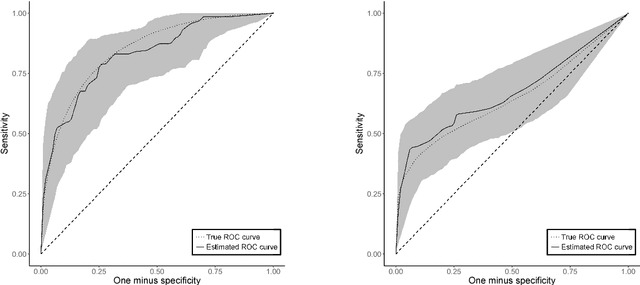
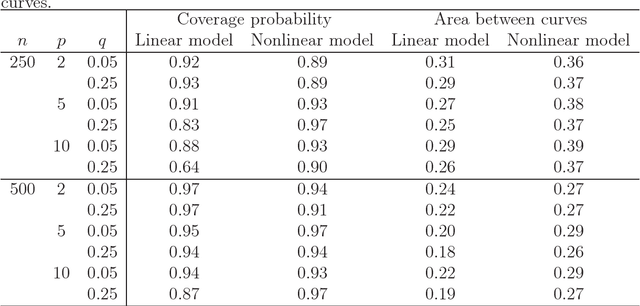
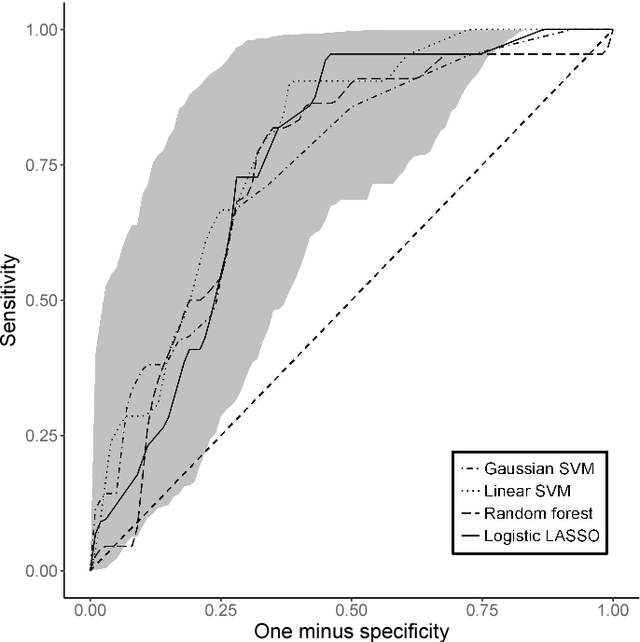
Many problems that appear in biomedical decision making, such as diagnosing disease and predicting response to treatment, can be expressed as binary classification problems. The costs of false positives and false negatives vary across application domains and receiver operating characteristic (ROC) curves provide a visual representation of this trade-off. Nonparametric estimators for the ROC curve, such as a weighted support vector machine (SVM), are desirable because they are robust to model misspecification. While weighted SVMs have great potential for estimating ROC curves, their theoretical properties were heretofore underdeveloped. We propose a method for constructing confidence bands for the SVM ROC curve and provide the theoretical justification for the SVM ROC curve by showing that the risk function of the estimated decision rule is uniformly consistent across the weight parameter. We demonstrate the proposed confidence band method and the superior sensitivity and specificity of the weighted SVM compared to commonly used methods in diagnostic medicine using simulation studies. We present two illustrative examples: diagnosis of hepatitis C and a predictive model for treatment response in breast cancer.