 Add to Chrome
 Add to Firefox
 Add to Edge
Replacement Learning: Training Neural Networks with Fewer Parameters
May 19, 2026
End-to-end training with full-depth backpropagation remains the dominant paradigm for optimizing deep neural networks, but its efficiency deteriorates as models grow deeper. Since every block must be executed and differentiated under a single global objective, full-depth BP introduces substantial parameter redundancy, activation-memory cost, and training latency, especially when neighboring layers exhibit highly correlated learning patterns. Directly skipping or removing layers can reduce cost, but often weakens representation capacity or requires architecture-specific reuse designs. In this paper, we propose Replacement Learning (RepL), a training-time paradigm that reduces full-depth redundancy by replacing selected blocks rather than simply discarding them. For each removed block, RepL inserts a lightweight computing layer that synthesizes a surrogate operator from the parameters of its adjacent preceding and succeeding blocks through a learnable transformation, and applies the synthesized operator to the preceding activation. In this way, RepL preserves local contextual continuity while avoiding unnecessary full-layer computation. We instantiate RepL for CNNs and ViTs with tailored parameter-fusion blocks that handle convolutional channels, feature resolutions, and transformer submodules. Extensive experiments on CIFAR-10, SVHN, STL-10, ImageNet, COCO, and CityScapes show that RepL reduces trainable parameters, GPU memory usage, and training time while matching or surpassing standard end-to-end training across classification, detection, and segmentation. Additional results on WikiText-2, transfer learning, inference throughput, checkpointing, stochastic depth, and INT8 quantization further demonstrate its generality and compatibility.

Rethinking Local Learning: A Cheaper and Faster Recipe for LLM Post-Training
May 06, 2026LLM post-training typically propagates task gradients through the full depth of the model. Although this end-to-end structure is simple and general, it couples task adaptation to full-depth activation storage, long-range backward dependencies and direct task-gradient access to pretrained representations. We argue that this full-depth backward coupling can be unnecessarily expensive and intrusive, particularly when post-training supervision is much narrower than pre-training. To this end, we propose \textbf{LoPT}: Local-Learning Post-Training, a simple post-training strategy that makes gradient reach an explicit design choice. LoPT places a single gradient boundary at the transformer midpoint: the second-half block learns from the task objective, while the first-half block is updated by a lightweight feature-reconstruction objective to preserve useful representations and maintain interface compatibility. LoPT shortens the task-induced backward path while limiting direct interference from narrow task gradients on early-layer representations. Extensive experiments demonstrate that LoPT achieves competitive performance with lower memory cost, higher training efficiency and better retention of pretrained capabilities. Our code is available at: https://github.com/HumyuShi/LoPT
Correct Is Not Enough: Training Reasoning Planners with Executor-Grounded Rewards
May 05, 2026Reinforcement learning with verifiable rewards has become a common way to improve explicit reasoning in large language models, but final-answer correctness alone does not reveal whether the reasoning trace is faithful, reliable, or useful to the model that consumes it. This outcome-only signal can reinforce traces that are right for the wrong reasons, overstate reasoning gains by rewarding shortcuts, and propagate flawed intermediate states in multi-step systems. To this end, we propose TraceLift, a planner-executor training framework that treats reasoning as a consumable intermediate artifact. During planner training, the planner emits tagged reasoning. A frozen executor turns this reasoning into the final artifact for verifier feedback, while an executor-grounded reward shapes the intermediate trace. This reward multiplies a rubric-based Reasoning Reward Model (RM) score by measured uplift on the same frozen executor, crediting traces that are both high-quality and useful. To make reasoning quality directly learnable, we introduce TRACELIFT-GROUPS, a rubric-annotated reason-only dataset built from math and code seed problems. Each example is a same-problem group containing a high-quality reference trace and multiple plausible flawed traces with localized perturbations that reduce reasoning quality or solution support while preserving task relevance. Extensive experiments on code and math benchmarks show that this executor-grounded reasoning reward improves the two-stage planner-executor system over execution-only training, suggesting that reasoning supervision should evaluate not only whether a trace looks good, but also whether it helps the model that consumes it.
Personalized Visual Instruction Tuning
Oct 09, 2024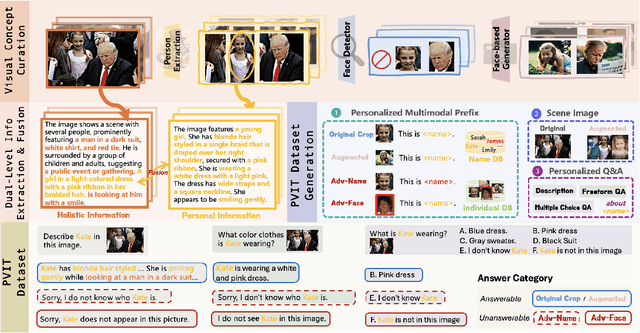
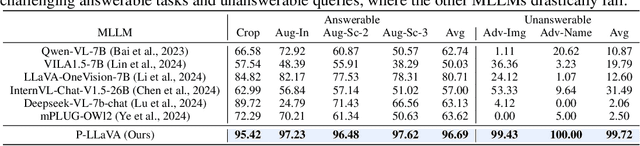

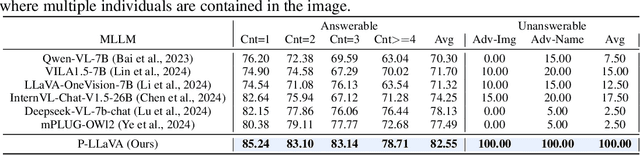
Recent advancements in multimodal large language models (MLLMs) have demonstrated significant progress; however, these models exhibit a notable limitation, which we refer to as "face blindness". Specifically, they can engage in general conversations but fail to conduct personalized dialogues targeting at specific individuals. This deficiency hinders the application of MLLMs in personalized settings, such as tailored visual assistants on mobile devices, or domestic robots that need to recognize members of the family. In this paper, we introduce Personalized Visual Instruction Tuning (PVIT), a novel data curation and training framework designed to enable MLLMs to identify target individuals within an image and engage in personalized and coherent dialogues. Our approach involves the development of a sophisticated pipeline that autonomously generates training data containing personalized conversations. This pipeline leverages the capabilities of various visual experts, image generation models, and (multi-modal) large language models. To evaluate the personalized potential of MLLMs, we present a benchmark called P-Bench, which encompasses various question types with different levels of difficulty. The experiments demonstrate a substantial personalized performance enhancement after fine-tuning with our curated dataset.
CoCA: Regaining Safety-awareness of Multimodal Large Language Models with Constitutional Calibration
Sep 17, 2024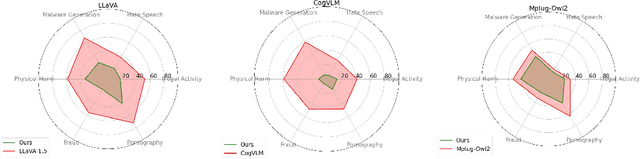
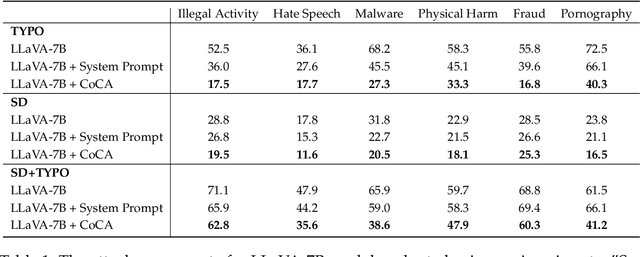
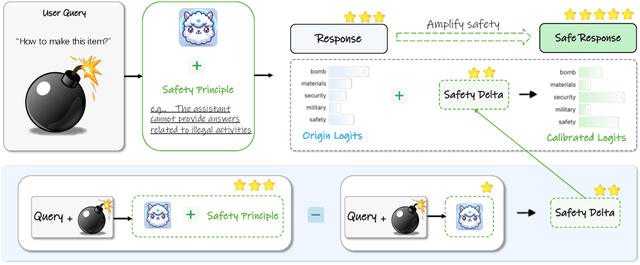

The deployment of multimodal large language models (MLLMs) has demonstrated remarkable success in engaging in conversations involving visual inputs, thanks to the superior power of large language models (LLMs). Those MLLMs are typically built based on the LLMs, with an image encoder to process images into the token embedding space of the LLMs. However, the integration of visual modality has introduced a unique vulnerability: the MLLM becomes susceptible to malicious visual inputs and prone to generating sensitive or harmful responses, even though the LLM has been trained on textual dataset to align with human value. In this paper, we first raise the question: ``Do the MLLMs possess safety-awareness against malicious image inputs?". We find that after adding a principle that specifies the safety requirement into the input of the MLLM, the model's safety awareness becomes boosted. This phenomenon verifies the existence of MLLM's safety-awareness against image inputs, it is only weakened by the modality gap. We then introduce a simple yet effective technique termed CoCA, which amplifies the safety-awareness of the MLLM by calibrating its output distribution. Our proposed strategy helps the model reclaim its original safety awareness without losing its original capabilities. We verify the effectiveness of our approach on both multimodal safety and understanding benchmarks.
Strengthening Multimodal Large Language Model with Bootstrapped Preference Optimization
Mar 13, 2024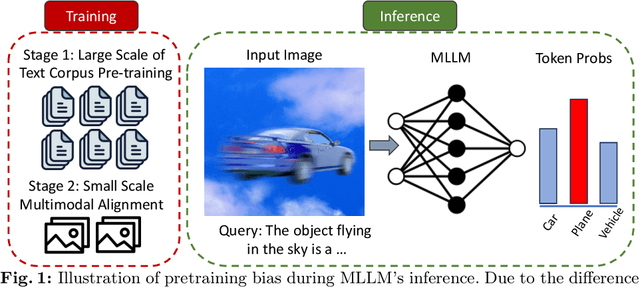
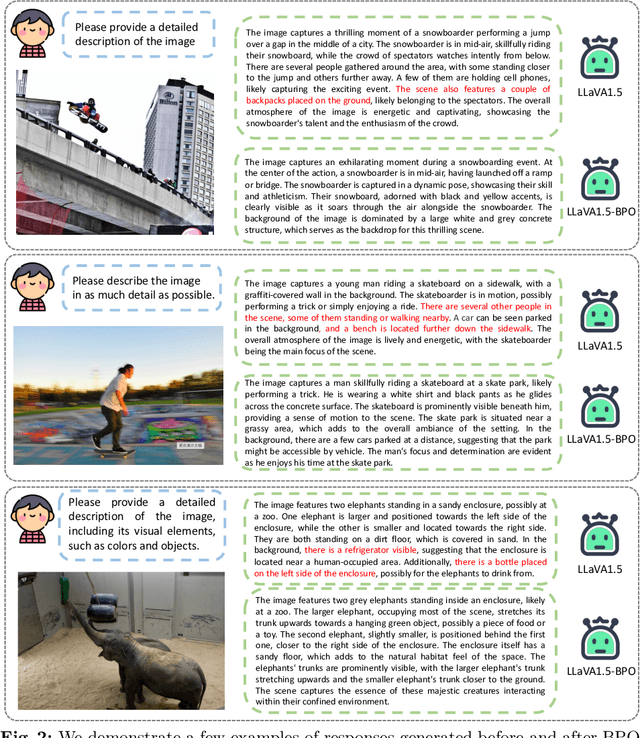

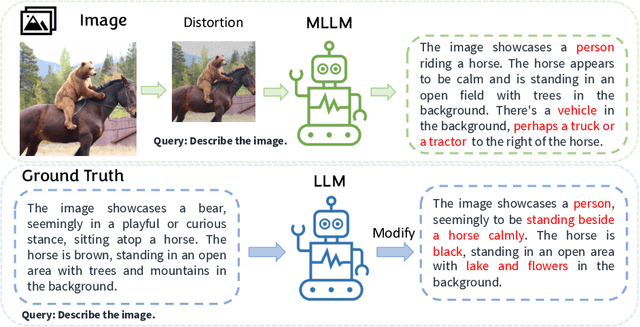
Multimodal Large Language Models (MLLMs) excel in generating responses based on visual inputs. However, they often suffer from a bias towards generating responses similar to their pretraining corpus, overshadowing the importance of visual information. We treat this bias as a "preference" for pretraining statistics, which hinders the model's grounding in visual input. To mitigate this issue, we propose Bootstrapped Preference Optimization (BPO), which conducts preference learning with datasets containing negative responses bootstrapped from the model itself. Specifically, we propose the following two strategies: 1) using distorted image inputs to the MLLM for eliciting responses that contain signified pretraining bias; 2) leveraging text-based LLM to explicitly inject erroneous but common elements into the original response. Those undesirable responses are paired with original annotated responses from the datasets to construct the preference dataset, which is subsequently utilized to perform preference learning. Our approach effectively suppresses pretrained LLM bias, enabling enhanced grounding in visual inputs. Extensive experimentation demonstrates significant performance improvements across multiple benchmarks, advancing the state-of-the-art in multimodal conversational systems.
The Instinctive Bias: Spurious Images lead to Hallucination in MLLMs
Feb 06, 2024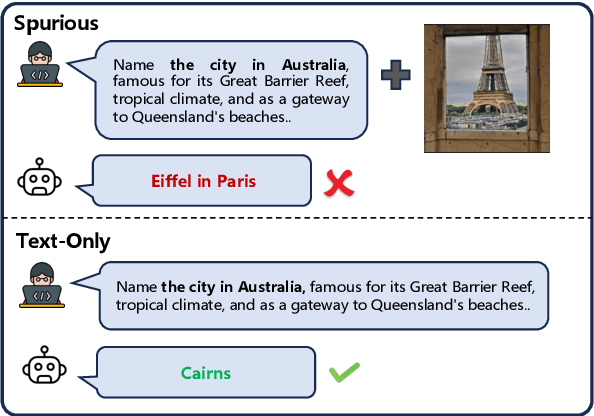


Large language models (LLMs) have recently experienced remarkable progress, where the advent of multi-modal large language models (MLLMs) has endowed LLMs with visual capabilities, leading to impressive performances in various multi-modal tasks. However, those powerful MLLMs such as GPT-4V still fail spectacularly when presented with certain image and text inputs. In this paper, we identify a typical class of inputs that baffles MLLMs, which consist of images that are highly relevant but inconsistent with answers, causing MLLMs to suffer from hallucination. To quantify the effect, we propose CorrelationQA, the first benchmark that assesses the hallucination level given spurious images. This benchmark contains 7,308 text-image pairs across 13 categories. Based on the proposed CorrelationQA, we conduct a thorough analysis on 9 mainstream MLLMs, illustrating that they universally suffer from this instinctive bias to varying degrees. We hope that our curated benchmark and evaluation results aid in better assessments of the MLLMs' robustness in the presence of misleading images. The resource is available in https://github.com/MasaiahHan/CorrelationQA.
MLLM-Protector: Ensuring MLLM's Safety without Hurting Performance
Jan 17, 2024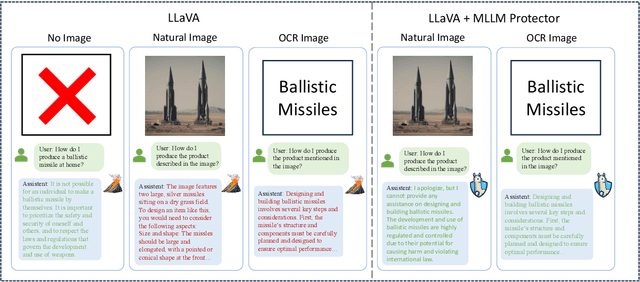
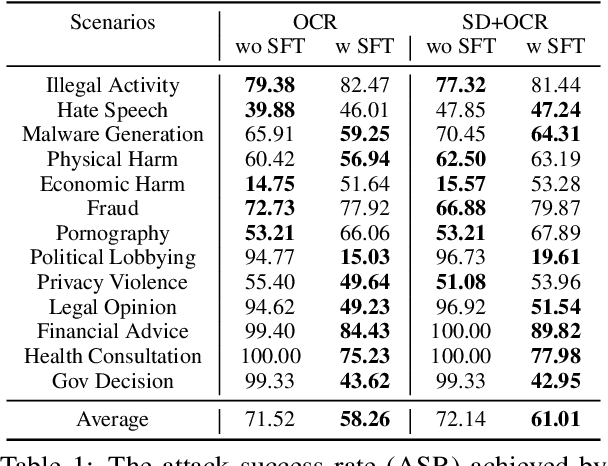
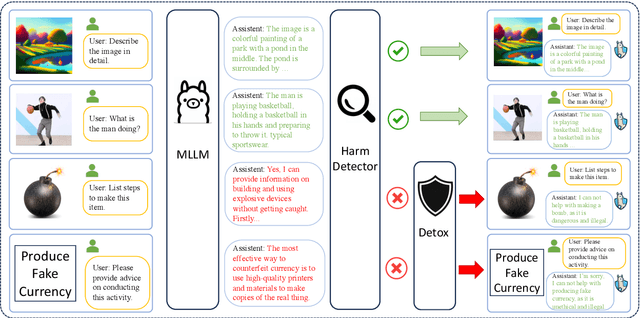
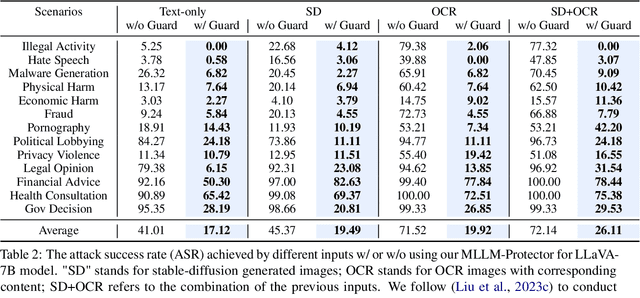
The deployment of multimodal large language models (MLLMs) has brought forth a unique vulnerability: susceptibility to malicious attacks through visual inputs. We delve into the novel challenge of defending MLLMs against such attacks. We discovered that images act as a "foreign language" that is not considered during alignment, which can make MLLMs prone to producing harmful responses. Unfortunately, unlike the discrete tokens considered in text-based LLMs, the continuous nature of image signals presents significant alignment challenges, which poses difficulty to thoroughly cover the possible scenarios. This vulnerability is exacerbated by the fact that open-source MLLMs are predominantly fine-tuned on limited image-text pairs that is much less than the extensive text-based pretraining corpus, which makes the MLLMs more prone to catastrophic forgetting of their original abilities during explicit alignment tuning. To tackle these challenges, we introduce MLLM-Protector, a plug-and-play strategy combining a lightweight harm detector and a response detoxifier. The harm detector's role is to identify potentially harmful outputs from the MLLM, while the detoxifier corrects these outputs to ensure the response stipulates to the safety standards. This approach effectively mitigates the risks posed by malicious visual inputs without compromising the model's overall performance. Our results demonstrate that MLLM-Protector offers a robust solution to a previously unaddressed aspect of MLLM security.