 Add to Chrome
 Add to Firefox
 Add to Edge
Replacement Learning: Training Neural Networks with Fewer Parameters
May 19, 2026
End-to-end training with full-depth backpropagation remains the dominant paradigm for optimizing deep neural networks, but its efficiency deteriorates as models grow deeper. Since every block must be executed and differentiated under a single global objective, full-depth BP introduces substantial parameter redundancy, activation-memory cost, and training latency, especially when neighboring layers exhibit highly correlated learning patterns. Directly skipping or removing layers can reduce cost, but often weakens representation capacity or requires architecture-specific reuse designs. In this paper, we propose Replacement Learning (RepL), a training-time paradigm that reduces full-depth redundancy by replacing selected blocks rather than simply discarding them. For each removed block, RepL inserts a lightweight computing layer that synthesizes a surrogate operator from the parameters of its adjacent preceding and succeeding blocks through a learnable transformation, and applies the synthesized operator to the preceding activation. In this way, RepL preserves local contextual continuity while avoiding unnecessary full-layer computation. We instantiate RepL for CNNs and ViTs with tailored parameter-fusion blocks that handle convolutional channels, feature resolutions, and transformer submodules. Extensive experiments on CIFAR-10, SVHN, STL-10, ImageNet, COCO, and CityScapes show that RepL reduces trainable parameters, GPU memory usage, and training time while matching or surpassing standard end-to-end training across classification, detection, and segmentation. Additional results on WikiText-2, transfer learning, inference throughput, checkpointing, stochastic depth, and INT8 quantization further demonstrate its generality and compatibility.

Rethinking Local Learning: A Cheaper and Faster Recipe for LLM Post-Training
May 06, 2026LLM post-training typically propagates task gradients through the full depth of the model. Although this end-to-end structure is simple and general, it couples task adaptation to full-depth activation storage, long-range backward dependencies and direct task-gradient access to pretrained representations. We argue that this full-depth backward coupling can be unnecessarily expensive and intrusive, particularly when post-training supervision is much narrower than pre-training. To this end, we propose \textbf{LoPT}: Local-Learning Post-Training, a simple post-training strategy that makes gradient reach an explicit design choice. LoPT places a single gradient boundary at the transformer midpoint: the second-half block learns from the task objective, while the first-half block is updated by a lightweight feature-reconstruction objective to preserve useful representations and maintain interface compatibility. LoPT shortens the task-induced backward path while limiting direct interference from narrow task gradients on early-layer representations. Extensive experiments demonstrate that LoPT achieves competitive performance with lower memory cost, higher training efficiency and better retention of pretrained capabilities. Our code is available at: https://github.com/HumyuShi/LoPT
Correct Is Not Enough: Training Reasoning Planners with Executor-Grounded Rewards
May 05, 2026Reinforcement learning with verifiable rewards has become a common way to improve explicit reasoning in large language models, but final-answer correctness alone does not reveal whether the reasoning trace is faithful, reliable, or useful to the model that consumes it. This outcome-only signal can reinforce traces that are right for the wrong reasons, overstate reasoning gains by rewarding shortcuts, and propagate flawed intermediate states in multi-step systems. To this end, we propose TraceLift, a planner-executor training framework that treats reasoning as a consumable intermediate artifact. During planner training, the planner emits tagged reasoning. A frozen executor turns this reasoning into the final artifact for verifier feedback, while an executor-grounded reward shapes the intermediate trace. This reward multiplies a rubric-based Reasoning Reward Model (RM) score by measured uplift on the same frozen executor, crediting traces that are both high-quality and useful. To make reasoning quality directly learnable, we introduce TRACELIFT-GROUPS, a rubric-annotated reason-only dataset built from math and code seed problems. Each example is a same-problem group containing a high-quality reference trace and multiple plausible flawed traces with localized perturbations that reduce reasoning quality or solution support while preserving task relevance. Extensive experiments on code and math benchmarks show that this executor-grounded reasoning reward improves the two-stage planner-executor system over execution-only training, suggesting that reasoning supervision should evaluate not only whether a trace looks good, but also whether it helps the model that consumes it.
PosterOmni: Generalized Artistic Poster Creation via Task Distillation and Unified Reward Feedback
Feb 12, 2026Image-to-poster generation is a high-demand task requiring not only local adjustments but also high-level design understanding. Models must generate text, layout, style, and visual elements while preserving semantic fidelity and aesthetic coherence. The process spans two regimes: local editing, where ID-driven generation, rescaling, filling, and extending must preserve concrete visual entities; and global creation, where layout- and style-driven tasks rely on understanding abstract design concepts. These intertwined demands make image-to-poster a multi-dimensional process coupling entity-preserving editing with concept-driven creation under image-prompt control. To address these challenges, we propose PosterOmni, a generalized artistic poster creation framework that unlocks the potential of a base edit model for multi-task image-to-poster generation. PosterOmni integrates the two regimes, namely local editing and global creation, within a single system through an efficient data-distillation-reward pipeline: (i) constructing multi-scenario image-to-poster datasets covering six task types across entity-based and concept-based creation; (ii) distilling knowledge between local and global experts for supervised fine-tuning; and (iii) applying unified PosterOmni Reward Feedback to jointly align visual entity-preserving and aesthetic preference across all tasks. Additionally, we establish PosterOmni-Bench, a unified benchmark for evaluating both local editing and global creation. Extensive experiments show that PosterOmni significantly enhances reference adherence, global composition quality, and aesthetic harmony, outperforming all open-source baselines and even surpassing several proprietary systems.
PosterCraft: Rethinking High-Quality Aesthetic Poster Generation in a Unified Framework
Jun 12, 2025
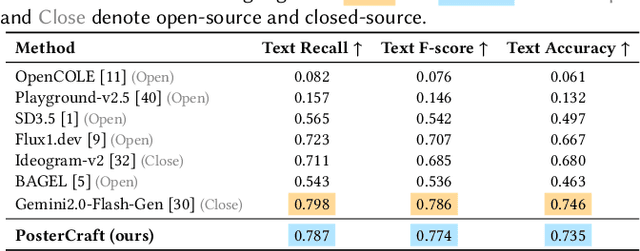


Generating aesthetic posters is more challenging than simple design images: it requires not only precise text rendering but also the seamless integration of abstract artistic content, striking layouts, and overall stylistic harmony. To address this, we propose PosterCraft, a unified framework that abandons prior modular pipelines and rigid, predefined layouts, allowing the model to freely explore coherent, visually compelling compositions. PosterCraft employs a carefully designed, cascaded workflow to optimize the generation of high-aesthetic posters: (i) large-scale text-rendering optimization on our newly introduced Text-Render-2M dataset; (ii) region-aware supervised fine-tuning on HQ-Poster100K; (iii) aesthetic-text-reinforcement learning via best-of-n preference optimization; and (iv) joint vision-language feedback refinement. Each stage is supported by a fully automated data-construction pipeline tailored to its specific needs, enabling robust training without complex architectural modifications. Evaluated on multiple experiments, PosterCraft significantly outperforms open-source baselines in rendering accuracy, layout coherence, and overall visual appeal-approaching the quality of SOTA commercial systems. Our code, models, and datasets can be found in the Project page: https://ephemeral182.github.io/PosterCraft
LayoutCoT: Unleashing the Deep Reasoning Potential of Large Language Models for Layout Generation
Apr 15, 2025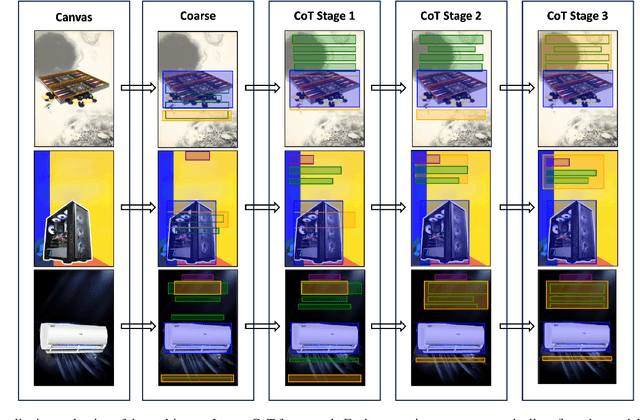
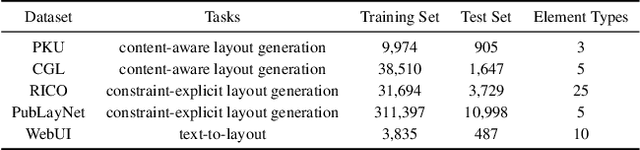
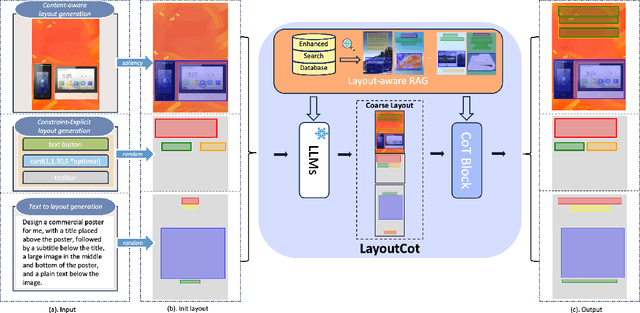
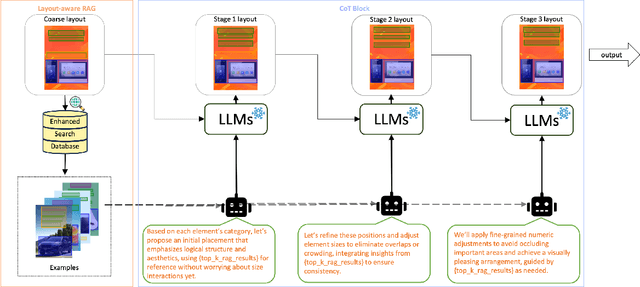
Conditional layout generation aims to automatically generate visually appealing and semantically coherent layouts from user-defined constraints. While recent methods based on generative models have shown promising results, they typically require substantial amounts of training data or extensive fine-tuning, limiting their versatility and practical applicability. Alternatively, some training-free approaches leveraging in-context learning with Large Language Models (LLMs) have emerged, but they often suffer from limited reasoning capabilities and overly simplistic ranking mechanisms, which restrict their ability to generate consistently high-quality layouts. To this end, we propose LayoutCoT, a novel approach that leverages the reasoning capabilities of LLMs through a combination of Retrieval-Augmented Generation (RAG) and Chain-of-Thought (CoT) techniques. Specifically, LayoutCoT transforms layout representations into a standardized serialized format suitable for processing by LLMs. A Layout-aware RAG is used to facilitate effective retrieval and generate a coarse layout by LLMs. This preliminary layout, together with the selected exemplars, is then fed into a specially designed CoT reasoning module for iterative refinement, significantly enhancing both semantic coherence and visual quality. We conduct extensive experiments on five public datasets spanning three conditional layout generation tasks. Experimental results demonstrate that LayoutCoT achieves state-of-the-art performance without requiring training or fine-tuning. Notably, our CoT reasoning module enables standard LLMs, even those without explicit deep reasoning abilities, to outperform specialized deep-reasoning models such as deepseek-R1, highlighting the potential of our approach in unleashing the deep reasoning capabilities of LLMs for layout generation tasks.