 Add to Chrome
 Add to Firefox
 Add to Edge
Best-Arm Identification with Generative Proxy
Jul 08, 2026
Best-arm identification is a canonical model for data-driven decision-making, but in many applications each reward observation is costly. Motivated by the growing availability of cheap predictions from machine learning and large language models, we study fixed-confidence best-arm identification in which each costly reward pull is paired with a cheap but correlated proxy score. The marginal mean of the proxy can be estimated offline and is treated as known, whereas its correlation $ρ$ with the reward, which governs how much the proxy helps, is unknown and must be learned online in pair with real rewards. We show that a control-variate adjustment turns this model into a heteroscedastic identification problem whose oracle sample complexity improves by residual variance $1-ρ^2$. The central difficulty is that the correlation must be learned from the same costly samples that identification consumes online, and that a plug-in estimate of the residual variance is anti-conservative and can compromise correctness. We propose PROBE (PRoxy OLS for Best-arm Exploration), a phase-elimination algorithm that directly maintains an upper certificate on the residual variance with an ordinary least squares fit, whose exact chi-square law keeps the certificate valid regardless of the unknown correlation. We prove that PROBE is $δ$-PAC and attains the known-correlation oracle sample complexity up to a constant multiplicative factor and a constant additive calibration cost. The guarantee extends to the $(ε,δ)$-PAC setting under minimal changes to the algorithm. Numerical experiments on synthetic instances and on an auto-loan pricing replay with large language model and tabular proxies confirm that the sample savings of PROBE scale with the strength of the reward-proxy correlation, exactly as the theory predicts.

Agents' Last Exam
Jun 03, 2026Recent AI systems have achieved strong results on a wide range of benchmarks, yet these gains have not translated into economically meaningful deployment across many professional domains. We argue that this gap is largely an evaluation problem: widely used benchmarks lack sustained performance measurement on real and economically valuable workflows. This paper introduces Agents' Last Exam (ALE), a benchmark designed to evaluate AI agents on long-horizon, economically valuable, real-world tasks with verifiable outcomes. Developed in collaboration with 250+ industry experts, ALE covers non-physical industries defined with reference to O*NET / SOC 2018 (the U.S. federal occupational taxonomy). It is organized around a task taxonomy with 55 subfields grouped into 13 industry clusters covering 1K+ tasks. Current results show that the hardest tier remains far from saturated: across mainstream harness and backbone configurations, the average full pass rate is 2.6%. ALE is designed as a living benchmark: its task pool grows continuously as new workflows and industries are onboarded. More broadly, ALE is intended not merely as another leaderboard, but as an instrument for closing the gap between benchmark success and GDP-relevant impact.
DDO-RM for LLM Preference Optimization: A Minimal Held-Out Benchmark against DPO
Apr 13, 2026This paper reorganizes the current manuscript around the DPO versus DDO-RM preference-optimization project and focuses on two parts: the algorithmic view and the preliminary held-out benchmark. The benchmark asks a narrow question: even in a minimal pairwise chosen-versus-rejected setting, can a reward-guided decision-distribution update outperform a direct pairwise objective? We compare Direct Preference Optimization (DPO) against DDO-RM on EleutherAI/pythia-410m using HuggingFaceH4/ultrafeedback\_binarized, evaluate on the held-out test\_prefs split, and report results for seeds 42, 13, and 3407. Algorithmically, DDO-RM treats each prompt as a finite decision problem over candidate responses. Instead of optimizing only a binary chosen-rejected relation, it forms a policy distribution over candidates, centers reward-model scores under that distribution, and distills a reward-guided target distribution back into the policy. In the current public benchmark, DDO-RM improves mean pair accuracy from 0.5238 to 0.5602, AUC from 0.5315 to 0.5382, and mean margin from 0.1377 to 0.5353 relative to DPO. These are encouraging but still preliminary results: the study covers one model family, one dataset, one held-out evaluation split, and three seeds.
On Pareto Optimality for the Multinomial Logistic Bandit
Jan 31, 2025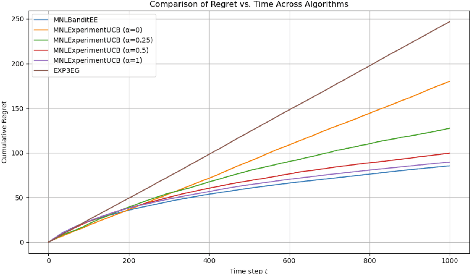
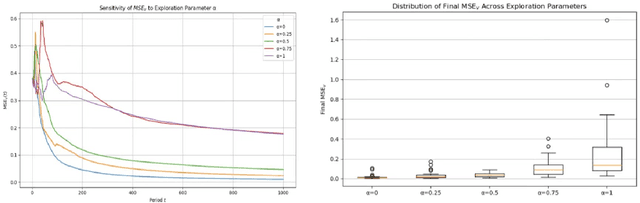
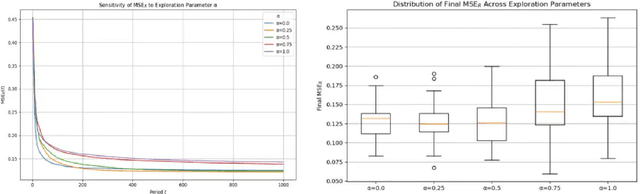
We provide a new online learning algorithm for tackling the Multinomial Logit Bandit (MNL-Bandit) problem. Despite the challenges posed by the combinatorial nature of the MNL model, we develop a novel Upper Confidence Bound (UCB)-based method that achieves Pareto optimality by balancing regret minimization and estimation error of the assortment revenues and the MNL parameters. We develop theoretical guarantees characterizing the tradeoff between regret and estimation error for the MNL-Bandit problem through information-theoretic bounds, and propose a modified UCB algorithm that incorporates forced exploration to improve parameter estimation accuracy while maintaining low regret. Our analysis sheds critical insights into how to optimally balance the collected revenues and the treatment estimation in dynamic assortment optimization.