 Add to Chrome
 Add to Firefox
 Add to Edge
i-Code Studio: A Configurable and Composable Framework for Integrative AI
May 23, 2023
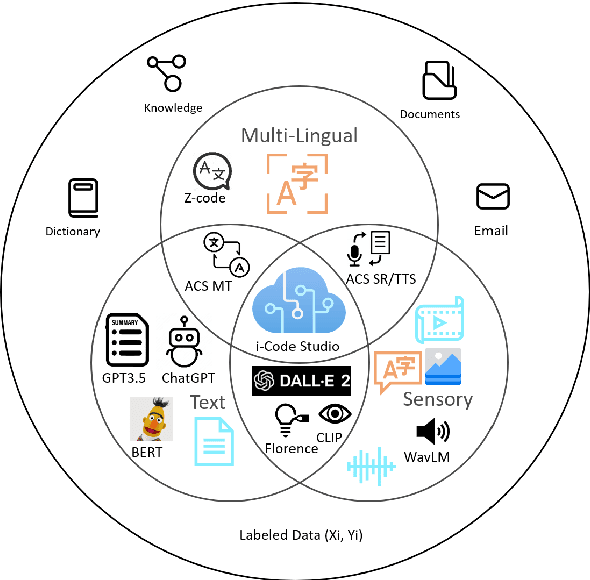
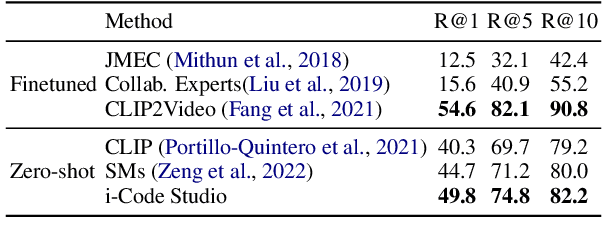
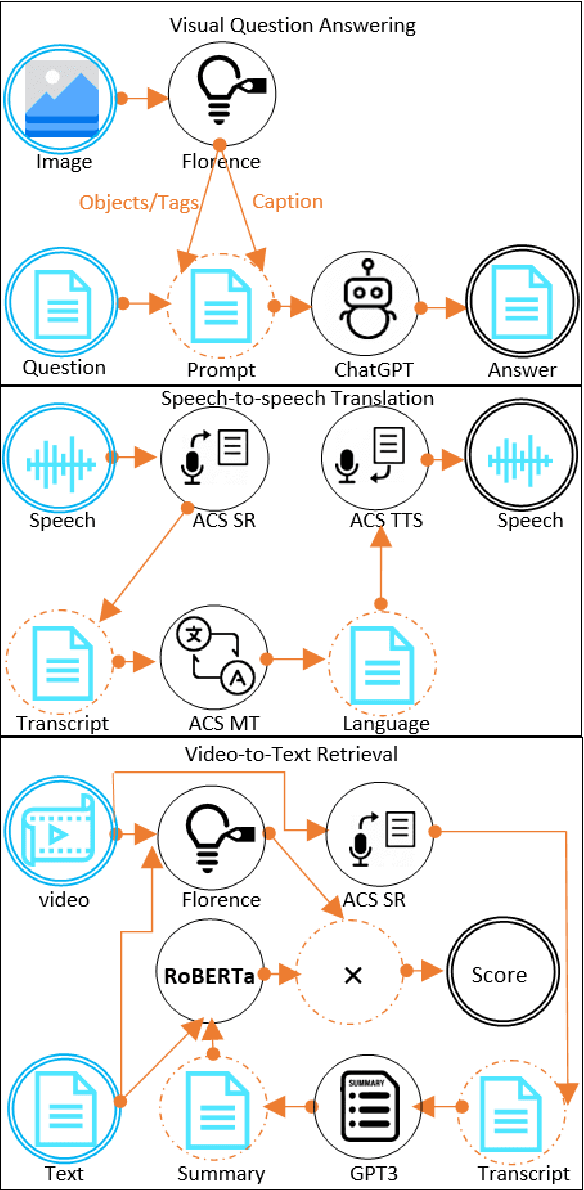
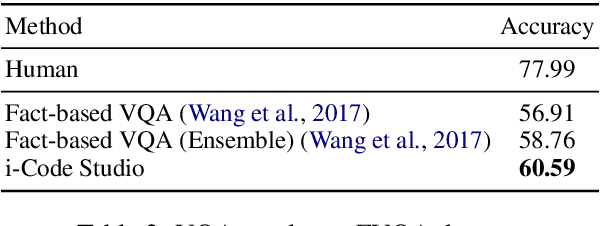
Artificial General Intelligence (AGI) requires comprehensive understanding and generation capabilities for a variety of tasks spanning different modalities and functionalities. Integrative AI is one important direction to approach AGI, through combining multiple models to tackle complex multimodal tasks. However, there is a lack of a flexible and composable platform to facilitate efficient and effective model composition and coordination. In this paper, we propose the i-Code Studio, a configurable and composable framework for Integrative AI. The i-Code Studio orchestrates multiple pre-trained models in a finetuning-free fashion to conduct complex multimodal tasks. Instead of simple model composition, the i-Code Studio provides an integrative, flexible, and composable setting for developers to quickly and easily compose cutting-edge services and technologies tailored to their specific requirements. The i-Code Studio achieves impressive results on a variety of zero-shot multimodal tasks, such as video-to-text retrieval, speech-to-speech translation, and visual question answering. We also demonstrate how to quickly build a multimodal agent based on the i-Code Studio that can communicate and personalize for users.

i-Code V2: An Autoregressive Generation Framework over Vision, Language, and Speech Data
May 21, 2023
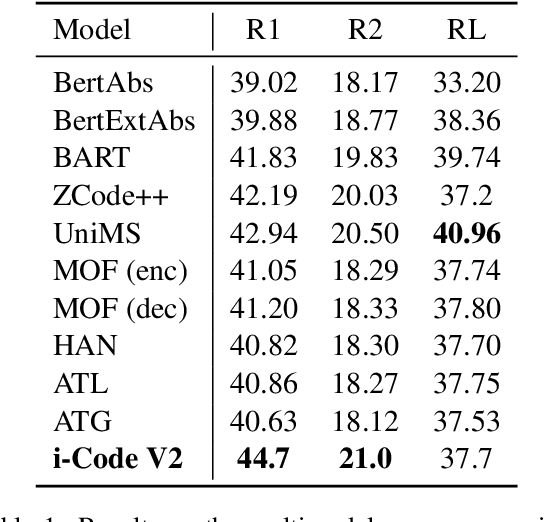
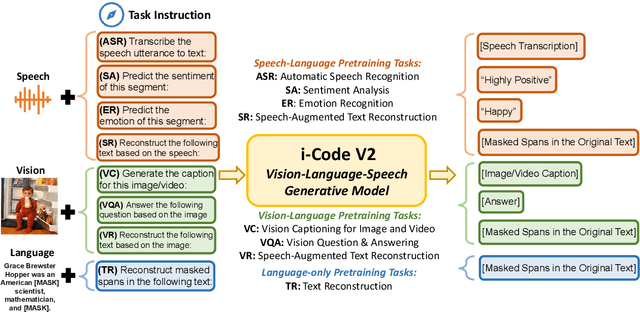
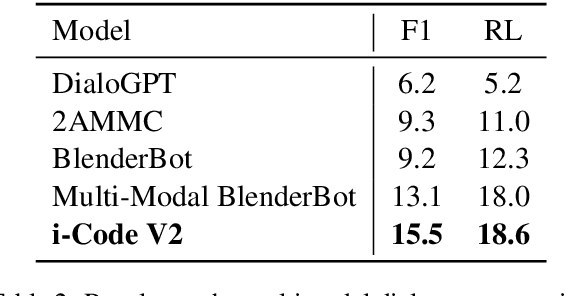
The convergence of text, visual, and audio data is a key step towards human-like artificial intelligence, however the current Vision-Language-Speech landscape is dominated by encoder-only models which lack generative abilities. We propose closing this gap with i-Code V2, the first model capable of generating natural language from any combination of Vision, Language, and Speech data. i-Code V2 is an integrative system that leverages state-of-the-art single-modality encoders, combining their outputs with a new modality-fusing encoder in order to flexibly project combinations of modalities into a shared representational space. Next, language tokens are generated from these representations via an autoregressive decoder. The whole framework is pretrained end-to-end on a large collection of dual- and single-modality datasets using a novel text completion objective that can be generalized across arbitrary combinations of modalities. i-Code V2 matches or outperforms state-of-the-art single- and dual-modality baselines on 7 multimodal tasks, demonstrating the power of generative multimodal pretraining across a diversity of tasks and signals.
Target Sound Extraction with Variable Cross-modality Clues
Mar 15, 2023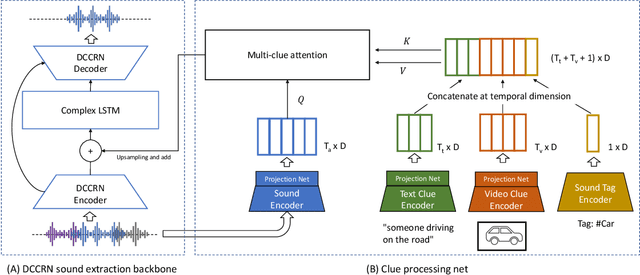
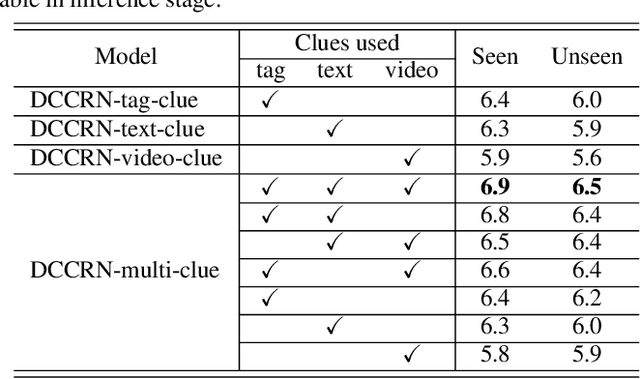
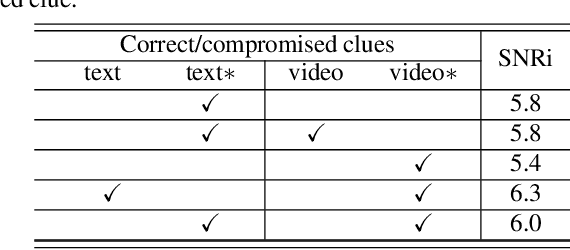
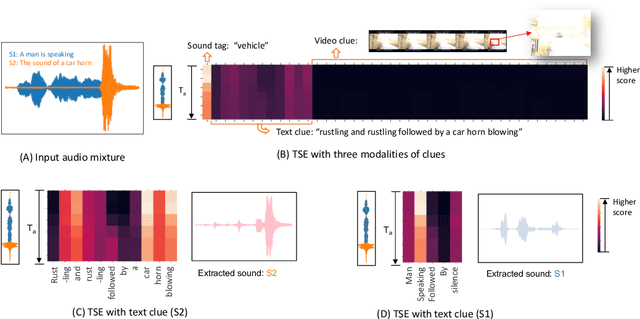
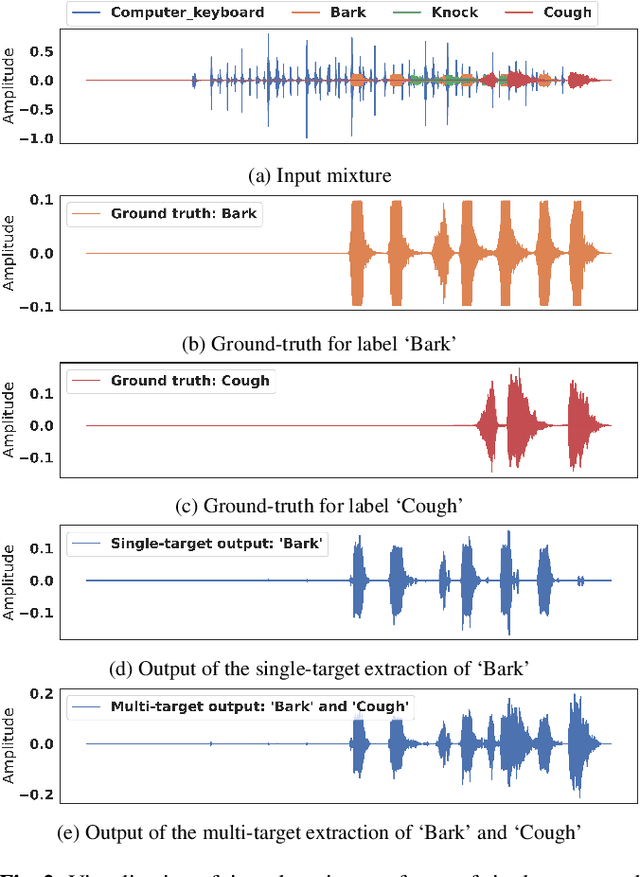
Automatic target sound extraction (TSE) is a machine learning approach to mimic the human auditory perception capability of attending to a sound source of interest from a mixture of sources. It often uses a model conditioned on a fixed form of target sound clues, such as a sound class label, which limits the ways in which users can interact with the model to specify the target sounds. To leverage variable number of clues cross modalities available in the inference phase, including a video, a sound event class, and a text caption, we propose a unified transformer-based TSE model architecture, where a multi-clue attention module integrates all the clues across the modalities. Since there is no off-the-shelf benchmark to evaluate our proposed approach, we build a dataset based on public corpora, Audioset and AudioCaps. Experimental results for seen and unseen target-sound evaluation sets show that our proposed TSE model can effectively deal with a varying number of clues which improves the TSE performance and robustness against partially compromised clues.
Factual Consistency Oriented Speech Recognition
Feb 24, 2023This paper presents a novel optimization framework for automatic speech recognition (ASR) with the aim of reducing hallucinations produced by an ASR model. The proposed framework optimizes the ASR model to maximize an expected factual consistency score between ASR hypotheses and ground-truth transcriptions, where the factual consistency score is computed by a separately trained estimator. Experimental results using the AMI meeting corpus and the VoxPopuli corpus show that the ASR model trained with the proposed framework generates ASR hypotheses that have significantly higher consistency scores with ground-truth transcriptions while maintaining the word error rates close to those of cross entropy-trained ASR models. Furthermore, it is shown that training the ASR models with the proposed framework improves the speech summarization quality as measured by the factual consistency of meeting conversation summaries generated by a large language model.
Exploring WavLM on Speech Enhancement
Nov 18, 2022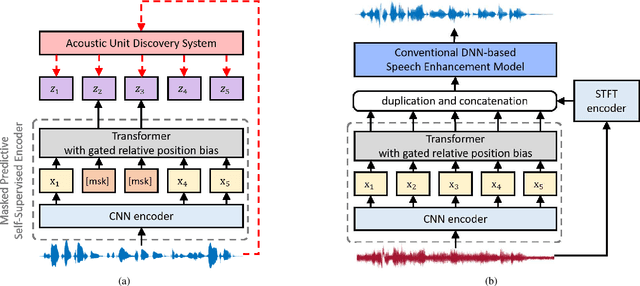
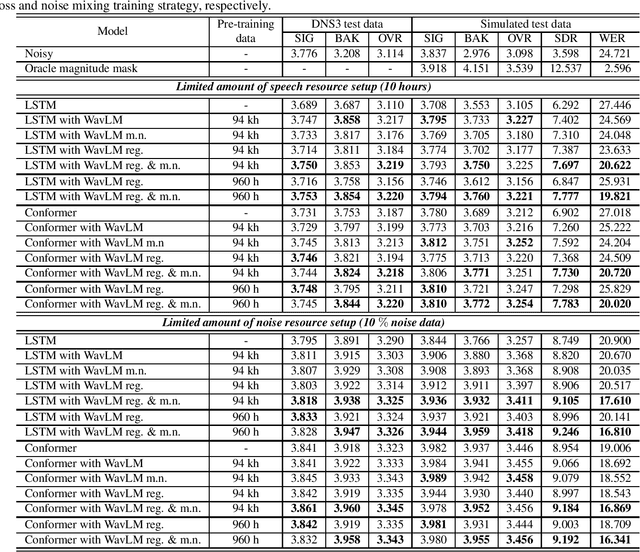

There is a surge in interest in self-supervised learning approaches for end-to-end speech encoding in recent years as they have achieved great success. Especially, WavLM showed state-of-the-art performance on various speech processing tasks. To better understand the efficacy of self-supervised learning models for speech enhancement, in this work, we design and conduct a series of experiments with three resource conditions by combining WavLM and two high-quality speech enhancement systems. Also, we propose a regression-based WavLM training objective and a noise-mixing data configuration to further boost the downstream enhancement performance. The experiments on the DNS challenge dataset and a simulation dataset show that the WavLM benefits the speech enhancement task in terms of both speech quality and speech recognition accuracy, especially for low fine-tuning resources. For the high fine-tuning resource condition, only the word error rate is substantially improved.
Simulating realistic speech overlaps improves multi-talker ASR
Nov 17, 2022Multi-talker automatic speech recognition (ASR) has been studied to generate transcriptions of natural conversation including overlapping speech of multiple speakers. Due to the difficulty in acquiring real conversation data with high-quality human transcriptions, a na\"ive simulation of multi-talker speech by randomly mixing multiple utterances was conventionally used for model training. In this work, we propose an improved technique to simulate multi-talker overlapping speech with realistic speech overlaps, where an arbitrary pattern of speech overlaps is represented by a sequence of discrete tokens. With this representation, speech overlapping patterns can be learned from real conversations based on a statistical language model, such as N-gram, which can be then used to generate multi-talker speech for training. In our experiments, multi-talker ASR models trained with the proposed method show consistent improvement on the word error rates across multiple datasets.
Real-Time Target Sound Extraction
Nov 14, 2022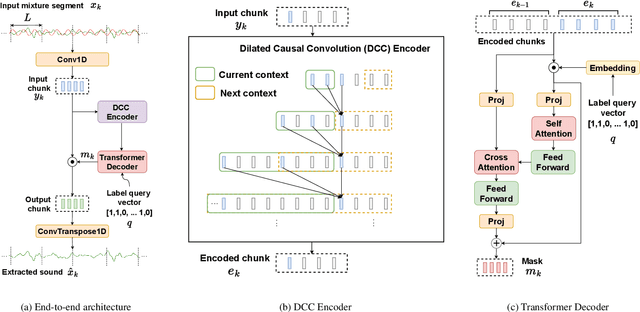
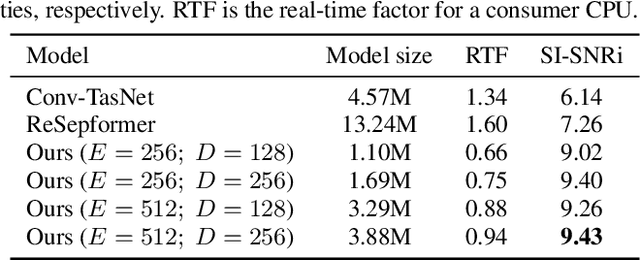
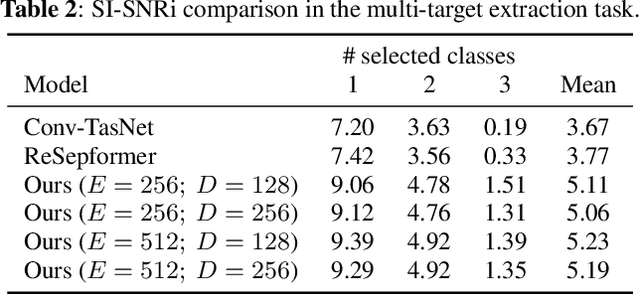
We present the first neural network model to achieve real-time and streaming target sound extraction. To accomplish this, we propose Waveformer, an encoder-decoder architecture with a stack of dilated causal convolution layers as the encoder, and a transformer decoder layer as the decoder. This hybrid architecture uses dilated causal convolutions for processing large receptive fields in a computationally efficient manner, while also benefiting from the performance transformer-based architectures provide. Our evaluations show as much as 2.2-3.3 dB improvement in SI-SNRi compared to the prior models for this task while having a 1.2-4x smaller model size and a 1.5-2x lower runtime. Open-source code and datasets: https://github.com/vb000/Waveformer
Breaking trade-offs in speech separation with sparsely-gated mixture of experts
Nov 11, 2022Several trade-offs need to be balanced when employing monaural speech separation (SS) models in conversational automatic speech recognition (ASR) systems. A larger SS model generally achieves better output quality at an expense of higher computation, meanwhile, a better SS model for overlapping speech often produces distorted output for non-overlapping speech. This paper addresses these trade-offs with a sparsely-gated mixture-of-experts (MoE). The sparsely-gated MoE architecture allows the separation models to be enlarged without compromising the run-time efficiency, which also helps achieve a better separation-distortion trade-off. To further reduce the speech distortion without compromising the SS capability, a multi-gate MoE framework is also explored, where different gates handle non-overlapping and overlapping frames differently. ASR experiments are conducted by using a simulated dataset for measuring both the speech separation accuracy and the speech distortion. Two advanced SS models, Conformer and WavLM-based models, are used as baselines. The sparsely-gated MoE models show a superior SS capability with less speech distortion, meanwhile marginally increasing the run-time computational cost. Experimental results using real conversation recordings are also presented, showing MoE's effectiveness in an end-to-end evaluation setting.
Self-supervised learning with bi-label masked speech prediction for streaming multi-talker speech recognition
Nov 10, 2022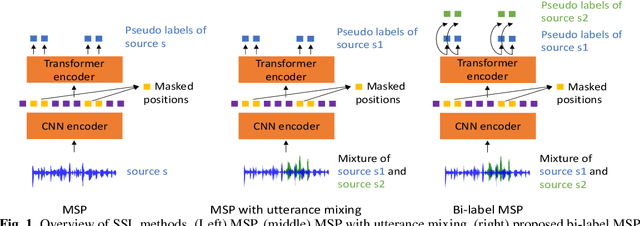
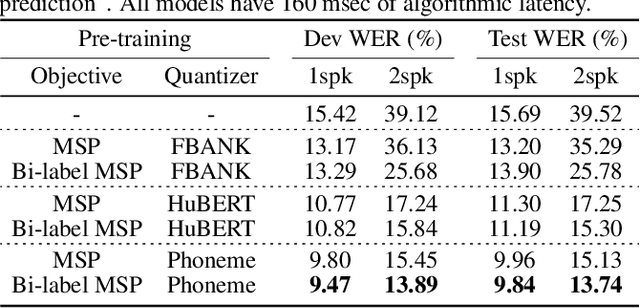
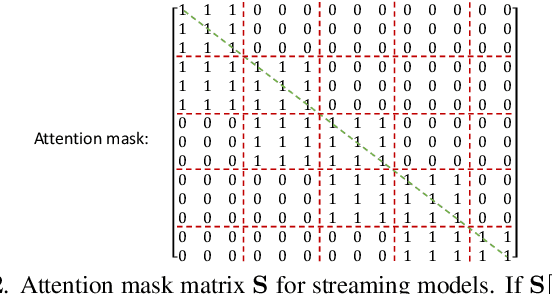

Self-supervised learning (SSL), which utilizes the input data itself for representation learning, has achieved state-of-the-art results for various downstream speech tasks. However, most of the previous studies focused on offline single-talker applications, with limited investigations in multi-talker cases, especially for streaming scenarios. In this paper, we investigate SSL for streaming multi-talker speech recognition, which generates transcriptions of overlapping speakers in a streaming fashion. We first observe that conventional SSL techniques do not work well on this task due to the poor representation of overlapping speech. We then propose a novel SSL training objective, referred to as bi-label masked speech prediction, which explicitly preserves representations of all speakers in overlapping speech. We investigate various aspects of the proposed system including data configuration and quantizer selection. The proposed SSL setup achieves substantially better word error rates on the LibriSpeechMix dataset.
Speech separation with large-scale self-supervised learning
Nov 09, 2022Self-supervised learning (SSL) methods such as WavLM have shown promising speech separation (SS) results in small-scale simulation-based experiments. In this work, we extend the exploration of the SSL-based SS by massively scaling up both the pre-training data (more than 300K hours) and fine-tuning data (10K hours). We also investigate various techniques to efficiently integrate the pre-trained model with the SS network under a limited computation budget, including a low frame rate SSL model training setup and a fine-tuning scheme using only the part of the pre-trained model. Compared with a supervised baseline and the WavLM-based SS model using feature embeddings obtained with the previously released 94K hours trained WavLM, our proposed model obtains 15.9% and 11.2% of relative word error rate (WER) reductions, respectively, for a simulated far-field speech mixture test set. For conversation transcription on real meeting recordings using continuous speech separation, the proposed model achieves 6.8% and 10.6% of relative WER reductions over the purely supervised baseline on AMI and ICSI evaluation sets, respectively, while reducing the computational cost by 38%.