 Add to Chrome
 Add to Firefox
 Add to Edge
SemEval-2026 Task 9: Detecting Multilingual, Multicultural and Multievent Online Polarization
Apr 08, 2026
We present SemEval-2026 Task 9, a shared task on online polarization detection, covering 22 languages and comprising over 110K annotated instances. Each data instance is multi-labeled with the presence of polarization, polarization type, and polarization manifestation. Participants were asked to predict labels in three sub-tasks: (1) detecting the presence of polarization, (2) identifying the type of polarization, and (3) recognizing the polarization manifestation. The three tasks attracted over 1,000 participants worldwide and more than 10k submission on Codabench. We received final submissions from 67 teams and 73 system description papers. We report the baseline results and analyze the performance of the best-performing systems, highlighting the most common approaches and the most effective methods across different subtasks and languages. The dataset of this task is publicly available.

AfriHate: A Multilingual Collection of Hate Speech and Abusive Language Datasets for African Languages
Jan 15, 2025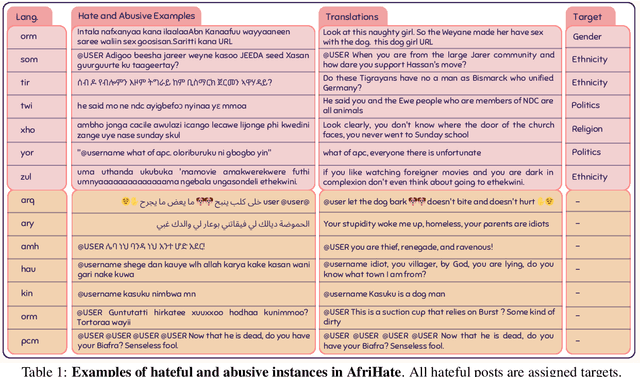

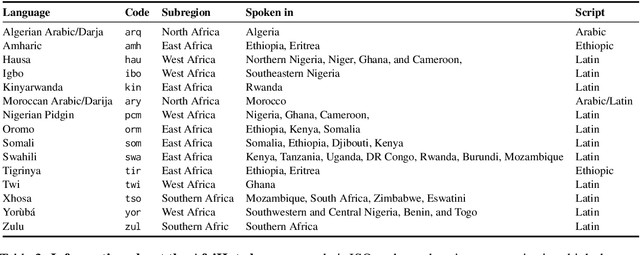

Hate speech and abusive language are global phenomena that need socio-cultural background knowledge to be understood, identified, and moderated. However, in many regions of the Global South, there have been several documented occurrences of (1) absence of moderation and (2) censorship due to the reliance on keyword spotting out of context. Further, high-profile individuals have frequently been at the center of the moderation process, while large and targeted hate speech campaigns against minorities have been overlooked. These limitations are mainly due to the lack of high-quality data in the local languages and the failure to include local communities in the collection, annotation, and moderation processes. To address this issue, we present AfriHate: a multilingual collection of hate speech and abusive language datasets in 15 African languages. Each instance in AfriHate is annotated by native speakers familiar with the local culture. We report the challenges related to the construction of the datasets and present various classification baseline results with and without using LLMs. The datasets, individual annotations, and hate speech and offensive language lexicons are available on https://github.com/AfriHate/AfriHate