 Add to Chrome
 Add to Firefox
 Add to Edge
TarGEN: Targeted Data Generation with Large Language Models
Oct 30, 2023
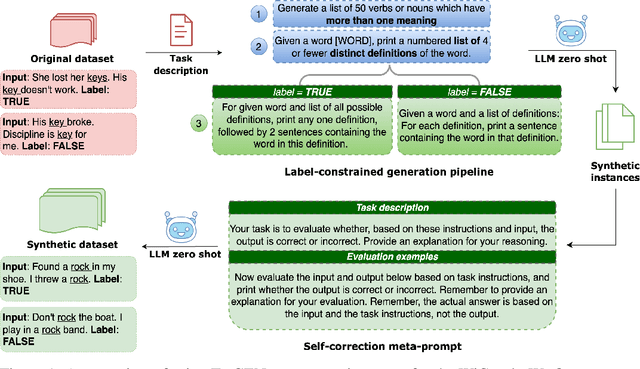
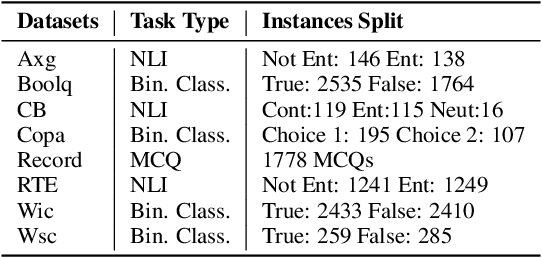
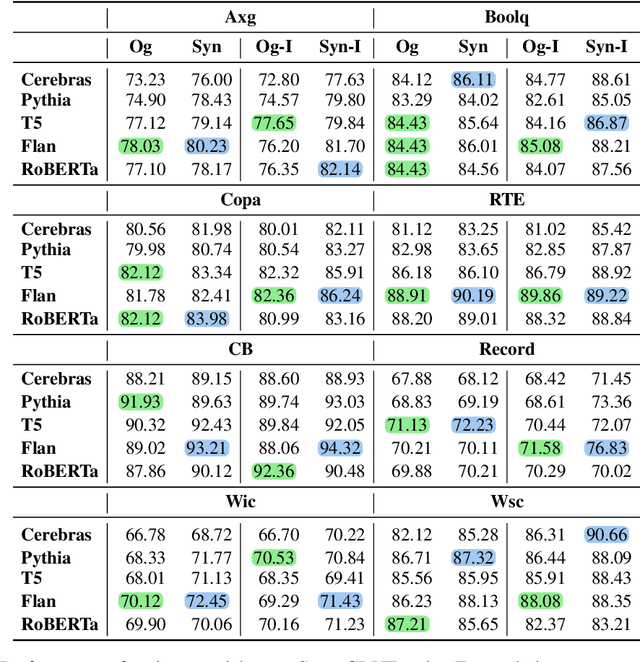
The rapid advancement of large language models (LLMs) has sparked interest in data synthesis techniques, aiming to generate diverse and high-quality synthetic datasets. However, these synthetic datasets often suffer from a lack of diversity and added noise. In this paper, we present TarGEN, a multi-step prompting strategy for generating high-quality synthetic datasets utilizing a LLM. An advantage of TarGEN is its seedless nature; it does not require specific task instances, broadening its applicability beyond task replication. We augment TarGEN with a method known as self-correction empowering LLMs to rectify inaccurately labeled instances during dataset creation, ensuring reliable labels. To assess our technique's effectiveness, we emulate 8 tasks from the SuperGLUE benchmark and finetune various language models, including encoder-only, encoder-decoder, and decoder-only models on both synthetic and original training sets. Evaluation on the original test set reveals that models trained on datasets generated by TarGEN perform approximately 1-2% points better than those trained on original datasets (82.84% via syn. vs. 81.12% on og. using Flan-T5). When incorporating instruction tuning, the performance increases to 84.54% on synthetic data vs. 81.49% on original data by Flan-T5. A comprehensive analysis of the synthetic dataset compared to the original dataset reveals that the synthetic dataset demonstrates similar or higher levels of dataset complexity and diversity. Furthermore, the synthetic dataset displays a bias level that aligns closely with the original dataset. Finally, when pre-finetuned on our synthetic SuperGLUE dataset, T5-3B yields impressive results on the OpenLLM leaderboard, surpassing the model trained on the Self-Instruct dataset by 4.14% points. We hope that TarGEN can be helpful for quality data generation and reducing the human efforts to create complex benchmarks.

InstructExcel: A Benchmark for Natural Language Instruction in Excel
Oct 23, 2023With the evolution of Large Language Models (LLMs) we can solve increasingly more complex NLP tasks across various domains, including spreadsheets. This work investigates whether LLMs can generate code (Excel OfficeScripts, a TypeScript API for executing many tasks in Excel) that solves Excel specific tasks provided via natural language user instructions. To do so we introduce a new large-scale benchmark, InstructExcel, created by leveraging the 'Automate' feature in Excel to automatically generate OfficeScripts from users' actions. Our benchmark includes over 10k samples covering 170+ Excel operations across 2,000 publicly available Excel spreadsheets. Experiments across various zero-shot and few-shot settings show that InstructExcel is a hard benchmark for state of the art models like GPT-4. We observe that (1) using GPT-4 over GPT-3.5, (2) providing more in-context examples, and (3) dynamic prompting can help improve performance on this benchmark.
AutoMix: Automatically Mixing Language Models
Oct 19, 2023


Large language models (LLMs) are now available in various sizes and configurations from cloud API providers. While this diversity offers a broad spectrum of choices, effectively leveraging the options to optimize computational cost and performance remains challenging. In this work, we present AutoMix, an approach that strategically routes queries to larger LMs, based on the approximate correctness of outputs from a smaller LM. Central to AutoMix is a few-shot self-verification mechanism, which estimates the reliability of its own outputs without requiring training. Given that verifications can be noisy, we employ a meta verifier in AutoMix to refine the accuracy of these assessments. Our experiments using LLAMA2-13/70B, on five context-grounded reasoning datasets demonstrate that AutoMix surpasses established baselines, improving the incremental benefit per cost by up to 89%. Our code and data are available at https://github.com/automix-llm/automix.
Take a Step Back: Evoking Reasoning via Abstraction in Large Language Models
Oct 09, 2023We present Step-Back Prompting, a simple prompting technique that enables LLMs to do abstractions to derive high-level concepts and first principles from instances containing specific details. Using the concepts and principles to guide the reasoning steps, LLMs significantly improve their abilities in following a correct reasoning path towards the solution. We conduct experiments of Step-Back Prompting with PaLM-2L models and observe substantial performance gains on a wide range of challenging reasoning-intensive tasks including STEM, Knowledge QA, and Multi-Hop Reasoning. For instance, Step-Back Prompting improves PaLM-2L performance on MMLU Physics and Chemistry by 7% and 11%, TimeQA by 27%, and MuSiQue by 7%.
How FaR Are Large Language Models From Agents with Theory-of-Mind?
Oct 04, 2023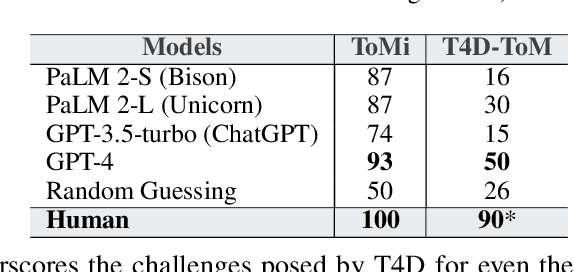
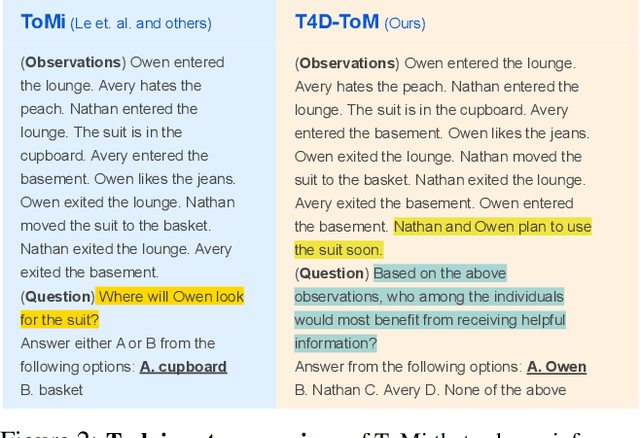
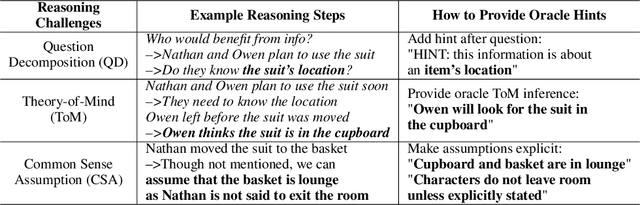
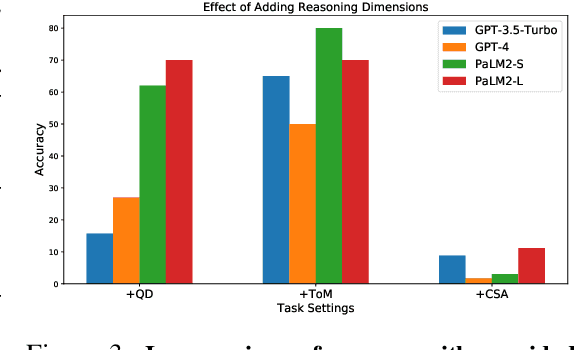
"Thinking is for Doing." Humans can infer other people's mental states from observations--an ability called Theory-of-Mind (ToM)--and subsequently act pragmatically on those inferences. Existing question answering benchmarks such as ToMi ask models questions to make inferences about beliefs of characters in a story, but do not test whether models can then use these inferences to guide their actions. We propose a new evaluation paradigm for large language models (LLMs): Thinking for Doing (T4D), which requires models to connect inferences about others' mental states to actions in social scenarios. Experiments on T4D demonstrate that LLMs such as GPT-4 and PaLM 2 seemingly excel at tracking characters' beliefs in stories, but they struggle to translate this capability into strategic action. Our analysis reveals the core challenge for LLMs lies in identifying the implicit inferences about mental states without being explicitly asked about as in ToMi, that lead to choosing the correct action in T4D. To bridge this gap, we introduce a zero-shot prompting framework, Foresee and Reflect (FaR), which provides a reasoning structure that encourages LLMs to anticipate future challenges and reason about potential actions. FaR boosts GPT-4's performance from 50% to 71% on T4D, outperforming other prompting methods such as Chain-of-Thought and Self-Ask. Moreover, FaR generalizes to diverse out-of-distribution story structures and scenarios that also require ToM inferences to choose an action, consistently outperforming other methods including few-shot in-context learning.
Large Language Models Cannot Self-Correct Reasoning Yet
Oct 03, 2023Large Language Models (LLMs) have emerged as a groundbreaking technology with their unparalleled text generation capabilities across various applications. Nevertheless, concerns persist regarding the accuracy and appropriateness of their generated content. A contemporary methodology, self-correction, has been proposed as a remedy to these issues. Building upon this premise, this paper critically examines the role and efficacy of self-correction within LLMs, shedding light on its true potential and limitations. Central to our investigation is the notion of intrinsic self-correction, whereby an LLM attempts to correct its initial responses based solely on its inherent capabilities, without the crutch of external feedback. In the context of reasoning, our research indicates that LLMs struggle to self-correct their responses without external feedback, and at times, their performance might even degrade post self-correction. Drawing from these insights, we offer suggestions for future research and practical applications in this field.
Let's Do a Thought Experiment: Using Counterfactuals to Improve Moral Reasoning
Jun 25, 2023Language models still struggle on moral reasoning, despite their impressive performance in many other tasks. In particular, the Moral Scenarios task in MMLU (Multi-task Language Understanding) is among the worst performing tasks for many language models, including GPT-3. In this work, we propose a new prompting framework, Thought Experiments, to teach language models to do better moral reasoning using counterfactuals. Experiment results show that our framework elicits counterfactual questions and answers from the model, which in turn helps improve the accuracy on Moral Scenarios task by 9-16% compared to other zero-shot baselines. Interestingly, unlike math reasoning tasks, zero-shot Chain-of-Thought (CoT) reasoning doesn't work out of the box, and even reduces accuracy by around 4% compared to direct zero-shot. We further observed that with minimal human supervision in the form of 5 few-shot examples, the accuracy of the task can be improved to as much as 80%.
InstructABSA: Instruction Learning for Aspect Based Sentiment Analysis
Feb 21, 2023In this paper, we present InstructABSA, Aspect-Based Sentiment Analysis (ABSA) using instruction learning paradigm for all ABSA subtasks: Aspect Term Extraction (ATE), Aspect Term Sentiment Classification (ATSC), and Joint Task modeling. Our method introduces positive, negative, and neutral examples to each training sample, and instruction tunes the model (Tk-Instruct Base) for each ABSA subtask, yielding significant performance improvements. Experimental results on the Sem Eval 2014 dataset demonstrate that InstructABSA outperforms the previous state-of-the-art (SOTA) approaches on all three ABSA subtasks (ATE, ATSC, and Joint Task) by a significant margin, outperforming 7x larger models. In particular, InstructABSA surpasses the SOTA on the restaurant ATE subtask by 7.31% points and on the Laptop Joint Task by 8.63% points. Our results also suggest a strong generalization ability to unseen tasks across all three subtasks.
Real-Time Visual Feedback to Guide Benchmark Creation: A Human-and-Metric-in-the-Loop Workflow
Feb 09, 2023Recent research has shown that language models exploit `artifacts' in benchmarks to solve tasks, rather than truly learning them, leading to inflated model performance. In pursuit of creating better benchmarks, we propose VAIDA, a novel benchmark creation paradigm for NLP, that focuses on guiding crowdworkers, an under-explored facet of addressing benchmark idiosyncrasies. VAIDA facilitates sample correction by providing realtime visual feedback and recommendations to improve sample quality. Our approach is domain, model, task, and metric agnostic, and constitutes a paradigm shift for robust, validated, and dynamic benchmark creation via human-and-metric-in-the-loop workflows. We evaluate via expert review and a user study with NASA TLX. We find that VAIDA decreases effort, frustration, mental, and temporal demands of crowdworkers and analysts, simultaneously increasing the performance of both user groups with a 45.8% decrease in the level of artifacts in created samples. As a by product of our user study, we observe that created samples are adversarial across models, leading to decreases of 31.3% (BERT), 22.5% (RoBERTa), 14.98% (GPT-3 fewshot) in performance.
Self-Instruct: Aligning Language Model with Self Generated Instructions
Dec 20, 2022Large "instruction-tuned" language models (finetuned to respond to instructions) have demonstrated a remarkable ability to generalize zero-shot to new tasks. Nevertheless, they depend heavily on human-written instruction data that is limited in quantity, diversity, and creativity, therefore hindering the generality of the tuned model. We introduce Self-Instruct, a framework for improving the instruction-following capabilities of pretrained language models by bootstrapping off its own generations. Our pipeline generates instruction, input, and output samples from a language model, then prunes them before using them to finetune the original model. Applying our method to vanilla GPT3, we demonstrate a 33% absolute improvement over the original model on Super-NaturalInstructions, on par with the performance of InstructGPT_001, which is trained with private user data and human annotations. For further evaluation, we curate a set of expert-written instructions for novel tasks, and show through human evaluation that tuning GPT3 with Self-Instruct outperforms using existing public instruction datasets by a large margin, leaving only a 5% absolute gap behind InstructGPT_001. Self-Instruct provides an almost annotation-free method for aligning pre-trained language models with instructions, and we release our large synthetic dataset to facilitate future studies on instruction tuning.