 Add to Chrome
 Add to Firefox
 Add to Edge
Improving (Dis)agreement Detection with Inductive Social Relation Information From Comment-Reply Interactions
Feb 08, 2023
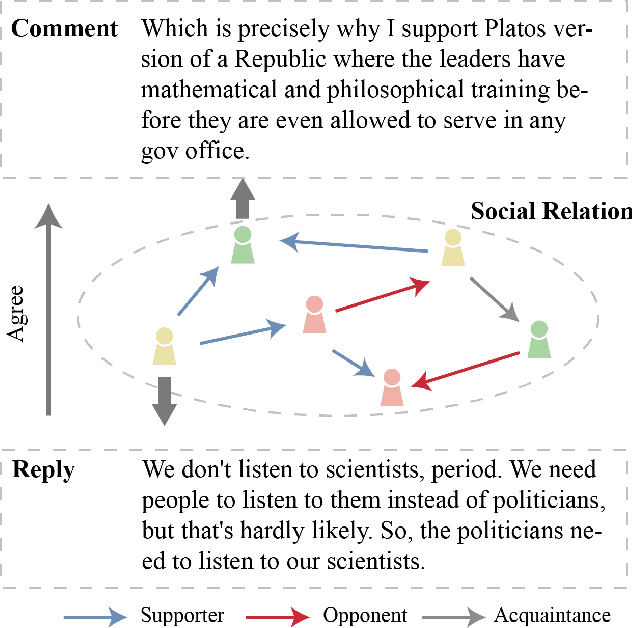
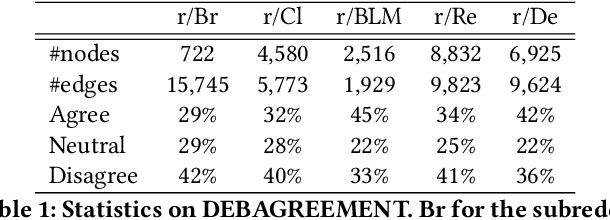
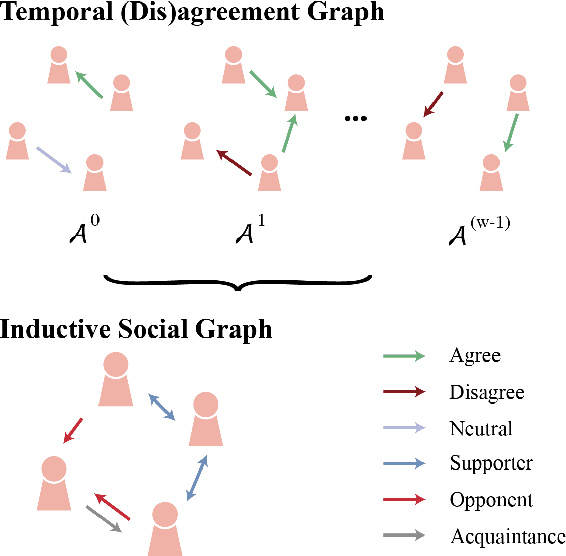
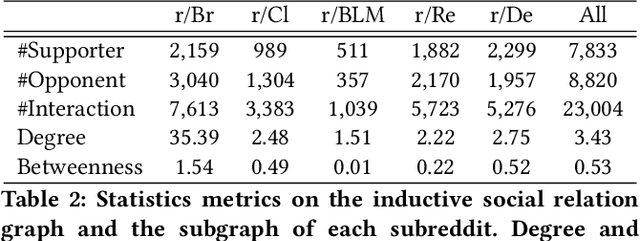
(Dis)agreement detection aims to identify the authors' attitudes or positions (\textit{{agree, disagree, neutral}}) towards a specific text. It is limited for existing methods merely using textual information for identifying (dis)agreements, especially for cross-domain settings. Social relation information can play an assistant role in the (dis)agreement task besides textual information. We propose a novel method to extract such relation information from (dis)agreement data into an inductive social relation graph, merely using the comment-reply pairs without any additional platform-specific information. The inductive social relation globally considers the historical discussion and the relation between authors. Textual information based on a pre-trained language model and social relation information encoded by pre-trained RGCN are jointly considered for (dis)agreement detection. Experimental results show that our model achieves state-of-the-art performance for both the in-domain and cross-domain tasks on the benchmark -- DEBAGREEMENT. We find social relations can boost the performance of the (dis)agreement detection model, especially for the long-token comment-reply pairs, demonstrating the effectiveness of the social relation graph. We also explore the effect of the knowledge graph embedding methods, the information fusing method, and the time interval in constructing the social relation graph, which shows the effectiveness of our model.

Characterization and Generation of 3D Realistic Geological Particles with Metaball Descriptor based on X-Ray Computed Tomography
Feb 05, 2023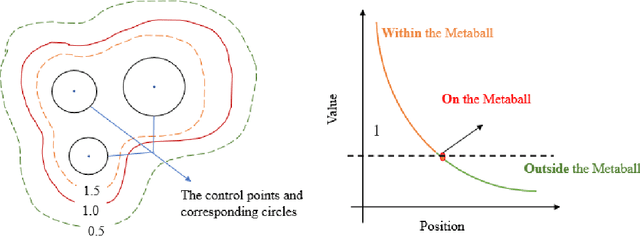
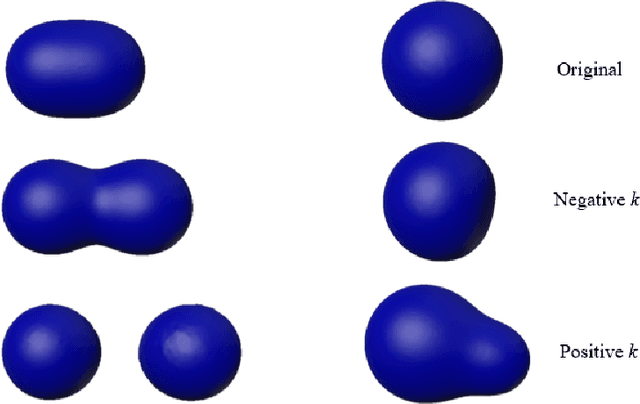
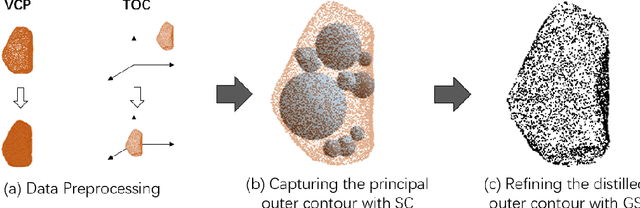
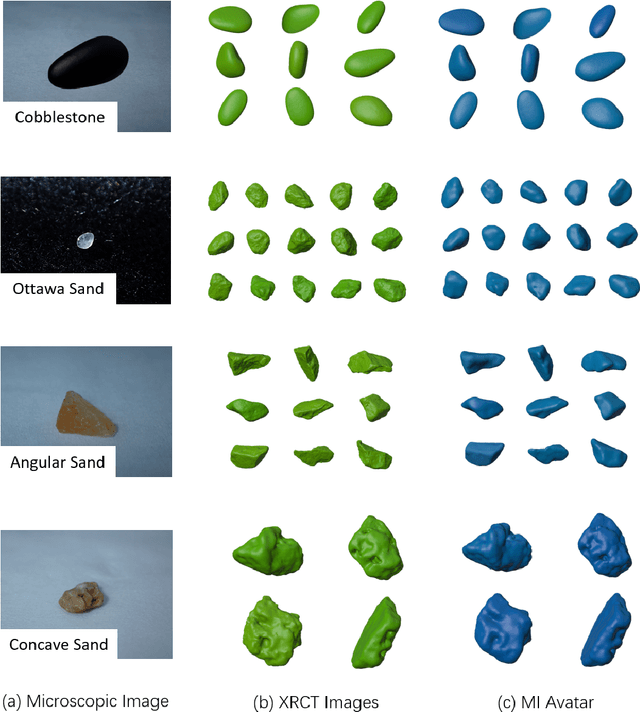
The morphology of geological particles is crucial in determining its granular characteristics and assembly responses. In this paper, Metaball-function based solutions are proposed for morphological characterization and generation of three-dimensional realistic particles according to the X-ray Computed Tomography (XRCT) images. For characterization, we develop a geometric-based Metaball-Imaging algorithm. This algorithm can capture the main contour of parental particles with a series of non-overlapping spheres and refine surface-texture details through gradient search. Four types of particles, hundreds of samples, are applied for evaluations. The result shows good matches on key morphological indicators(i.e., volume, surface area, sphericity, circularity, corey-shape factor, nominal diameter and surface-equivalent-sphere diameter), confirming its characterization precision. For generation, we propose the Metaball Variational Autoencoder. Assisted by deep neural networks, this method can generate 3D particles in Metaball form, while retaining coessential morphological features with parental particles. Additionally, this method allows for control over the generated shapes through an arithmetic pattern, enabling the generation of particles with specific shapes. Two sets of XRCT images different in sample number and geometric features are chosen as parental data. On each training set, one thousand particles are generated for validations. The generation fidelity is demonstrated through comparisons of morphologies and shape-feature distributions between generated and parental particles. Examples are also provided to demonstrate controllability on the generated shapes. With Metaball-based simulations frameworks previously proposed by the authors, these methods have the potential to provide valuable insights into the properties and behavior of actual geological particles.
Data-Efficient Protein 3D Geometric Pretraining via Refinement of Diffused Protein Structure Decoy
Feb 05, 2023Learning meaningful protein representation is important for a variety of biological downstream tasks such as structure-based drug design. Having witnessed the success of protein sequence pretraining, pretraining for structural data which is more informative has become a promising research topic. However, there are three major challenges facing protein structure pretraining: insufficient sample diversity, physically unrealistic modeling, and the lack of protein-specific pretext tasks. To try to address these challenges, we present the 3D Geometric Pretraining. In this paper, we propose a unified framework for protein pretraining and a 3D geometric-based, data-efficient, and protein-specific pretext task: RefineDiff (Refine the Diffused Protein Structure Decoy). After pretraining our geometric-aware model with this task on limited data(less than 1% of SOTA models), we obtained informative protein representations that can achieve comparable performance for various downstream tasks.
Generative Tertiary Structure-based RNA Design
Jan 25, 2023Learning from 3D biological macromolecules with artificial intelligence technologies has been an emerging area. Computational protein design, known as the inverse of protein structure prediction, aims to generate protein sequences that will fold into the defined structure. Analogous to protein design, RNA design is also an important topic in synthetic biology, which aims to generate RNA sequences by given structures. However, existing RNA design methods mainly focus on the secondary structure, ignoring the informative tertiary structure, which is commonly used in protein design. To explore the complex coupling between RNA sequence and 3D structure, we introduce an RNA tertiary structure modeling method to efficiently capture useful information from the 3D structure of RNA. For a fair comparison, we collect abundant RNA data and split the data according to tertiary structures. With the standard dataset, we conduct a benchmark by employing structure-based protein design approaches with our RNA tertiary structure modeling method. We believe our work will stimulate the future development of tertiary structure-based RNA design and bridge the gap between the RNA 3D structures and sequences.
DiffSDS: A language diffusion model for protein backbone inpainting under geometric conditions and constraints
Jan 22, 2023Have you ever been troubled by the complexity and computational cost of SE(3) protein structure modeling and been amazed by the simplicity and power of language modeling? Recent work has shown promise in simplifying protein structures as sequences of protein angles; therefore, language models could be used for unconstrained protein backbone generation. Unfortunately, such simplification is unsuitable for the constrained protein inpainting problem, where the model needs to recover masked structures conditioned on unmasked ones, as it dramatically increases the computing cost of geometric constraints. To overcome this dilemma, we suggest inserting a hidden \textbf{a}tomic \textbf{d}irection \textbf{s}pace (\textbf{ADS}) upon the language model, converting invariant backbone angles into equivalent direction vectors and preserving the simplicity, called Seq2Direct encoder ($\text{Enc}_{s2d}$). Geometric constraints could be efficiently imposed on the newly introduced direction space. A Direct2Seq decoder ($\text{Dec}_{d2s}$) with mathematical guarantees is also introduced to develop a \textbf{SDS} ($\text{Enc}_{s2d}$+$\text{Dec}_{d2s}$) model. We apply the SDS model as the denoising neural network during the conditional diffusion process, resulting in a constrained generative model--\textbf{DiffSDS}. Extensive experiments show that the plug-and-play ADS could transform the language model into a strong structural model without loss of simplicity. More importantly, the proposed DiffSDS outperforms previous strong baselines by a large margin on the task of protein inpainting.
Explaining Graph Neural Networks via Non-parametric Subgraph Matching
Jan 07, 2023


The great success in graph neural networks (GNNs) provokes the question about explainability: Which fraction of the input graph is the most determinant of the prediction? Particularly, parametric explainers prevail in existing approaches because of their stronger capability to decipher the black-box (i.e., the target GNN). In this paper, based on the observation that graphs typically share some joint motif patterns, we propose a novel non-parametric subgraph matching framework, dubbed MatchExplainer, to explore explanatory subgraphs. It couples the target graph with other counterpart instances and identifies the most crucial joint substructure by minimizing the node corresponding-based distance. Moreover, we note that present graph sampling or node-dropping methods usually suffer from the false positive sampling problem. To ameliorate that issue, we design a new augmentation paradigm named MatchDrop. It takes advantage of MatchExplainer to fix the most informative portion of the graph and merely operates graph augmentations on the rest less informative part. We conduct extensive experiments on both synthetic and real-world datasets and show the effectiveness of our MatchExplainer by outperforming all parametric baselines with significant margins. Additional results also demonstrate that our MatchDrop is a general scheme to be equipped with GNNs for enhanced performance.
Surveillance Face Anti-spoofing
Jan 03, 2023Face Anti-spoofing (FAS) is essential to secure face recognition systems from various physical attacks. However, recent research generally focuses on short-distance applications (i.e., phone unlocking) while lacking consideration of long-distance scenes (i.e., surveillance security checks). In order to promote relevant research and fill this gap in the community, we collect a large-scale Surveillance High-Fidelity Mask (SuHiFiMask) dataset captured under 40 surveillance scenes, which has 101 subjects from different age groups with 232 3D attacks (high-fidelity masks), 200 2D attacks (posters, portraits, and screens), and 2 adversarial attacks. In this scene, low image resolution and noise interference are new challenges faced in surveillance FAS. Together with the SuHiFiMask dataset, we propose a Contrastive Quality-Invariance Learning (CQIL) network to alleviate the performance degradation caused by image quality from three aspects: (1) An Image Quality Variable module (IQV) is introduced to recover image information associated with discrimination by combining the super-resolution network. (2) Using generated sample pairs to simulate quality variance distributions to help contrastive learning strategies obtain robust feature representation under quality variation. (3) A Separate Quality Network (SQN) is designed to learn discriminative features independent of image quality. Finally, a large number of experiments verify the quality of the SuHiFiMask dataset and the superiority of the proposed CQIL.
A Survey on Protein Representation Learning: Retrospect and Prospect
Dec 31, 2022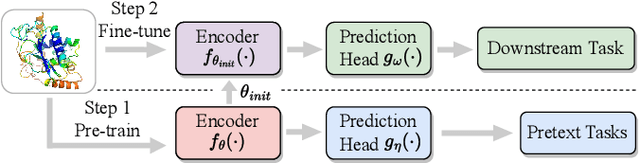

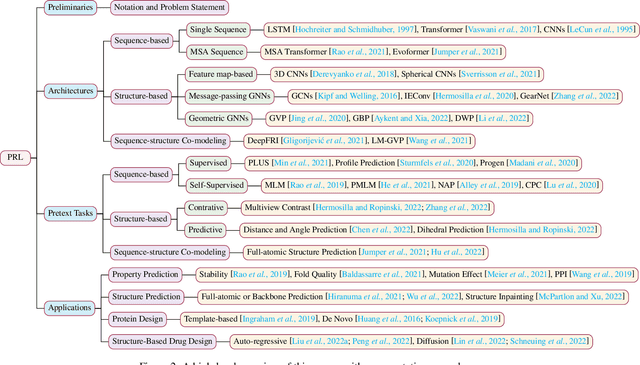
Proteins are fundamental biological entities that play a key role in life activities. The amino acid sequences of proteins can be folded into stable 3D structures in the real physicochemical world, forming a special kind of sequence-structure data. With the development of Artificial Intelligence (AI) techniques, Protein Representation Learning (PRL) has recently emerged as a promising research topic for extracting informative knowledge from massive protein sequences or structures. To pave the way for AI researchers with little bioinformatics background, we present a timely and comprehensive review of PRL formulations and existing PRL methods from the perspective of model architectures, pretext tasks, and downstream applications. We first briefly introduce the motivations for protein representation learning and formulate it in a general and unified framework. Next, we divide existing PRL methods into three main categories: sequence-based, structure-based, and sequence-structure co-modeling. Finally, we discuss some technical challenges and potential directions for improving protein representation learning. The latest advances in PRL methods are summarized in a GitHub repository https://github.com/LirongWu/awesome-protein-representation-learning.
Federated Learning for Inference at Anytime and Anywhere
Dec 08, 2022
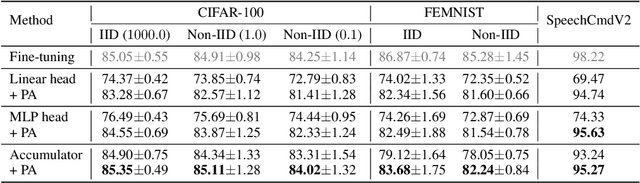

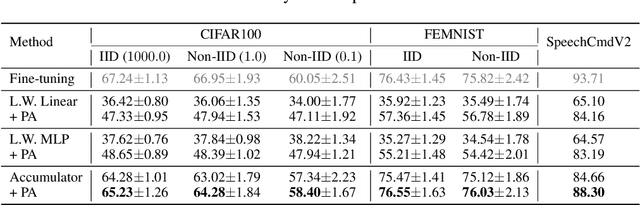
Federated learning has been predominantly concerned with collaborative training of deep networks from scratch, and especially the many challenges that arise, such as communication cost, robustness to heterogeneous data, and support for diverse device capabilities. However, there is no unified framework that addresses all these problems together. This paper studies the challenges and opportunities of exploiting pre-trained Transformer models in FL. In particular, we propose to efficiently adapt such pre-trained models by injecting a novel attention-based adapter module at each transformer block that both modulates the forward pass and makes an early prediction. Training only the lightweight adapter by FL leads to fast and communication-efficient learning even in the presence of heterogeneous data and devices. Extensive experiments on standard FL benchmarks, including CIFAR-100, FEMNIST and SpeechCommandsv2 demonstrate that this simple framework provides fast and accurate FL while supporting heterogenous device capabilities, efficient personalization, and scalable-cost anytime inference.
DiffBP: Generative Diffusion of 3D Molecules for Target Protein Binding
Dec 01, 2022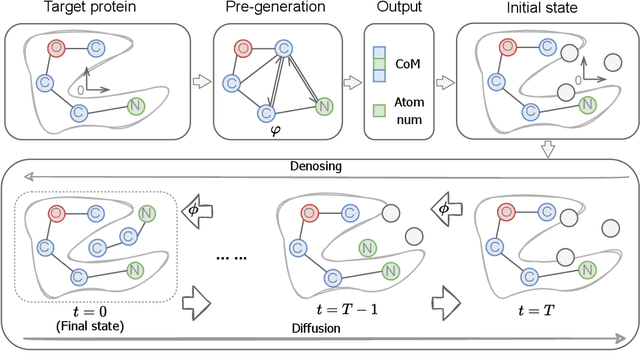

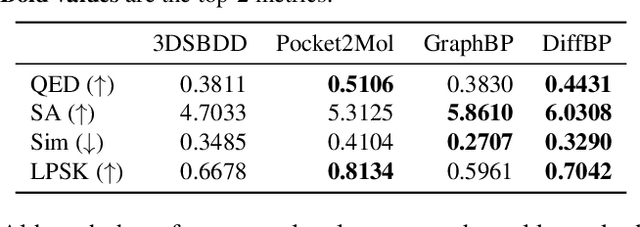
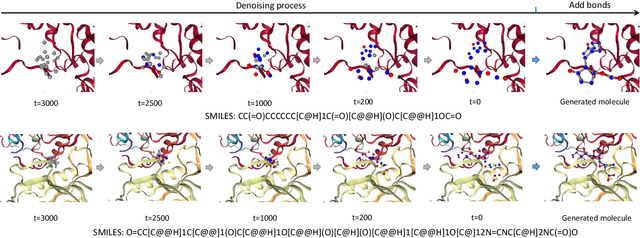
Generating molecules that bind to specific proteins is an important but challenging task in drug discovery. Previous works usually generate atoms in an auto-regressive way, where element types and 3D coordinates of atoms are generated one by one. However, in real-world molecular systems, the interactions among atoms in an entire molecule are global, leading to the energy function pair-coupled among atoms. With such energy-based consideration, the modeling of probability should be based on joint distributions, rather than sequentially conditional ones. Thus, the unnatural sequentially auto-regressive modeling of molecule generation is likely to violate the physical rules, thus resulting in poor properties of the generated molecules. In this work, a generative diffusion model for molecular 3D structures based on target proteins as contextual constraints is established, at a full-atom level in a non-autoregressive way. Given a designated 3D protein binding site, our model learns the generative process that denoises both element types and 3D coordinates of an entire molecule, with an equivariant network. Experimentally, the proposed method shows competitive performance compared with prevailing works in terms of high affinity with proteins and appropriate molecule sizes as well as other drug properties such as drug-likeness of the generated molecules.