 Add to Chrome
 Add to Firefox
 Add to Edge
MOSS-Audio Technical Report
Jun 01, 2026
MOSS-Audio is a unified audio-language model for speech, environmental sound, and music understanding, supporting audio captioning, time-aware question answering, timestamped transcription, and audio-grounded reasoning. MOSS-Audio couples a dedicated audio encoder with a modality adapter and a large language model: the encoder produces 12.5 Hz temporal representations, the adapter projects them into the decoder space, and the decoder generates autoregressive text outputs. Two design choices are central to the system: \textbf{DeepStack cross-layer feature injection}, which exposes the decoder to acoustic information from multiple encoder depths, and \textbf{time markers}, which provide explicit temporal cues by inserting timestamp markers into the audio-token stream. At the data level, we design an event-preserving audio annotation pipeline that segments raw audio at coherent event boundaries, applies branch-specific annotation to speech, music, and general audio, and merges the results into unified captions for pretraining. The intermediate branch-specific captions are further retained to support the construction of task-oriented SFT data. The model is pretrained on large-scale audio-language data, with time-aware objectives incorporated to support temporal grounding, and then undergoes multi-stage post-training to enhance instruction following and audio-grounded reasoning. We release 4B and 8B variants in both Instruct and Thinking configurations. MOSS-Audio achieves strong performance across general audio understanding, speech captioning, ASR, and timestamped ASR, positioning it as a promising understanding foundation for future voice agents.

MOSS-TTS Technical Report
Mar 18, 2026This technical report presents MOSS-TTS, a speech generation foundation model built on a scalable recipe: discrete audio tokens, autoregressive modeling, and large-scale pretraining. Built on MOSS-Audio-Tokenizer, a causal Transformer tokenizer that compresses 24 kHz audio to 12.5 fps with variable-bitrate RVQ and unified semantic-acoustic representations, we release two complementary generators: MOSS-TTS, which emphasizes structural simplicity, scalability, and long-context/control-oriented deployment, and MOSS-TTS-Local-Transformer, which introduces a frame-local autoregressive module for higher modeling efficiency, stronger speaker preservation, and a shorter time to first audio. Across multilingual and open-domain settings, MOSS-TTS supports zero-shot voice cloning, token-level duration control, phoneme-/pinyin-level pronunciation control, smooth code-switching, and stable long-form generation. This report summarizes the design, training recipe, and empirical characteristics of the released models.
Towards Efficient and Generalizable Retrieval: Adaptive Semantic Quantization and Residual Knowledge Transfer
Feb 27, 2026While semantic ID-based generative retrieval enables efficient end-to-end modeling in industrial applications, these methods face a persistent trade-off: head items are susceptible to ID collisions that negatively impact downstream tasks, whereas data-sparse tail items, including cold-start items, exhibit limited generalization. To address this issue, we propose the Anchored Curriculum with Sequential Adaptive Quantization (SA^2CRQ) framework. The framework introduces Sequential Adaptive Residual Quantization (SARQ) to dynamically allocate code lengths based on item path entropy, assigning longer, discriminative IDs to head items and shorter, generalizable IDs to tail items. To mitigate data sparsity, the Anchored Curriculum Residual Quantization (ACRQ) component utilizes a frozen semantic manifold learned from head items to regularize and accelerate the representation learning of tail items. Experimental results from a large-scale industrial search system and multiple public datasets indicate that SA^2CRQ yields consistent improvements over existing baselines, particularly in cold-start retrieval scenarios.
RAD-DPO: Robust Adaptive Denoising Direct Preference Optimization for Generative Retrieval in E-commerce
Feb 27, 2026Generative Retrieval (GR) has emerged as a powerful paradigm in e-commerce search, retrieving items via autoregressive decoding of Semantic IDs (SIDs). However, aligning GR with complex user preferences remains challenging. While Direct Preference Optimization (DPO) offers an efficient alignment solution, its direct application to structured SIDs suffers from three limitations: (i) it penalizes shared hierarchical prefixes, causing gradient conflicts; (ii) it is vulnerable to noisy pseudo-negatives from implicit feedback; and (iii) in multi-label queries with multiple relevant items, it exacerbates a probability "squeezing effect" among valid candidates. To address these issues, we propose RAD-DPO, which introduces token-level gradient detachment to protect prefix structures, similarity-based dynamic reward weighting to mitigate label noise, and a multi-label global contrastive objective integrated with global SFT loss to explicitly expand positive coverage. Extensive offline experiments and online A/B testing on a large-scale e-commerce platform demonstrate significant improvements in ranking quality and training efficiency.
MOVA: Towards Scalable and Synchronized Video-Audio Generation
Feb 09, 2026Audio is indispensable for real-world video, yet generation models have largely overlooked audio components. Current approaches to producing audio-visual content often rely on cascaded pipelines, which increase cost, accumulate errors, and degrade overall quality. While systems such as Veo 3 and Sora 2 emphasize the value of simultaneous generation, joint multimodal modeling introduces unique challenges in architecture, data, and training. Moreover, the closed-source nature of existing systems limits progress in the field. In this work, we introduce MOVA (MOSS Video and Audio), an open-source model capable of generating high-quality, synchronized audio-visual content, including realistic lip-synced speech, environment-aware sound effects, and content-aligned music. MOVA employs a Mixture-of-Experts (MoE) architecture, with a total of 32B parameters, of which 18B are active during inference. It supports IT2VA (Image-Text to Video-Audio) generation task. By releasing the model weights and code, we aim to advance research and foster a vibrant community of creators. The released codebase features comprehensive support for efficient inference, LoRA fine-tuning, and prompt enhancement.
MOSS Transcribe Diarize: Accurate Transcription with Speaker Diarization
Jan 08, 2026Speaker-Attributed, Time-Stamped Transcription (SATS) aims to transcribe what is said and to precisely determine the timing of each speaker, which is particularly valuable for meeting transcription. Existing SATS systems rarely adopt an end-to-end formulation and are further constrained by limited context windows, weak long-range speaker memory, and the inability to output timestamps. To address these limitations, we present MOSS Transcribe Diarize, a unified multimodal large language model that jointly performs Speaker-Attributed, Time-Stamped Transcription in an end-to-end paradigm. Trained on extensive real wild data and equipped with a 128k context window for up to 90-minute inputs, MOSS Transcribe Diarize scales well and generalizes robustly. Across comprehensive evaluations, it outperforms state-of-the-art commercial systems on multiple public and in-house benchmarks.
A Simple and Effective Framework for Symmetric Consistent Indexing in Large-Scale Dense Retrieval
Dec 15, 2025Dense retrieval has become the industry standard in large-scale information retrieval systems due to its high efficiency and competitive accuracy. Its core relies on a coarse-to-fine hierarchical architecture that enables rapid candidate selection and precise semantic matching, achieving millisecond-level response over billion-scale corpora. This capability makes it essential not only in traditional search and recommendation scenarios but also in the emerging paradigm of generative recommendation driven by large language models, where semantic IDs-themselves a form of coarse-to-fine representation-play a foundational role. However, the widely adopted dual-tower encoding architecture introduces inherent challenges, primarily representational space misalignment and retrieval index inconsistency, which degrade matching accuracy, retrieval stability, and performance on long-tail queries. These issues are further magnified in semantic ID generation, ultimately limiting the performance ceiling of downstream generative models. To address these challenges, this paper proposes a simple and effective framework named SCI comprising two synergistic modules: a symmetric representation alignment module that employs an innovative input-swapping mechanism to unify the dual-tower representation space without adding parameters, and an consistent indexing with dual-tower synergy module that redesigns retrieval paths using a dual-view indexing strategy to maintain consistency from training to inference. The framework is systematic, lightweight, and engineering-friendly, requiring minimal overhead while fully supporting billion-scale deployment. We provide theoretical guarantees for our approach, with its effectiveness validated by results across public datasets and real-world e-commerce datasets.
Advancing Re-Ranking with Multimodal Fusion and Target-Oriented Auxiliary Tasks in E-Commerce Search
Aug 11, 2024


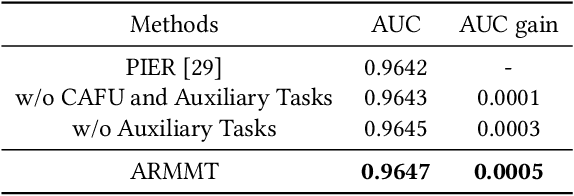
In the rapidly evolving field of e-commerce, the effectiveness of search re-ranking models is crucial for enhancing user experience and driving conversion rates. Despite significant advancements in feature representation and model architecture, the integration of multimodal information remains underexplored. This study addresses this gap by investigating the computation and fusion of textual and visual information in the context of re-ranking. We propose \textbf{A}dvancing \textbf{R}e-Ranking with \textbf{M}ulti\textbf{m}odal Fusion and \textbf{T}arget-Oriented Auxiliary Tasks (ARMMT), which integrates an attention-based multimodal fusion technique and an auxiliary ranking-aligned task to enhance item representation and improve targeting capabilities. This method not only enriches the understanding of product attributes but also enables more precise and personalized recommendations. Experimental evaluations on JD.com's search platform demonstrate that ARMMT achieves state-of-the-art performance in multimodal information integration, evidenced by a 0.22\% increase in the Conversion Rate (CVR), significantly contributing to Gross Merchandise Volume (GMV). This pioneering approach has the potential to revolutionize e-commerce re-ranking, leading to elevated user satisfaction and business growth.
Breaking the Hourglass Phenomenon of Residual Quantization: Enhancing the Upper Bound of Generative Retrieval
Jul 31, 2024

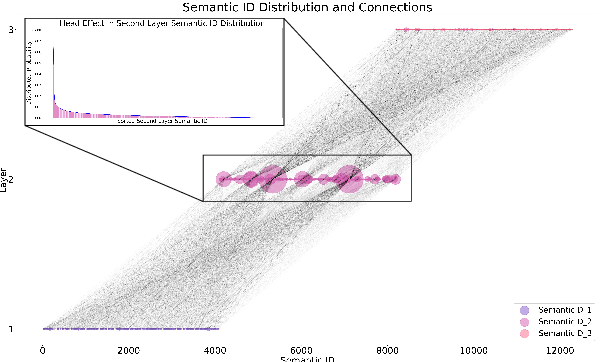

Generative retrieval (GR) has emerged as a transformative paradigm in search and recommender systems, leveraging numeric-based identifier representations to enhance efficiency and generalization. Notably, methods like TIGER employing Residual Quantization-based Semantic Identifiers (RQ-SID), have shown significant promise in e-commerce scenarios by effectively managing item IDs. However, a critical issue termed the "\textbf{Hourglass}" phenomenon, occurs in RQ-SID, where intermediate codebook tokens become overly concentrated, hindering the full utilization of generative retrieval methods. This paper analyses and addresses this problem by identifying data sparsity and long-tailed distribution as the primary causes. Through comprehensive experiments and detailed ablation studies, we analyze the impact of these factors on codebook utilization and data distribution. Our findings reveal that the "Hourglass" phenomenon substantially impacts the performance of RQ-SID in generative retrieval. We propose effective solutions to mitigate this issue, thereby significantly enhancing the effectiveness of generative retrieval in real-world E-commerce applications.
MODRL-TA:A Multi-Objective Deep Reinforcement Learning Framework for Traffic Allocation in E-Commerce Search
Jul 22, 2024


Traffic allocation is a process of redistributing natural traffic to products by adjusting their positions in the post-search phase, aimed at effectively fostering merchant growth, precisely meeting customer demands, and ensuring the maximization of interests across various parties within e-commerce platforms. Existing methods based on learning to rank neglect the long-term value of traffic allocation, whereas approaches of reinforcement learning suffer from balancing multiple objectives and the difficulties of cold starts within realworld data environments. To address the aforementioned issues, this paper propose a multi-objective deep reinforcement learning framework consisting of multi-objective Q-learning (MOQ), a decision fusion algorithm (DFM) based on the cross-entropy method(CEM), and a progressive data augmentation system(PDA). Specifically. MOQ constructs ensemble RL models, each dedicated to an objective, such as click-through rate, conversion rate, etc. These models individually determine the position of items as actions, aiming to estimate the long-term value of multiple objectives from an individual perspective. Then we employ DFM to dynamically adjust weights among objectives to maximize long-term value, addressing temporal dynamics in objective preferences in e-commerce scenarios. Initially, PDA trained MOQ with simulated data from offline logs. As experiments progressed, it strategically integrated real user interaction data, ultimately replacing the simulated dataset to alleviate distributional shifts and the cold start problem. Experimental results on real-world online e-commerce systems demonstrate the significant improvements of MODRL-TA, and we have successfully deployed MODRL-TA on an e-commerce search platform.