 Add to Chrome
 Add to Firefox
 Add to Edge
PlanCraft: Sketch, Refine, and Furnish for Architect-Inspired Progressive 3D Residential Scene Generation
Jul 26, 2026
Two structural insights have been overlooked in automated residential floor plan generation. First, design is inherently progressive. Architects begin with rough strokes and refine them over time, whereas existing methods typically require their conditioning representation to be fully specified before generation, a fundamental mismatch with how design actually works. Second, the 2D floor plan is not an optional intermediate but an irreplaceable spatial contract. Once room boundaries, doors, and windows are fixed, furnishing reduces from open-ended spatial reasoning to bounded constraint satisfaction. Bypassing this contract, as existing 3D systems do by delegating layout to language models, yields overlapping rooms and implausible proportions; directly calling general-purpose language models likewise produces geometrically invalid layouts. Guided by these insights, we present PlanCraft. SketchPlan supplies the missing training signal by replaying the architect's drawing process on 80K real floor plans, producing partial sketches at every completeness level. PlanCraft-Diff progressively sharpens an incomplete sketch into a geometrically precise, vectorizable floor plan through a coarse-to-fine strategy. With the spatial contract established, PlanCraft-Agent then furnishes the scene within well-defined room boundaries. Experiments show that PlanCraft achieves a 61.1\% lower FID than the best existing 2D method and surpasses existing 3D systems by 15 points in expert-rated spatial rationality, with a sketch at only 25\% completion already outperforming all fully specified baselines.

TopoAgent: A Self-Evolving Topological Agent for Multimodal Scientific Reasoning
Jul 16, 2026While Multimodal Large Language Models (MLLMs) excel in general tasks, rigorous scientific reasoning remains challenging due to the limitations of monolithic, linear planning. Such sequential designs often suffer from visual-semantic misalignment, long-context hallucinations, and brittle execution under fixed task granularity. We propose TopoAgent, a self-evolving topological framework that replaces linear trajectories with dynamic, state-isolated graph evolution. TopoAgent first employs a front-end decomposer to fracture complex queries into visually-grounded atoms. These atoms are organized into a Directed Acyclic Graph (DAG) based on their dependencies, enabling strict context isolation to shield the reasoning engine from irrelevant historical noise. Furthermore, we introduce adaptive atomic fission, which dynamically splits bottleneck nodes into finer-grained sub-atoms at runtime when tool capability boundaries are exceeded. Extensive experiments across mathematics, physics, and chemistry benchmarks demonstrate that TopoAgent significantly outperforms state-of-the-art linear agent frameworks, providing a robust, noise-resistant, and self-correcting paradigm for autonomous scientific reasoning.
Belief-reality separation lives in routing over a shared value slot in language models
Jul 11, 2026Capable language models hold what a character believes apart from what is true: told "Anna believes the cup is blue; in reality it is red," they answer blue about Anna and red about the world. Where in the computation does that separation live? We show it rests on two separable mechanisms at two positions. A generic value slot binds the attributed value. A router at the query position selects which frame, the character's belief or reality, a query reads out. Two routes fill the slot: an asserted belief, whose value the text supplies, binds in directly; a derived belief, whose value must be inferred from what the character could see, arrives by a visibility-gated lookback. A subspace trained on either route steers the other, and only the derived route depends on described visibility. The slot itself carries no belief-reality tag: intervening on it moves a reality readout as strongly as a belief one. The separation lives instead in a dissociated pair of routing subspaces, which flip a query between frames without injecting the donor's value. These results hold across three architectures, on stimuli de-confounded against theory-of-mind-benchmark shortcuts; the behavior itself emerges between 3B and 7B across five model families. This paper develops the single belief-reality axis in depth; a companion paper shows the same slot-and-router format is shared across the other non-actual contexts a sentence can open (counterfactual, fictional, temporal).
One mechanism for many mental spaces: a shared router over a value slot in language models
Jul 11, 2026Language builds discourse contexts other than the actual: a painting, a belief, a memory, a hypothetical. Each is a mental space in which the same entity can take a different value, as when a flower is red in reality but purple in a portrait. Formal semantics keeps these contexts apart because their logics differ (modal, temporal, doxastic, depictive); Fauconnier's mental-space theory treats them as one space-building operation. We ask which of these a transformer language model implements, and find a mechanistic version of Fauconnier's unification. The model uses one router/slot format across the inventory: a reusable value slot stores attributed content, and a causally manipulable router (the space index) selects which space is read. A subspace trained with Distributed Alignment Search to control one space type, counterfactual, belief, fictional, or temporal, also controls the others, well above a random floor, on three model families; belief, which formal semantics marks as a distinct case, is not specially separated. The router is low-rank, composes additively with entity identity, and acts through a few late-layer heads. Two further results show the mechanism drives inference and composes: a subspace trained on a rule-derived conclusion flips what the model infers while dissociating from what it reports, and composing space-builders mints a fresh router over the shared slot. This paper establishes the cross-type generality. A companion paper develops belief in depth, because of its special status in philosophy, psychology, and linguistics (epistemology, theory of mind, and propositional attitude reports).
OmniRefine: Alignment-Aware Cooperative Compression for Efficient Omnimodal Large Language Models
May 12, 2026Omnimodal large language models (Omni-LLMs) show strong capability in audio-video understanding, but their practical deployment remains limited by high inference cost of long video streams and dense audio sequences. Despite recent progress, existing compression methods for Omni-LLMs typically rely on fixed or native compression units, which can disrupt cross-modal correspondence and the complementary information required for audio-video reasoning, making it difficult to improve inference efficiency while stably preserving performance. To address this, we propose OmniRefine, a training-free two-stage framework for efficient audio-visual token compression in Omni-LLMs. First, Correspondence-Preserving Chunk Refinement refines native chunk boundaries into cross-modally aligned compression units through frame-audio similarity and dynamic programming. Second, Modality-Aware Cooperative Compression jointly compresses video and audio tokens within each refined unit to reduce redundancy while preserving critical evidence. Extensive experiments show that OmniRefine achieves a better efficiency-performance trade-off than strong baselines and maintains stable performance under lower compression ratios. On WorldSense, it still reaches 46.7% accuracy at a 44% token retention ratio, nearly matching the full-token baseline. The code and interface will be released to facilitate further research.
Diffusion Path Alignment for Long-Range Motion Generation and Domain Transitions
Mar 31, 2026Long-range human movement generation remains a central challenge in computer vision and graphics. Generating coherent transitions across semantically distinct motion domains remains largely unexplored. This capability is particularly important for applications such as dance choreography, where movements must fluidly transition across diverse stylistic and semantic motifs. We propose a simple and effective inference-time optimization framework inspired by diffusion-based stochastic optimal control. Specifically, a control-energy objective that explicitly regularizes the transition trajectories of a pretrained diffusion model. We show that optimizing this objective at inference time yields transitions with fidelity and temporal coherence. This is the first work to provide a general framework for controlled long-range human motion generation with explicit transition modeling.
FedGRPO: Privately Optimizing Foundation Models with Group-Relative Rewards from Domain Client
Feb 12, 2026One important direction of Federated Foundation Models (FedFMs) is leveraging data from small client models to enhance the performance of a large server-side foundation model. Existing methods based on model level or representation level knowledge transfer either require expensive local training or incur high communication costs and introduce unavoidable privacy risks. We reformulate this problem as a reinforcement learning style evaluation process and propose FedGRPO, a privacy preserving framework comprising two modules. The first module performs competence-based expert selection by building a lightweight confidence graph from auxiliary data to identify the most suitable clients for each question. The second module leverages the "Group Relative" concept from the Group Relative Policy Optimization (GRPO) framework by packaging each question together with its solution rationale into candidate policies, dispatching these policies to a selected subset of expert clients, and aggregating solely the resulting scalar reward signals via a federated group-relative loss function. By exchanging reward values instead of data or model updates, FedGRPO reduces privacy risk and communication overhead while enabling parallel evaluation across heterogeneous devices. Empirical results on diverse domain tasks demonstrate that FedGRPO achieves superior downstream accuracy and communication efficiency compared to conventional FedFMs baselines.
Backslash: Rate Constrained Optimized Training of Large Language Models
Apr 23, 2025The rapid advancement of large-language models (LLMs) has driven extensive research into parameter compression after training has been completed, yet compression during the training phase remains largely unexplored. In this work, we introduce Rate-Constrained Training (Backslash), a novel training-time compression approach based on rate-distortion optimization (RDO). Backslash enables a flexible trade-off between model accuracy and complexity, significantly reducing parameter redundancy while preserving performance. Experiments in various architectures and tasks demonstrate that Backslash can reduce memory usage by 60\% - 90\% without accuracy loss and provides significant compression gain compared to compression after training. Moreover, Backslash proves to be highly versatile: it enhances generalization with small Lagrange multipliers, improves model robustness to pruning (maintaining accuracy even at 80\% pruning rates), and enables network simplification for accelerated inference on edge devices.
Flow Intelligence: Robust Feature Matching via Temporal Signature Correlation
Apr 16, 2025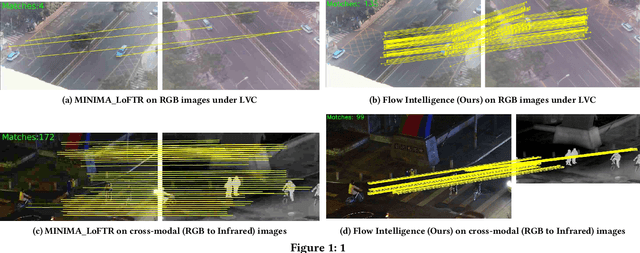
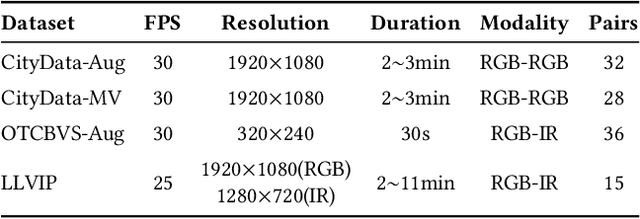

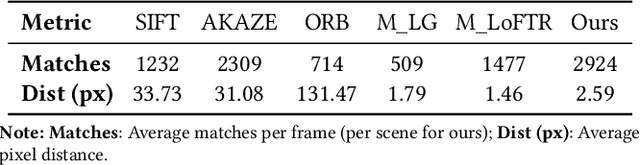
Feature matching across video streams remains a cornerstone challenge in computer vision. Increasingly, robust multimodal matching has garnered interest in robotics, surveillance, remote sensing, and medical imaging. While traditional rely on detecting and matching spatial features, they break down when faced with noisy, misaligned, or cross-modal data. Recent deep learning methods have improved robustness through learned representations, but remain constrained by their dependence on extensive training data and computational demands. We present Flow Intelligence, a paradigm-shifting approach that moves beyond spatial features by focusing on temporal motion patterns exclusively. Instead of detecting traditional keypoints, our method extracts motion signatures from pixel blocks across consecutive frames and extract temporal motion signatures between videos. These motion-based descriptors achieve natural invariance to translation, rotation, and scale variations while remaining robust across different imaging modalities. This novel approach also requires no pretraining data, eliminates the need for spatial feature detection, enables cross-modal matching using only temporal motion, and it outperforms existing methods in challenging scenarios where traditional approaches fail. By leveraging motion rather than appearance, Flow Intelligence enables robust, real-time video feature matching in diverse environments.
Efficient Video Neural Network Processing Based on Motion Estimation
Jan 25, 2025Video neural network (VNN) processing using the conventional pipeline first converts Bayer video information into human understandable RGB videos using image signal processing (ISP) on a pixel by pixel basis. Then, VNN processing is performed on a frame by frame basis. Both ISP and VNN are computationally expensive with high power consumption and latency. In this paper, we propose an efficient VNN processing framework. Instead of using ISP, computer vision tasks are directly accomplished using Bayer pattern information. To accelerate VNN processing, motion estimation is introduced to find temporal redundancies in input video data so as to avoid repeated and unnecessary computations. Experiments show greater than 67\% computation reduction, while maintaining computer vision task accuracy for typical computer vision tasks and data sets.