 Add to Chrome
 Add to Firefox
 Add to Edge
SKILLC: Learning Autonomous Skill Internalization in LLM Agents via Contrastive Credit Assignment
May 27, 2026
Structured skill prompts improve exploration in long-horizon agentic reinforcement learning (RL). Skill-augmented RL methods retain external skills at inference, while skill-internalization RL methods withdraw them during training to enable autonomous performance. However, existing internalization approaches only use skill-helpfulness contrast for curriculum control, leaving the policy update unchanged and unable to distinguish skill-dependent from autonomous success. We propose SkillC, a framework based on Contrastive Skill Credit Assignment (CSCA) that converts this contrast into a direct learning signal for internalization. \textsc{SkillC} samples paired skill-injected and skill-free rollouts for tasks from active skill types within the same policy update, and injects their task-level contrast into optimization via a dual-stream advantage estimator that preserves global ranking while applying a one-sided correction toward skill-free success. A smoothed validation-level signal further drives an adaptive curriculum over attribution strength, rollout allocation, and monotonic active-set pruning. Experiments on ALFWorld and WebShop show that, without runtime skill access, SkillC surpasses the strongest prior skill-internalization RL baseline by 5.5\% and 4.4\%, respectively, while remaining competitive with skill-augmented RL methods.

When the Majority Votes Wrong, the Intervention Timing for Test-Time Reinforcement Learning Hides in the Extinction Window
May 19, 2026Test-time reinforcement learning (TTRL) reports substantial accuracy gains on mathematical reasoning benchmarks using majority vote as a pseudo-label signal. We argue these gains are systematically misinterpreted: most reflect sharpening of already-solvable problems rather than genuine learning, while problems corrupted from correct to incorrect outnumber truly learned ones, and this damage is irreversible once majority vote locks onto a wrong answer. Per-problem tracking reveals that correct-answer signals in low-ability problems are briefly active before being permanently suppressed, a phenomenon we term the \textit{Correct-Answer Extinction Window}, with Flip Rate (FR) as its leading indicator. We thus propose \textbf{TTRL-Guard}, a lightweight framework with three mechanisms targeting the extinction window: Flip-Rate-Aware Reward Scaling (FRS) down-weights at-risk updates as FR declines, Minority-Preserving Sampling (MPS) retains gradient signal from minority correct answers, and Risk-Conditioned Sparse Updatings (RCSU) suspends updates on polarized problems. Experiments across three models and four benchmarks show that TTRL-Guard achieves the best average pass@1 on Qwen2.5-7B-Instruct and Qwen3-4B, improves relatively over TTRL by +54\% on AIME 2025. \footnote{Our code and implementation details are available at https://github.com/linhxkkkk/TTRL-Guard.
Breaking the Hourglass Phenomenon of Residual Quantization: Enhancing the Upper Bound of Generative Retrieval
Jul 31, 2024

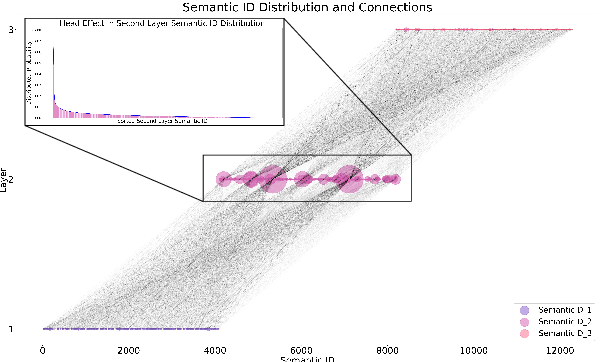

Generative retrieval (GR) has emerged as a transformative paradigm in search and recommender systems, leveraging numeric-based identifier representations to enhance efficiency and generalization. Notably, methods like TIGER employing Residual Quantization-based Semantic Identifiers (RQ-SID), have shown significant promise in e-commerce scenarios by effectively managing item IDs. However, a critical issue termed the "\textbf{Hourglass}" phenomenon, occurs in RQ-SID, where intermediate codebook tokens become overly concentrated, hindering the full utilization of generative retrieval methods. This paper analyses and addresses this problem by identifying data sparsity and long-tailed distribution as the primary causes. Through comprehensive experiments and detailed ablation studies, we analyze the impact of these factors on codebook utilization and data distribution. Our findings reveal that the "Hourglass" phenomenon substantially impacts the performance of RQ-SID in generative retrieval. We propose effective solutions to mitigate this issue, thereby significantly enhancing the effectiveness of generative retrieval in real-world E-commerce applications.