 Add to Chrome
 Add to Firefox
 Add to Edge
MoCRA: Mixture of Compositional Rank-1 Atoms for 4K All-in-One Video Restoration
Aug 03, 2026
Real-world video arrives hazy, rainy, dark, or noisy, and a deployable restorer faces three demands at once: no degradation label, native 4K output, and stability in playback. Existing methods answer them separately and break on the joint problem, because per-frame degradation readings flip between frames, downsampled proxies erase the rain and noise they are meant to remove, and dense temporal alignment does not fit 4K memory. No paired benchmark even poses that problem, so we build one. UHV-4K-AIO renders physically modeled haze, rain, sensor noise, and low light over the same 100 clean 4K clips with shared depth and motion, and its construction exposes the split MoCRA is built on: haze and low light survive aggressive downsampling, while rain and noise exist only at native scale. Band-matched compositional conditioning follows, spending conditioning capacity, computation, and supervision in the band where each degradation lives. One dictionary of rank-1 atoms, recomposed sparsely per frame, conditions both a once-per-clip coarse branch and a shallow native-resolution refiner, in 3.6M parameters and with no optical flow. Trained once for all four tasks, MoCRA takes the best task-mean PSNR of eleven retrained image and video baselines, holds warping error at the level of the flow-based video models while never estimating motion, and restores native 4K in under half a second, against 1.7 seconds for the fastest baseline.

Loop-Mamba: A Loop Mamba with Degradation-Aware and Shared Memory for Old Photo Restoration
Aug 03, 2026Old photographs often suffer from multiple coupled degradations, including scratches, cracks, fading, blur, noise, and missing regions, severely degrading both visual quality and semantic content. We propose Loop-Mamba, a lightweight loop-based state-space framework that formulates old photo restoration as progressive state evolution, where a persis- tent restoration state is continuously propagated and refined through iterative computation. Specifically, we introduce a Semantic-Guided Degradation Estimator (SGDE) to explicitly model heterogeneous degradations by jointly predicting local degradation maps and global degradation scores, providing degradation-aware guidance for state evolution. We further develop a Shared Structural Memory Mamba (S$^2$M- Mamba), which maintains a persistent restoration state across iterations, enabling persistent state evolution through shared structural memory for robust long-range structural reconstruction. Benefiting from first-order state recursion, Loop-Mamba propagates latent restoration states through recurrent tran- sitions instead of repeatedly stacking deep feature transformations, thereby alleviating gradient dilution while avoiding the computational overhead inherent in iterative CNN- and Transformer-based restoration frameworks. A lightweight multi-directional scanning strategy further enhances direc- tional information aggregation and preserves structural continuity. To better evaluate restoration quality, we introduce the task-oriented Old Photo Damage Recovery Score (ODRS), which jointly measures degradation recovery and structural reconstruction fidelity. Experimental results on the public SynOld benchmark demonstrate that Loop-Mamba consistently outperforms previous state-of-the-art methods across both conventional restoration metrics and the proposed ODRS.
RPBA-Net: An Interpretable Residual Pyramid Bilateral Affine Network for RAW-Domain ISP Enhancement
May 05, 2026To address module fragmentation, uninterpretable mappings, and deployment constraints in RAW-domain demosaicing, color correction, and detail enhancement, this paper proposes RPBA-Net, an interpretable residual pyramid bilateral affine network for RAW-domain ISP enhancement. Given packed RAW as input, the method performs residual affine base reconstruction by estimating a base RGB representation and learning identity-guided residual affine corrections, thereby unifying demosaicing and enhancement. It further builds pyramid bilateral affine grids and combines guide-driven autoregressive adaptive slicing with adaptive cross-layer fusion to hierarchically model global tone restoration and local texture enhancement. In addition, smoothness, cross-scale consistency, and magnitude regularization terms are introduced to improve model stability, controllability, and structural interpretability. Extensive experiments demonstrate that RPBA-Net surpasses representative RAW-to-sRGB methods and achieves state-of-the-art performance in reconstruction fidelity and perceptual quality, while maintaining low model complexity and strong deployment potential for mobile and embedded platforms.
Learn Weightlessness: Imitate Non-Self-Stabilizing Motions on Humanoid Robot
Apr 23, 2026The integration of imitation and reinforcement learning has enabled remarkable advances in humanoid whole-body control, facilitating diverse human-like behaviors. However, research on environment-dependent motions remains limited. Existing methods typically enforce rigid trajectory tracking while neglecting physical interactions with the environment. We observe that humans naturally exploit a "weightless" state during non-self-stabilizing (NSS) motions--selectively relaxing specific joints to allow passive body--environment contact, thereby stabilizing the body and completing the motion. Inspired by this biological mechanism, we design a weightlessness-state auto-labeling strategy for dataset annotation; and we propose the Weightlessness Mechanism (WM), a method that dynamically determines which joints to relax and to what level, together enabling effective environmental interaction while executing target motions. We evaluate our approach on 3 representative NSS tasks: sitting on chairs of varying heights, lying down on beds with different inclinations, and leaning against walls via shoulder or elbow. Extensive experiments in simulation and on the Unitree G1 robot demonstrate that our WM method, trained on single-action demonstrations without any task-specific tuning, achieves strong generalization across diverse environmental configurations while maintaining motion stability. Our work bridges the gap between precise trajectory tracking and adaptive environmental interaction, offering a biologically-inspired solution for contact-rich humanoid control.
RPG: Robust Policy Gating for Smooth Multi-Skill Transitions in Humanoid Fighting
Apr 23, 2026Humanoid robots have demonstrated impressive motor skills in a wide range of tasks, yet whole-body control for humanlike long-time, dynamic fighting remains particularly challenging due to the stringent requirements on agility and stability. While imitation learning enables robots to execute human-like fighting skills, existing approaches often rely on switching among multiple single-skill policies or employing a general policy to imitate input reference motions. These strategies suffer from instability when transitioning between skills, as the mismatch of initial and terminal states across skills or reference motions introduces out-of-domain disturbances, resulting in unsmooth or unstable behaviors. In this work, we propose RPG, a hybrid expert policy framework, for smooth and stable humanoid multi-skills transition. Our approach incorporates motion transition randomization and temporal randomization to train a unified policy that generates agile fighting actions with stability and smoothness during skill transitions. Furthermore, we design a control pipeline that integrates walking/running locomotion with fighting skills, allowing humanlike long-time combat of arbitrary duration that can be seamlessly interrupted or transit action policies at any time. Extensive experiments in simulation demonstrate the effectiveness of the proposed framework, and real-world deployment on the Unitree G1 humanoid robot further validates its robustness and applicability.
UHD Image Deblurring via Autoregressive Flow with Ill-conditioned Constraints
Mar 11, 2026Ultra-high-definition (UHD) image deblurring poses significant challenges for UHD restoration methods, which must balance fine-grained detail recovery and practical inference efficiency. Although prominent discriminative and generative methods have achieved remarkable results, a trade-off persists between computational cost and the ability to generate fine-grained detail for UHD image deblurring tasks. To further alleviate these issues, we propose a novel autoregressive flow method for UHD image deblurring with an ill-conditioned constraint. Our core idea is to decompose UHD restoration into a progressive, coarse-to-fine process: at each scale, the sharp estimate is formed by upsampling the previous-scale result and adding a current-scale residual, enabling stable, stage-wise refinement from low to high resolution. We further introduce Flow Matching to model residual generation as a conditional vector field and perform few-step ODE sampling with efficient Euler/Heun solvers, enriching details while keeping inference affordable. Since multi-step generation at UHD can be numerically unstable, we propose an ill-conditioning suppression scheme by imposing condition-number regularization on a feature-induced attention matrix, improving convergence and cross-scale consistency. Our method demonstrates promising performance on blurred images at 4K (3840$\times$2160) or higher resolutions.
ZeroWBC: Learning Natural Visuomotor Humanoid Control Directly from Human Egocentric Video
Mar 10, 2026Achieving versatile and naturalistic whole-body control for humanoid robot scene-interaction remains a significant challenge. While some recent works have demonstrated autonomous humanoid interactive control, they are constrained to rigid locomotion patterns and expensive teleoperation data collection, lacking the versatility to execute more human-like natural behaviors such as sitting or kicking. Furthermore, acquiring the necessary real robot teleoperation data is prohibitively expensive and time-consuming. To address these limitations, we introduce ZeroWBC, a novel framework that learns a natural humanoid visuomotor control policy directly from human egocentric videos, eliminating the need for large-scale robot teleoperation data and enabling natural humanoid robot scene-interaction control. Specifically, our approach first fine-tunes a Vision-Language Model (VLM) to predict future whole-body human motions based on text instructions and egocentric visual context, then these generated motions are retargeted to real robot joints and executed via our robust general motion tracking policy for humanoid whole-body control. Extensive experiments on the Unitree G1 humanoid robot demonstrate that our method outperforms baseline approaches in motion naturalness and versatility, successfully establishing a pipeline that eliminates teleoperation data collection overhead for whole-body humanoid control, offering a scalable and efficient paradigm for general humanoid whole-body control.
FOSP: Fine-tuning Offline Safe Policy through World Models
Jul 06, 2024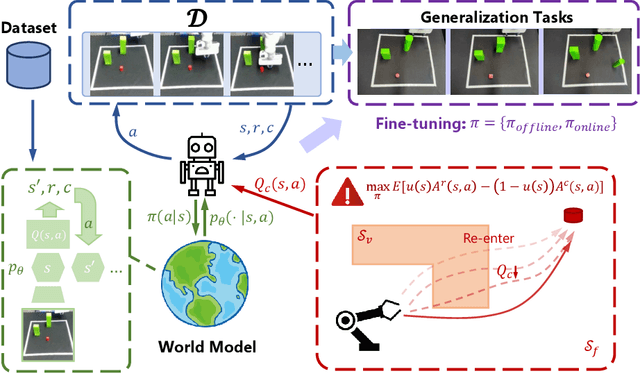
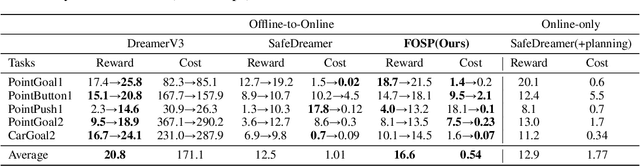
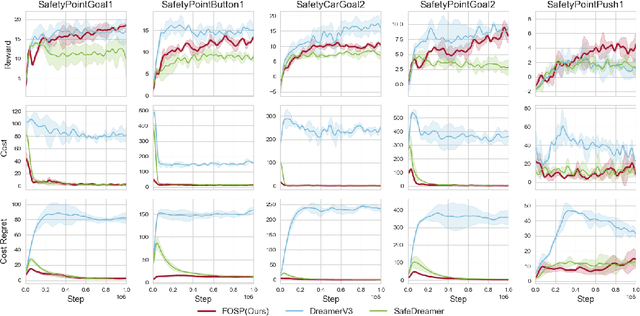
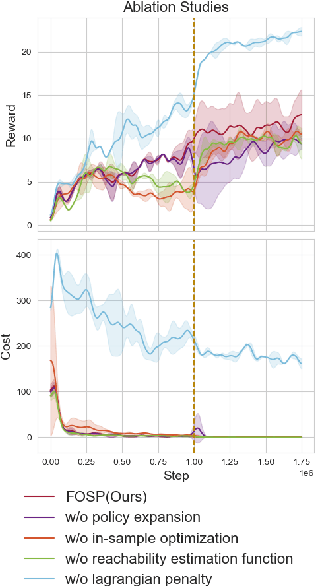
Model-based Reinforcement Learning (RL) has shown its high training efficiency and capability of handling high-dimensional tasks. Regarding safety issues, safe model-based RL can achieve nearly zero-cost performance and effectively manage the trade-off between performance and safety. Nevertheless, prior works still pose safety challenges due to the online exploration in real-world deployment. To address this, some offline RL methods have emerged as solutions, which learn from a static dataset in a safe way by avoiding interactions with the environment. In this paper, we aim to further enhance safety during the deployment stage for vision-based robotic tasks by fine-tuning an offline-trained policy. We incorporate in-sample optimization, model-based policy expansion, and reachability guidance to construct a safe offline-to-online framework. Moreover, our method proves to improve the generalization of offline policy in unseen safety-constrained scenarios. Finally, the efficiency of our method is validated on simulation benchmarks with five vision-only tasks and a real robot by solving some deployment problems using limited data.