 Add to Chrome
 Add to Firefox
 Add to Edge
DyFrDet: Towards Accurate Small Object Detection via Dynamic Frequency Suppression with Label Disambiguation
Aug 03, 2026
Despite the remarkable progress over the past decades, accurately identifying small objects remains challenging because of their insufficient visual cues. Previous works typically attempt to construct discriminative representation of the small objects. However, the wide range frequency domain noises and label ambiguities have been greatly overlooked, which significantly hinders the accurate localization. To address these issues, we propose a novel small object detection (SOD) detector termed DyFrDet, which is able to precisely localize the small object by dynamically suppressing the background distractions in frequency domain. Specifically, we propose a Dynamic Frequency-aware Feature Pyramid Network (DyFrFPN) to adaptively suppress low-frequency redundancy and excessive high-frequency noises. The DyFrFPN transforms the hierarchical features into frequency domain representation, and introduces a Dynamic Band Predictor (DBP) to preserve the discriminative components for small object identification. Afterwards, we present a novel Label Disambiguation Module (LDM), which leverages probabilistic distributions to explicitly model and alleviate the inherent ambiguity of target labels, yielding efficient improvement in localization precision of the small objects with low-resolution. Extensive experiments demonstrate that DyFrDet achieves state-of-the-art performance across multiple benchmarks, indicating its effectiveness and robustness in various challenging scenarios. Our code is available at https://github.com/ManOfStory/DyFrDet.

Emerging Flexible Designs for Geospatial Multimodal Foundation Models
Jun 10, 2026Foundation models are rapidly transforming Earth observation by enabling scalable pretraining across diverse unlabeled geospatial modalities. However, their architectural diversity ranging from encoder-only to encoder-decoder and masked autoencoding paradigms makes it challenging to assess performance trade offs in a consistent manner. In this work, we present an apples-to-apples comparison of leading FM architectures designed for geospatial multimodal reasoning, with a particular focus on flexibility across varied spectral band configurations. We standardize pretraining using identical self supervised learning objectives and training datasets, and evaluate all models under consistent parameterization on the GEOBench benchmark across classification and segmentation tasks. Our results offer new insights into the design trade-offs between model flexibility, modality alignment, and downstream task performance. By highlighting architectural strengths and limitations under controlled conditions, this study provides practical guidance for building next generation geospatial foundation models capable of robust multimodal reasoning.
Physical probes expose and alleviate chemical-environment collapse in molecular representations
May 11, 2026Nuclear magnetic resonance (NMR) spectroscopy provides an experimental readout of local chemical environments, but its use in molecular representation learning has been constrained by heterogeneous data and incomplete atom-level assignments. Here we construct complementary high-fidelity experimental and computational 13C NMR resources, which reveal a recurrent form of representational collapse: atoms that are equivalent in molecular topology can remain experimentally distinct in their real chemical environments, whereas explicit 3D descriptions are further limited by static conformations in dynamic regimes. To alleviate this bottleneck, we develop CLAIM (Contrastive Learning for Atom-to-molecule Inference of Molecular NMR), a framework that aligns efficient topological molecular inputs with atom-resolved NMR observables. Through hierarchical chemical priors and cross-level contrastive learning, CLAIM restores lost chemical resolution and markedly improves atom-level molecule-spectrum retrieval. CLAIM remains robust in flexible and tautomeric systems for 13C NMR prediction, improves stereoisomer discrimination without explicit 3D modelling, and transfers to broader molecular property tasks including ADMET prediction and fluorescence estimation. These results establish physically grounded spectral alignment as an effective strategy for alleviating chemical-environment collapse and for guiding experimentally grounded molecular representation learning.
Towards Adaptive Humanoid Control via Multi-Behavior Distillation and Reinforced Fine-Tuning
Nov 11, 2025Humanoid robots are promising to learn a diverse set of human-like locomotion behaviors, including standing up, walking, running, and jumping. However, existing methods predominantly require training independent policies for each skill, yielding behavior-specific controllers that exhibit limited generalization and brittle performance when deployed on irregular terrains and in diverse situations. To address this challenge, we propose Adaptive Humanoid Control (AHC) that adopts a two-stage framework to learn an adaptive humanoid locomotion controller across different skills and terrains. Specifically, we first train several primary locomotion policies and perform a multi-behavior distillation process to obtain a basic multi-behavior controller, facilitating adaptive behavior switching based on the environment. Then, we perform reinforced fine-tuning by collecting online feedback in performing adaptive behaviors on more diverse terrains, enhancing terrain adaptability for the controller. We conduct experiments in both simulation and real-world experiments in Unitree G1 robots. The results show that our method exhibits strong adaptability across various situations and terrains. Project website: https://ahc-humanoid.github.io.
Adaptive Graph Learning with Transformer for Multi-Reservoir Inflow Prediction
Nov 10, 2025Reservoir inflow prediction is crucial for water resource management, yet existing approaches mainly focus on single-reservoir models that ignore spatial dependencies among interconnected reservoirs. We introduce AdaTrip as an adaptive, time-varying graph learning framework for multi-reservoir inflow forecasting. AdaTrip constructs dynamic graphs where reservoirs are nodes with directed edges reflecting hydrological connections, employing attention mechanisms to automatically identify crucial spatial and temporal dependencies. Evaluation on thirty reservoirs in the Upper Colorado River Basin demonstrates superiority over existing baselines, with improved performance for reservoirs with limited records through parameter sharing. Additionally, AdaTrip provides interpretable attention maps at edge and time-step levels, offering insights into hydrological controls to support operational decision-making. Our code is available at https://github.com/humphreyhuu/AdaTrip.
Decoding Memories: An Efficient Pipeline for Self-Consistency Hallucination Detection
Aug 28, 2025Large language models (LLMs) have demonstrated impressive performance in both research and real-world applications, but they still struggle with hallucination. Existing hallucination detection methods often perform poorly on sentence-level generation or rely heavily on domain-specific knowledge. While self-consistency approaches help address these limitations, they incur high computational costs due to repeated generation. In this paper, we conduct the first study on identifying redundancy in self-consistency methods, manifested as shared prefix tokens across generations, and observe that non-exact-answer tokens contribute minimally to the semantic content. Based on these insights, we propose a novel Decoding Memory Pipeline (DMP) that accelerates generation through selective inference and annealed decoding. Being orthogonal to the model, dataset, decoding strategy, and self-consistency baseline, our DMP consistently improves the efficiency of multi-response generation and holds promise for extension to alignment and reasoning tasks. Extensive experiments show that our method achieves up to a 3x speedup without sacrificing AUROC performance.
Distributed Cross-Channel Hierarchical Aggregation for Foundation Models
Jun 26, 2025Vision-based scientific foundation models hold significant promise for advancing scientific discovery and innovation. This potential stems from their ability to aggregate images from diverse sources such as varying physical groundings or data acquisition systems and to learn spatio-temporal correlations using transformer architectures. However, tokenizing and aggregating images can be compute-intensive, a challenge not fully addressed by current distributed methods. In this work, we introduce the Distributed Cross-Channel Hierarchical Aggregation (D-CHAG) approach designed for datasets with a large number of channels across image modalities. Our method is compatible with any model-parallel strategy and any type of vision transformer architecture, significantly improving computational efficiency. We evaluated D-CHAG on hyperspectral imaging and weather forecasting tasks. When integrated with tensor parallelism and model sharding, our approach achieved up to a 75% reduction in memory usage and more than doubled sustained throughput on up to 1,024 AMD GPUs on the Frontier Supercomputer.
ORBIT-2: Scaling Exascale Vision Foundation Models for Weather and Climate Downscaling
May 07, 2025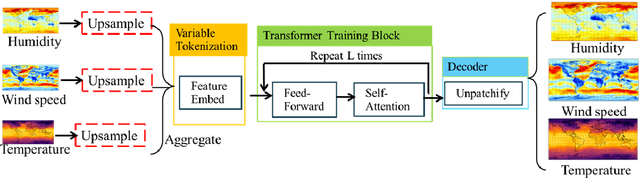
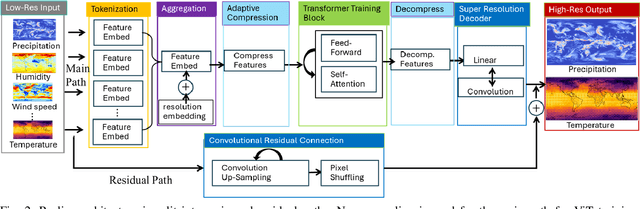
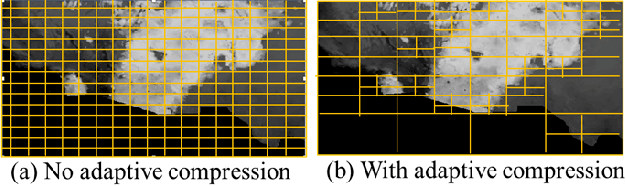
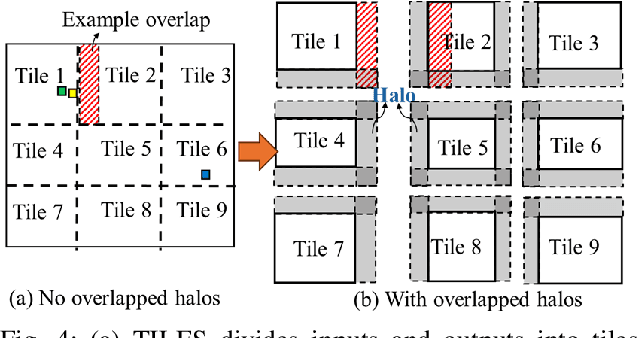
Sparse observations and coarse-resolution climate models limit effective regional decision-making, underscoring the need for robust downscaling. However, existing AI methods struggle with generalization across variables and geographies and are constrained by the quadratic complexity of Vision Transformer (ViT) self-attention. We introduce ORBIT-2, a scalable foundation model for global, hyper-resolution climate downscaling. ORBIT-2 incorporates two key innovations: (1) Residual Slim ViT (Reslim), a lightweight architecture with residual learning and Bayesian regularization for efficient, robust prediction; and (2) TILES, a tile-wise sequence scaling algorithm that reduces self-attention complexity from quadratic to linear, enabling long-sequence processing and massive parallelism. ORBIT-2 scales to 10 billion parameters across 32,768 GPUs, achieving up to 1.8 ExaFLOPS sustained throughput and 92-98% strong scaling efficiency. It supports downscaling to 0.9 km global resolution and processes sequences up to 4.2 billion tokens. On 7 km resolution benchmarks, ORBIT-2 achieves high accuracy with R^2 scores in the range of 0.98 to 0.99 against observation data.
GenAI4UQ: A Software for Inverse Uncertainty Quantification Using Conditional Generative Models
Dec 09, 2024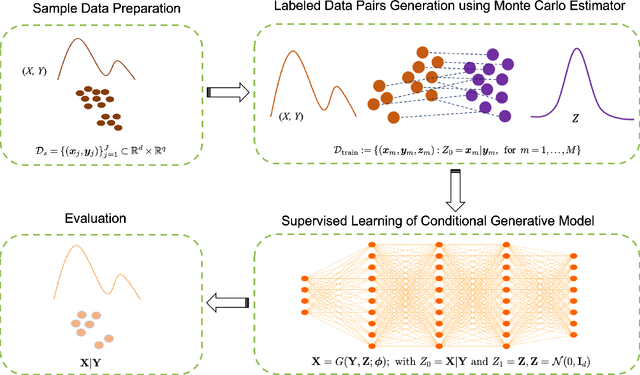
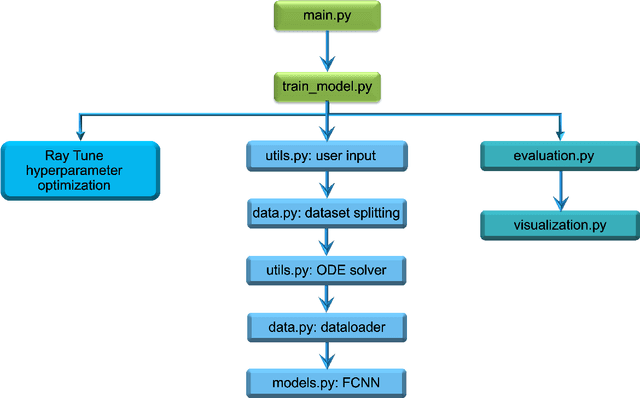
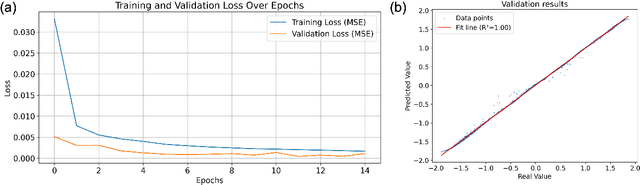

We introduce GenAI4UQ, a software package for inverse uncertainty quantification in model calibration, parameter estimation, and ensemble forecasting in scientific applications. GenAI4UQ leverages a generative artificial intelligence (AI) based conditional modeling framework to address the limitations of traditional inverse modeling techniques, such as Markov Chain Monte Carlo methods. By replacing computationally intensive iterative processes with a direct, learned mapping, GenAI4UQ enables efficient calibration of model input parameters and generation of output predictions directly from observations. The software's design allows for rapid ensemble forecasting with robust uncertainty quantification, while maintaining high computational and storage efficiency. GenAI4UQ simplifies the model training process through built-in auto-tuning of hyperparameters, making it accessible to users with varying levels of expertise. Its conditional generative framework ensures versatility, enabling applicability across a wide range of scientific domains. At its core, GenAI4UQ transforms the paradigm of inverse modeling by providing a fast, reliable, and user-friendly solution. It empowers researchers and practitioners to quickly estimate parameter distributions and generate model predictions for new observations, facilitating efficient decision-making and advancing the state of uncertainty quantification in computational modeling. (The code and data are available at https://github.com/patrickfan/GenAI4UQ).
Recommendations for Comprehensive and Independent Evaluation of Machine Learning-Based Earth System Models
Oct 24, 2024Machine learning (ML) is a revolutionary technology with demonstrable applications across multiple disciplines. Within the Earth science community, ML has been most visible for weather forecasting, producing forecasts that rival modern physics-based models. Given the importance of deepening our understanding and improving predictions of the Earth system on all time scales, efforts are now underway to develop forecasting models into Earth-system models (ESMs), capable of representing all components of the coupled Earth system (or their aggregated behavior) and their response to external changes. Modeling the Earth system is a much more difficult problem than weather forecasting, not least because the model must represent the alternate (e.g., future) coupled states of the system for which there are no historical observations. Given that the physical principles that enable predictions about the response of the Earth system are often not explicitly coded in these ML-based models, demonstrating the credibility of ML-based ESMs thus requires us to build evidence of their consistency with the physical system. To this end, this paper puts forward five recommendations to enhance comprehensive, standardized, and independent evaluation of ML-based ESMs to strengthen their credibility and promote their wider use.