 Add to Chrome
 Add to Firefox
 Add to Edge
Loop-Mamba: A Loop Mamba with Degradation-Aware and Shared Memory for Old Photo Restoration
Aug 03, 2026
Old photographs often suffer from multiple coupled degradations, including scratches, cracks, fading, blur, noise, and missing regions, severely degrading both visual quality and semantic content. We propose Loop-Mamba, a lightweight loop-based state-space framework that formulates old photo restoration as progressive state evolution, where a persis- tent restoration state is continuously propagated and refined through iterative computation. Specifically, we introduce a Semantic-Guided Degradation Estimator (SGDE) to explicitly model heterogeneous degradations by jointly predicting local degradation maps and global degradation scores, providing degradation-aware guidance for state evolution. We further develop a Shared Structural Memory Mamba (S$^2$M- Mamba), which maintains a persistent restoration state across iterations, enabling persistent state evolution through shared structural memory for robust long-range structural reconstruction. Benefiting from first-order state recursion, Loop-Mamba propagates latent restoration states through recurrent tran- sitions instead of repeatedly stacking deep feature transformations, thereby alleviating gradient dilution while avoiding the computational overhead inherent in iterative CNN- and Transformer-based restoration frameworks. A lightweight multi-directional scanning strategy further enhances direc- tional information aggregation and preserves structural continuity. To better evaluate restoration quality, we introduce the task-oriented Old Photo Damage Recovery Score (ODRS), which jointly measures degradation recovery and structural reconstruction fidelity. Experimental results on the public SynOld benchmark demonstrate that Loop-Mamba consistently outperforms previous state-of-the-art methods across both conventional restoration metrics and the proposed ODRS.

MoCRA: Mixture of Compositional Rank-1 Atoms for 4K All-in-One Video Restoration
Aug 03, 2026Real-world video arrives hazy, rainy, dark, or noisy, and a deployable restorer faces three demands at once: no degradation label, native 4K output, and stability in playback. Existing methods answer them separately and break on the joint problem, because per-frame degradation readings flip between frames, downsampled proxies erase the rain and noise they are meant to remove, and dense temporal alignment does not fit 4K memory. No paired benchmark even poses that problem, so we build one. UHV-4K-AIO renders physically modeled haze, rain, sensor noise, and low light over the same 100 clean 4K clips with shared depth and motion, and its construction exposes the split MoCRA is built on: haze and low light survive aggressive downsampling, while rain and noise exist only at native scale. Band-matched compositional conditioning follows, spending conditioning capacity, computation, and supervision in the band where each degradation lives. One dictionary of rank-1 atoms, recomposed sparsely per frame, conditions both a once-per-clip coarse branch and a shallow native-resolution refiner, in 3.6M parameters and with no optical flow. Trained once for all four tasks, MoCRA takes the best task-mean PSNR of eleven retrained image and video baselines, holds warping error at the level of the flow-based video models while never estimating motion, and restores native 4K in under half a second, against 1.7 seconds for the fastest baseline.
6thGrid-Net: Unified Remote Sensing Image Dehazing Based on Color Restoration and Edge-Preserving
Apr 27, 2026Remote sensing images are frequently degraded by adverse weather conditions, particularly clouds and haze, which severely impair downstream applications. Existing restoration methods typically rely on computationally heavy architectures or sequential pipelines (e.g., detail enhancement followed by color rendition) that suffer from mutual interference and artifact accumulation. Furthermore, recent unified grid-based approaches utilize fixed, isotropic interpolation kernels, neglecting the intrinsic low-dimensional manifold of natural images and inevitably causing edge blur. To address these limitations, we propose 6th Grid-Net, a highly efficient and unified remote sensing image restoration framework tailored for resource-constrained edge devices. Specifically, we construct a novel six-dimensional fusion tensor that seamlessly integrates the color rendition capabilities of 3D LUTs with the spatial-luminance detail preservation of bilateral grids. To overcome the drawbacks of standard trilinear interpolation, we introduce a manifold-adaptive high-dimensional sampling mechanism. This mechanism dynamically adjusts the interpolation kernel based on local edge orientation, texture strength, and color similarity, enabling simultaneous global color stylization and local edge refinement in a single forward pass. Additionally, an edge-aware grid smoothing constraint and dynamic quantization are incorporated to suppress ghosting artifacts and significantly compress the model size. Extensive experiments on multiple benchmark datasets demonstrate that 6th Grid-Net achieves state-of-the-art restoration quality across various degradation scenarios.
SCC-YOLO: An Improved Object Detector for Assisting in Brain Tumor Diagnosis
Jan 07, 2025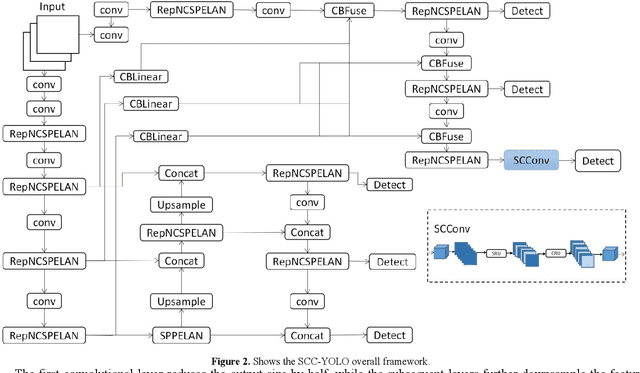
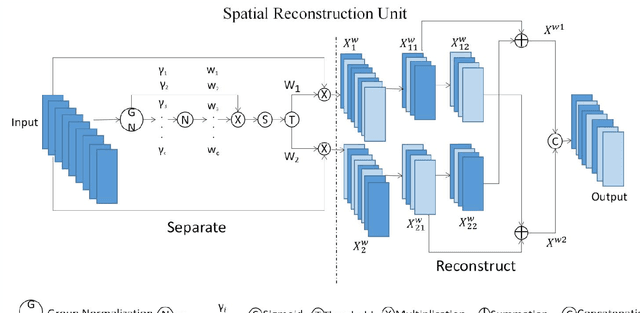

Brain tumors can result in neurological dysfunction, alterations in cognitive and psychological states, increased intracranial pressure, and the occurrence of seizures, thereby presenting a substantial risk to human life and health. The You Only Look Once(YOLO) series models have demonstrated superior accuracy in object detection for medical imaging. In this paper, we develop a novel SCC-YOLO architecture by integrating the SCConv attention mechanism into YOLOv9. The SCConv module reconstructs an efficient convolutional module by reducing spatial and channel redundancy among features, thereby enhancing the learning of image features. We investigate the impact of intergrating different attention mechanisms with the YOLOv9 model on brain tumor image detection using both the Br35H dataset and our self-made dataset(Brain_Tumor_Dataset). Experimental results show that on the Br35H dataset, SCC-YOLO achieved a 0.3% improvement in mAp50 compared to YOLOv9, while on our self-made dataset, SCC-YOLO exhibited a 0.5% improvement over YOLOv9. SCC-YOLO has reached state-of-the-art performance in brain tumor detection. Source code is available at : https://jihulab.com/healthcare-information-studio/SCC-YOLO/-/tree/master