 Add to Chrome
 Add to Firefox
 Add to Edge
ManiWAV: Learning Robot Manipulation from In-the-Wild Audio-Visual Data
Jun 27, 2024
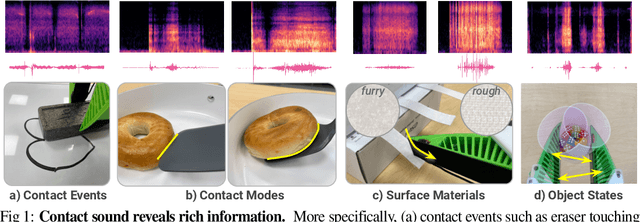
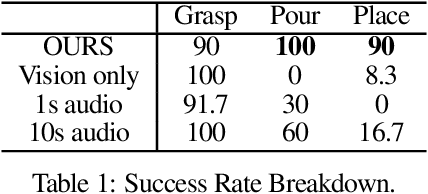
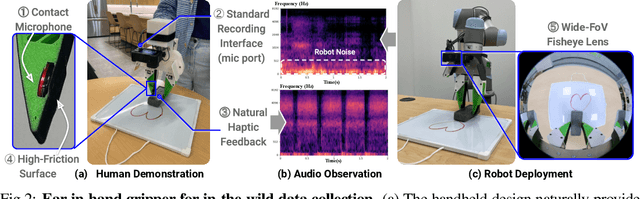
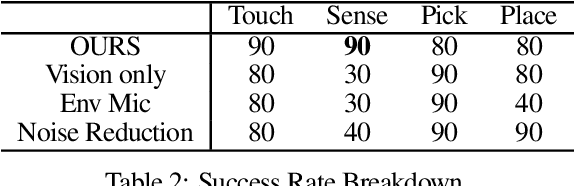
Audio signals provide rich information for the robot interaction and object properties through contact. These information can surprisingly ease the learning of contact-rich robot manipulation skills, especially when the visual information alone is ambiguous or incomplete. However, the usage of audio data in robot manipulation has been constrained to teleoperated demonstrations collected by either attaching a microphone to the robot or object, which significantly limits its usage in robot learning pipelines. In this work, we introduce ManiWAV: an 'ear-in-hand' data collection device to collect in-the-wild human demonstrations with synchronous audio and visual feedback, and a corresponding policy interface to learn robot manipulation policy directly from the demonstrations. We demonstrate the capabilities of our system through four contact-rich manipulation tasks that require either passively sensing the contact events and modes, or actively sensing the object surface materials and states. In addition, we show that our system can generalize to unseen in-the-wild environments, by learning from diverse in-the-wild human demonstrations. Project website: https://mani-wav.github.io/

Dreamitate: Real-World Visuomotor Policy Learning via Video Generation
Jun 24, 2024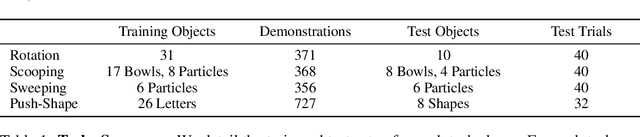


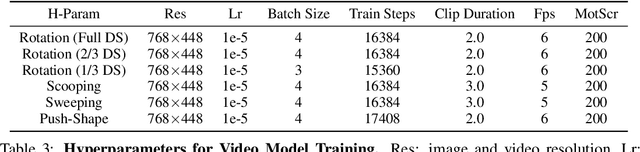
A key challenge in manipulation is learning a policy that can robustly generalize to diverse visual environments. A promising mechanism for learning robust policies is to leverage video generative models, which are pretrained on large-scale datasets of internet videos. In this paper, we propose a visuomotor policy learning framework that fine-tunes a video diffusion model on human demonstrations of a given task. At test time, we generate an example of an execution of the task conditioned on images of a novel scene, and use this synthesized execution directly to control the robot. Our key insight is that using common tools allows us to effortlessly bridge the embodiment gap between the human hand and the robot manipulator. We evaluate our approach on four tasks of increasing complexity and demonstrate that harnessing internet-scale generative models allows the learned policy to achieve a significantly higher degree of generalization than existing behavior cloning approaches.
DataComp-LM: In search of the next generation of training sets for language models
Jun 18, 2024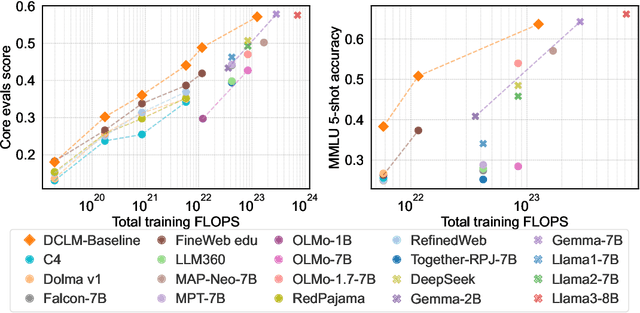

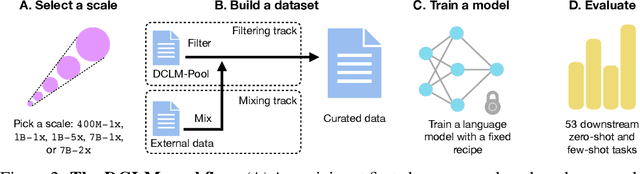
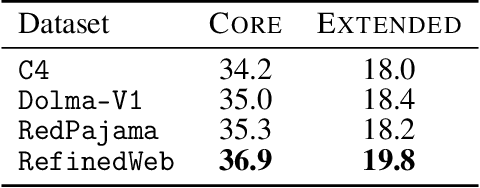
We introduce DataComp for Language Models (DCLM), a testbed for controlled dataset experiments with the goal of improving language models. As part of DCLM, we provide a standardized corpus of 240T tokens extracted from Common Crawl, effective pretraining recipes based on the OpenLM framework, and a broad suite of 53 downstream evaluations. Participants in the DCLM benchmark can experiment with data curation strategies such as deduplication, filtering, and data mixing at model scales ranging from 412M to 7B parameters. As a baseline for DCLM, we conduct extensive experiments and find that model-based filtering is key to assembling a high-quality training set. The resulting dataset, DCLM-Baseline enables training a 7B parameter language model from scratch to 64% 5-shot accuracy on MMLU with 2.6T training tokens. Compared to MAP-Neo, the previous state-of-the-art in open-data language models, DCLM-Baseline represents a 6.6 percentage point improvement on MMLU while being trained with 40% less compute. Our baseline model is also comparable to Mistral-7B-v0.3 and Llama 3 8B on MMLU (63% & 66%), and performs similarly on an average of 53 natural language understanding tasks while being trained with 6.6x less compute than Llama 3 8B. Our results highlight the importance of dataset design for training language models and offer a starting point for further research on data curation.
Real2Code: Reconstruct Articulated Objects via Code Generation
Jun 12, 2024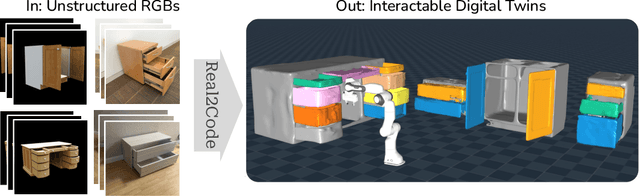
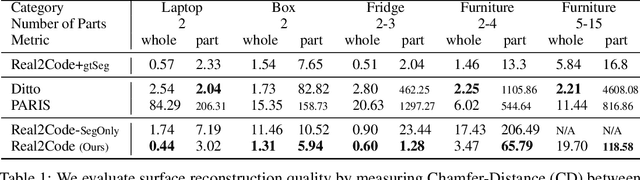
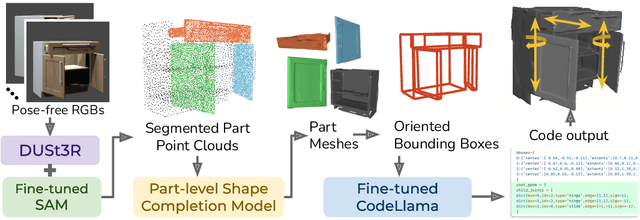
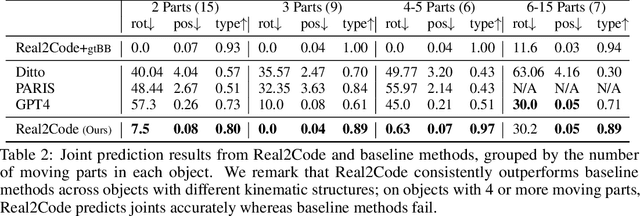
We present Real2Code, a novel approach to reconstructing articulated objects via code generation. Given visual observations of an object, we first reconstruct its part geometry using an image segmentation model and a shape completion model. We then represent the object parts with oriented bounding boxes, which are input to a fine-tuned large language model (LLM) to predict joint articulation as code. By leveraging pre-trained vision and language models, our approach scales elegantly with the number of articulated parts, and generalizes from synthetic training data to real world objects in unstructured environments. Experimental results demonstrate that Real2Code significantly outperforms previous state-of-the-art in reconstruction accuracy, and is the first approach to extrapolate beyond objects' structural complexity in the training set, and reconstructs objects with up to 10 articulated parts. When incorporated with a stereo reconstruction model, Real2Code also generalizes to real world objects from a handful of multi-view RGB images, without the need for depth or camera information.
DoughNet: A Visual Predictive Model for Topological Manipulation of Deformable Objects
Apr 18, 2024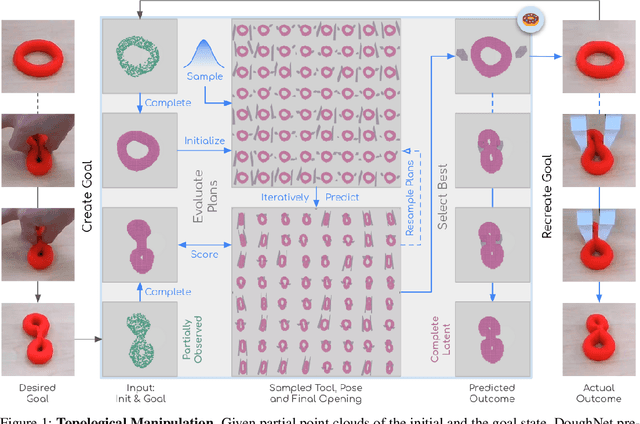
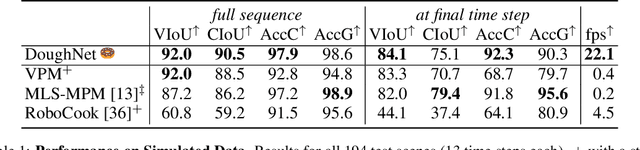
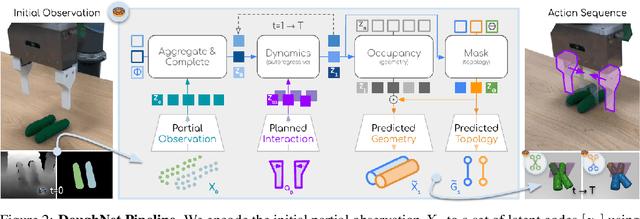
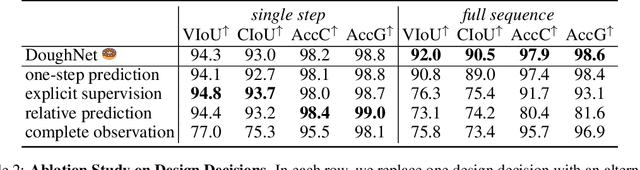
Manipulation of elastoplastic objects like dough often involves topological changes such as splitting and merging. The ability to accurately predict these topological changes that a specific action might incur is critical for planning interactions with elastoplastic objects. We present DoughNet, a Transformer-based architecture for handling these challenges, consisting of two components. First, a denoising autoencoder represents deformable objects of varying topology as sets of latent codes. Second, a visual predictive model performs autoregressive set prediction to determine long-horizon geometrical deformation and topological changes purely in latent space. Given a partial initial state and desired manipulation trajectories, it infers all resulting object geometries and topologies at each step. DoughNet thereby allows to plan robotic manipulation; selecting a suited tool, its pose and opening width to recreate robot- or human-made goals. Our experiments in simulated and real environments show that DoughNet is able to significantly outperform related approaches that consider deformation only as geometrical change.
ContactHandover: Contact-Guided Robot-to-Human Object Handover
Apr 01, 2024Robot-to-human object handover is an important step in many human robot collaboration tasks. A successful handover requires the robot to maintain a stable grasp on the object while making sure the human receives the object in a natural and easy-to-use manner. We propose ContactHandover, a robot to human handover system that consists of two phases: a contact-guided grasping phase and an object delivery phase. During the grasping phase, ContactHandover predicts both 6-DoF robot grasp poses and a 3D affordance map of human contact points on the object. The robot grasp poses are reranked by penalizing those that block human contact points, and the robot executes the highest ranking grasp. During the delivery phase, the robot end effector pose is computed by maximizing human contact points close to the human while minimizing the human arm joint torques and displacements. We evaluate our system on 27 diverse household objects and show that our system achieves better visibility and reachability of human contacts to the receiver compared to several baselines. More results can be found on https://clairezixiwang.github.io/ContactHandover.github.io
DROID: A Large-Scale In-The-Wild Robot Manipulation Dataset
Mar 19, 2024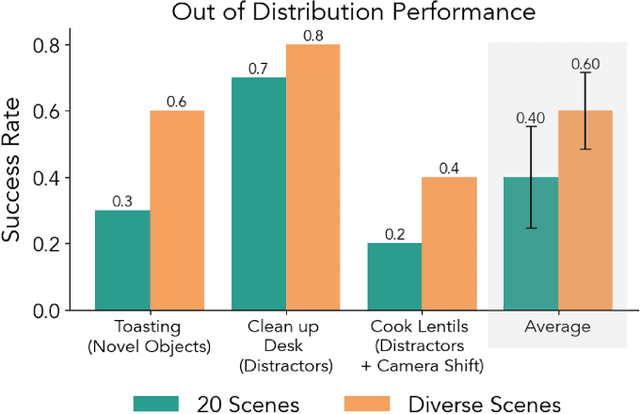
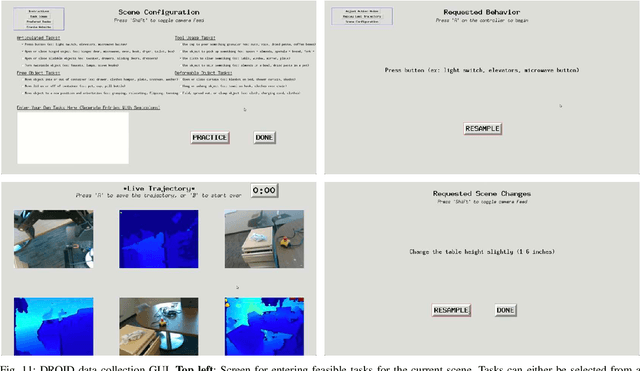
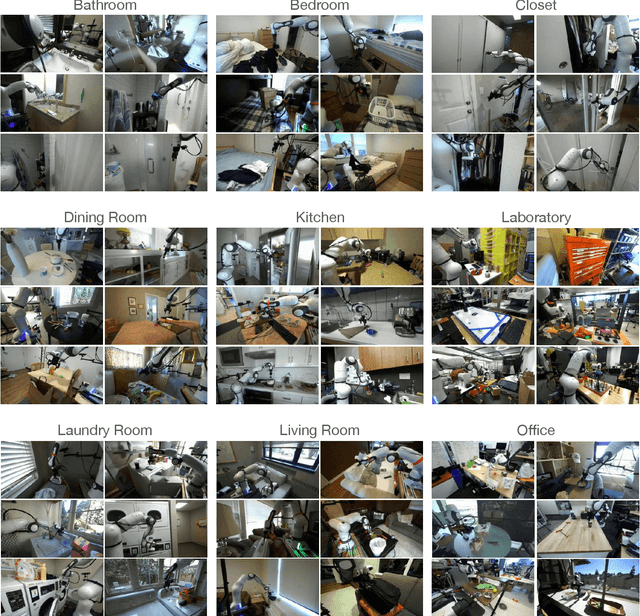
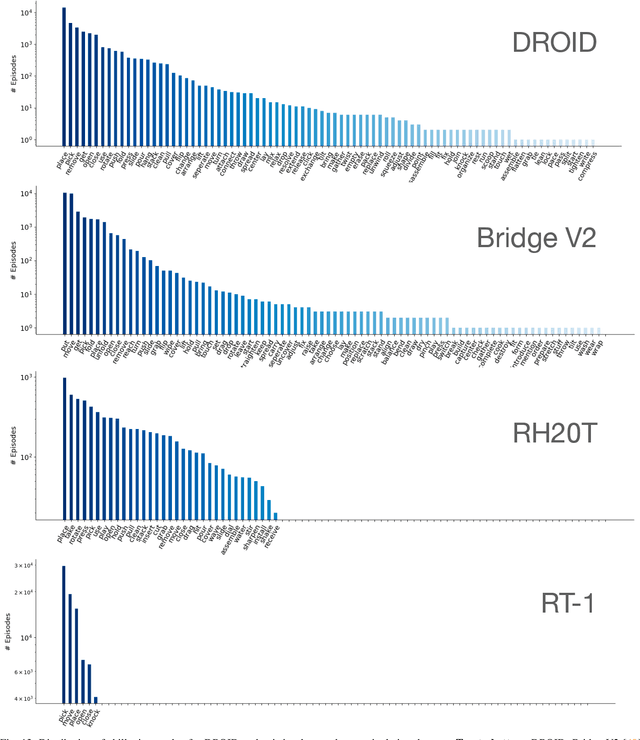
The creation of large, diverse, high-quality robot manipulation datasets is an important stepping stone on the path toward more capable and robust robotic manipulation policies. However, creating such datasets is challenging: collecting robot manipulation data in diverse environments poses logistical and safety challenges and requires substantial investments in hardware and human labour. As a result, even the most general robot manipulation policies today are mostly trained on data collected in a small number of environments with limited scene and task diversity. In this work, we introduce DROID (Distributed Robot Interaction Dataset), a diverse robot manipulation dataset with 76k demonstration trajectories or 350 hours of interaction data, collected across 564 scenes and 84 tasks by 50 data collectors in North America, Asia, and Europe over the course of 12 months. We demonstrate that training with DROID leads to policies with higher performance and improved generalization ability. We open source the full dataset, policy learning code, and a detailed guide for reproducing our robot hardware setup.
PaperBot: Learning to Design Real-World Tools Using Paper
Mar 14, 2024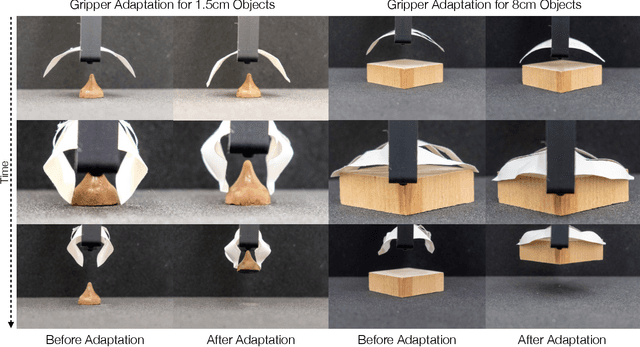
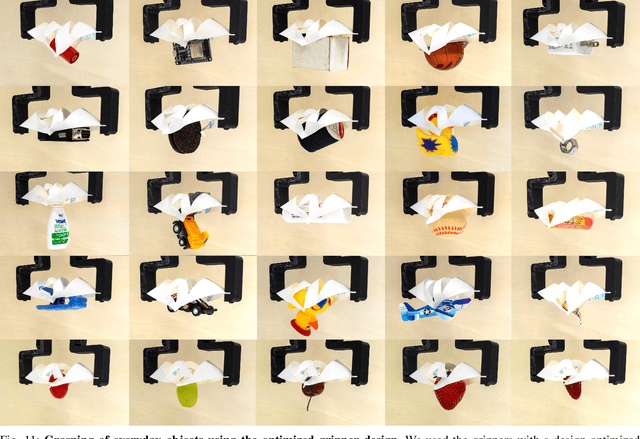

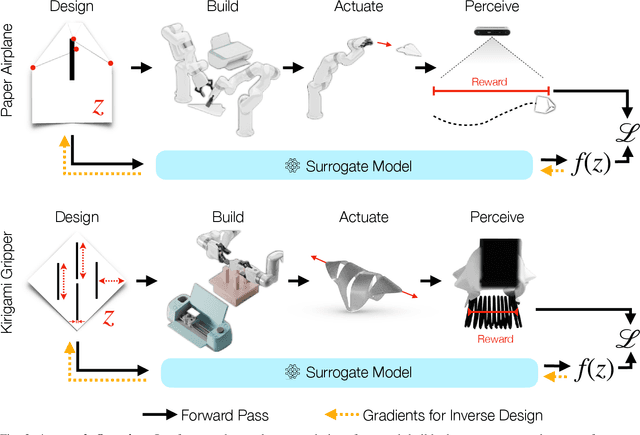
Paper is a cheap, recyclable, and clean material that is often used to make practical tools. Traditional tool design either relies on simulation or physical analysis, which is often inaccurate and time-consuming. In this paper, we propose PaperBot, an approach that directly learns to design and use a tool in the real world using paper without human intervention. We demonstrated the effectiveness and efficiency of PaperBot on two tool design tasks: 1. learning to fold and throw paper airplanes for maximum travel distance 2. learning to cut paper into grippers that exert maximum gripping force. We present a self-supervised learning framework that learns to perform a sequence of folding, cutting, and dynamic manipulation actions in order to optimize the design and use of a tool. We deploy our system to a real-world two-arm robotic system to solve challenging design tasks that involve aerodynamics (paper airplane) and friction (paper gripper) that are impossible to simulate accurately.
Language models scale reliably with over-training and on downstream tasks
Mar 13, 2024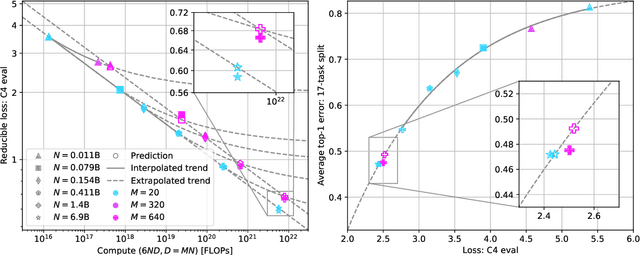
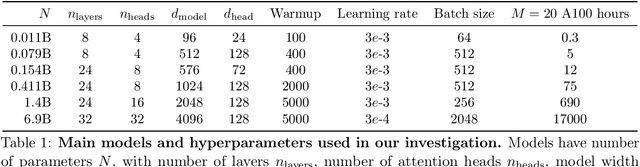


Scaling laws are useful guides for developing language models, but there are still gaps between current scaling studies and how language models are ultimately trained and evaluated. For instance, scaling is usually studied in the compute-optimal training regime (i.e., "Chinchilla optimal" regime); however, in practice, models are often over-trained to reduce inference costs. Moreover, scaling laws mostly predict loss on next-token prediction, but ultimately models are compared based on downstream task performance. In this paper, we address both shortcomings. To do so, we create a testbed of 104 models with 0.011B to 6.9B parameters trained with various numbers of tokens on three data distributions. First, we investigate scaling in the over-trained regime. We fit scaling laws that extrapolate in both the number of model parameters and the ratio of training tokens to parameters. This enables us to predict the validation loss of a 1.4B parameter, 900B token run (i.e., 32$\times$ over-trained) and a 6.9B parameter, 138B token run$\unicode{x2014}$each from experiments that take 300$\times$ less compute. Second, we relate the perplexity of a language model to its downstream task performance via a power law. We use this law to predict top-1 error averaged over downstream tasks for the two aforementioned models using experiments that take 20$\times$ less compute. Our experiments are available at https://github.com/mlfoundations/scaling.
Dynamics-Guided Diffusion Model for Robot Manipulator Design
Feb 23, 2024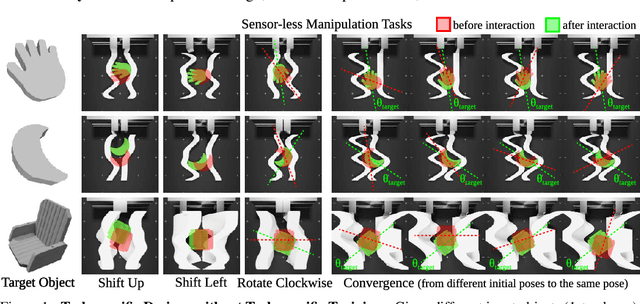
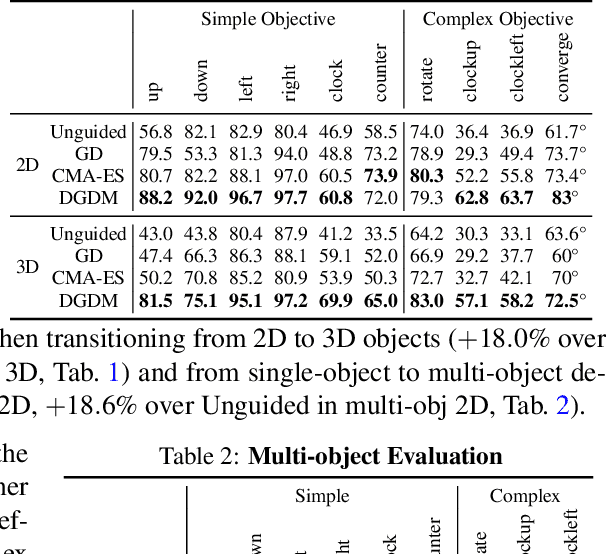
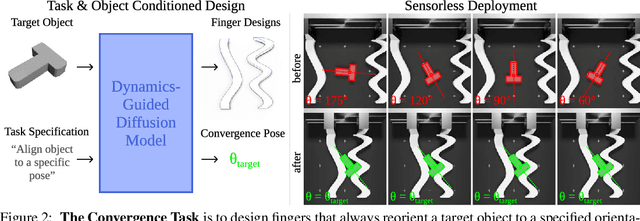
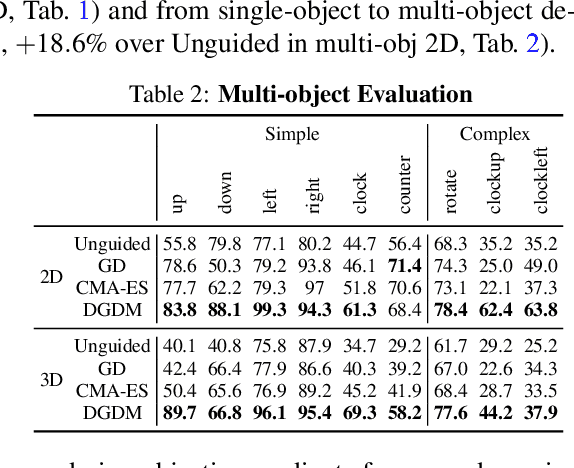
We present Dynamics-Guided Diffusion Model, a data-driven framework for generating manipulator geometry designs for a given manipulation task. Instead of training different design models for each task, our approach employs a learned dynamics network shared across tasks. For a new manipulation task, we first decompose it into a collection of individual motion targets which we call target interaction profile, where each individual motion can be modeled by the shared dynamics network. The design objective constructed from the target and predicted interaction profiles provides a gradient to guide the refinement of finger geometry for the task. This refinement process is executed as a classifier-guided diffusion process, where the design objective acts as the classifier guidance. We evaluate our framework on various manipulation tasks, under the sensor-less setting using only an open-loop parallel jaw motion. Our generated designs outperform optimization-based and unguided diffusion baselines relatively by 31.5% and 45.3% on average manipulation success rate. With the ability to generate a design within 0.8 seconds, our framework could facilitate rapid design iteration and enhance the adoption of data-driven approaches for robotic mechanism design.