 Add to Chrome
 Add to Firefox
 Add to Edge
Egocentric Station Holding of Robotic Fish in Unknown Turbulent Background Flow
Jul 26, 2026
Approaching a target position and holding station in flowing water is a fundamental and critical capability for robotic fish operating in natural aquatic environments. Despite decades of advances in enhancing swimming efficiency and maneuverability, this capability remains underdeveloped, largely owing to the insufficiently characterized, highly nonlinear fluid-structure interactions inherent to freely swimming robotic fish in flows. To bridge this gap, we propose the SWiFT framework, a Swimming With Flow Toolbox that enables the efficient exploration of an egocentric station-holding policy for a body and/or caudal fin (BCF) robotic fish in unknown and turbulent background flows via reinforcement learning (RL). Our SWiFT integrates a free-swimming flow-tank experimental setup with a highly efficient, physically consistent computational fluid dynamics (CFD)-based simulator and a systematic sim-to-real transfer pipeline. The resulting policy achieves substantial improvements over state-of-the-art methods across all metrics, most notably root-mean-square error (RMSE) of distance. Furthermore, we validated that egocentric feedback alone, without any explicit flow sensing, enables station-holding in unknown turbulent flows, closely mirroring the biological phenomenon of rheotaxis. Accordingly, the success of this egocentric station-holding policy not only advances robotic fish control toward real-world deployment, but also highlights SWiFT's promise as a foundation for tackling complex swimming tasks for underwater robots.

Learning Agile Swimming: An End-to-End Approach without CPGs
Sep 16, 2024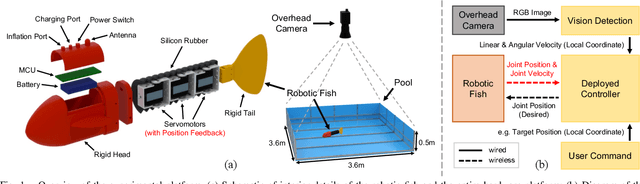
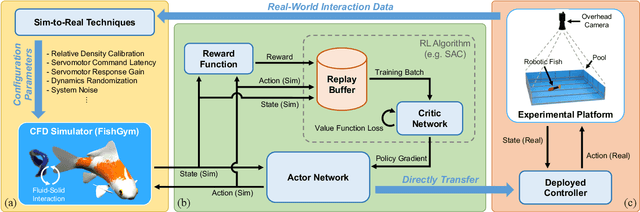
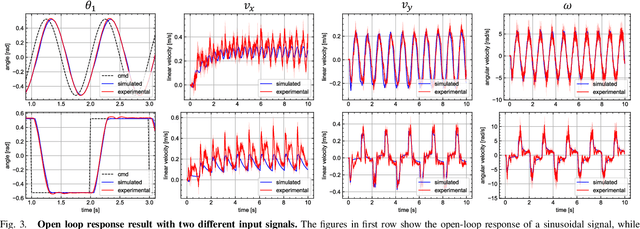
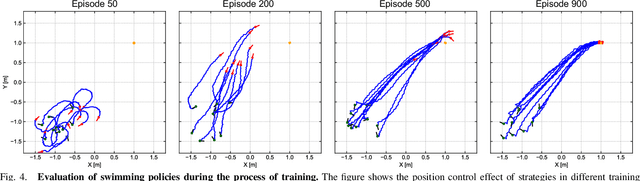
The pursuit of agile and efficient underwater robots, especially bio-mimetic robotic fish, has been impeded by challenges in creating motion controllers that are able to fully exploit their hydrodynamic capabilities. This paper addresses these challenges by introducing a novel, model-free, end-to-end control framework that leverages Deep Reinforcement Learning (DRL) to enable agile and energy-efficient swimming of robotic fish. Unlike existing methods that rely on predefined trigonometric swimming patterns like Central Pattern Generators (CPG), our approach directly outputs low-level actuator commands without strong constraint, enabling the robotic fish to learn agile swimming behaviors. In addition, by integrating a high-performance Computational Fluid Dynamics (CFD) simulator with innovative sim-to-real strategies, such as normalized density matching and servo response matching, the proposed framework significantly mitigates the sim-to-real gap, facilitating direct transfer of control policies to real-world environments without fine-tuning. Comparative experiments demonstrate that our method achieves faster swimming speeds, smaller turning radii, and reduced energy consumption compared to the conventional CPG-PID-based controllers. Furthermore, the proposed framework shows promise in addressing complex tasks in diverse scenario, paving the way for more effective deployment of robotic fish in real aquatic environments.
FishGym: A High-Performance Physics-based Simulation Framework for Underwater Robot Learning
Jun 03, 2022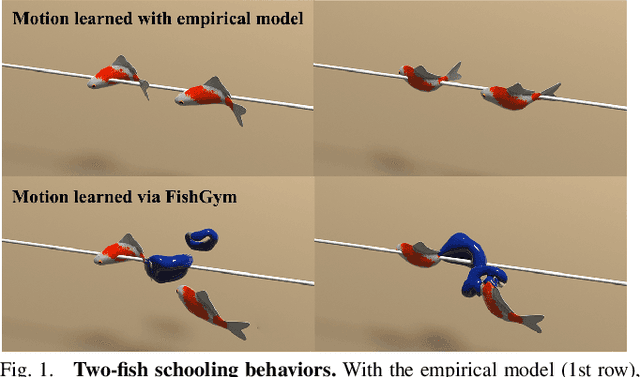
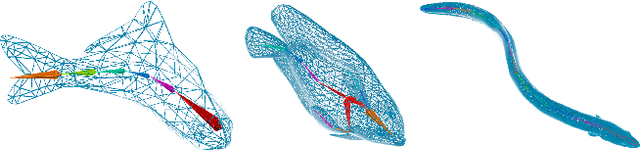
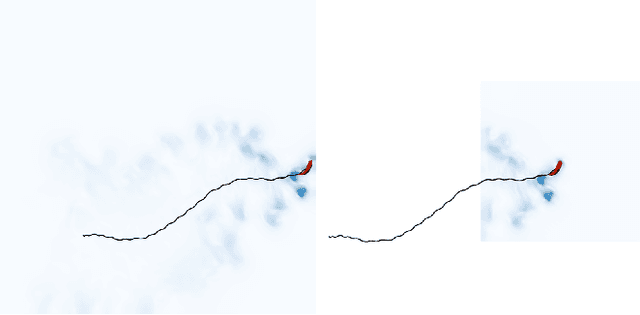
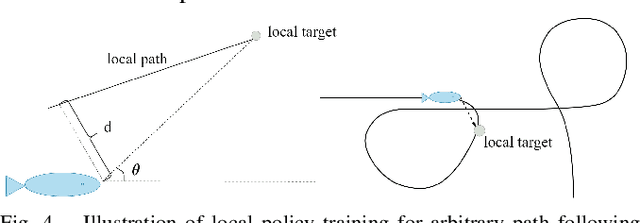
Bionic underwater robots have demonstrated their superiority in many applications. Yet, training their intelligence for a variety of tasks that mimic the behavior of underwater creatures poses a number of challenges in practice, mainly due to lack of a large amount of available training data as well as the high cost in real physical environment. Alternatively, simulation has been considered as a viable and important tool for acquiring datasets in different environments, but it mostly targeted rigid and soft body systems. There is currently dearth of work for more complex fluid systems interacting with immersed solids that can be efficiently and accurately simulated for robot training purposes. In this paper, we propose a new platform called "FishGym", which can be used to train fish-like underwater robots. The framework consists of a robotic fish modeling module using articulated body with skinning, a GPU-based high-performance localized two-way coupled fluid-structure interaction simulation module that handles both finite and infinitely large domains, as well as a reinforcement learning module. We leveraged existing training methods with adaptations to underwater fish-like robots and obtained learned control policies for multiple benchmark tasks. The training results are demonstrated with reasonable motion trajectories, with comparisons and analyses to empirical models as well as known real fish swimming behaviors to highlight the advantages of the proposed platform.